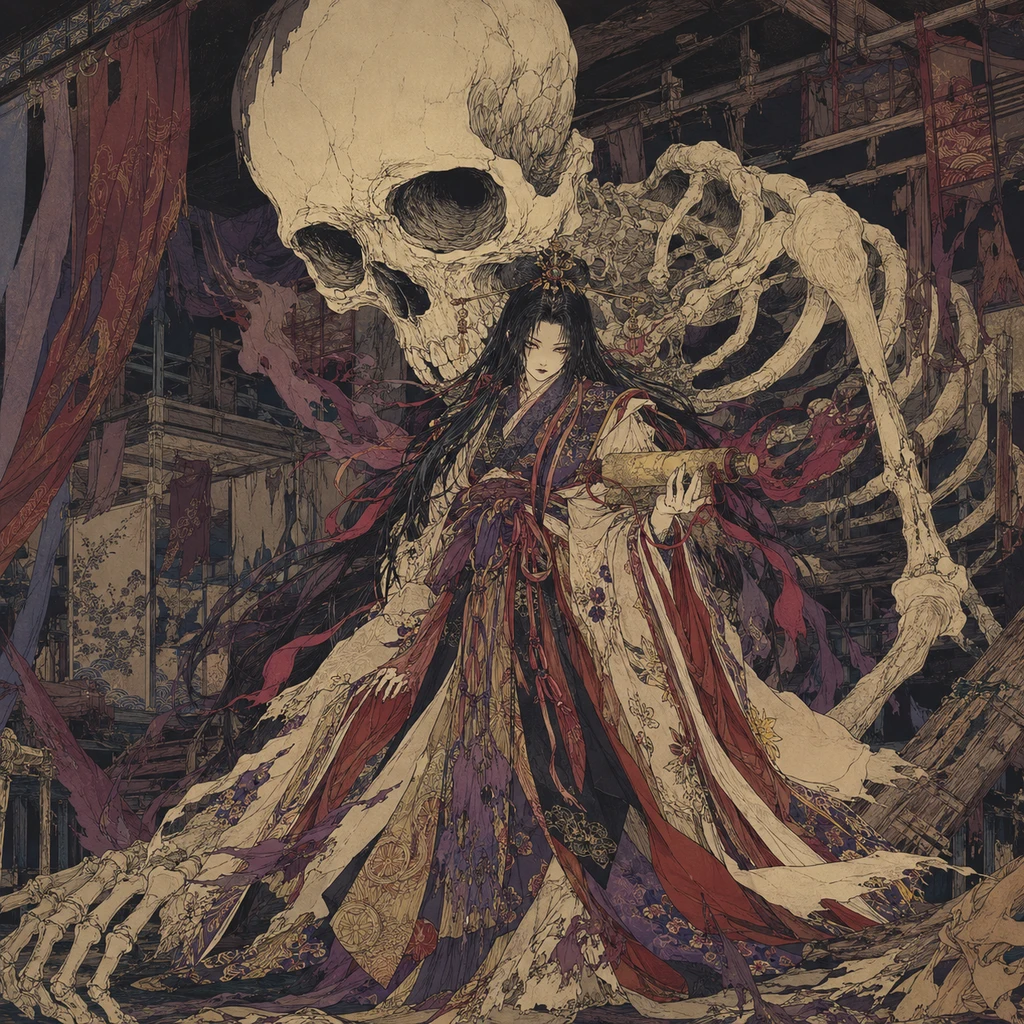
Takiyasha-himeThe Sorceress Princess of Soma's Ruined Palace: Takiyasha-hime
takiyasha-hime
Detailed Description
In this version, we read Takiyasha-hime as "the sorceress princess of the ruined palace of Soma." She is not a figure directly copied from the historical daughter of Masakado, but a being born when the imagination of yomihon and theatre seeped into the blanks of the Masakado legend[1]. Therefore, to understand Takiyasha-hime, one must look not only at whether she existed, but why later generations needed her.
The story of Takiyasha-hime concentrates the memory of the defeated onto female sorcery. Taira no Masakado is a rebel, a vengeful spirit, and also a hero of the eastern provinces[2]. The princess, said to be his daughter, inherits her father's defeat and aims for a resurgence from the ruins. Here, sorcery works not merely as magic, but as a power to call a lost political dream back to the stage.
Kuniyoshi's "Soma no Furudairi" pushed this princess to the center of yokai iconography[3]. The giant skeleton can be read on a narrative level as a summoned beast, but looking deeper, it is also a visualization of the dead and the grudges accumulated in the ruins of Soma. With the skeleton standing behind the princess, personal revenge expands into the memory of a clan and a battlefield.
The charm of Takiyasha-hime lies in the fact that fear and beauty are not separated. She does not merely attack like a demoness; she simultaneously wears the pride of a ruined house, the loneliness of a woman, the glamour of sorcery, and the darkness of the ruins. The viewer cannot process her merely as a villain. This is because the story of the defeated side rises up along with the skeleton.
Takiyasha-hime in this version is not a historical figure, but a phantom born of history. Departing from historical fact does not mean her value is low. Rather, she is important in showing what people saw in the gaps of history. In the place where the darkness of Soma's ruined palace, Masakado's name, and the iconography of the giant skeleton overlap, Takiyasha-hime transforms the memory of defeat into a yokai-like beauty.
Takiyasha-hime is also unique as a female sorcery-user. Instead of a male warrior taking revenge with a sword, the princess uses ruins, curses, and phantoms. This can be read as a story where the defeated, stripped of direct military power, regains power in another form. Her sorcery is not the flip side of weakness, but an alias for lost power.
The stage of Soma no Furudairi strongly supports her existence. "Dairi" (palace) is originally a word evoking the center of political power. Yet it has become old, ruined, and a nest of anomalies. Takiyasha-hime is a princess standing in a ruined political space, and with the appearance of the giant skeleton there, the dead of the past return to the stage of power once more.
In this version, we do not confine Takiyasha-hime as an "evil woman." She is clad in rebellion and grudges, but behind her is her defeated father, the memory of her clan, and the pride of the eastern provinces. This is precisely why the viewer feels regret along with fear. Takiyasha-hime, before being a sorceress to be struck down, is first and foremost another stage dreamed of by the side defeated by history.
Takiyasha-hime, having passed through Kuniyoshi's brush, transcended being a character in a story to become a yokai of the visual itself. The composition of the princess standing before a giant skeleton is unforgettable once seen. There, before the logic of text, defeat, death, and beauty bear down as a single picture.
Source Information
種類全体の出典reference
相馬の古内裏(浮世絵)
著者: 歌川国芳
年代: 弘化年間(1845年頃)
出版社: (錦絵・三枚続)
種類全体の出典reference
将門塚(首塚)
著者: (東京都指定史跡)
年代: 940〜
出版社: 東京都千代田区大手町
種類全体の出典reference
善知安方忠義伝
著者: 山東京伝
年代: 文化3年(1806年)
出版社: (読本)
バージョン固有出典 (相馬古内裏の妖術姫・滝夜叉姫)reference
相馬の古内裏(浮世絵)
著者: 歌川国芳
年代: 弘化年間(1845年頃)
出版社: (錦絵・三枚続)
バージョン固有出典 (相馬古内裏の妖術姫・滝夜叉姫)reference
将門塚(首塚)
著者: (東京都指定史跡)
年代: 940〜
出版社: 東京都千代田区大手町
バージョン固有出典 (相馬古内裏の妖術姫・滝夜叉姫)reference
善知安方忠義伝
著者: 山東京伝
年代: 文化3年(1806年)
出版社: (読本)
Personality
Proud and deeply tenacious. Bearing the memory of her ruined house, she uses ruins and sorcery as her weapons to raise the story of the defeated once again.
Compatibility
怨霊伝説、敗者の美学、浮世絵の強い図像、廃墟と妖術に惹かれる人と相性がよい。歴史と文芸の境界を楽しめる人にも向く。
Abilities & Skills
Weaknesses
Difficult to confirm as a historical figure, relying heavily on the modeling of later literature. Mixing her up with the legends of Masakado himself blurs the era of her establishment.
🔮Test your compatibility with Takiyasha-hime now!
Analyze your personality and values to get a detailed compatibility rating with this yokai.
Free, simple, and results in just minutes.