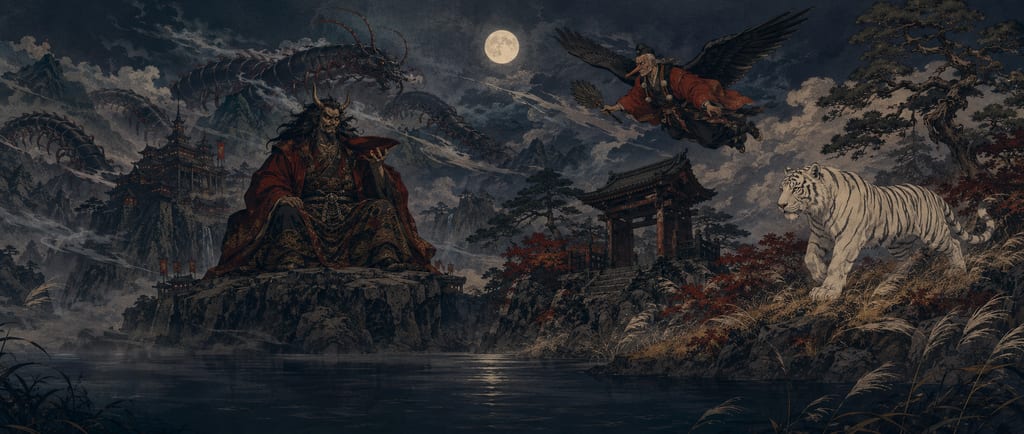
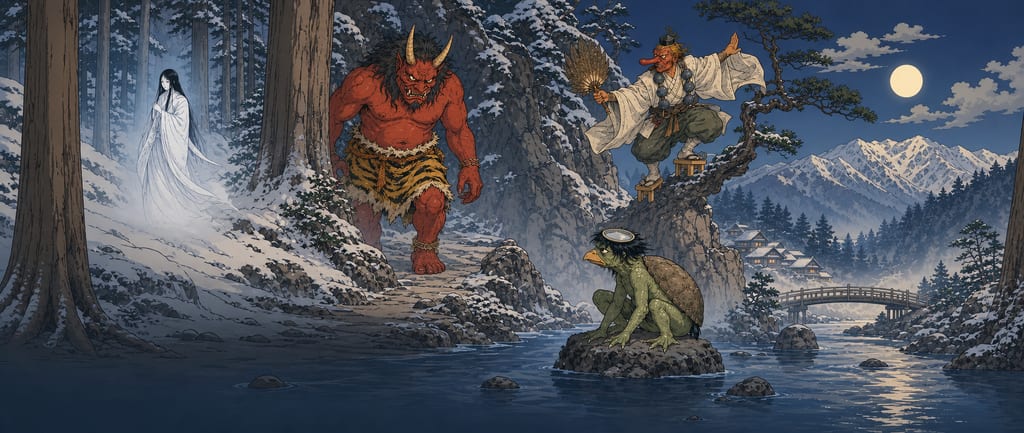
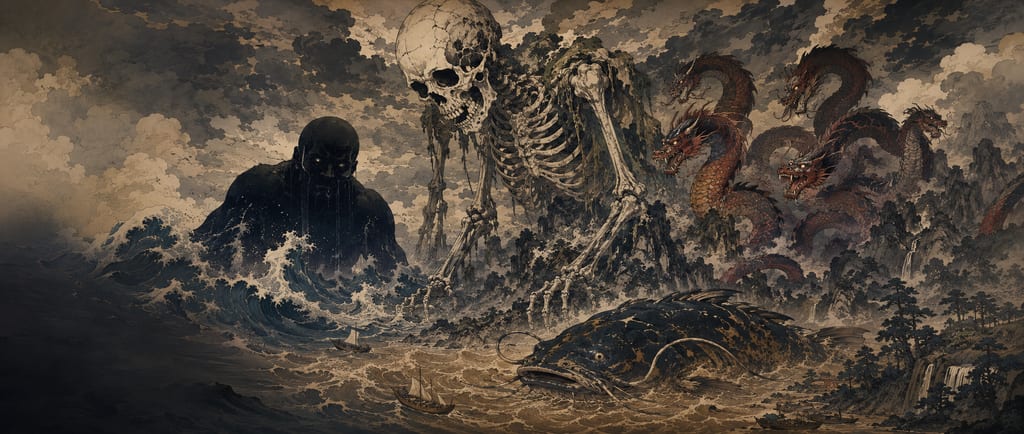
A gigantic skeleton stands in a dark stretch of open country. Gashadokuro’s visual force begins before its complicated history, in this simple reversal of scale. Woods and hills that could hide a human shrink into background at its feet; familiar bones—the skull, palm, and jaw—become as large as buildings. A fleshless skeleton usually erases differences among people. Once it towers over them, however, it combines the anonymity of a death that cannot be assigned to anyone with a pressure that leaves no place to flee. The spare outline created by a Shōwa horror article was easy to carry into pictures, manga, film, and games, leaving room for later creators to add different origins and abilities.
Its name gives sound to a motionless skeleton. The sound *gasha* suggests hard bones striking as a huge body moves, but what can be imagined from its sound is not the same as what sources record. The name verified in the first 1966 article is the hiragana がしゃどくろ[2]. The characters 餓者髑髏 fit a widely known explanation involving resentment of starvation victims, but they were not the formal spelling at first appearance. The type of rattling, whether it sounds at every step, and whether it warns of an approach vary by work. The onomatopoeic name, later ateji, and each medium’s staging together made the present image; they were not all fixed at once as one set of abilities.
Kuniyoshi’s triptych is unavoidable when considering Gashadokuro today. In the National Diet Library’s *Takiyasha-hime to Dokuro no Zu*, a giant skull peers from behind a torn blind; an extended arm and open hand reach toward the room occupied by Ōya Tarō Mitsukuni and others[9]. The skeleton exceeds a single sheet, crossing the seams of three. The viewer’s eye is drawn first to the sockets and teeth, then follows the ribs, arm, and fingertips before grasping the difference in scale between the skeleton and the people below. The triptych format itself creates the feeling that the huge body cannot be taken in at once.
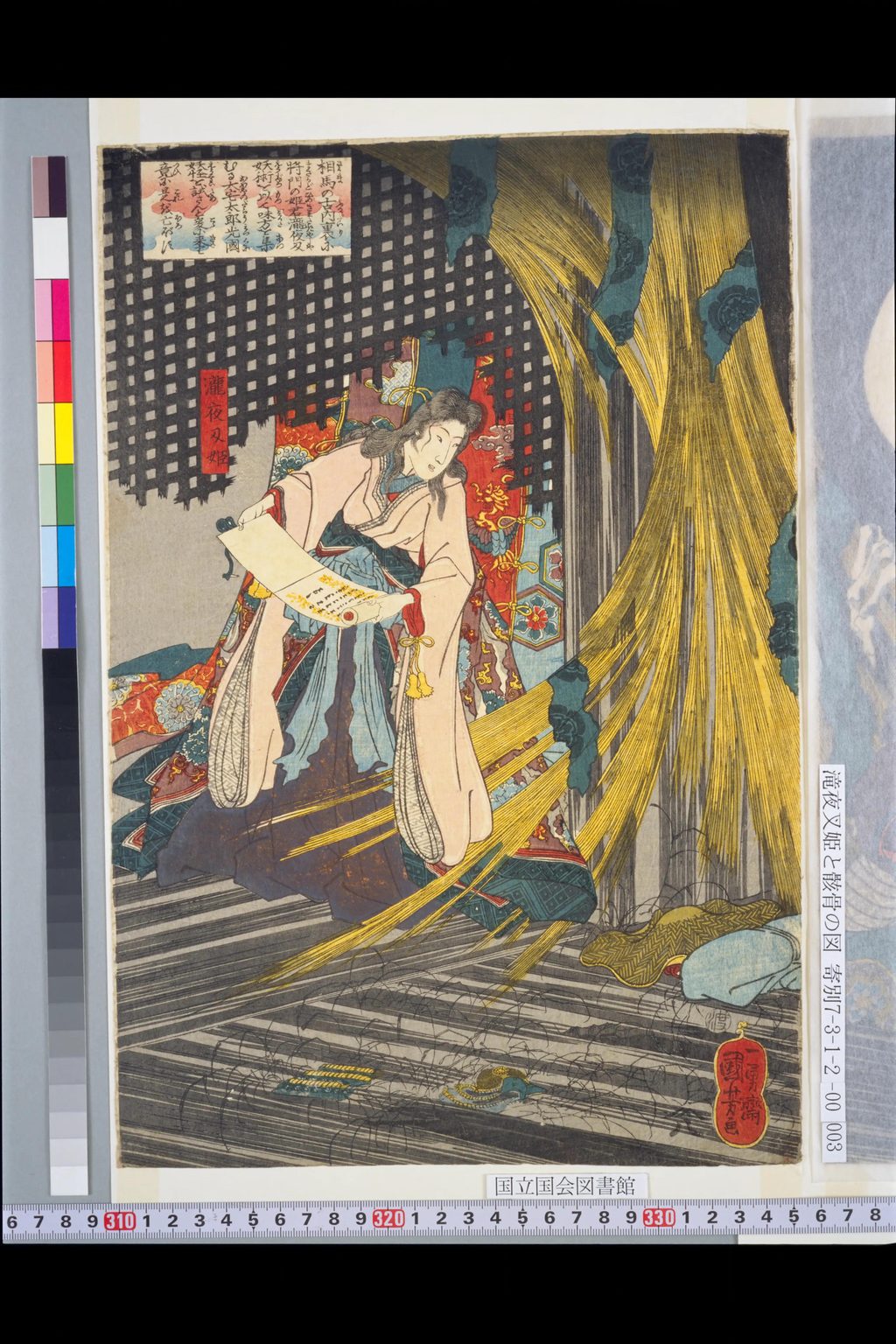
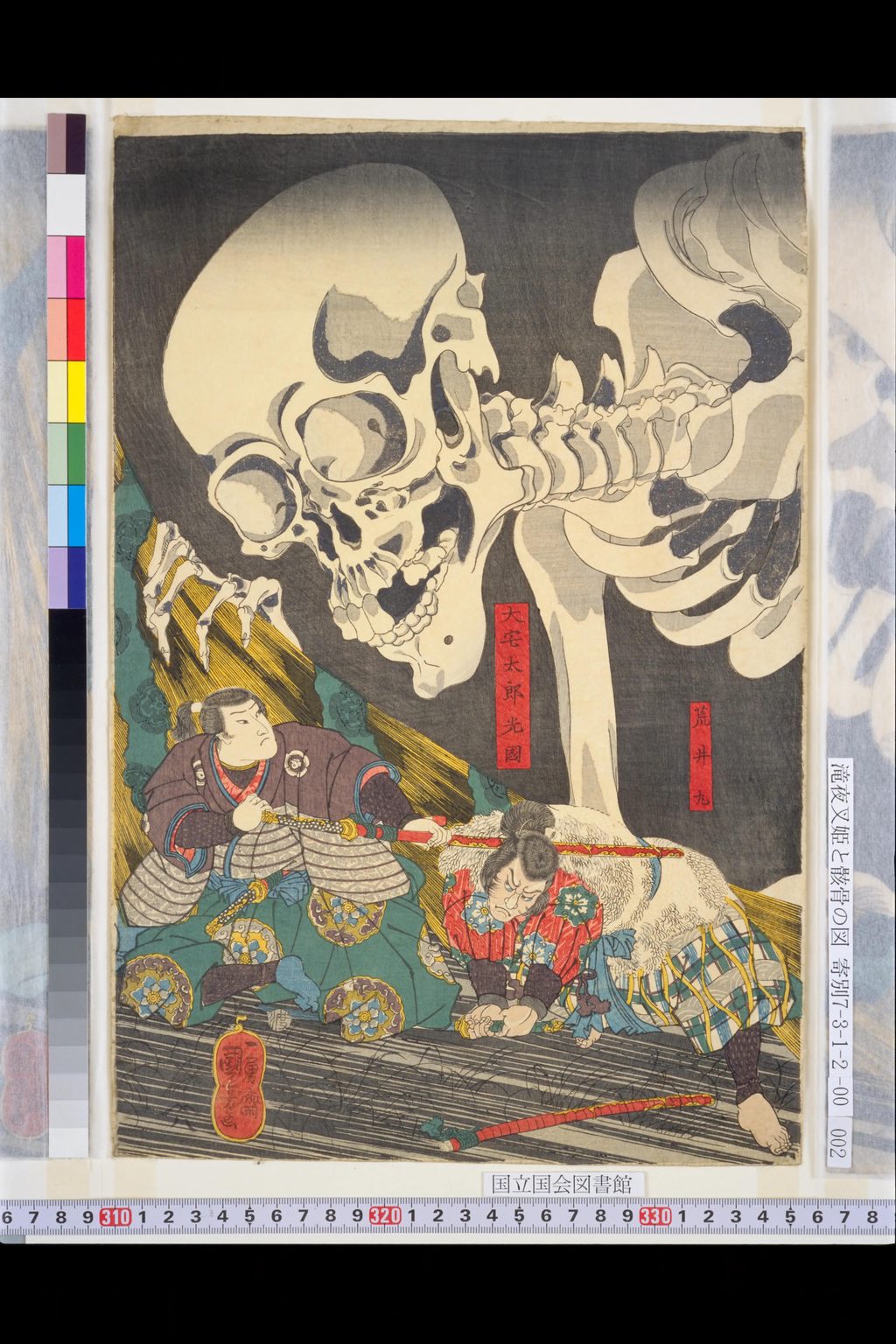
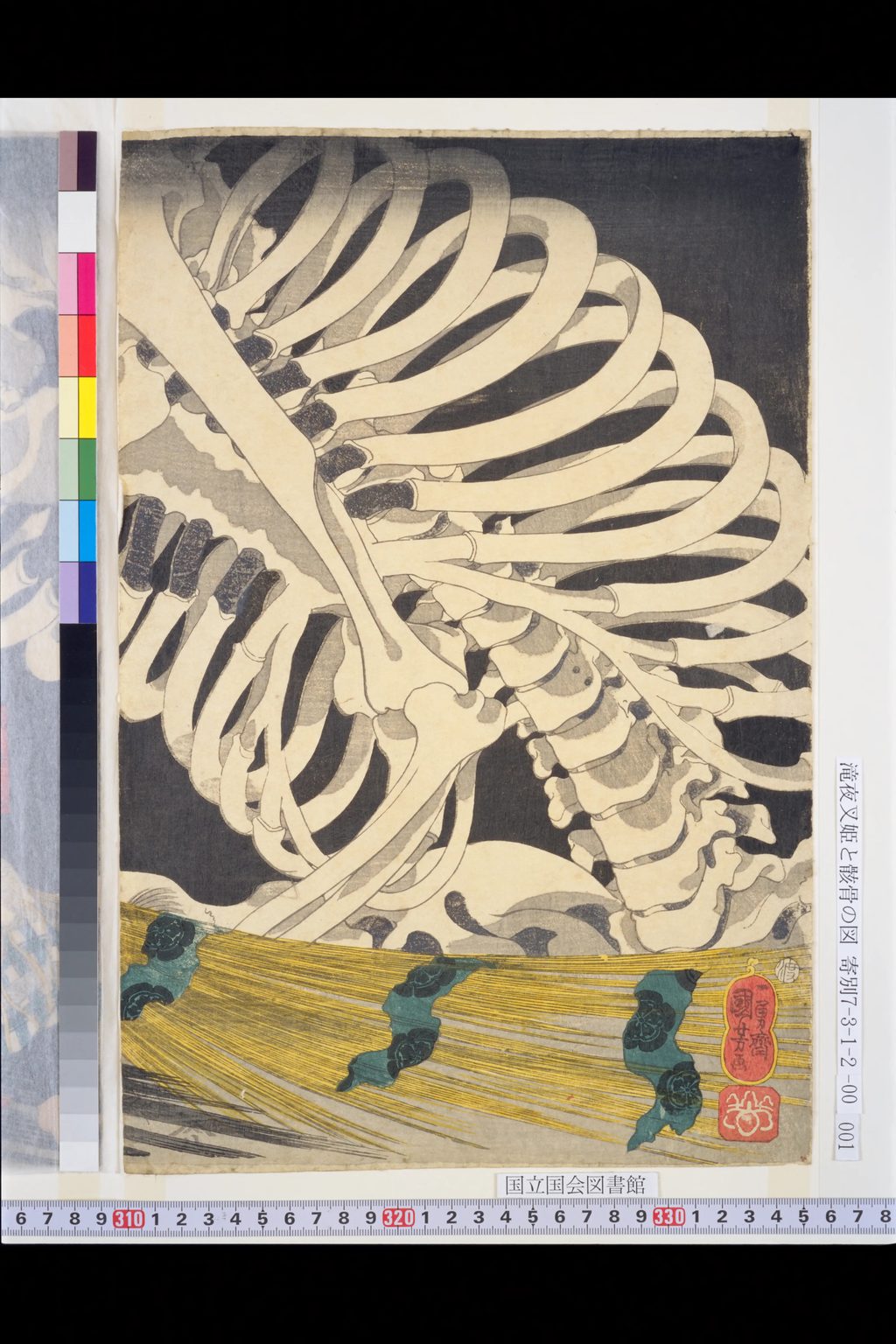
The skeleton’s size also results from Kuniyoshi’s rearrangement of the fiction. According to the Tokyo Fuji Art Museum, where *Uto Yasukata Chūgiden* has hundreds of skeletons appear, Kuniyoshi replaced them with one giant skeleton[3]. Turning fear of numbers into fear of scale made full use of the triptych’s width. Although exaggerated into a monster, the figure retains human anatomy from skull through spine, ribs, shoulders, and arms. Its size is impossible, but it does not arrive as an entirely unfamiliar creature; it looms as bones like our own made gigantic. Kuniyoshi painted a skeleton brought forth by Princess Takiyasha’s sorcery, not Gashadokuro. For the later yōkai, though, no other image offered such a convincing face.
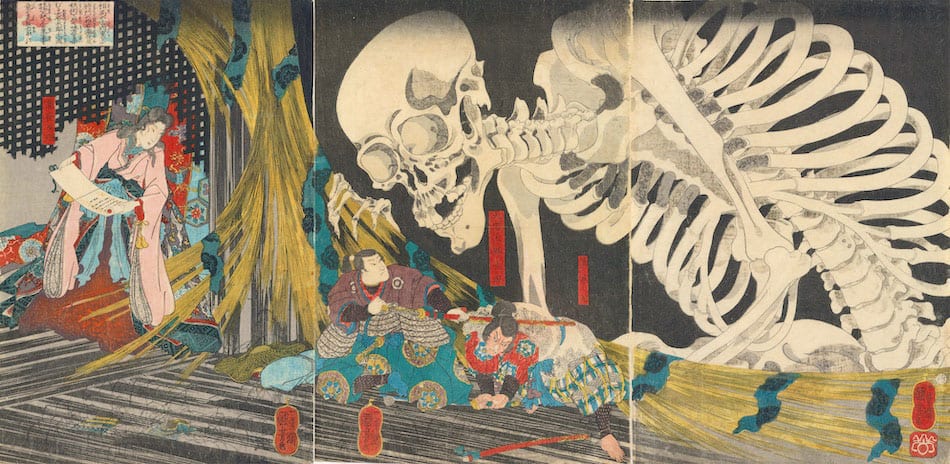
When an old image and a new name become linked, the age of the image can easily appear to prove the age of the yōkai. Ichikawa discusses the re-creation found in Mizuki’s yōkai collections, in which new names are given to earlier images, and cites the pairing of Gashadokuro with Kuniyoshi’s giant skeleton[4]. The print did not validate a yōkai created in 1966; the new name gave a celebrated image another way to be read. Knowing the original title, maker, date, and narrative characters lets us see two periods in one picture: late-Edo fiction culture and postwar yōkai-encyclopedia culture.
Early sources say little about the giant skeleton’s inner life. A single will made from countless dead, a hunger for the living, or a creature that advances in silence except for rattling bones are natural readings of its appearance that modern works have developed. Yet size and attack alone cannot settle its psychology as anger, grief, or obsession. Gashadokuro has no single character norm shared among regions; each medium has given motives and a voice to anonymous bones in its own way. Classical-looking silence and the first-person voice of gathered dead alike are best read as modern personalities fashioned with the history of the yōkai in mind.
Neither is a distinctive weakness or method of defeat established. Explanations that it vanishes at dawn, yields to talismans, falls when its bones are broken, or is calmed by sutras and memorial rites cannot be traced beyond individual works or later interpretations to a shared tradition before 1966. The skull in the twenty-seventh story of the lower volume of the Nihon Ryōiki is one dead person, repaying the removal of bamboo from its eye socket and an offering of food[8]. That plot of rescue cannot be transferred into a way of defeating a gigantic monster formed from countless bones. Respecting the dead and not treating their remains carelessly are serious human obligations, but they are distinct from a reliable method that works specifically against Gashadokuro.
Gashadokuro’s depth lies not in the length of a lost old tradition, but in the many connections it acquired after it was made. A name born in a Shōwa girls’ magazine passed through the postwar yōkai boom, took on a late-Edo giant skeleton as its representative image, and came to evoke ancient skull tales and sensibilities around unclaimed dead. Rather than folding these into one old origin, tracing their dates and media makes the image sharper. Gashadokuro is not a counterfeit of a classical yōkai. It is a huge witness to how publishing, imagery, and repeated acts of creation can bring yōkai into being in the modern era and turn them, in a short time, into shared memory.
Character Profile
This section is our own creative profile for storytelling. It is not historical fact or scholarship.
Yokai Type - Modern Kaii
Category - Ghosts & Spirits
Rarity - Legendary
Personality - No inherited tradition defines an inner character. Modern works may portray the huge skeleton as quiet and weighty, expressing anger or sorrow through its presence rather than words as it approaches with a clatter.
Compatibility - For someone who enjoys tracing dates of origin and image histories, recognizes cultural value in yōkai made in the modern era, and does not treat representations of the dead lightly.
Abilities - Appears as a gigantic full skeleton walking through night fieldsApproaches with the sound of bones striking togetherIntimidates and attacks people with huge hands and an opening jawIs depicted on a scale that makes people and buildings seem smallIn later works, is portrayed as a being made from the gathered bones of countless dead
Weaknesses - No distinctive weakness or method of defeat can be established from the first or early sources. Dawn, talismans, broken bones, sutra recitation, and memorial rites must be distinguished as settings or interpretations added by particular works.
Habitat - No fixed place in local tradition exists. Since 1966, depictions have placed Gashadokuro in remote night fields, wastelands, graveyards, and sites that evoke battlefields, but none is an established traditional location.