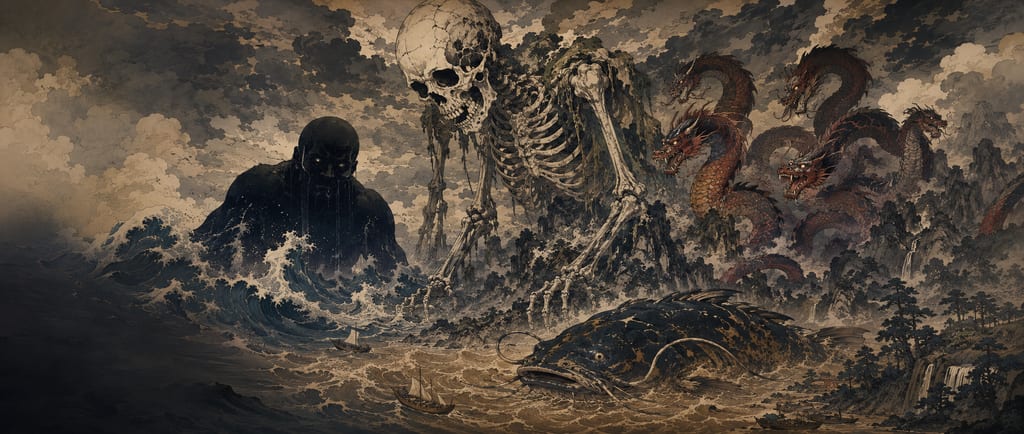
A colossal catfish believed to lurk underground, twisting its body to cause earthquakes. Earlier notions held that dragons or serpents beneath the earth triggered quakes, but by the Edo period the agent shifted in popular belief to a catfish. Faith spread that the keystones (kaname-ishi) of Kashima and Katori shrines pinned the creature in place. After the 1855 Ansei earthquake, woodblock “catfish prints” (namazu-e) proliferated, turning the catfish into an emblem of quake protection and social upheaval.
Folklore & Legends
In Chikushino, a stone called Namazu-ishi is said to be a great catfish turned to stone after Sugawara no Michizane drove it from a blocked road. In the Aso region, when Tateiwatatsu-no-Mikoto opened the rice fields, he admonished the lake’s catfish lord to let the waters flow, creating a river course. The Chikubu Island origin tale in Omi tells of a sea dragon changing into a great catfish to repel a giant serpent, leaving the island under the catfish’s protection. Links between earthquakes and catfish appear in old records, and in early modern times the belief in the keystones made the catfish a focus of earthquake-warding faith.
An image based on the early modern belief that a great catfish causes earthquakes and is held down by the keystones of Kashima and Katori Shrines. The ancient notion of an underworld dragon-serpent was reworked in early modern urban society into imagery for interpreting disasters and critiquing the times. After the Ansei Earthquake, many namazu-e prints were published, adding allegories of recovery and debt relief. Here the great catfish lies in the subterranean mud, at times shuddering to cause quakes, yet is pacified when pressed by the keystone. Regional lore links it to origin tales of stones, landforms, and river courses, serving as markers of shrine-temple origins and local spiritual power. It appears in early modern documents, broadsides, and origin tales without fixed personal names or lineage, told as a symbolic personification of earthquakes rather than an observed creature, with a yokai framework for interpreting calamities at its core.
Character Profile
This section is our own creative profile for storytelling. It is not historical fact or scholarship.
free-spirited, calm when restrained by the keystone
Compatibility
affinity with rites praying to quell earthquakes, compatible with nishiki-e and woodblock print beliefs
Abilities
said to cause earthquakes by its movementsa conceptual being that freely burrows through subterranean mudtemporarily pacified by keystones and divine authority
Weaknesses
subjugation by keystones, divine power and prayers for pacification
Habitat
deep subterranean mud, sites tied to legends of lakes and islands, locales with keystone traditions at shrines and temples
The diagram below is a diagnostic evaluation chart for Traditional Version: The Great Catfish Subdued by the Keystone. The higher the value of each item, the stronger that characteristic is expressed.