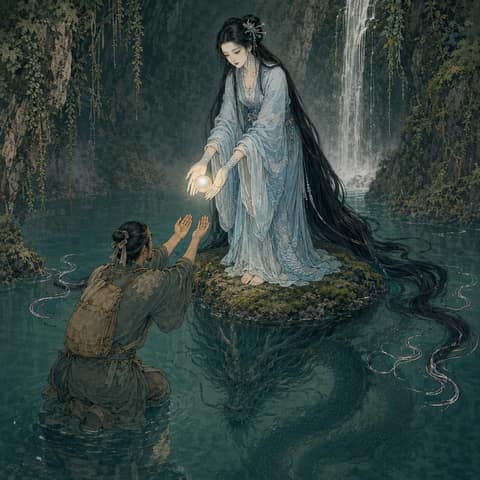
Ryūjin is a dragon- or serpent-shaped deity who governs water, rain, and the sea. Rather than descending from a single tradition, the god took shape where Japan's older worship of serpents as water spirits met the Chinese dragon and the Buddhist nāga, including the Eight Dragon Kings. In the early chronicles, the ruler of the sea appears as Watatsumi. In the Yamasachi-hiko myth told by the Kojiki[1] and the Nihon Shoki[2], the sea god's daughter Toyotama-hime reveals at childbirth that her true form is a wani—an ancient sea creature—or a dragon. Because Ryūjin can call rain and quiet water, shrines across Japan receive prayers for rain during drought and for clear skies when floods threaten. Images often show the god holding the tide-controlling jewels or a wish-granting jewel. Sea, lake, great river, and deep pool all lie within this supreme water deity's domain.
Folklore & Legends
At the deepest layer of Ryūjin worship is the old Japanese association between serpents and water. Ōmononushi of Mount Miwa appears as a small snake, while the force of the flooding Hii River is embodied in Yamata-no-Orochi. The coiled serpent represented water's numinous power. When the imported idea that a serpent becomes a dragon with age joined this tradition, serpent deity and dragon god became difficult to separate.
The palace of the dragon, Ryūgū, is equally old. The sea god's palace visited by Yamasachi-hiko in search of a lost fishhook became, in medieval tales, the home of Otohime and the otherworld from which Urashima Tarō returns with the jeweled box. Individual shrines preserve their own dragon legends. The Enoshima Engi[5] tells of a five-headed dragon that brought floods and disease to the lake at Fukasawa, fell in love with the descending Benzaiten, repented, and became a guardian. The Taiheiki[6] says that Benzaiten became a dragon before Hōjō Tokimasa and left three scales that inspired the Hōjō crest. At Kifune Shrine in Kyoto, a black horse was offered during drought and a white horse during prolonged rain, a custom sometimes linked to the origin of ema votive plaques. Nine-headed dragon worship likewise took root at Togakushi and Lake Ashi.
In art, Ryūjin typically has a horned, scaled serpentine body, four legs, long whiskers, and a jewel. Toriyama Sekien's Konjaku Gazu Zoku Hyakki[7] depicts the underwater dragon-serpent Mizuchi, preserving an image of a water spirit that has not yet become a full dragon. Since the modern period, Ryūjin has also attracted prayers for wealth and good fortune. The widely circulated 'Ryūjin norito,' however, is a modern folk composition despite claims of antiquity and is not an official liturgy of the Association of Shinto Shrines.
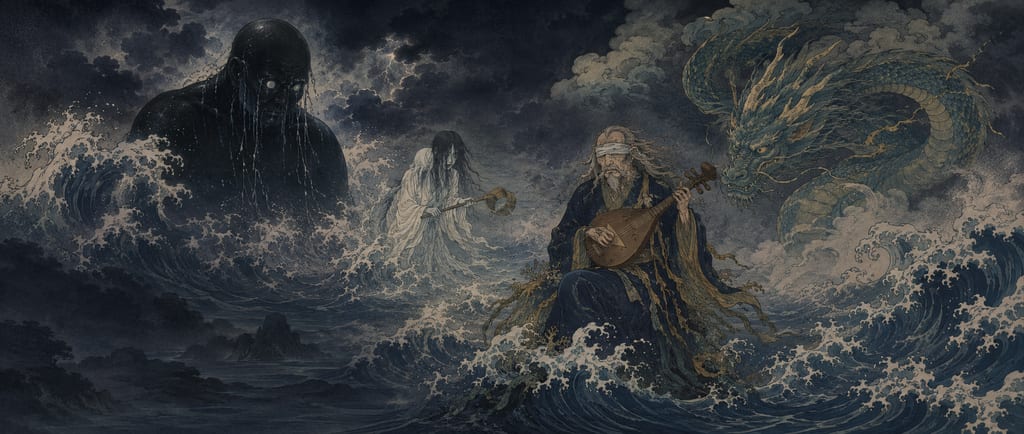
As the water god who stills storms, Ryūjin stands at the meeting of sea and sky and holds the weather in divine power. Fishers, sailors, and rice-growing communities all prayed to this god in moments of need. That power has two edges: timely rain can nourish a field, while great waves and violent wind can break a ship. People therefore developed rites not simply to obtain power from Ryūjin, but to soothe the raging aspect of water and invite its life-giving one.
The sea god's greatest treasures are the tide-flowing and tide-ebbing jewels[2], which command the rise and retreat of the sea. Yamasachi-hiko receives the pair from the sea god, uses one to overwhelm his elder brother with water, and the other to draw it away and save him. Their control of the tide expresses the heart of Ryūjin's authority. Coastal shrines received prayers for calm weather and a rich catch; inland rites sought rain, offered black horses in drought, or lowered offerings into deep pools. Legends from Lake Ashi and other waters in which a monk subdues a dragon and transforms it into a guardian preserve the close bond between fear and reverence.
Ryūjin's role as lord of the Dragon Palace grows from the same divinity of water. Beyond the sea or beneath it lies a realm of wealth and a different measure of time. A visitor may return with treasure, or carry away years that cannot be recovered, as Urashima Tarō does when he opens the jeweled box. Ryūjin is therefore not merely a fabulous beast but the deification of water itself, the source on which life and death both depend. To still the storm is also to renew the fragile covenant between human beings and the natural world.
Character Profile
This section is our own creative profile for storytelling. It is not historical fact or scholarship.
Majestic and merciful at once. Respect draws blessing, contempt draws rough water; like the sea, the god settles when appeased and rages when angered.
Compatibility
Ryūjin protects people who remember their awe of nature, keep vows and memorial rites, and make their lives beside the sea or other waters.
Abilities
Calling rain and breaking droughtCommanding tides, waves, and windCalming floods and storms and protecting people from disaster on the waterRuling the wealth of the Dragon Palace and the altered time of the otherworld
Weaknesses
Neglected rites and disrespect can provoke the god; Ryūjin abhors defilement and withholds blessing from those who break their vows.
Habitat
The open sea and coast, great rivers, lakes and deep pools, and Ryūgū, the Dragon Palace beneath the water.
The diagram below is a diagnostic evaluation chart for Ryūjin, the Water God Who Stills the Storm. The higher the value of each item, the stronger that characteristic is expressed.