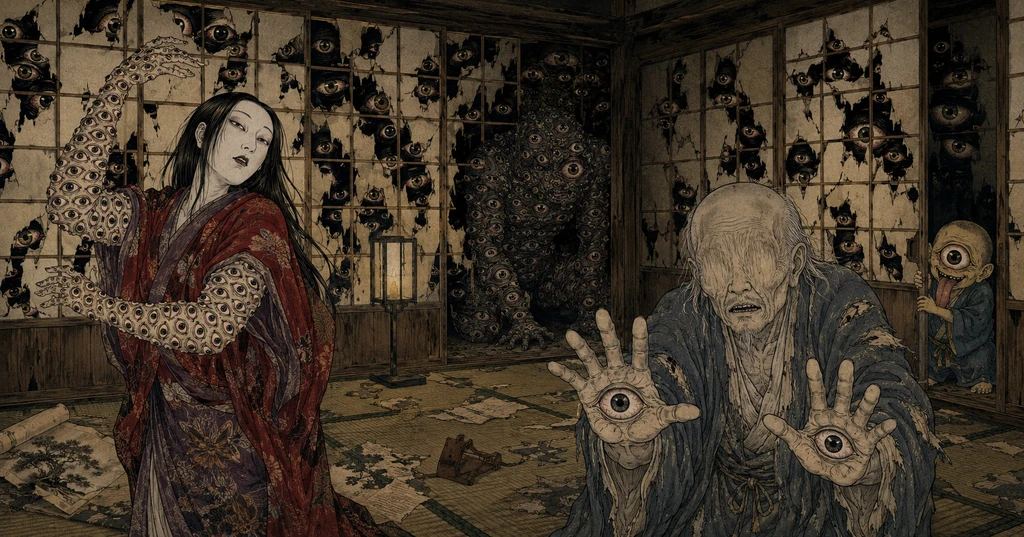
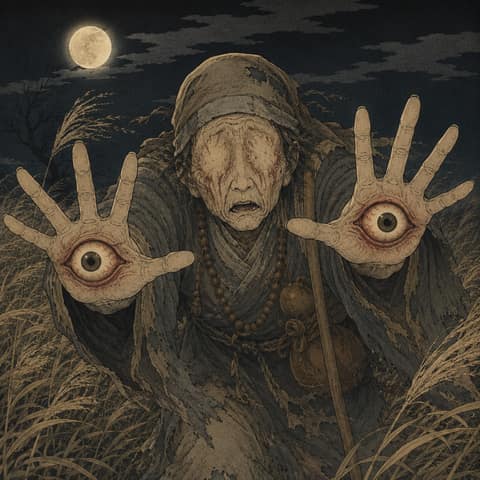
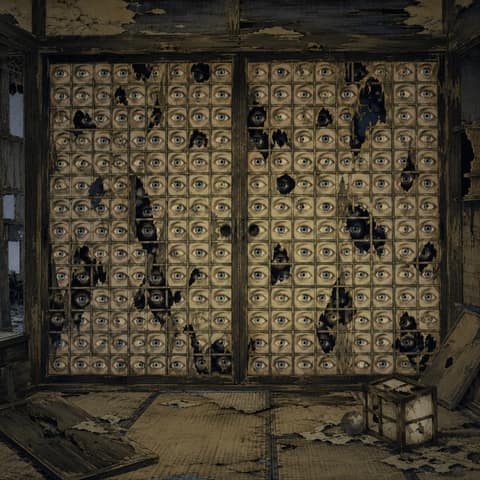
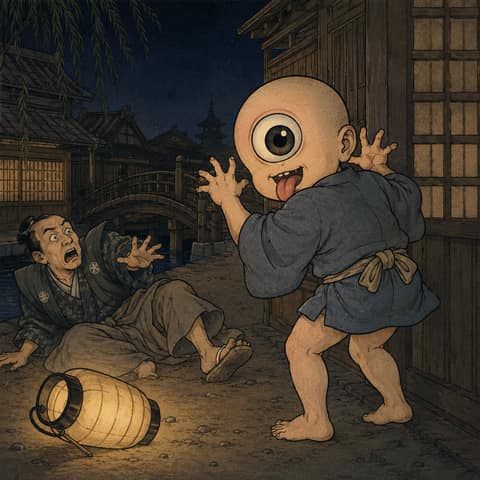
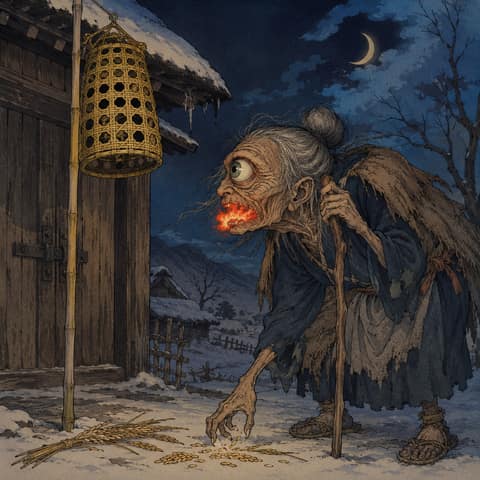
The Borrowed Sieve Hag is a one-eyed crone yokai from the Kantō region. On Koto-no-Hachi (the 8th day of the 12th or 2nd lunar month), she visits homes to “borrow” a winnowing basket (mi) or even a person’s eye. She is sometimes said to travel with the One-Eyed Boy (Hitotsume-kozō). People believed she could be averted by setting out baskets or sieves with many mesh “eyes” at the gate, or by mounting a mesh basket on a pole at the roof ridge. The tale is tied to house-seclusion and taboo-observance customs, serving as a symbol to enforce prohibitions.
Folklore & Legends
In Kanagawa, Chiba, and Tokyo, it’s said that on Koto-no-Hachi the Borrowed Sieve Hag comes seeking sieves—or people’s eyes. In Yokohama’s Kōhoku Ward, she was feared for picking up even fallen grains of rice and starting fires with the flame held in her mouth. To ward her off, people made “Tsujō dango” from gleaned rice on December 1 and stuck them at the doorway, signaling there was no rice left to take. In southern Chiba, a period of taboo called “Mikari (Mikawari)” was observed, avoiding going out at night or into the mountains, refraining from noise, lighting, hairdressing, and bathing.
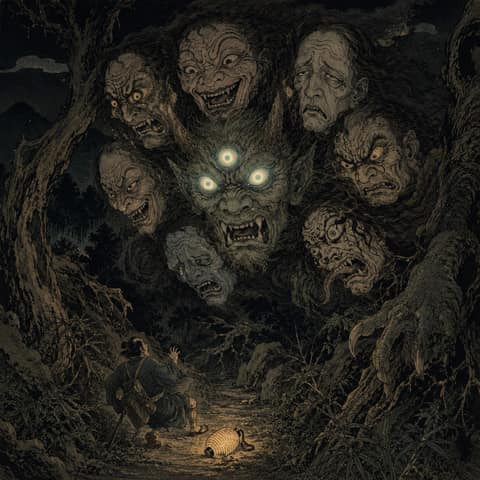
A整理 of the Mikari-bā (Mikakari-bā) yokai as preserved in folklore. She appears on Koto-yōka (the eighth days of the month) as a one-eyed crone, enforcing restraint on housework and outings. Her act of “borrowing” winnowing baskets and human eyes links to avoidance of mesh-patterned tools and symbols with many eyes, giving rise to countermeasures like placing baskets or sieves at the gate, or fixing a mesh basket to a pole on the roof ridge. In the Kōhoku, Yokohama accounts, her greed extends to gleaning even fallen ears of grain, and depictions of her carrying fire in her mouth serve as a caution against conflagration. In southern Chiba, customs of taboo and house-seclusion called “Mikari” (body-substitution) recast pre-festival liminality as a yokai rule. Despite regional variation, these tales share a framework that transmits norms of household safety, fire prevention, and labor abstinence at seasonal thresholds from winter to spring. Creative embellishments are set aside in favor of points attested in Kanto eyewitness reports and folklore records.
Character Profile
This section is our own creative profile for storytelling. It is not historical fact or scholarship.
relentless, covetous, feared as a tempter toward taboo
Compatibility
harmonizes with households that keep cleanliness, quiet, and ritual abstinence
Abilities
appears on the eighth days to visit householdsborrows winnowing baskets and human eyesgathers fallen ears of grainis feared to invite calamity with fire held in her mouth
Weaknesses
baskets and sieves with many meshes, a mesh basket mounted on the roof ridge, repelled by dumplings pinned at the doorway
Habitat
Kanagawa Prefecture (Yokohama, Kawasaki), southern Chiba Prefecture, former village areas of Tokyo
The diagram below is a diagnostic evaluation chart for Lore-Faithful Edition. The higher the value of each item, the stronger that characteristic is expressed.