YOKAI.JP
Shiramine 日本最大の怨霊、白峰に眠る ── 崇徳上皇と相模坊

崇徳·大魔縁·白峰の天狗。三大怨霊の筆頭

日本最大の怨霊、
白峰に眠る ── 崇徳上皇と相模坊

Shiramine · しらみね

Also known as: 白峯 / 白峯寺 / 相模坊 / 崇徳天皇陵
View on map

香川県坂出市、五色台の一峰·白峰に、一つの陵がある。崇徳天皇陵 ── かつて帝位にあった一人の上皇が、流刑の地で果て、葬られた場所である。そしてこの白峰は、日本三大怨霊の「筆頭」、すなわち最強の怨霊が眠る地として知られてきた。

菅原道真は学者であり、平将門は武将であった。だが崇徳上皇は、天皇その人である。位の頂点にあった者が、なぜ日本でもっとも恐れられた大魔縁·大天狗となったのか。本稿は、白峰に眠る崇徳の物語をたどる。

帝、
讃岐に流される

崇徳天皇は、鳥羽上皇の皇子として生まれ、わずか五歳で即位した。だが父·鳥羽との不和は深く、やがて譲位を強いられる。鳥羽の死をきっかけに、皇位継承と摂関家の対立がからみあい、ついに武力衝突へと至った ── 保元元年(一一五六)の保元の乱である。崇徳上皇は後白河天皇方に敗れた

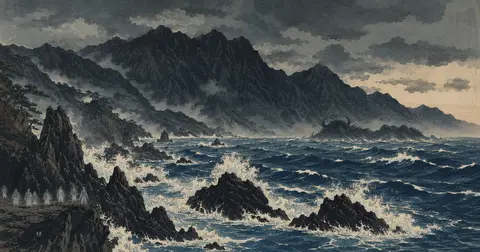
敗者となった崇徳に下された処分は、苛烈なものだった。崇徳は讃岐国(現·香川県)へ配流された。天皇·上皇の配流は、およそ四百年ぶりの出来事であった。かつて宮廷の頂点にあった帝が、海を渡って西国の地へ流される ── それは前例なき転落であった。

保元の乱は、王家と摂関家の対立が武力に転じた、日本史の転換点でもあった。崇徳上皇と左大臣·藤原頼長の側に対し、後白河天皇·関白藤原忠通の側 ── そして双方の陣営に、源氏と平氏の武士が分かれて加わった。父と子、兄と弟が敵味方に裂かれて戦ったこの乱を境に、政の実権は貴族から武士の手へと移りはじめる。崇徳の敗北と配流は、古い時代の終わりを告げる事件でもあった。

血で書いた呪い

讃岐での崇徳には、一つの名高い伝説がある。崇徳は配流先で五部大乗経を写経し、せめてこれを都の寺に納めたいと朝廷に差し出した。だが後白河院は「呪詛が込められているのではないか」と疑い、受け取りを拒んだという。

返された写経を前に、崇徳の絶望は怒りへと変わる。激怒した上皇は舌を噛み切り、その血で「日本国の大魔縁となり、皇を取って民とし民を皇となさん」と書きつけたと『保元物語』は伝える。帝位を奪われた者が、国そのものを呪い、秩序の転覆を誓ったのである。ただし、この血書経の逸話は崇徳の崩御から年を経てはじめて語られたもので、実物を見た者はなく、後世の脚色である可能性も指摘されている。伝説の真偽はともあれ、人々が崇徳の無念をそれほど深いものと感じていたことは確かである。

都を遠く離れた讃岐で、崇徳がどのような日々を送ったかは、その多くが伝説に包まれている。ひたすら写経に明け暮れたとも、わずかな供の者とともに寂しく暮らしたとも語られる。かつて万乗の位にあった帝が、ふたたび都の土を踏むことなく、八年あまりの歳月を西国の地で過ごした ── その深い孤独と無念こそが、のちの壮大な怨霊伝説を育む土壌となった。

長寛二年(一一六四)、崇徳は讃岐で崩御し、白峰に葬られた

大天狗となった帝 ── 白峰相模坊

崇徳の死後、都には不穏な出来事が続いた。保元の乱ののち、平治の乱、平氏の専横、源平の争乱と、世はとめどなく乱れていく。人々はこれを、崇徳の呪いの成就と見た。帝位を追われた崇徳の怨霊は、もはや並の亡霊ではない ── 天狗の王、大魔縁として畏れられるようになる。
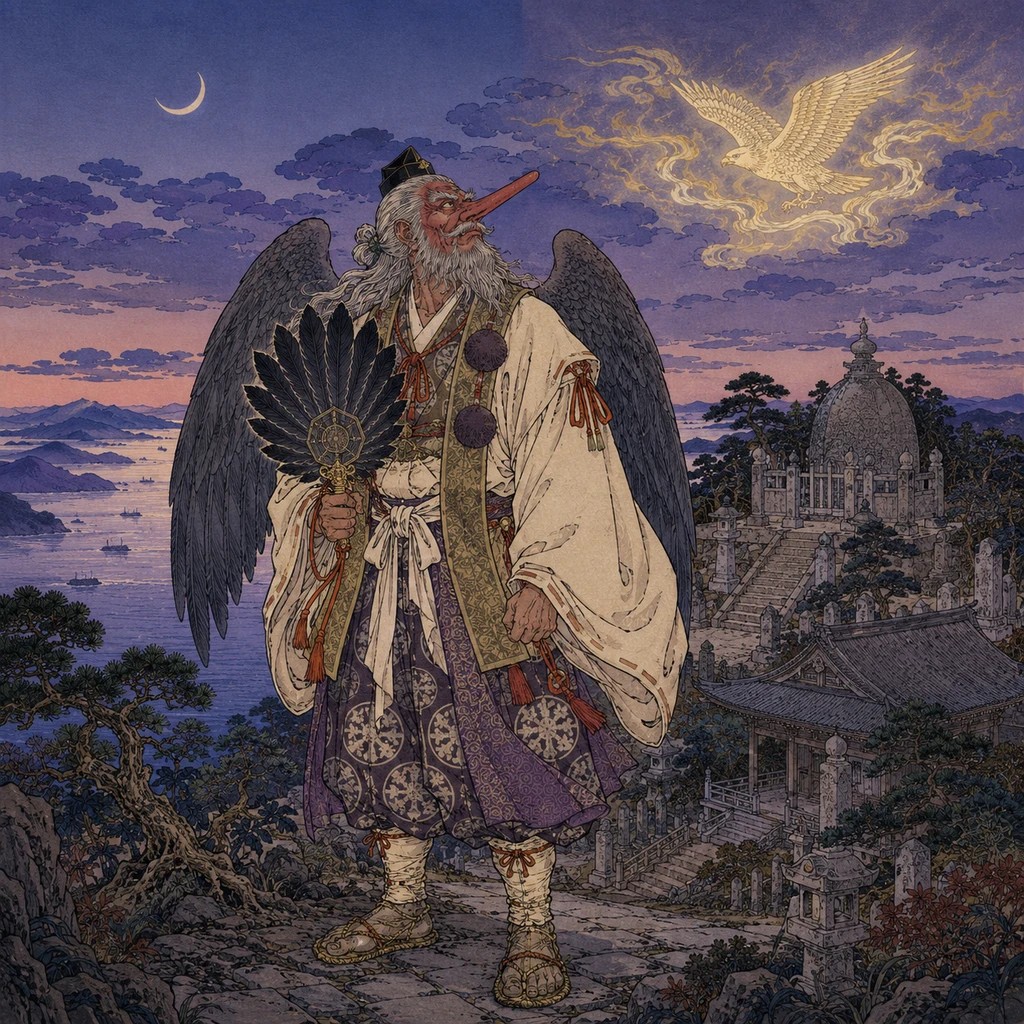
Shiramine Sagamibō

Shiramine Sagamibō

Shiramine Sagamibō is a great tengu enthroned at Shiramine in Sanuki Province, and is counted among the Eight Great Tengu. He is chanted in the Muromachi Noh play Kurama Tengu as "in Shishū, the Sagamibō of Shiramine." His greatest distinction lies in being the tengu who guards the Shiramine mausoleum of the Retired Emperor Sutoku, who lost the Hōgen Rebellion, was exiled to Sanuki, and died there. There are two theories on the origin of his name. One holds that it derives from Sagami Ajari Shōson, the monk who took Sutoku's side in the Hōgen Monogatari; the other, that a great ascetic come from Mt. Ōyama in Sagami became the tutelary guardian of Sutoku's spirit—the latter forming a pair with the "seat transfer" tradition of Ōyama Hōkibō. Sutoku, one of Japan's three great vengeful spirits and called "the greatest tengu in Japan," and the tengu who guards his tomb—their two stories are bound together inseparably.

Read more

その崇徳の霊と分かちがたく結びつくのが、白峰相模坊である。讃岐白峰に住むとされる大天狗で、日本を代表する天狗の一に数えられる。崇徳院の陵を守り、あるいはその配下として、白峰の山に君臨すると語られてきた。帝が大天狗となり、天狗がそれに従う ── 白峰は、人の世の秩序が裏返った、もう一つの宮廷のような様相を帯びていく。

西行、
白峰に霊を見る

この崇徳の怨霊を、文学の頂点で描いたのが、上田秋成の『雨月物語』(安永五年·一七七六刊)の一篇「白峯」である。

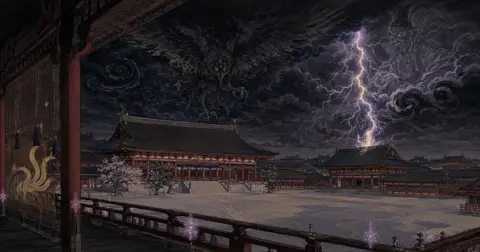
物語はこう進む。歌僧·西行が讃岐の白峰陵を訪れ、読経して歌を手向けると、崇徳院の亡霊が返歌で応じる。やがて西行と院のあいだに激しい論争が起こり、院は怨念をあらわにして、平氏の滅亡を予言する大風とともに、その異形の姿を現す。このとき、院の配下の天狗「相模」が現れる── 白峰相模坊である。崇徳を頂く魔界の宮廷が、まざまざと立ち上がる場面であった。秋成は、史実の怨霊伝説を、文学の極北へと昇華させたのである。

三大怨霊の筆頭

崇徳上皇は、菅原道真·平将門とならぶ「日本三大怨霊」の筆頭、すなわち最強の怨霊とされる。学者·道真の祟りも、武将·将門の祟りも恐ろしい。だが帝位そのものにあった崇徳の怨念は、国家の根幹を揺るがすものとして、別格の畏怖を集めた。保元の乱から始まる武士の時代の到来そのものを、崇徳の呪いの結果と見る向きさえあった。

この最強の怨霊を、朝廷はついに鎮めにかかる。明治元年(一八六八)、明治天皇は勅使を讃岐に遣わし、京都に白峯神宮を創建して崇徳の霊を都へ迎えた。崩御から七百年をへて、ようやく崇徳は京へ帰ったのである。怨霊を否定せず、神として手厚く祀り、その力を鎮める ── 道真や将門と同じく、崇徳もまた御霊信仰の枠組みのなかで祀られた。だが筆頭の怨霊の帰京に、明治の新政府がみずから動いたという事実は、その霊力がいかに重く受けとめられていたかを物語る。

白峰は、
今も

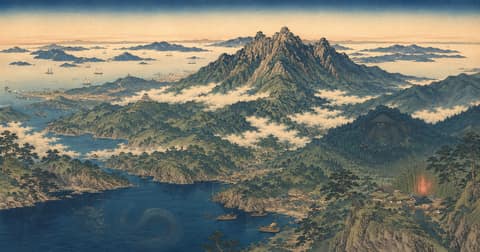
白峰には、今も崇徳天皇陵が静かに眠る。四国八十八ヶ所の一つ·白峯寺がその近くに建ち、参る人の姿が絶えない。瀬戸内の穏やかな海を見おろすこの峰が、日本最大の怨霊を抱く地であることを、訪れる多くの人は知らない。陵のかたわらには四国霊場の札所·白峯寺があり、巡礼の鈴の音が今も山に響く。崇徳を祀る頓証寺殿も陵に寄り添うように建ち、流された帝の魂を、この地は八百年以上にわたって守りつづけてきた。

帝でありながら流人として死に、怨霊となって国を呪い、大天狗の王として畏れられ、七百年をへて神として京へ迎えられた ── 崇徳上皇の生涯は、日本人が「祟り」と「鎮め」をどう考えてきたかの、究極の一例である。香川県全体の妖怪文化については、香川県の妖怪事典も併せて読まれたい。
All yokai of Shiramine2

Complete list of yokai linked to Shiramine, including those not featured in the article above.

  • Tengu

    Tengu

    Legendary

    Tengu

    What Is a Tengu? An Overview of Types and Iconography

    Mountain & Wilderness SpiritsKyoto, Shiga, and Wakayama Prefectures (the seats of the great tengu on the various sacred mountains)

    This edition is not about a single seat on a particular sacred mountain, but a general treatise that thoroughly unravels "what a tengu is" from the history of its iconography and types. The individual traditions of each seat are left to the page of each great tengu. The form of the tengu is not uniform. The first type is the long-nosed tengu—ruddy face and high nose, clad in the ascetic's headcloth (tokin) and the suzukake robe, a feather fan in hand and one-toothed high clogs on the feet. The second is the crow tengu, with a crow's beak and wings, grasping a sword or a vajra staff. The third are the lesser tengu called leaf tengu and wood-chip tengu, held to be weak and numerous kin. Rather than a fixed classification, these reflect the breadth of the tengu image across eras and regions. The iconography shifted over time. The Heian-period tengu was first conceived as a bird like a black kite, and the image of the crow tengu retains that vestige. The long nose grows prominent only from the late Kamakura period; the Zegaibō Emaki depicts a scene in which a tengu that had disguised itself as a human has its nose lengthen as it returns to bird form. As for the origin of the long nose, there are theories that derive it from the high-nosed Jidō mask of gigaku and link the crow tengu to the Karura (Garuda) mask, and a view that sees the long nose as an iconographic vestige of a bird's beak—but none can be called settled doctrine. It was overlaid with the god Sarutahiko, described in the Nihon Shoki as having a nose seven hand-spans long, and the custom arose of using a tengu mask for the role of Sarutahiko in festivals. The tengu's dual nature is rooted in the Buddhist notion of the way of the tengu. Because it studies the Buddhist path it does not fall into hell, and because it handles heterodox arts it cannot reach paradise either—an intermediate state, and the one who falls there was held to be the arrogant monk. The Tengu Zōshi depicts this notion as satire of the monks of the seven great temples, yet Chigiri Kōsai too warns that the simplification "only arrogant monks become tengu" goes too far. Demon though it is, once subdued it turns to guardianship, and it was held that if a Shugendō practitioner recites the Tengu Sutra he may summon the tengu of the various provinces to grant his wishes—this amplitude between guardian and demon is the very core of the tengu. The certain medieval source for the grouping called the "Eight Great Tengu" lies in the libretto of the Muromachi-period Noh play Kurama Tengu. The passage in which the great tengu calls up the tengu of the provinces he commands in geographical order—"In Tsukushi, Buzenbō of Hiko-san; in the four provinces of Shikoku, Sagamibō of Shiramine; Hōkibō of Ōyama; Saburō of Iizuna… the host of Zenki of Ōmine, Takama of Katsuragi"—shows that the Eight Great Tengu were rooted in medieval belief and performing arts, not an Edo invention. Still, the composition wavers by source, with a variant that adds Hōkibō of Ishizuchi-san; it is no fixed roster.

  • Shiramine Sagamibō

    Shiramine Sagamibō

    Legendary

    Shiramine Sagamibō

    The Tengu Who Guards the Mausoleum of Sutoku — Shiramine Sagamibō

    Mountain & Wilderness SpiritsShiramine, Sanuki Province (Sakaide, Kagawa)

    Shiramine Sagamibō is, among the Eight Great Tengu, the tengu most firmly bound to a single person—the Retired Emperor Sutoku. His image cannot stand apart from the story of Sutoku's vengeful spirit. The Retired Emperor Sutoku, defeated in the Hōgen Rebellion (1156), was exiled to Sanuki and died in the second year of Chōkan (1164) without ever being permitted to return to the capital. At his place of exile he copied out the five Mahāyāna sutras and sent them to the capital, but, suspected of a curse, had them flung back at him; in fury he swore an oath written in blood and is said to have become, while still living, a great tengu and a great demon (daimaen). Sagamibō guards the Shiramine mausoleum of this Sutoku, whom Yoritomo called "the greatest tengu in Japan." Shiramine-ji is the eighty-first station of the eighty-eight temples of Shikoku, the Shiramine mausoleum is the only imperial tomb in Shikoku, and beside it stands the Tonshō-ji-den, which enshrines the spirit of Sutoku-in. It was literature that made Sagamibō immortal. Its original source is the mid-Kamakura Senjūshō, attributed to Saigyō, whose "On the New Retired Emperor's Tomb at Shiramine" carries a tale of Saigyō mourning Sutoku's tomb at Shiramine. The Noh play Matsuyama Tengu, which dramatized it, takes Sutoku-in as the shite and Saigyō as the waki, and depicts Sagamibō as a tengu attending Sutoku. Further, the "Shiramine" of Ueda Akinari's Ugetsu Monogatari is a story in which Saigyō mourns Sutoku's spirit at the Shiramine mausoleum and converses with the wrathful Sutoku-in; Sagamibō became the being running through this lineage since the Senjūshō. The vengeful spirit and the tengu who stays beside it—the relation of Sutoku and Sagamibō is a rare point where the faith in goryō (vengeful spirits) and the faith in tengu meet. There are two theories on Sagamibō's origin: that it derives from Sagami Ajari Shōson, who sided with Sutoku in the Hōgen Monogatari, and that he was a tengu who came from Mt. Ōyama in Sagami. The latter forms a pair with the seat-transfer tradition arranged by Chigiri Kōsai—that the Sagamibō of Ōyama, in devotion to Sutoku, removed to Sanuki, and Hōkibō entered the vacant Sagami Ōyama. Either way, Shiramine Sagamibō sits at the western end of the Eight Great Tengu, transmitted at Shiramine in Sanuki as the tengu who keeps guarding the soul of Sutoku, one of Japan's three great vengeful spirits.

Read on ── other regions