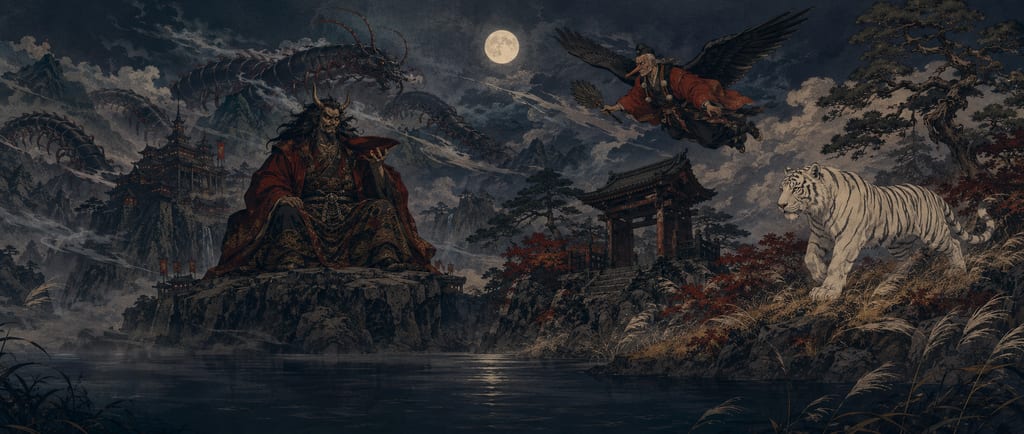
A chieftain who commands legions of yokai in the mid-Edo ghost chronicle Inō Mononoke-roku. In 1749, he harried the youth Inō Heitarō of Miyoshi for thirty nights, finally appearing as a samurai of about forty and giving his name. He insisted he was neither tengu nor fox, explaining that Heitarō’s ordeal was part of a contest for the mantle of demon king. His name varies across manuscripts, and paintings sometimes render him like a three-eyed crow-tengu, but his true nature remains unresolved.
Folklore & Legends
In various versions of Inō Mononoke-roku, he appears on the thirtieth night of the seventh month, admits defeat, declares he will start the trial over, then promises future protection and bestows a talismanic tool before departing. Local traditions at Kokuzō-ji speak of a wooden mallet he left; other variants say he presented a scroll. The miscellany Mimibukuro records related tales under names like Sanbon Gorōzaemon, echoing a regional pattern around Hiroshima in which a leader of spirits appears to commend the courageous.
Yokai Cards1
Yamamoto Gorōzaemon across multiple art-style decks
This version builds on a record narrative centering on the Miyoshi anomalies of Kan’en 2. The chieftain declares himself in samurai guise at the close of the thirty days of hauntings, mentioning a wager with Kamino Akugorō. He states he is neither tengu nor fox spirit, yet some paintings depict him as a three-eyed crow-tengu, revealing a gap between text and image. Across manuscripts his name varies—Yamamoto Gorōzaemon, Yaman-moto Gorōzaemon, Yamamoto Tarōzaemon—and in alternate strands he bestows different gifts, such as a mallet or a scroll of rites. Around Miyoshi, multiple “trial of the brave” tales persist, sharing a sequence of fixed-term hauntings, the master of the house remaining unshaken, the leader’s appearance and words of praise, and a token left upon departure. His concrete nature and origin remain unsettled, while his role as a demon-king-like commander is emphasized. Given differences among early modern essays and picture scrolls, proper names and details should be treated as variant by text.
Character Profile
This section is our own creative profile for storytelling. It is not historical fact or scholarship.
The diagram below is a diagnostic evaluation chart for Inō Mononoke-roku: Variorum Tradition. The higher the value of each item, the stronger that characteristic is expressed.
Love Yokai Type Test
The diagram below is a diagnostic evaluation chart for Inō Mononoke-roku: Variorum Tradition. The higher the value of each item, the stronger that characteristic is expressed.