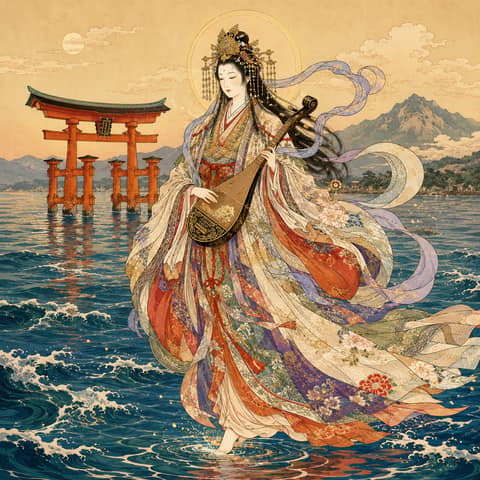
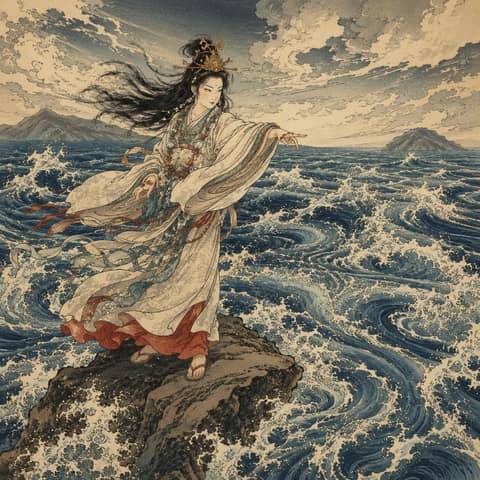
Tagorihime, said to have been born from the oath between Amaterasu Omikami and Susanoo-no-Mikoto, is a goddess who protects the seas of Munakata. At Munakata Taisha, Tagorihime, Tagitsuhime, and Ichikishimahime are enshrined as the Munakata Three Goddesses[1], among whom Tagorihime is revered as the deity enshrined at Okitsumiya[2], located on the Genkai Sea. According to the main text of the Kojiki, Amaterasu Omikami took Susanoo-no-Mikoto's sword, washed it in the Ame-no-Manai well, chewed it to pieces, and blew out a mist from which Takiribime-no-Mikoto[3] (Tagorihime) was born first.
The names Tagori, Takiri, and Tagiri evoke the mist rising over the distant sea, the surging tides, and the unseen boundaries enveloping the island. Rather than being an approachable deity of fortune close to human settlements, she is a deity presiding over the offshore boundary, looked up to with awe by those who cross the sea. On Okinoshima, the island itself is regarded as sacred; the places of ritual, taboos, and offerings are layered together, and it is not just the divine name but the silence of the island itself that upholds Tagorihime's presence.
While the Munakata Three Goddesses are often spoken of as a set, looking at Tagorihime independently reveals her as having the most pelagic character among them. Whereas Ichikishimahime approaches human prayers through Hetsumiya and the Itsukushima faith, and Tagitsuhime resides at Nakatsumiya on Oshima, Tagorihime is seated on Okinoshima, an island not easily accessible. There, the deity does not merely accept human wishes but screens the very manner in which one approaches. Tagorihime is a guardian deity granting safety in navigation, while also being a goddess who demands silence, purification, and moderation from those who cross the sea. Thus, her divine majesty is maintained not through an approachable image, but by being viewed from afar, worshipped, and never fully spoken of.
Folklore & Legends
The story of Tagorihime begins with the tension between Amaterasu Omikami and Susanoo-no-Mikoto. Amaterasu Omikami was suspicious of Susanoo-no-Mikoto when he ascended to Takamagahara, and an oath (ukehi) was made to prove his innocence. According to the history of Munakata Taisha, it is explained that three goddesses were born when Amaterasu Omikami chewed Susanoo-no-Mikoto's sword to pieces and breathed it out. This birth tale, while an oath to avoid war, holds a highly symbolic structure in which a goddess of the sea is born from sword, water, breath, and mist.
Okinoshima, the center of this faith, is located between the Japanese archipelago and the Korean Peninsula, serving as a maritime signpost for ancient navigators. Official World Heritage documents state that rituals praying for navigational safety and the success of exchanges were held on Okinoshima from the latter half of the 4th century to the end of the 9th century. The approximately 80,000 offerings[4] discovered there have all been designated as National Treasures; mirrors, swords, curved beads, gilt-bronze artifacts, pottery, and human-, horse-, and boat-shaped objects all simultaneously narrate ancient East Asian exchange and prayers to the gods.
The awe surrounding Okinoshima remains today in the form of taboos. Official World Heritage documents refer to the island as Oiwazu-sama[5] (the Unspoken), conveying that traditions such as not speaking of what is seen or heard on the island, not removing a single tree, blade of grass, or stone, and performing purification (misogi) before landing have been strictly observed. This is not a mere restriction of entry, but a religious distance maintained so as not to turn the island of the gods into a human possession. Tagorihime's spiritual power lies not in supernatural apparitions that manifest to punish people, but in the fact that the island, mist, sea routes, and silence themselves constitute the sacred domain.
The establishment of the three shrines is also indispensable in considering Tagorihime's character. Official World Heritage documents explain that by the late 7th century, open-air rituals sharing commonalities with the Okinoshima rituals were held at the Mt. Mitake ritual site on Oshima and the Shimotakamiya ritual site on the mainland, and that the Kojiki and Nihon Shoki, compiled in the early 8th century, recorded that the Munakata clan worshipped the Munakata Three Goddesses at these three shrines. In other words, Tagorihime is a deity of an isolated island, but also a deity enshrined within the structure of Munakata Taisha, connecting the open sea, the inner islands, and the mainland.
The existence of the Munakata clan links this faith to actual history. Official World Heritage documents suggest that the ancient rituals on Okinoshima were conducted by the people of the Munakata region, who possessed advanced navigational skills and engaged in foreign exchange. In ancient times, crossing the sea was an act in which trade, diplomacy, military affairs, and prayer were inextricably linked. Okinoshima, where Tagorihime resides, was a landmark on the path toward the sea's horizon, and simultaneously a place where national and regional prayers were left as offerings on an island of silence.
In the genealogy of Okuninushi-no-Kami[6] in the Kojiki, Takiribime-no-Mikoto is also recorded as the wife of Okuninushi-no-Kami, giving birth to Ajisukitakahikone-no-Kami and Takahime-no-Mikoto. It is significant that despite being a goddess of the Munakata sea, she is inserted into the genealogy of Izumo mythology, indicating that Tagorihime was not merely a local island deity, but a nodal point connecting maritime traffic, royal rituals, and the Izumo lineage. Even among the Munakata Three Goddesses, Tagorihime is the deity who, from the most distant offshore position, reconnects the politics of the land with the dangers of the sea.
The key to understanding Tagorihime lies in the fact that Okinoshima is a "distant island." The three shrines of Munakata Taisha are arranged such that one ventures deeper into the sacred realm the further one crosses the sea: Hetsumiya on the Kyushu mainland, Nakatsumiya on Oshima, and Okitsumiya on Okinoshima in the Genkai Sea. The fact that the deity of Okitsumiya[2], placed furthest offshore, is Tagorihime clearly illustrates her character. She is not a guardian nestling close to human settlements, but a divine presence that arises when navigators spot the island's silhouette, read the tides, and stand in awe of unseen dangers.
In the classic texts, she is born from a sword. The ukehi (oath) section of the Kojiki records that Amaterasu Omikami took Susanoo-no-Mikoto's ten-span sword, rinsed it in the Ame-no-Manai well, chewed it to pieces, and from the narrow mist of her breath blown away, Takiribime-no-Mikoto[3] was formed. The sword is an object of military might and oaths, the well water is a medium of purification, and breath and mist are boundaries without form. Because Tagorihime is born at the intersection of these three, she can be understood not merely as a sea deity, but as the goddess of the very moment when martial force is transformed into prayer.
The variations in her divine name indicate that she is a deity who cannot be confined to a single reading. Called Takiribime-no-Mikoto or Okitsushima-hime-no-Mikoto in the Kojiki, she is spoken of as Tagorihime or Tagirihime in the Nihon Shoki lineage. Depending on whether "Takiri" is read as the "surging (tagiru)" of the tides or "Tagiri" as the mist upon the sea, the expression she shows changes slightly. In either case, however, at her core lies the power to alter visibility right in the middle of the water's surface. To navigators, fog was both a danger and a sign signaling the realm of the gods.
In the Munakata faith, this mythology is tied to actual sea routes. Okinoshima is a maritime transport hub connecting the Japanese archipelago and the Korean Peninsula, and official World Heritage documents explain that rituals praying for navigational safety and successful exchange were held from the late 4th century to the late 9th century. The evolution of offerings shows a transition of ritual sites from atop giant boulders, to rock shelters, half-rock-shelter half-open-air, and finally open-air locations, narrating how the ancient rituals of Okinoshima[4] are essential in considering the formation of indigenous Japanese faith moving from nature worship to shrine rituals.
The taboos surrounding the island reinforce Tagorihime's "invisibility." Official World Heritage documents convey customs such as not speaking of what one sees or hears on Okinoshima, not taking a single tree, blade of grass, or stone, and requiring even Shinto priests to undergo purification in the sea before entering. These are not so much a matter of secrecy as they are a decorum meant to prevent the consumption of the sacred realm. Tagorihime is not a deity who discloses everything within statues or narratives. Through what is not spoken, what is not taken away, and what is left behind on the island, she exists all the more profoundly.
On the other hand, she is not confined solely to Okinoshima. The history of Munakata Taisha regards the three goddesses as the three daughters of Amaterasu Omikami, telling how the land of Munakata, which fulfilled the functions of overseas diplomacy, trade, and national defense, became deeply tied to state rituals. The description of "state rituals" seen in the history of Munakata Taisha[1] prevents Tagorihime from remaining merely a deity of maritime safety. In the ancient state, crossing the sea meant trade, diplomacy, warfare, and prayer. Precisely because of this complexity, her stillness resonates not as weakness, but as the posture that both the state and humanity ought to uphold when facing the ocean.
Furthermore, in the genealogy of the Kojiki, Takiribime-no-Mikoto bears Ajisukitakahikone-no-Kami and Takahime-no-Mikoto with Okuninushi-no-Kami. This means that the maritime goddess of Munakata also holds a place within the Izumo lineage. Situated in the genealogy of Okuninushi-no-Kami[6], Tagorihime is a guardian of the northern sea routes, while simultaneously a mother goddess expanding the bloodline of Izumo mythology. The goddess retreating far offshore paradoxically links the myths of the land. This duality is the quiet strength of Tagorihime. The deeper she withdraws into the island, the more she expands as the knot binding the entire mythology together.
Character Profile
This section is our own creative profile for storytelling. It is not historical fact or scholarship.
Residing quietly in the offshore sacred realm, she guides people through taboos and sea currents rather than words. She demands purification and awe from those who approach, and bestows a sense of unseen boundaries upon those crossing the sea.
Compatibility
Highly compatible with those who value the boundaries of the sea, travel, trade, diplomacy, and prayer. The more one holds an attitude of not consuming secrets and revering the unspoken, the easier it is to draw near to her.
Abilities
Maritime protectionNavigational safetyTaboos of the boundaryMemories of state ritualsGuidance through fog and tidesAcceptance of prayers through offeringsDivine majesty of the Munakata Three Goddesses at Okitsumiya
Weaknesses
Incompatible with attitudes that seek to uncover the sacred realm out of mere curiosity, greed that breaks taboos to take things away, and arrogance that makes light of the sea's dangers.
Habitat
Okinoshima, Munakata City, Fukuoka Prefecture (Okitsumiya, Munakata Taisha); sea routes of the Munakata region; memories of ancient rituals along the northern sea routes from the Genkai Sea