Kodama, often searched in English as “kodamas,” are Japanese tree spirits: presences believed to dwell in old trees, or sometimes in the trees themselves[1]. In older belief, a tree that had lived for many generations could hold a sacred presence, and the delayed voice that returns from a mountain or valley, known as yamabiko, was also understood as a reply from the kodama[1]. The idea reaches back toward Japanese tree divinity: some interpretations connect kodama with Kukunochi, the tree deity named in the Kojiki[2], while the Heian-period dictionary Wamyo Ruijusho records “Kotama” as a Japanese name for a tree god[3]. Genji monogatari also places kodama among beings that are hard to separate cleanly from oni, kami, or fox spirits, showing that the word already carried an uncanny, yokai-like edge in the Heian imagination[4]. A kodama usually does not look like a separate monster; it may be indistinguishable from an ordinary tree, yet the tree is feared as charged with spirit, and careless felling could bring misfortune[1]. Toriyama Sekien’s Gazu Hyakki Yagyo[1] illustrates this under the title Mokumi, explaining that a god appears in a tree more than a hundred years old and drawing aged human figures beside an ancient trunk. Written as 木霊, 木魂, 木魅, or 谺, kodama sits at the meeting point of tree soul and echo: the forest speaks back, and the tree is imagined as the one answering[1].
Folklore & Legends
Kodama folklore centers on reverence for old trees and fear of cutting them without permission. A tree that has accumulated age may also have accumulated spirit; to treat it roughly risks illness, strange events, or a curse, and some traditions even say that blood flows when an old tree is cut[1]. Woodsmen therefore approached such trees with etiquette: they might strike the trunk first, ask leave, and make clear that the tree was not being taken thoughtlessly. In the Izu Islands, Aogashima preserved the cult of Kidama-sama or Kodama-sama at the roots of great cedars, and Hachijo Island traditions also spoke of rites offered to Kidama-sama before felling. In Okinawa, a tree spirit called Kinushi or Ki-nushi was addressed before cutting wood; the heavy sound of a falling tree heard at night could be heard as the cry of that spirit, and the tree associated with the sound was expected to wither. Kijimuna, the well-known Okinawan tree sprite, is sometimes understood as a personified form of this tree-spirit complex. The echo side of kodama belief is just as important. A returning voice in the mountains could be treated as a kodama’s answer, or identified with yamabiko and mountain spirits; in some traditions the presence might even take human or animal form[1]. A respectful woodcutter might work safely and avoid losing the path, while a careless person might hear warped, unlucky echoes. In this sense, kodama is not merely a “forest fairy.” It is a way of giving shape to the life of old trees, the etiquette of mountain work, and the feeling that a forest can answer back. As the wording in Genji monogatari suggests, kodama has long occupied the border between kami, ghost, and yokai rather than belonging neatly to only one category[4].
Yokai Cards2
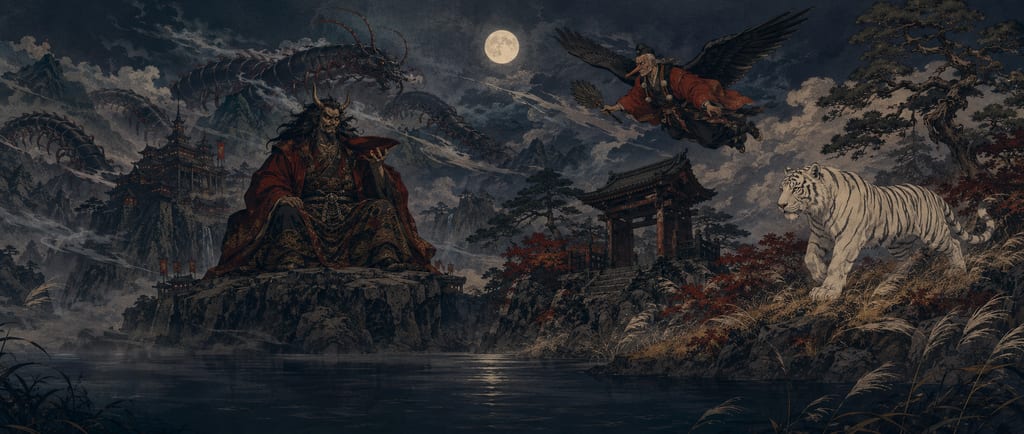
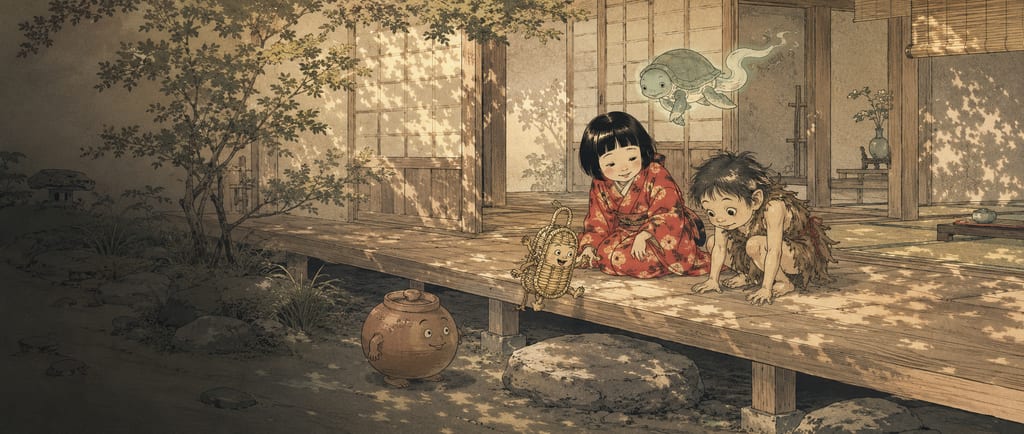
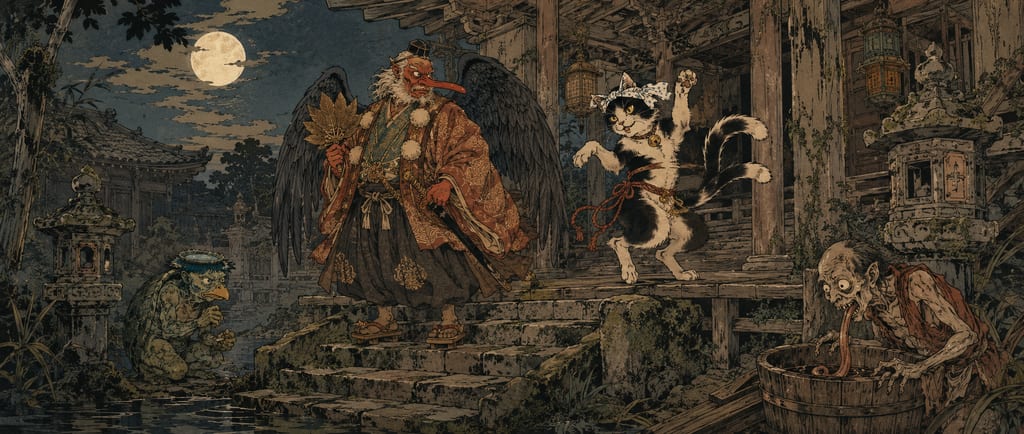
Kodama (Japanese Tree Spirit) across multiple art-style decks
Kodamas are Japanese tree spirits associated with old trees, sacred forests, and mountain echoes. In folklore, a kodama may be the spirit dwelling inside a tree, the tree itself when it has become spiritually charged, or the unseen presence that answers a human voice from the mountains.
Q2
Is “kodamas” the correct plural of kodama?
A:
In Japanese, kodama does not change form for plural. In English writing, both “kodama” and “kodamas” are used. This page uses “kodama” for the Japanese term and recognizes “kodamas” as the common English search form.
Q3
Are kodama the same as the white forest spirits in Princess Mononoke?
A:
The small white forest spirits in Princess Mononoke are inspired by the idea of kodama, but the older folklore is broader. Traditional kodama are not always visible or childlike; they are more often the spirit of an old tree, a sacred presence in the forest, or the echoing voice of the mountain.
Q4
Are kodama yokai or kami?
A:
Kodama sit between categories. They can be discussed as yokai because they appear in yokai picture books and uncanny folklore, but they also preserve an older sense of tree divinity close to kami belief. That ambiguity is part of what makes kodama important.
Q5
What happens if someone cuts down a tree with a kodama?
A:
Folklore warns that cutting an old tree without respect can bring illness, misfortune, or strange events. Some traditions say an old tree may bleed when cut. Woodsmen therefore asked permission, made offerings, or observed rituals before felling spiritually charged trees.
Q6
What is the difference between kodama and yamabiko?
A:
Yamabiko usually refers to the mountain echo itself, or to a spirit that returns voices from the mountains. Kodama is more strongly tied to trees and tree spirits. The two overlap because many people understood an echoing mountain voice as the answer of a kodama.
3 different forms of Kodama (Japanese Tree Spirit) have been confirmed. Each has unique characteristics and personality, with various ways of interacting with people. Details of each form are introduced below.
Kodama (Ancient Tree and Echo Spirit)
To explain Kodama (Ancient Tree and Echo Spirit) in detail:
This is the classical kodama: not a mascot-like creature, but the unseen presence of an old tree and the voice that seems to answer from the mountain. It draws on older ideas of tree divinity, on the belief that ancient trunks hold spiritual force, and on the folk reading of yamabiko, the returning mountain echo. The kodama may remain invisible, showing itself only through sound, silence, unease, or the taboo surrounding a tree that should not be cut without ceremony. This version emphasizes the traditional boundary: kodama can be described as a tree spirit, a forest yokai, or a lingering kami-like presence, but its power lies precisely in not fitting only one category.
Character Profile
This section is our own creative profile for storytelling. It is not historical fact or scholarship.
harmonizes with people who keep forest etiquette and recoils from those who damage mountains carelessly
Abilities
answering through mountain echoessensing respect or disrespect toward old treessignaling danger before travelers lose their way
Weaknesses
rudeness, noisy disturbance, drought, fire, and careless cutting of old trees
Habitat
deep mountain groves, ancient cedars and firs, sacred trees near shrines, rocky valleys where voices return as echoes
Kidama-sama of Aogashima
To explain Kidama-sama of Aogashima in detail:
A wood spirit from Aogashima in the Izu Islands, long honored by islanders as “Kidama-sama” or “Kodama-sama,” enshrined at small altars set at the roots of great cedars. The island forest drinks sea wind and volcanic breath, driving deep roots through shallow soil. The spirit dwelling there is not a mere echo, but an ancient memory woven from the age of the tree itself. At dawn mist, if you call its name before the shrine, the reply comes only once, a slightly damp sound, taken as a sign of assent. If it returns twice or thrice, uneven and jarring, it warns that the season is wrong—do not cut. Before felling wood, locals offer a handful of rice, sea salt, and a cup of shochu, tap the trunk three times, and state the reason and the count. Kidama-sama honors this rule: when respect is paid, it sets the wind fair, keeps blades from dulling, and prevents workers from losing their way. If slighted, the mountain’s sounds grow muddy, blades kick against knots, and toil is shadowed by illness. Its form is uncertain, yet elders speak of a “shadow of rings”: when the bark reddens in the evening glow, a single pale eye like a water mirror appears deep in the grain and melts away. Before great winds or earth-rumblings, pebbles at the shrine rearrange themselves, a sign of the forest’s breath in disorder; those who heed it halt farm and boat work and lessen harm. It is not closed to outsiders: give your name, bring salt as a gift, keep your voice low before the shrine, and the returning echo softens and the mountain path confuses less. Laughing and shouting bring a delayed, high, splintered reply that lingers in the ear and upsets your sense of direction. When a tree’s life nears its end, Kidama-sama may appear in dreams to say, “Now I change worlds.” Villagers take this as a good omen, planting three saplings after a fall and moving the shrine to the new root to carry the breath onward. Thus the island forest renews by generations, and the spirit moves without fading, a vivid afterimage of the old tree gods living strong on a sea-bound isle, quietly listening as a mediator between mountain rites and ocean sustenance.
Character Profile
This section is our own creative profile for storytelling. It is not historical fact or scholarship.
solemn and dutiful, grateful and never forgets favors, answers rudeness with cold silence, gentle and guiding to those who keep proper conduct
Compatibility
woodsmen and hunters who follow mountain etiquette, travelers who bow at roadside shrines, people who keep their promises
Abilities
judgment by echo indicating consent or omenslocal wind adjustment calming airflow during workwarding off wayfinding errors by steadying respectful travelers’ sense of directionportent signs by moving shrine trinkets before quakes or gales
Weaknesses
falls silent before rude noise or mocking voices, power wanes and signs dull if offerings of salt and water cease
Habitat
roots of giant cedars on Aogashima in the Izu Islands, shrine groves with small altars, valleys of the volcanic outer rim
Southern Island Kinushi-Haunted Kodama
To explain Southern Island Kinushi-Haunted Kodama in detail:
Among the kodama whose echoes are heard across Japan, a southern island variant dwelling especially in Okinawa’s Yanbaru and sacred utaki groves is known as the Kinushi-Haunted Kodama. As its name implies, it settles like a lord within each individual tree, living in sync with the tree’s breath, the flow of sap, and the spread of its roots. Old lore says that if a woodcutter lightly taps the trunk before the first axe bite and offers a name and prayer, the kodama will tune the sound within the wood, align the wind with the intended fall, and guide the work safely. Strike in silence, however, and the tree will creak and cry, hollow tones will stutter across the mountains, and within days the surrounding leaves will lose color as if scorched. On uneasy nights, a heavy thud may carry through the mountain village though no tree has fallen; this is said to be the cry of a Kinushi-Kodama in unbearable pain. The tree where that sound is heard will soon shed dieback from its crown, white mycelium will gather at the roots, and its life will end. Witnessing this, elders understood that sound is the true form of the kodama, and passed down taboos: do not raise your voice at the forest’s threshold, and when calling a tree by name, pause to await its answer. Though it has no body, at dusk the air around the roots will sometimes shimmer like water and a childlike laugh may echo twice or thrice; islanders take this as a good omen and offer salt and black sugar to that tree. If a small child naps in its shade, mosquitoes and midges keep away and the sea breeze softens. Elders say that when winds from beyond the sea make their rounds among the mountain gods, the kodama resonates with the wind and guards the village bounds. Often confused with mountain echoes, the Kinushi-Haunted Kodama differs in that it does more than repeat a voice: by the timing and tone of its reply it foretells fortune. A clear prompt note means a good day for work, a heavy delayed reply is a sign to rest, and a muffled response from within the trunk portends sickly leaves. The islands also keep rites for transplanting trees. On the eve of root-pruning, stroke the trunk three times and name the soil of the new site; the kodama will fold the root tips and slim itself so it will not thirst during the journey. Neglect this and hollow knocks will sound nightly at the new place and the household may fall to fever. In coastal banyans dwell playful spirits known as Kijimunā. In older thought, Kijimunā are those Kinushi-Kodama that took on a more human-like notion of form: the kodama is the voice of the roots, the Kijimunā the laughter of the branches. Both are tree divinities at heart, guiding the respectful and chastening the careless with sound. Thus in the southern island forests, sound is law, and people and trees have long lived by each other’s breath.
Character Profile
This section is our own creative profile for storytelling. It is not historical fact or scholarship.
quiet and courteous, strict toward those who disrespect trees, expresses pain and joy through sound, reciprocates human feeling with equal blessing or curse
Compatibility
those who follow mountain and forest etiquette, those who offer prayers and courtesy before felling, those who faithfully care for trees
Abilities
echo divination by tone and timing to reveal fortune and weather shiftsfelling guidance aligning fall direction and wind when honoredinsect-warding presence that keeps small pests from its sheltered shadetransplant ward that eases root strain and delays dieback
Weaknesses
vulgar noise and harsh metal sounds weaken it and prolonged exposure drives it into silence, dry wind without salt steals its voice and saps its strength
Habitat
ancient banyans and sago palms in Okinawa’s Yanbaru, shrine groves around utaki sacred sites, great village trees facing the sea wind
Kodama (Ancient Tree and Echo Spirit) — Yokai Compatibility Test
The diagram below is a diagnostic evaluation chart for Kodama (Ancient Tree and Echo Spirit). The higher the value of each item, the stronger that characteristic is expressed.
Kidama-sama of Aogashima — Yokai Compatibility Test
The diagram below is a diagnostic evaluation chart for Kidama-sama of Aogashima. The higher the value of each item, the stronger that characteristic is expressed.
Southern Island Kinushi-Haunted Kodama — Yokai Compatibility Test
The diagram below is a diagnostic evaluation chart for Southern Island Kinushi-Haunted Kodama. The higher the value of each item, the stronger that characteristic is expressed.