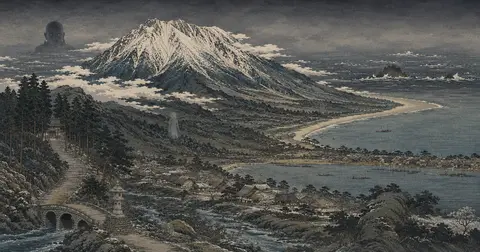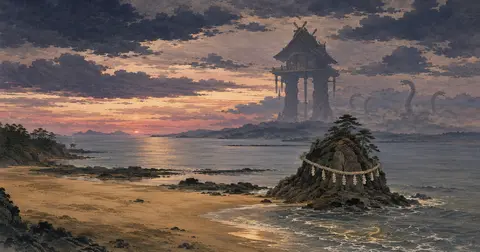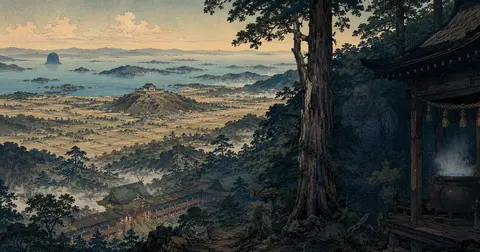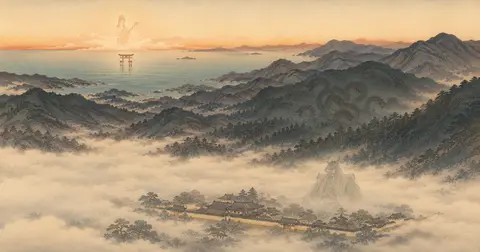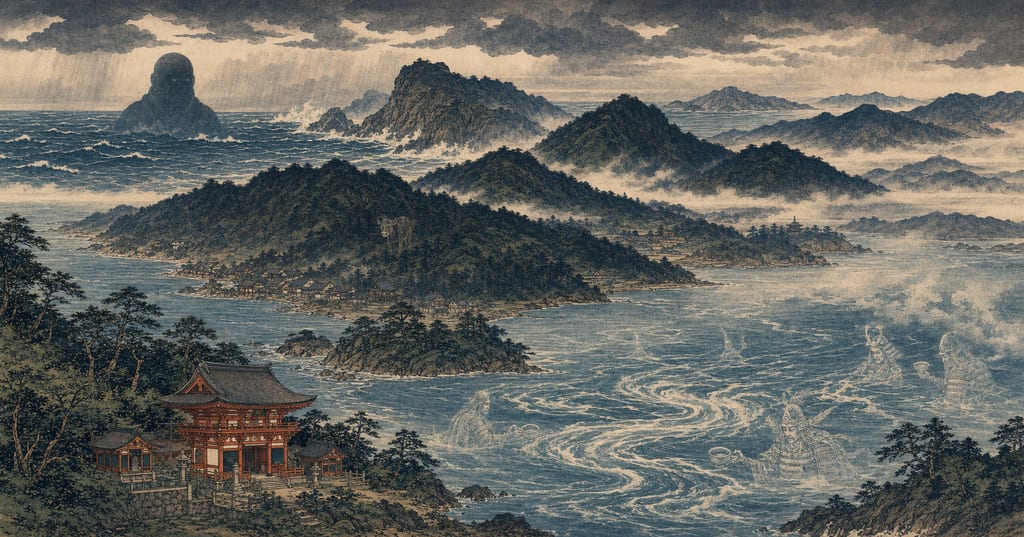
Yamaguchi Prefecture is a land situated at the westernmost tip of Honshu, wedged between two seas. To the north lies the Hibikinada of the Sea of Japan, to the south the Seto Inland Sea, and at its western edge, the Kanmon Strait divides Honshu from Kyushu. Historically split into Suo Province in the east and Nagato Province in the west, a lifestyle of maritime transport and fishing has taken deep root in every corner of the prefecture. Naturally, the yokai of a land open to the sea predominantly consist of maritime apparitions. The massive black shadow of the umibouzu rising offshore, and the funayurei demanding a ladle on stormy nights—both were born from the terror of living alongside death that fishermen constantly face.
However, the yokai of Yamaguchi cannot be simply categorized, because it is simultaneously a "prefecture of the sea" and a "prefecture where history sank." Dan-no-ura in the Kanmon Strait is the site of ruin where the Taira (Heike) clan sank into the sea along with the young Emperor Antoku in 1185 (the fourth year of Juei)[1]. That memory has been passed down and transformed over centuries—into the tale of "Hoichi the Earless" at Akama Shrine, into spirits of armored warriors appearing in the sea, and into the suzuri-no-tamashii (spirit of the inkstone) that Toriyama Sekien envisioned on an Akama inkstone. Conversely, turning one's eyes inland reveals the prophetic beast kudan that runs across the Chugoku region, as well as the darkness of the inugami that bound the bloodlines of western Japan. Where maritime anomalies, the grudges of the Taira clan, and the social history of spirit possession intersect—that is where the yokai culture of Yamaguchi Prefecture lies.
A Giant Rising in the Sea:
The Umibouzu of Mukatsuku
The Mukatsuku Peninsula, which juts thinly into the Sea of Japan to the north of Yamaguchi Prefecture, is a cape in Nagato dotted with ancient fishing villages. One legend of the umibouzu remains in this land.
Umibōzu
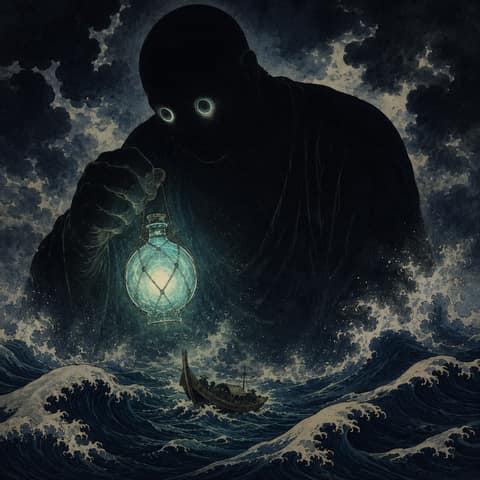
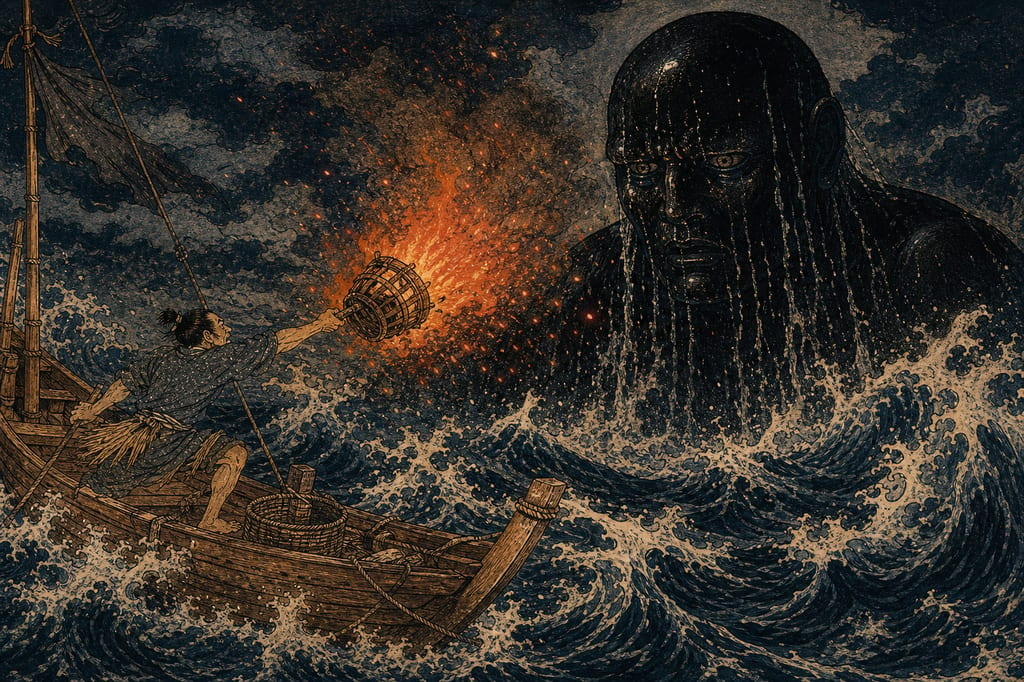
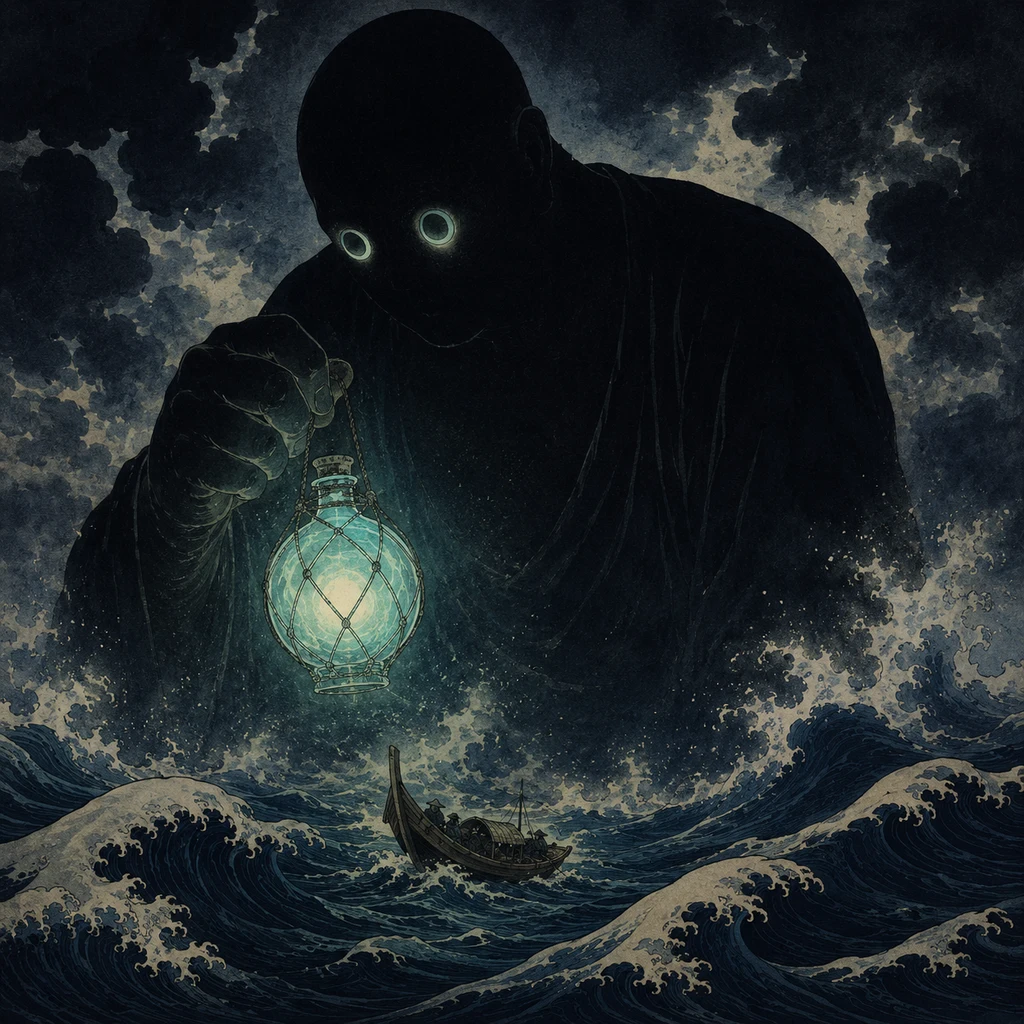
Umibōzu is a maritime apparition known along coasts throughout Japan and long feared especially by fishers. A calm sea is said to heave without warning, becoming an immense black shadow or the bald form of a Buddhist monk that blocks a vessel's path. Accounts rarely show a whole body; most describe only a head and shoulders rising above the water. It appears at night or in heavy seas, overturning boats and dragging people into the depths. Edo-period sources including the Wakan Sansai Zue (1712) and the Butsurui Shōko (1775) also record the name of a giant apparition standing at sea.
Read moreThe umibouzu is a maritime apparition where the once-calm surface of the sea suddenly swells up, taking the form of a massive black shadow or a bald-headed monk to block the path of a ship. It is rare for its entire body to be seen; it is mostly spoken of as appearing with only its head and shoulders thrust out of the sea. In the tale passed down in Kawajiri, Mukatsuku, Nagato, it is said that fishermen night-fishing escaped disaster by throwing their bonfire at an umibouzu that came to extinguish it[2]. The nature of this apparition—a monster that fears fire—is evident here.
Legends of the umibouzu are distributed across fishing villages nationwide, from the Goto Islands (Nagasaki) to Ehime, Okayama, Tottori, Wakayama, and Miyagi[2]. Its characteristics are not uniform in every region. While some lands speak of it as a beast of enormous strength that blocks ships and breaks nets and oars, a different motif is passed down in the Goto Islands of Nagasaki and Morozaki in Aichi: it demands, "Lend me a ladle," and if given one, it will pour seawater into the ship to sink it, so sailors survived by handing it a ladle with the bottom knocked out. As for its true identity, theories have circulated that it is a drowned person's ghost transformed, or the fallen figure of a dragon god or sea god demanding a sacrifice. The name of a colossal apparition rising from the sea is also found in the Edo period natural history encyclopedia *Wakan Sansai Zue* (1712), and for the people of the early modern era, the umibouzu was a giant that bore the "terror of the sea itself" upon its own body.
For fishing villages on capes like Mukatsuku, the night sea is literally a world adjacent to death. If the bonfire goes out, they lose the direction home; if swallowed by the waves, they never return. The umibouzu was a mechanism to explain such an unreasonable death as the "malice of a giant." The narrative from Mukatsuku of driving it away by throwing fire reflects the mindset of fishing villages—an act of hurling fire, the only tool of resistance powerless humans possessed, against the apparition.
The Mukatsuku Peninsula protrudes long and thin into the Hibikinada of the Sea of Japan, and at the Kawajiri Cape at its tip, the tides clash complexly. Such capes were strategic points for waiting for favorable winds and tides, but they were also treacherous spots where a misreading of the current proved fatal. The motif of the umibouzu appearing as the sea surface swelling to form the shadow of a giant can be seen as a direct translation into a monster's form of the terror experienced the moment the "eye" catches a sudden storm or the crest of a wave in the dark of night. In early modern yokai illustrations, a blind monk standing on the sea called "Umi-zato" was often depicted rather than the umibouzu itself, but both are images crystallized from the shared awe of an "inhuman giant body rising in the sea." While Yamaguchi's umibouzu is one variant of a type distributed nationwide, it has become a grounded apparition precisely because it is spoken of in connection with the specific cape of Mukatsuku.
The Dead Seeking Ladles:
The Funayurei of Dan-no-ura
If the umibouzu is the "giant of the sea," the funayurei are the "dead of the sea." In Yamaguchi Prefecture, this throng of dead spirits bears a gravity unlike anywhere else. This is because Dan-no-ura in the Kanmon Strait is the very place where the entire Taira clan sank into the sea.

Funayūrei
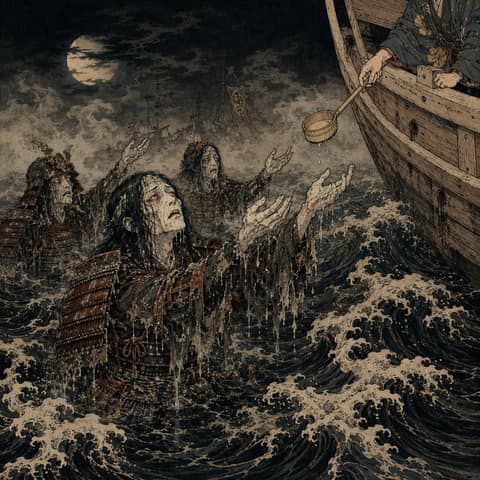
Funayūrei are maritime apparitions formed from the spirits of people who died by drowning or shipwreck. Depending on the region, they may appear as ghosts, phantom boats, eerie lights, or dark figures resembling Umibōzu. They most often emerge on stormy or fogbound nights, when they try to sink a vessel by ladling seawater aboard or confuse its course until it runs aground. Local defenses include offering a ladle with its bottom removed, throwing rice balls or ash, or meeting the ghosts with an unwavering stare. Mōjabune, Bōko, and Ayakashi are among the names applied to such spirits. Toriyama Sekien also depicted Funayūrei in Konjaku Gazu Zoku Hyakki.
Read moreThe funayurei is an apparition where the spirits of those who died in shipwrecks or drownings appear on the sea, and its form is described variously depending on the region—as phantom ships, mysterious fires, or shadows like the umibouzu. They often appear on stormy nights or foggy evenings, attempting to sink ships by pouring seawater inside with ladles. Countermeasures also differ by region, such as handing over a ladle with the bottom knocked out, throwing rice balls or ash, or glaring them down. They also go by names such as *moja-bune* (ship of the dead), *bouko*, or *ayakashi*, and Toriyama Sekien also depicted this monster in his *Konjaku Gazu Zoku Hyakki*.
What is unique to Yamaguchi's narrative is that this throng of spirits is linked to the "ghosts of the Taira clan." Takehara Shunsensai's *Ehon Hyakumonogatari* (1841)[3] identified the funayurei appearing in the western seas as the ghosts of the Heike, and depicted armor-clad spirits near Dan-no-ura in the Kanmon Strait pressing sailors with the demand, "Give us a *hisage* (sake vessel)." The demand for a *hisage*—a vessel for pouring sake—rather than a ladle adds a tinge of the ghosts of ruined nobility. The custom of knocking out the bottom of bowls and ladles in advance and surviving by handing them over when asked spread not only to Dan-no-ura but to various coastal regions in Fukushima, Hirado in Nagasaki, and Goshoura Island in Kumamoto.
Furthermore, a taboo was spoken of in various regions: if one operates a boat on the sixteenth day of the Bon festival, the dead will gather at the gunwales and try to sink the ship. Funayurei appear exactly in the stormy sea and the sea of Bon—that is, "the time and place when the dead return." The diverse countermeasures across regions are also noteworthy. In Miyagi, they disappear if you stop the ship and glare at them; in Kochi, ashes and mochi are thrown; in Nagasaki, woven rush mats and ashes are tossed in; and on Kozushima in Izu, it is said that incense and dumplings are offered. In Chiba, sailors were accosted with "Lend us an *inada* (a small wooden tub)," and survived by handing over a ladle with the bottom removed. The fact that the item demanded differs by region—ladles, *hisage*, *inada*—is likely because the dead reflect "what they desired in life" in their respective seas.
And in Yamaguchi, those dead bear the specific name of the Taira clan. It was even reported that the spirits of Taira warriors could be seen on the sea surface at Dan-no-ura during the Tenmei era (1781–1789). The ruined clan, sunken in the sea, clings to the ships of the living seeking *hisage*—the motif of the funayurei begging for ladles here overlaps with the memory of the banquet of the doomed nobles. And those ghosts, across the sea, connect to tales on land: "Hoichi the Earless" and the "Spirit of the Inkstone" (suzuri-no-tamashii), discussed next. Yamaguchi's funayurei, while being a throng of spirits born from fishing accidents common nationwide, gained a weight distinct from the funayurei of any other sea by absorbing the single historical point of the Taira clan's destruction.
The Vessel Harboring the Grudge of the Taira:
Akama Shrine and the Suzuri-no-tamashii
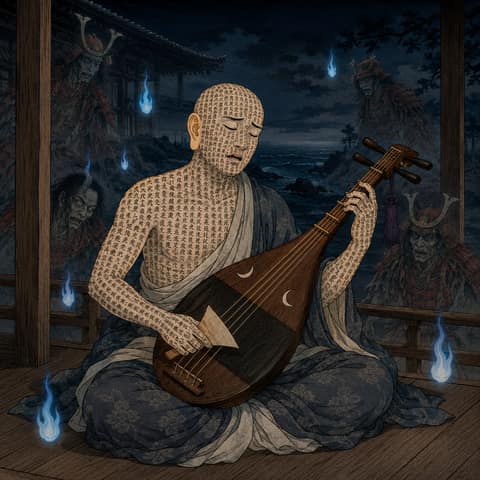
Akama Shrine in Shimonoseki, originally called Amida-ji Temple, enshrines Emperor Antoku and the Taira clan who met their end at Dan-no-ura. The graves of fourteen Taira warriors line the Nanamori-zuka mound within the precincts, and this is the setting for one of Japan's most famous ghost stories, "Hoichi the Earless." The blind biwa lute priest Hoichi is invited by nobles night after night to play the biwa, until he realizes he has been performing before the ghosts of the Taira clan—a tale made world-famous by Lafcadio Hearn (Koizumi Yakumo), who included it in his English ghost story collection *Kwaidan* (1904)[4]. What Hoichi played was none other than the segment of Dan-no-ura. The Taira who sank into the sea listening to their own demise through the biwa of a monk on land—this nested structure is the core of Yamaguchi's apparitions.
Toriyama Sekien crystallized this same concept of "the memory of the Taira lodging in a vessel" with unmatched beauty in the suzuri-no-tamashii (spirit of the inkstone).
Suzuri-no-tamashii
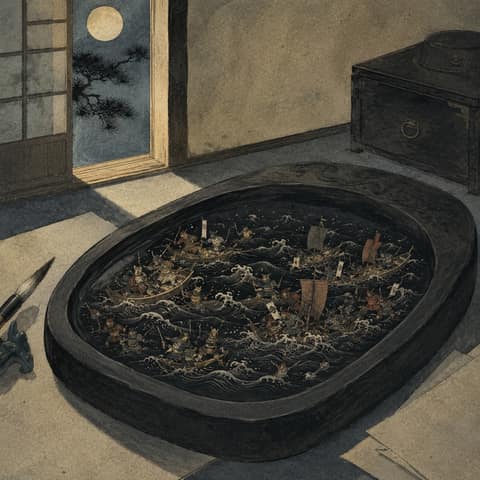
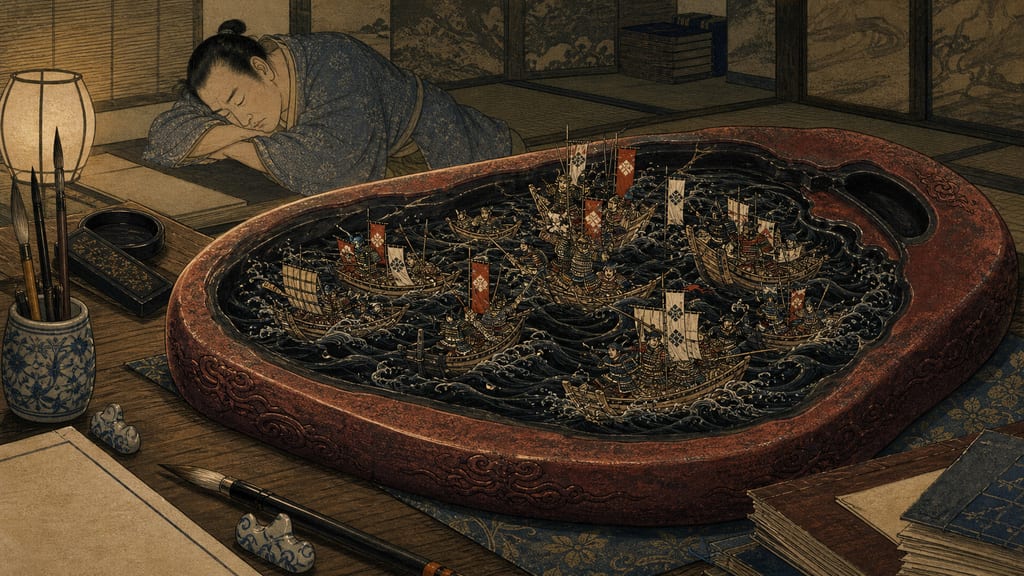
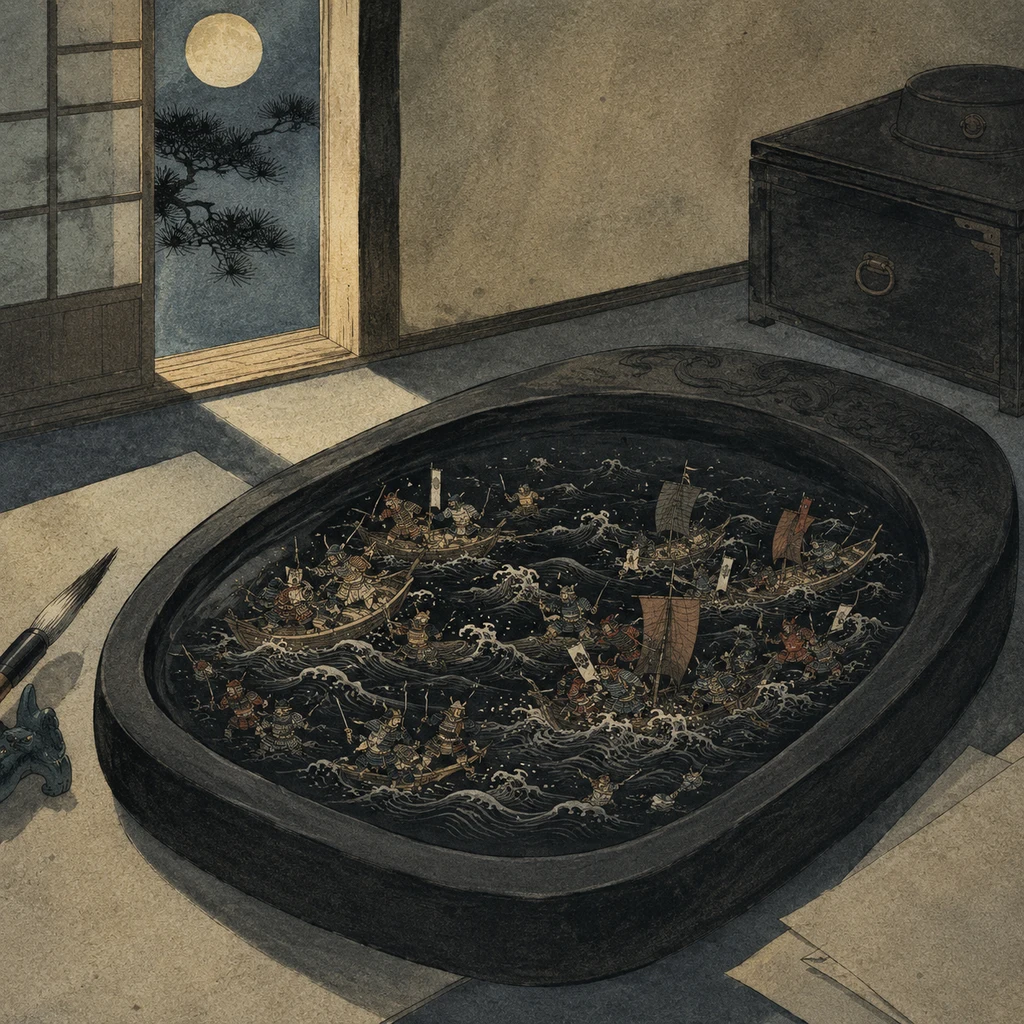
Suzuri-no-tamashii (the Spirit of the Inkstone) is a highly literary and romantic *tsukumogami* (artifact spirit) created by the Edo-period yokai artist Toriyama Sekien in his art collection *Konjaku Hyakki Shui* (Supplement to The Hundred Demons from the Present and the Past). It is not a terrifying monster that threatens or harms people, but rather a beautiful yet sorrowful phantom that appears only in the fleeting moment when the memories dwelling in stationery intersect with the user's deep "immersion in literature." The greatest charm of this yokai lies in the brilliant fusion of "wordplay" and "historical background" orchestrated by Sekien. In calligraphy, the shallow depression in an inkstone (suzuri) where the liquid ink pools is called the "umi" (sea or ink sea). Sekien established that the inkstone favored by a certain literatus was specifically set as an "Akama stone inkstone" produced in "Akamagaseki" (present-day Shimonoseki City, Yamaguchi Prefecture), known as a masterpiece. Akamagaseki is not merely a production site for high-quality inkstones; it is the very stage of the "Battle of Dan-no-ura," the final decisive battle of the Genpei War, where the Heike (Taira) clan met their tragic end alongside the young Emperor Antoku. One quiet night, while the literatus was rubbing ink on this Akama inkstone and reading *The Tale of the Heike*, he dozed off. Suddenly, real waves swelled in the "sea" of the inkstone, and amidst the vast ocean of black ink, the warships of the Minamoto (Genji) and Taira (Heike) clans clashed chaotically, vividly recreating the fierce battle of Dan-no-ura as a phantom across hundreds of years. This phenomenon occurs because the Akama stone, steeped in the blood and lingering regrets of the Heike, projected memories of the past through the black sea of ink. It is one of the most poetic supernatural anomalies in the history of Japanese yokai, perfectly uniting the three elements of the "inkstone's sea," the "origin of the Akama stone," and the "fall of the Heike" in flawless aesthetic harmony.
Read moreThe suzuri-no-tamashii is a tsukumogami depicted by Sekien in his *Konjaku Hyakki Shui* (1781)[5]. In calligraphy, the shallow depression in an inkstone where ink gathers is called the "sea" (ink-sea). Sekien set the inkstone of a certain literati as the Akama inkstone, made of Akama stone from Akamagasheki (present-day Shimonoseki), known as a superb stone. Akamagasheki is both the producing area for high-quality inkstones and the very stage of the Battle of Dan-no-ura.
One quiet night, a literati read the *Heike Monogatari*[1] while rubbing ink on this Akama inkstone and nodded off. Then, real waves rose in the "sea" of the inkstone, and the warships of the Minamoto and Taira clashed in the vast expanse of ink, resurrecting the fierce battle of Dan-no-ura as a phantom across hundreds of years—so Sekien describes. It is one of the most poetic apparitions in Japanese yokai history, bundling the three elements of "the sea of the inkstone," "the origin of the Akama stone," and "the ruin of the Taira clan" into a single vision.
The background of this idea is said to be a Chinese anomaly tale (*zhiguai*) in which armor-clad warriors the size of rice grains appear on an inkstone in a study late at night and start a battle. Sekien did not merely import it; by replacing it with the *Heike Monogatari* and Dan-no-ura—the most dramatic of Japanese history—he elevated it into a yokai rooted in the land. The concept of "tsukumogami," where old stationery acquires spiritual power after long years, also reflects the profound reverence for the tools of learning shared among the literati class of East Asia. The thoughts and passions of those who used the tools that wrote words and recorded history and tales were believed to lodge within them.
The Akama inkstone is an actual famous product of Yamaguchi. Carved from Akama stone found from Shimonoseki to Nagato City, its fine texture and excellent ink development have made it prized by calligraphers since ancient times. Sekien choosing this inkstone as the stage for a yokai was not a mere whim. The very quarry for Akama stone was the battlefield of Dan-no-ura, and the association of "stones stained with the blood of the Taira clan" came quite naturally to the people of that time. The blood of the Taira sunken in the sea stains the Akama stone, and the past is projected through the black sea of ink—if Hoichi the Earless resurrected the Taira through "sound," the suzuri-no-tamashii accomplishes it through "words and ink." One is the biwa of a blind monk, the other the inkstone of a literati. Though the mediums differ, both are born from the same conviction that "the memory of the Taira clan resurrects through vessels." The memories of the Taira's ruin have settled as multiple apparitions at the single point of Shimonoseki.
Born from a Cow,
Foretelling the Future,
and Dying:
The Prophetic Beast Kudan of the Chugoku Region
When turning our eyes inland from the maritime anomalies, Yamaguchi lies right in the middle of another yokai cultural sphere. It is the world of the prophetic beast "kudan" that runs through the Chugoku region.
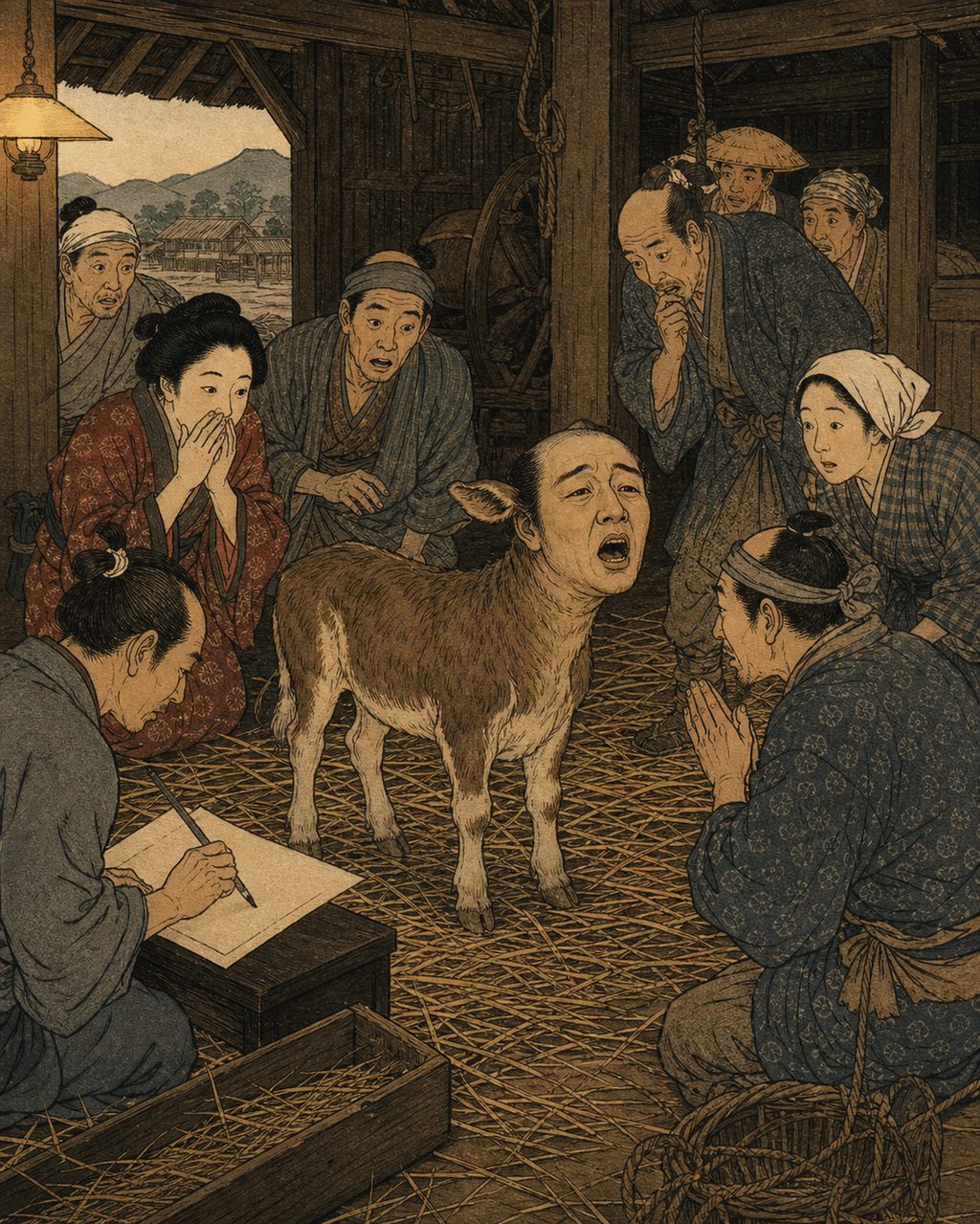
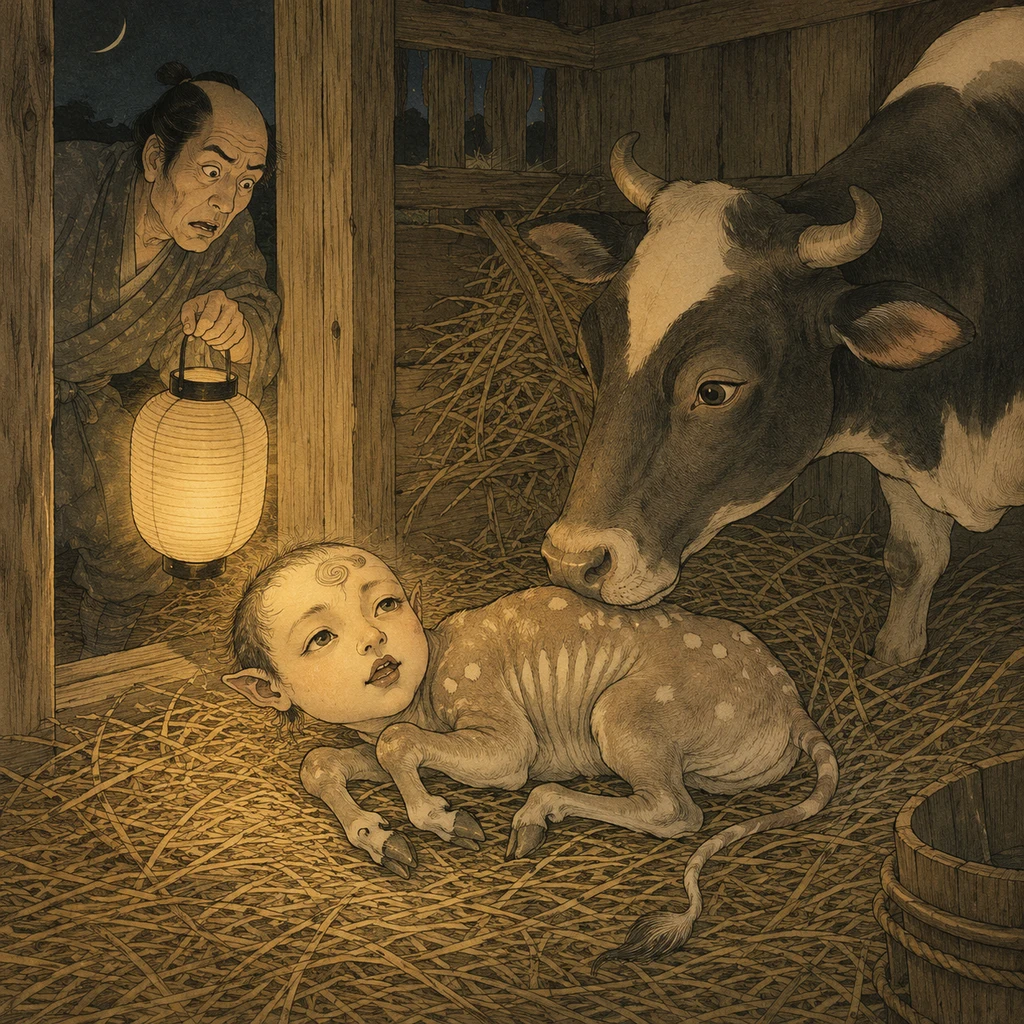
Kudan (Prophetic Human-Cow Yokai)
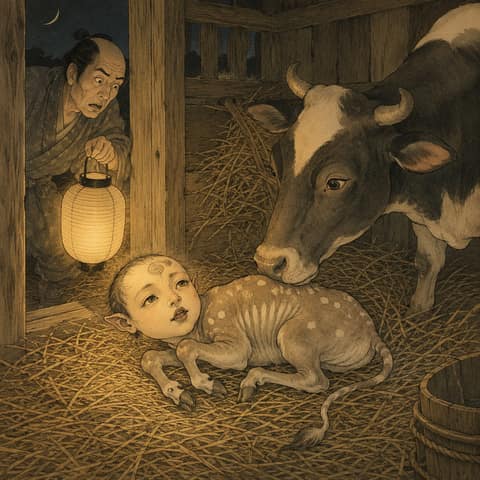
Kudan is a half-human, half-cow prophetic creature that spread widely in the late Edo period. It has a human face on a bovine body and is said to appear, deliver prophecies about public affairs or harvests, and soon die. Broadsheets and printed books from the Tenpō era record varying locations and appearances. Some notices claimed that displaying its image brought protection from calamity and prosperity at home, though accounts differ by region and source. The supposed link to the legal phrase ‘ken no gotoshi’ (“as stated above”) is considered a folk etymology.
Read moreThe kudan is a half-human, half-cow prophetic beast that circulated widely in the late Edo period; it possesses a human face on a cow's body, appears to declare the state of the world or agricultural fortunes, and is said to die shortly after. Although a *kawaraban* broadsheet from 1836 (the seventh year of Tenpo) reporting that one appeared at Mount Kurahashi in Yosa District, Tango Province, and foretold several years of good harvest and the efficacy of talismans is well-known, tales of the kudan's appearance were densely distributed throughout the Chugoku region.
A record of the kudan specific to Yamaguchi comes from Iwakuni City. It is said that in 1943 (Showa 18), a kudan was born at a sandal maker's in Iwakuni City and prophesied that the war would end around April or May of the following year[6]. Around the same time, rumors of the kudan's appearance also surfaced in the mountains of Hiroshima and in Matsuyama. This is one point in Yamaguchi in a band of rumors of the prophetic beast that ran across the Chugoku region during wartime.
While the Edo kudan foretold "good or bad harvests" for a few years, the Chugoku kudan under the Pacific War foretold the "end of the war." This point clearly shows how the prophetic beast was re-narrated in response to the anxieties of the era. The anxiety of farming villages, where the only foreseeable future was a good or bad harvest, was replaced by the anxiety of "When will this war end?" amid total war—the content the kudan declares is precisely what the people of that era most wanted to know. When the world is in turmoil and people harbor unpredictable anxieties, the kudan emerges from the belly of a cow, speaks a single word about the future, and dies immediately. Because it dies immediately, the prophecy is passed down merely as having "come true" without being disproven. Traces of this interest in anomalies surrounding the state of the world can also be observed in the rumor records related to the Hagi domain[7] preserved at the Yamaguchi Prefectural Archives. There was also a popular belief that putting up a picture of a kudan would ward off evil and bring domestic prosperity, and the prophecy and the talisman merged to quell people's anxieties. Furthermore, the association with the customary phrasing in deeds, "As aforementioned (kudan-no-gotoshi)," is considered a folk etymology derived from later interpretations, and the origin of the word "kudan" cannot immediately be traced to this monster.
The Darkness Possessing Bloodlines:
The Social History Named Inugami
If the prophetic beast reflects the "anxieties of the world," the inugami is a yokai that reflects the "anxieties of the village." And the darkness of this possession had taken deep root in the lands of Suo and Nagato as well.
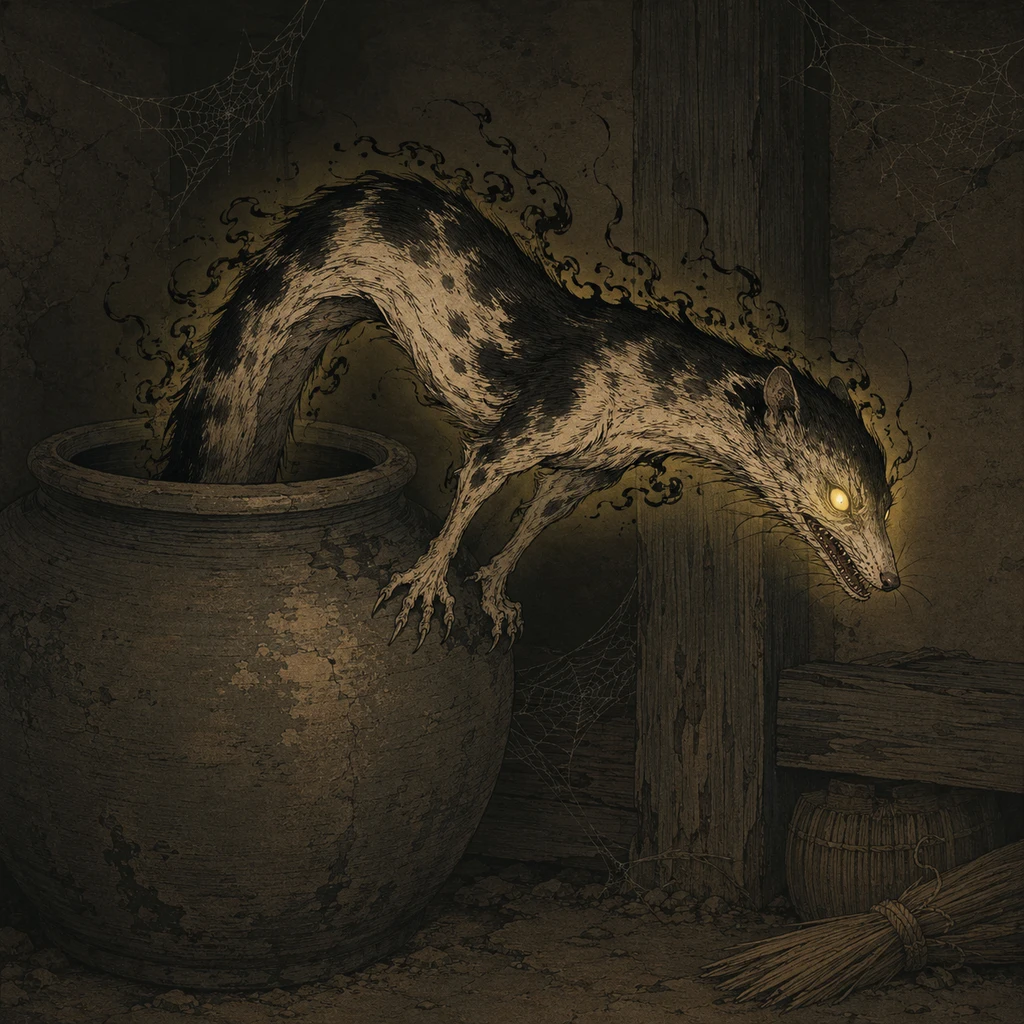
Inugami
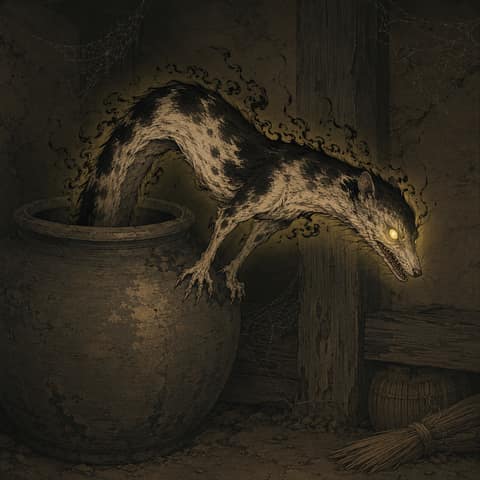
Inugami are possessing dog-spirits found mainly in western Japan, counted alongside fox possession and kuda-gitsune as a powerful occult force. Shikoku—especially Tokushima, Kochi, and Ehime—is regarded as their heartland, with traces reported from Shimane and Yamaguchi down through Kyushu to the Satsunan Islands and Okinawa. Families believed to host hereditary Inugami—called “Inugami bloodlines”—were stigmatized, leading to marriage taboos and social discrimination. Their form and temperament vary widely by locale, with traditions describing them as mouse-like, weasel-like, or bat-like, among other shapes.
Read moreThe inugami is an animal spirit possession primarily distributed across western Japan, considered a powerful possessing spirit alongside fox possession and the *kudagitsune* (pipe fox). While Shikoku—especially Tokushima, Kochi, and Ehime—is viewed as its heartland, in Bingo, Aki, Suo, Nagato, and Shikoku, the true form of the inugami was said to be a small beast the size of a house mouse, and households harboring it were called "inugami-suji" (inugami bloodlines)[8]. Inugami were kept in closets, under floorboards, or in water jars, and reading the will of their master, they would possess other households, bringing illness and disrupting the family's fortunes. Those possessed exhibited pain in the chest and limbs or barked like dogs, and it was believed that medical treatment could not cure them; they had to be exorcised through prayer.
What is critical here is that the inugami was not merely a tale of the supernatural; it was accompanied by a negative social history intertwined with real-world discrimination. Families deemed to be *inugami-suji* had their lineage investigated during marriages and were shunned from intermarriage. The logic of village society, which explained the uneven distribution of wealth and the rise and fall of households by saying, "That house is possessed by an inugami," irrationally bound specific families. Folk beliefs concerning its creation—such as burying the head of a starved dog at a crossroads to turn its vengeful spirit into a cursed object—were also passed down, but these are pointed out to be fabricated narratives added later to justify the discrimination against *inugami-suji*, rather than historical facts.
Regarding the origin of the inugami, a widely known theory traces it to the transmission of *Gu* magic to Japan, connected to the "dog *Gu*" described in the Chinese *Soushen Ji* (In Search of the Supernatural), positioning it within the lineage of *ko-jutsu* and *enmi* (curses) of the Heian period. However, what spread the concept of *inugami-suji* at the grassroots level of folk culture was not the lineage of such arts, but rather the logic of village society seeking to explain the uneven distribution of wealth and the rise and fall of households. Why does that one family prosper? Why won't this illness heal? Unseen misfortunes and envy, lacking clear reasons, were entrusted to an unseen small beast—the "inugami." In Tokushima, it is said the possessed exhibited fierce gluttony, and Kenmi Shrine in Shikoku is still renowned today as a shrine for warding off inugami. Suo and Nagato were also within the sphere of this possession belief.
The fact that the concept of *inugami-suji* was spoken of in the lands of Suo and Nagato shows that Yamaguchi's yokai culture is not composed solely of "glamorous" apparitions like maritime anomalies or the grudges of the Taira clan. If the umibouzu and funayurei are "threats of the sea coming from the outside," the inugami is a monster born of "inner village suspicion." The darkness of spirit possession that kept certain people bound in the corners of villages is also a part of this land's yokai history that must be counted without turning our eyes away.
Monsters of Sound Alone,
Drums Echoing from the Sea:
Auditory Yokai of Riverbanks and Oceans
Finally, I wish to touch upon another lineage of Yamaguchi's yokai—apparitions where "there is no form, and the sound itself is the entity."
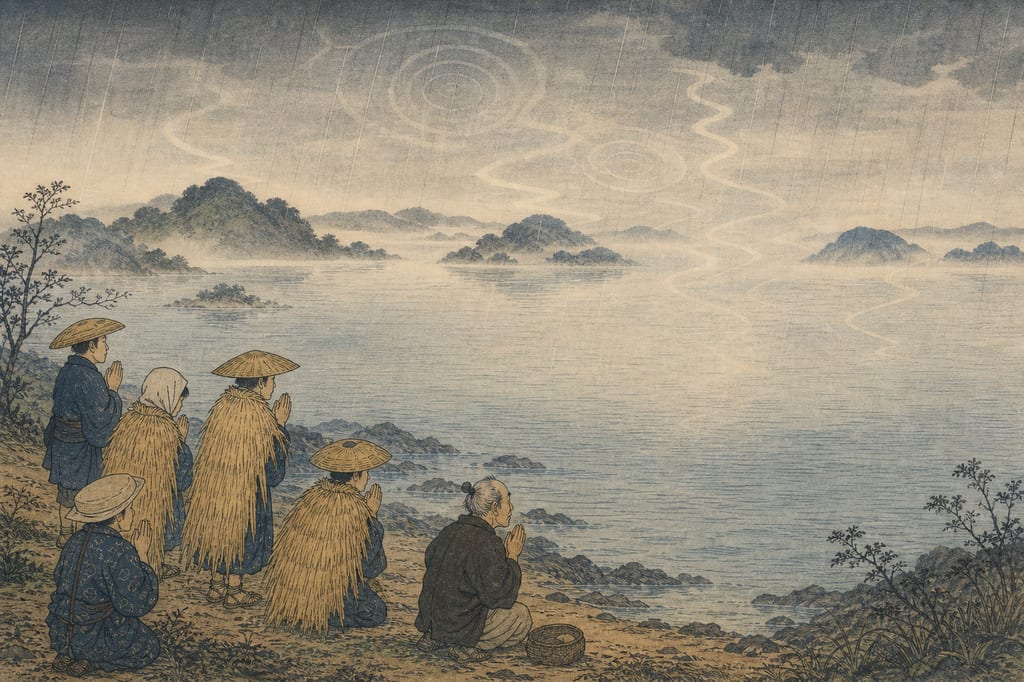
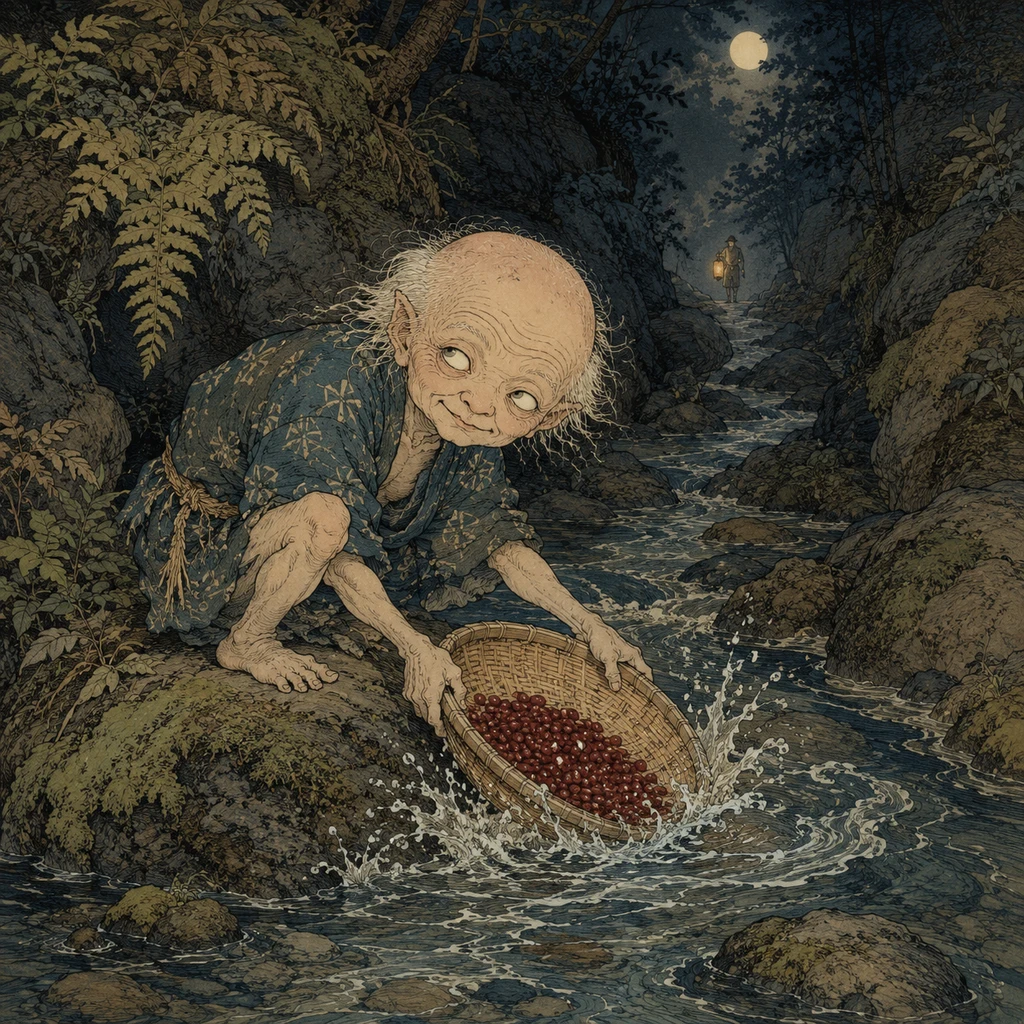
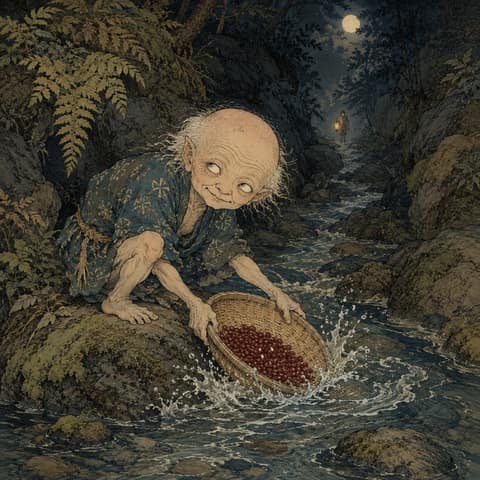
The azuki-arai is a yokai whose true form is sound, echoing the *shoki-shoki*, *zaku-zaku* sounds of washing adzuki beans at riversides and streams late at night. In many legends, its form does not appear; as one approaches, the sound abruptly stops, and it is said that those distracted by the sound slip and fall into the river or valley. In the Chugoku region, it is distributed in Sera District in Hiroshima Prefecture, Mine District (present-day Mine City) and Ube City in Yamaguchi Prefecture, and in these lands, they were called "azuki-togi" (bean-washers) and marked as frequent appearance zones[9]. The prefecture's topography, full of mountain valleys and streams, is highly suited to linking the sounds of night water and rustling leaves to anomalies. In literature, Volume Five "Azuki-arai" of the *Ehon Hyakumonogatari* (1841)[10] tells of a young monk at a mountain temple who excelled at washing adzuki beans; envied by a wicked monk, he was pushed into a valley stream, and since then, his spirit makes the sound of washing adzuki beans every night. Rational interpretations attributing the sound to animals like weasels, otters, or raccoon dogs, or to the sound of streams, coexisted, and it has been passed down with the boundary between anomaly and nature remaining ambiguous. Monsters of sound lacking physical substance strongly bear the folkloric function of warning children about the dangers of the waterside.
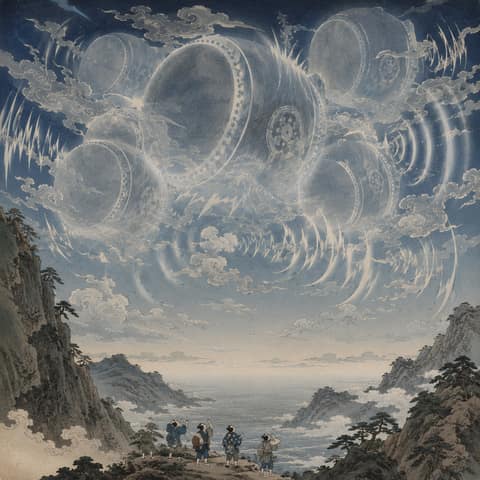
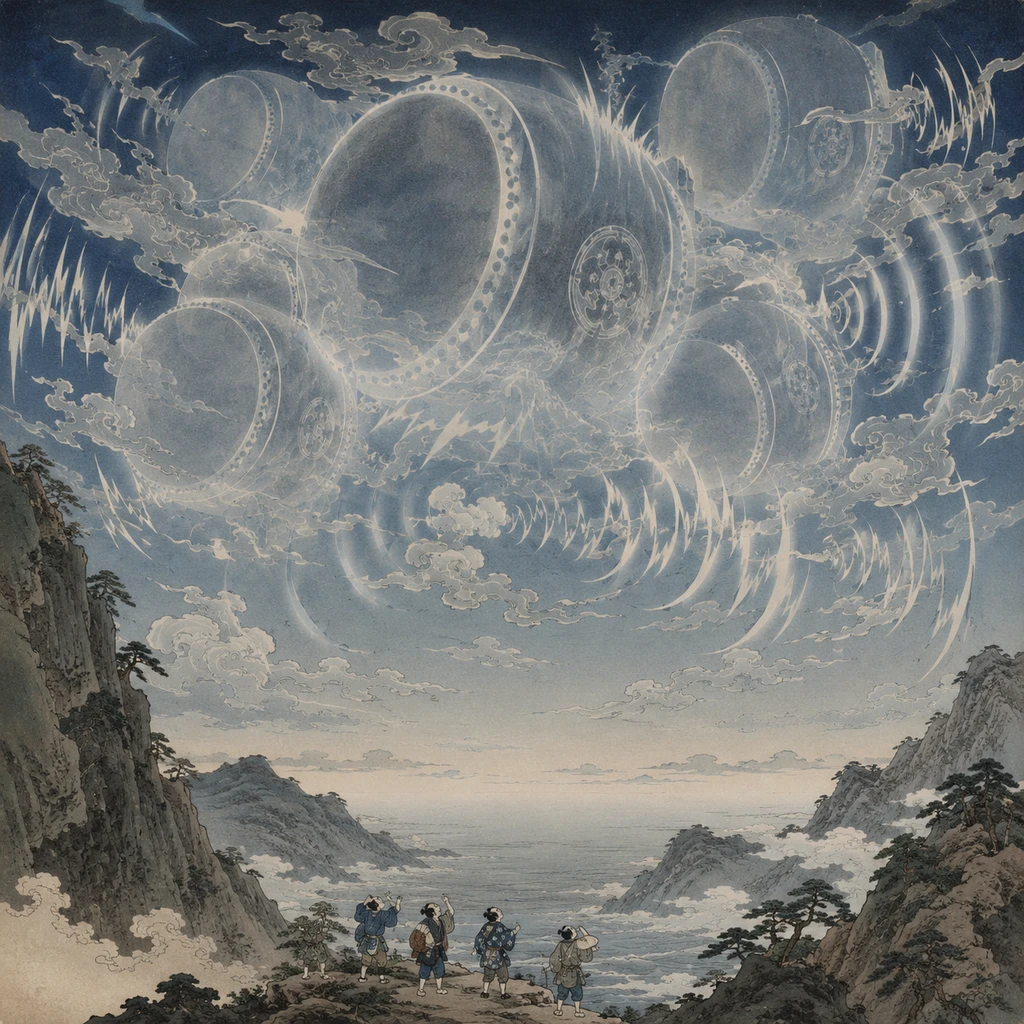
The sea also has its sound-only apparitions. One is the *kokuu-daiko* (void drum) passed down in Suo-Oshima, an island floating in the Seto Inland Sea. On this island, around June during the rainy season, regardless of clear or rainy weather, the barrage of drums is said to echo from the sea out of nowhere. The form remains unseen, and the sound reverberates against the beaches, capes, and inlets, startling people. Its origin is said to be that long ago, a ship carrying an entertainment troupe met a storm and sank into the sea while beating drums to call for help, and only that sound resurrects when the season arrives. It is said that when approached, the sound recedes, and when retreating, it approaches, and it is not tied to any specific drum or festival. No specific year or names are passed down; it is only orally transmitted as an event of the "past," and some households did not brand it as an omen of bad luck but received it as a sign of comforting the spirits of the sea.
What is fascinating about the kokuu-daiko is that, despite being a "monster of shipwrecked dead" like the funayurei, it carries a completely different emotional tone. If the funayurei is a vengeful throng of spirits seeking to sink the ships of the living, the kokuu-daiko attacks no one. Only when the season arrives do the drums of the sunken entertainers ring out from the sea. It is closer to mourning for those swallowed by the sea than to terror. When the distant drums were heard mingling with the sound of the waves on Suo-Oshima during the rainy season, the islanders pressed their hands together in prayer rather than in fear. Even in the calm Seto Inland Sea, the memories of the shipwrecked dead reverberate as the sound of drums. Although occurring in the same seas of Yamaguchi, while the rough Sea of Japan and the rapid currents of Kanmon birthed the grudges of the umibouzu and funayurei, the inland sea of Suo-Oshima sublimated those dead into sounds of comfort.
The river sounds of the azuki-arai and the kokuu-daiko. The auditory yokai of Yamaguchi have transformed the deaths and fears of people into sound in their respective ways at the two "watersides" of inland valleys and the Seto Inland Sea islands.
Two Seas,
One Memory
What pierces through the yokai of Yamaguchi Prefecture is "water" and "the memory of the dead." The umibouzu rises on the capes of the Sea of Japan, the funayurei of the Taira clan demand ladles in the Kanmon Strait, and the memory of their ruin has settled into the biwa of Hoichi the Earless and the ink of the suzuri-no-tamashii. Inland, the kudan of the Chugoku region declares the anxieties of the world, the inugami binds bloodlines, the sound of the azuki-arai echoes in the valley streams, and the kokuu-daiko continues to ring in the sea of Suo-Oshima.
The two ancient provinces of Suo and Nagato both opened to the sea, and many dead have been swallowed by it. Surrounded on three sides by seas of differing characters—the Hibikinada to the north, the Seto Inland Sea to the south, and the Kanmon Strait to the west—the maritime apparitions of this prefecture are also not uniform. The umibouzu that swallows people stands on the capes of the rough Sea of Japan, the funayurei of the Taira demand sake vessels in the rapid currents of the Kanmon Strait, and the comforting kokuu-daiko rings in the gentle islands of the Seto Inland Sea. The same "memory of the shipwrecked dead" changes its form into grudge or mourning according to the character of the sea.
In particular, the memory of the Taira clan's destruction, concentrated at the single point of Dan-no-ura, made the yokai of this land unlike any other. The ladle-begging of the funayurei becomes a memory of the Taira's banquet, and the biwa of Hoichi the Earless and the ink of the suzuri-no-tamashii repeatedly resurrect their ruin in sound and words. The giant of the sea, the dead of the sea, the phantom lodging in the vessel, the foretelling cow, the small beast possessing the house, and the sounds ringing in the valleys and sea—all are born from the conviction of the people along the coasts and in the mountains that "what has sunk will not vanish" and "what is unseen is most terrifying." To visit the yokai of Yamaguchi is nothing other than to carefully listen, even now, to the memories sunken in its two seas.