Hoichi the Earless
miminashi-hoichi
The Earless Biwa Priest Reciting Dan-no-ura
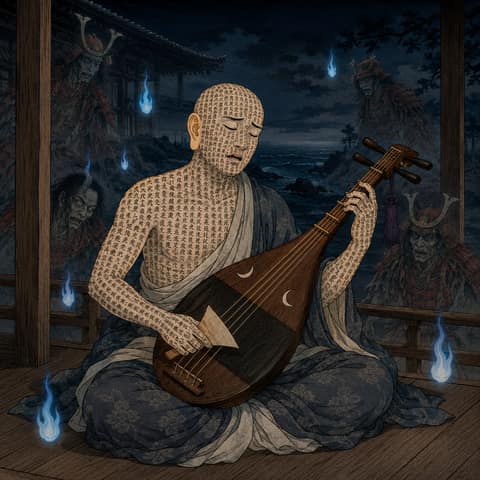
It is deepest to read Hoichi in this version not as a yokai, but as a "narrator who was almost taken to the side of anomalies." He himself does not appear to threaten humans. Rather, his body was forced to become a boundary line precisely because he was chosen by the Taira ghosts. The dead wanted to claim his voice for themselves because his recitation of Dan-no-ura was so magnificent. Hoichi's power is inseparable from his blindness. Unable to confirm the palace with his eyes, he perceives the world through sounds, presences, voices, and the formality of orders. The ghosts' banquet does not begin as a visual anomaly, but through a calling voice and the performance of the biwa. The unseeing man is called by the unseen dead. This double invisibility elevates Hoichi's tale from a simple haunted house story to an acoustic ghost story. The relationship with the Tale of the Heike is the backbone of this version. The Tale of the Heike is the story of the defeated, and through the recitation of the biwa priest, the destruction of the samurai was repeatedly called back to the present. Hoichi bears this tradition entirely, performing the story of the dead for the dead. Therefore, his fear is not only the fear of being attacked by unknown ghosts. It is the fear of the narrator being swallowed by the very story he is telling. The protection of the sutras is also a scene where writing seals sound. The sutras written all over Hoichi's body erase his figure from the ghosts. In other words, the writing becomes a barrier blocking the gaze of the dead. However, because the ears were left behind, only the entrance of sound did not disappear. For a biwa priest, the ears are the root of his art and the connection port to the dead. The development of having that very part snatched away is cruel, but terrifyingly accurate as a story. Losing his ears does not merely end Hoichi's art. He becomes the subject of narration himself through the name "Hoichi the Earless." The person who originally narrated the Taira is now narrated as a ghost story. This inversion is the beauty of the Hoichi tale. The narrator seems to be outside the story, but at some point enters it. Hoichi's flawed body demonstrates the thinness of that boundary. In modern YOKAI.JP, there is value in establishing Hoichi as a symbol of performing arts ghost stories, rather than merely a part of the ghost pages. He connects the vengeful spirits of the Taira, Buddhist talismans, the locality of Akamagaseki, Hearn's adaptation, and the symbolism of the body part that is the "ear" into a single thread. If made into a card, the background should feature a biwa, sutras, sea breeze, and ghosts in red armor, while Hoichi himself is better suited turning his ears toward a voice he shouldn't hear, rather than screaming in terror. Hoichi's anomalous nature depends on whether the writing on his body is read or not. The ghosts cannot see the body written with sutras. However, because only the ears lack writing, only that part remains in the world. This mechanism is extremely precise, concentrating the relationship between the seen, the heard, the written, and the spoken into a single scene. Furthermore, the tale of Hoichi is also a story of the "reward of narration." A masterful recitation gathers an audience, but that audience is not always the living. The higher the art, the further the narrator reaches the distant dead. Hoichi is saved by his talent, and falls into crisis because of his talent. Therefore, it is appropriate to treat this version as a figure who simultaneously holds the blessing and the curse of performing arts.