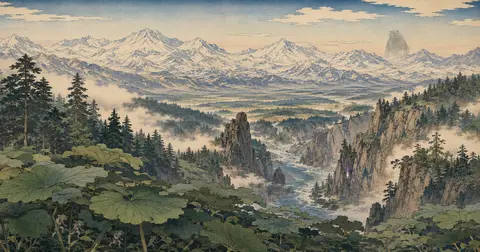
Tottori Prefecture is one of the regions in Japan most deeply connected to yokai. The reason is twofold. One is ancient: with its long sandy beaches facing the Sea of Japan, the cloud-draped Mount Daisen (also known as Hoki Fuji), and the White Hare of Inaba whose name is etched in the *Kojiki*, this corner of the San'in region is a place where myths and maritime anomalies have accumulated in layers. The other reason is modern: manga artist Shigeru Mizuki, who grew up in Sakaiminato City, revived the very culture of yokai in post-war Japan. Thus, to speak of Tottori's yokai is to draw a single line connecting the thousand-year-old awe of sea gods with the memories of a single twentieth-century illustrator.
In terms of old provinces, the prefecture consists of Inaba Province in the east and Hoki Province in the west. Inaba is home to the White Hare myth and the prefectural capital, Tottori, while Hoki encompasses Mount Daisen and Sakaiminato. The differing climates of these regions also shape the character of the strange tales passed down in this land. This article centers on three entities—the giant sea monster Umibozu, the riverside sound phenomenon Azuki-arai, and the giant woman of Hoki, Nanahiro-nyobo—to explore why these anomalies are told in this land and how Sakaiminato came to be known as the "Holy Land of Yokai."
The Land of Myths ── The White Hare of Inaba and the Ancient Strata of San'in
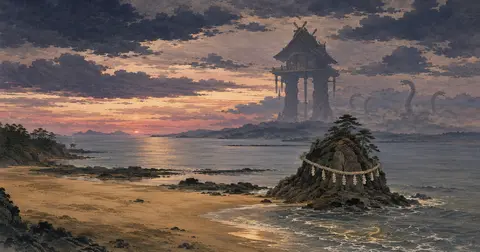
Before delving into Tottori's supernatural phenomena, it is essential to first acknowledge this land as a stage for mythology. The tale of the "Naked Hare of Inaba," recorded in the first volume of the *Kojiki* (compiled in 712, the 5th year of Wado)[1], is set on what is now Hakuto Coast in Tottori City. A hare attempting to cross from Oki to Inaba deceives a wani (shark or crocodile) and is stripped of its skin. As it suffers from its wounds, the deity Onamuji-no-kami (later known as Okuninushi) heals it with cattail pollen and is prophesied to marry Princess Yakami ── this hare is the White Hare deity enshrined at Hakuto Shrine.
This narrative weaves in an often-overlooked compositional contrast. Onamuji-no-kami had many older brothers called the Yasogami, who were traveling to propose to Princess Yakami of Inaba. Encountering the injured hare, the Yasogami taught it a false remedy, saying, "Wash yourself in seawater and dry yourself in the wind," which only worsened its wounds. Only Onamuji-no-kami, who passed by later carrying their baggage, gave the correct instruction: "Wash yourself in fresh water and roll on cattail pollen." Because of this kindness, the hare prophesied, "You are the one who will marry Princess Yakami." In other words, the episode of the White Hare is a story where an incomprehensible, wounded, and misshapen creature tests the true nature of a person (a god); it is recounted as the first trial of Okuninushi, who would later become the great deity of nation-building and matchmaking. The significance of Tottori being chosen as the stage for the grand prologue of Izumo mythology is profound.
What is crucial here is that the White Hare of Inaba is enshrined not as a "yokai" but as a "god." The oldest stratum of Tottori's supernatural culture lies within the grammar of mythology, where incomprehensible beings are treated as divine. Along the path leading into the shrine precincts remains the Mitarashi Pond, where the hare is said to have washed its wounds. It is called the pond of "no decrease, no increase" because its water level remains constant regardless of the season. The details of the myth are fixed to the terrain, enduring as places one can walk and trace ── this is a feature common to the ancient sites of faith in the San'in region, sharing the same sensibility as neighboring Izumo, which is filled with place-name origin tales in the *Izumo no Kuni Fudoki* (compiled in 733, the 5th year of Tenpyo)[2]. A land where the boundary between gods and monsters is thin. That is the soil of Tottori's yokai culture.
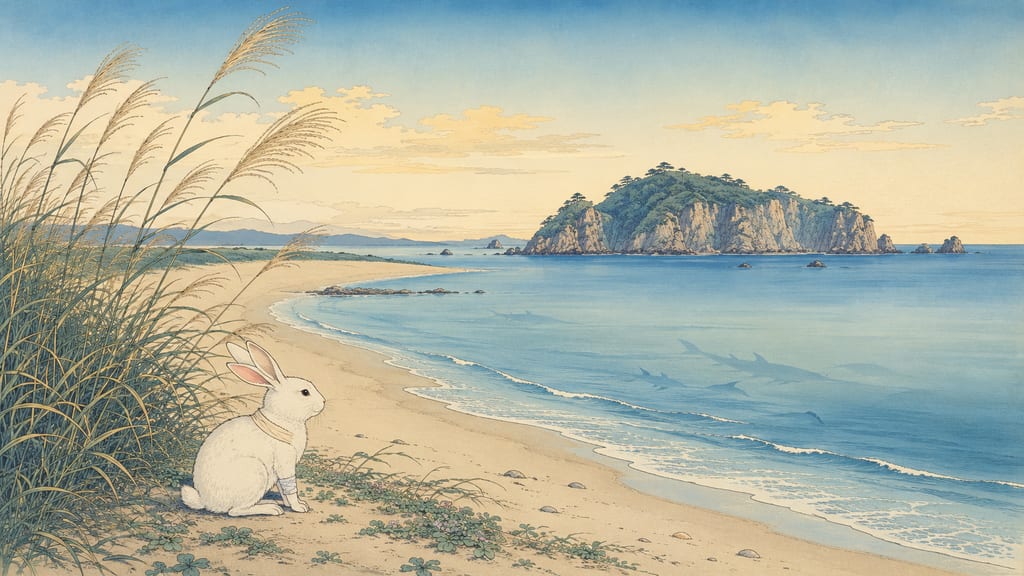
The Hakuto Coast is a curving sandy beach along Route 9 in the western part of Tottori City. Offshore floats Okinoshima, the island from which the hare is said to have crossed by deceiving the wani. The geographical depth of this myth lies in the fact that its setting remains as an existing landscape. While Hakuto Shrine became widely known in the modern era as a god of matchmaking, and has also been said to possess miraculous powers for skin diseases and burns, tracing its origins leads back to the healing tale of curing the wounded hare with cattail pollen. Instead of exorcising or driving away the incomprehensible, one heals the wounded anomaly and receives a blessing in return ── at the root of Tottori's faith runs a gaze that treats different beings coming from the outside not as enemies, but as guests to be welcomed and healed. This attitude is the oldest current that eventually led to Sakaiminato's modern style of "welcoming yokai as an entire town."
The Giant Monster of the Sea of Japan ── Umibozu
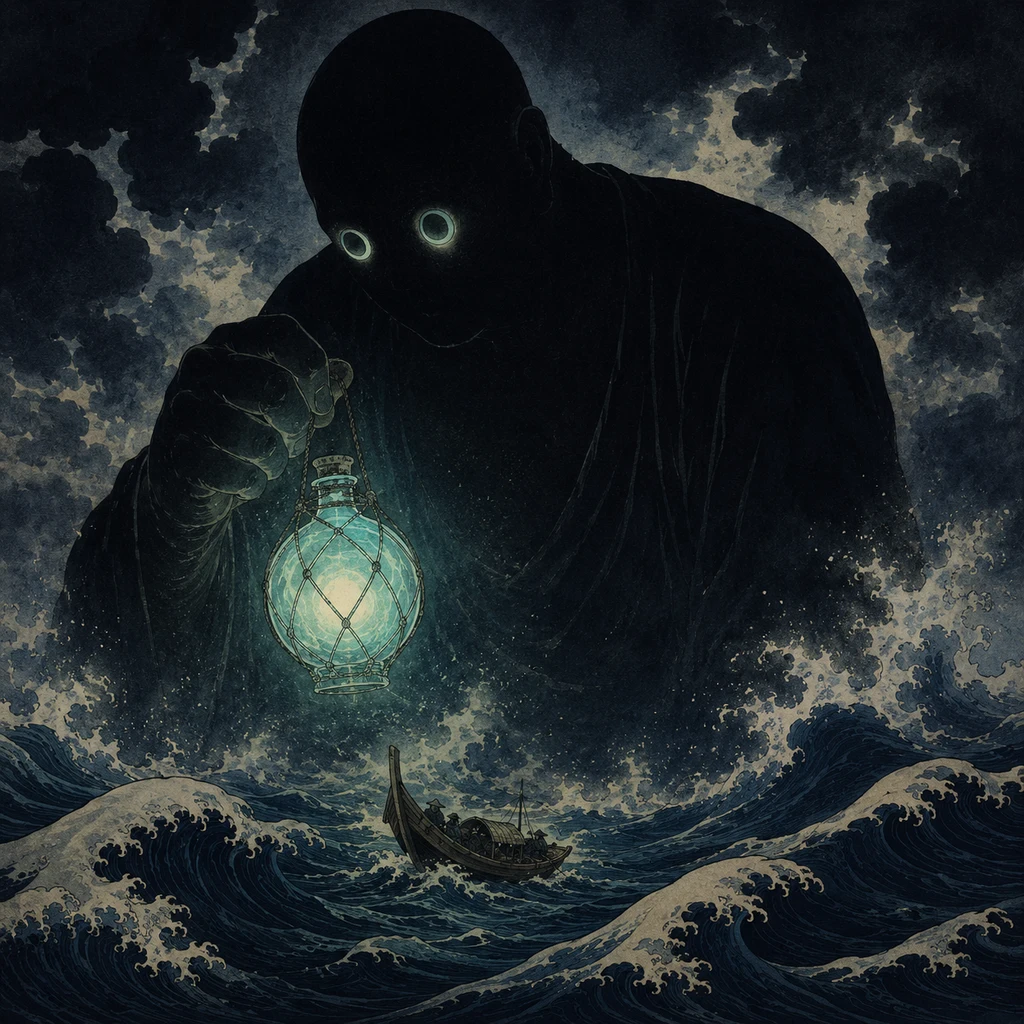
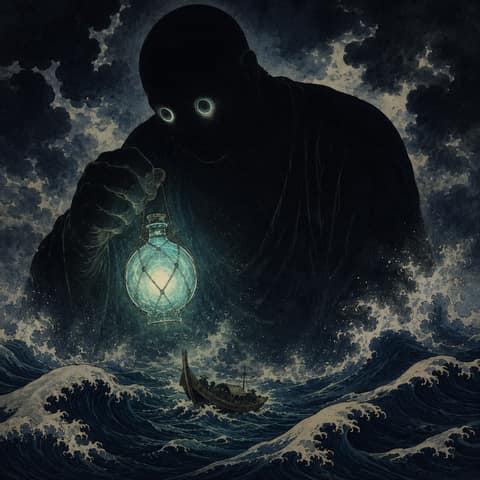
Umibōzu
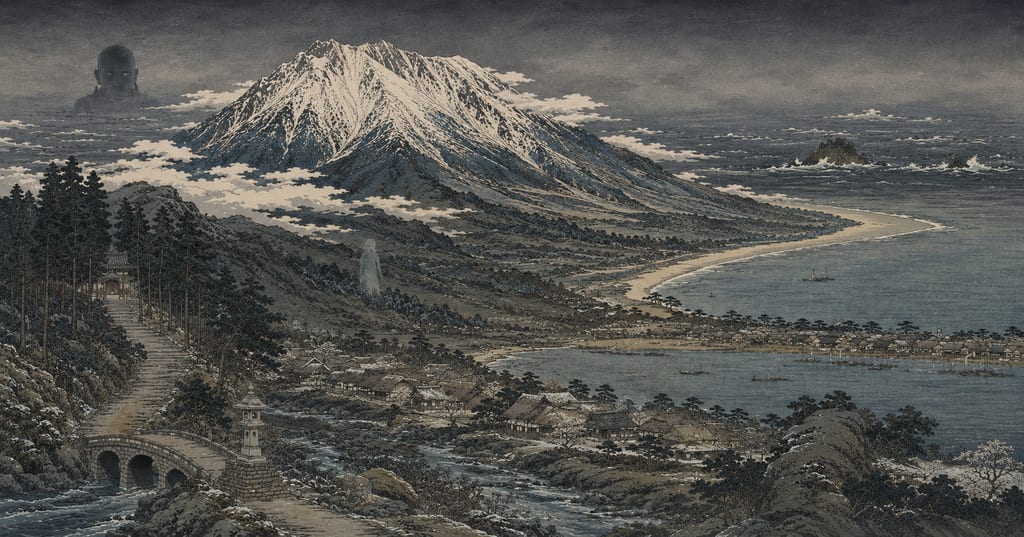
Umibōzu is a maritime apparition known along coasts throughout Japan and long feared especially by fishers. A calm sea is said to heave without warning, becoming an immense black shadow or the bald form of a Buddhist monk that blocks a vessel's path. Accounts rarely show a whole body; most describe only a head and shoulders rising above the water. It appears at night or in heavy seas, overturning boats and dragging people into the depths. Edo-period sources including the Wakan Sansai Zue (1712) and the Butsurui Shōko (1775) also record the name of a giant apparition standing at sea.
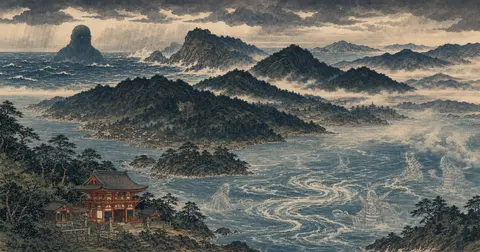
Read moreFacing the Sea of Japan to the north, Tottori Prefecture has lived alongside the fishing industry. The Sea of Japan in winter is rough, and countless boats have been swallowed by storms never to return. The image crystallized from that fundamental awe of the sea is the Umibozu. The calm surface of the sea suddenly swells, and a massive black shadow, or the figure of a bald-headed monk, looms in the path of the ship ── it is rarely seen in its entirety, often described merely as a head or shoulders thrusting out above the water.
The lore of the Umibozu is not limited to Tottori; as recorded in works like *Butsurui Shoko* (1775, the 4th year of An'ei)[3] and *Wakan Sansai Zue* (c. 1712, the 2nd year of Shotoku)[4], it is widely distributed among fishing villages nationwide. It is told in places such as the Goto Islands, Ehime, Okayama, Wakayama, and Miyagi, and its figure was also spoken of on the beaches across the San'in region, including Tottori. Regarding its true identity, there are competing theories: some say it is the transformed ghost of a drowned person[4], while others claim it is a fallen dragon god or sea deity demanding a sacrifice.
What is noteworthy is the regional variation in the story patterns. While some areas tell of it as a monster of great strength that blocks ships and breaks nets and oars, in the Goto Islands of Nagasaki and Chita District of Aichi, it is said that the Umibozu demands, "Lend me a ladle." If given one, it will scoop seawater to sink the ship, so people escaped danger by handing it a ladle with a missing bottom[3]. The sea does not merely threaten; it is portrayed as an entity that engages in dialogue and tests human resourcefulness. For the fishermen of Tottori, the Umibozu was a personified embodiment of "the terror of the sea itself," and beyond the dark horizon of the Sea of Japan, this black head was always crouching.
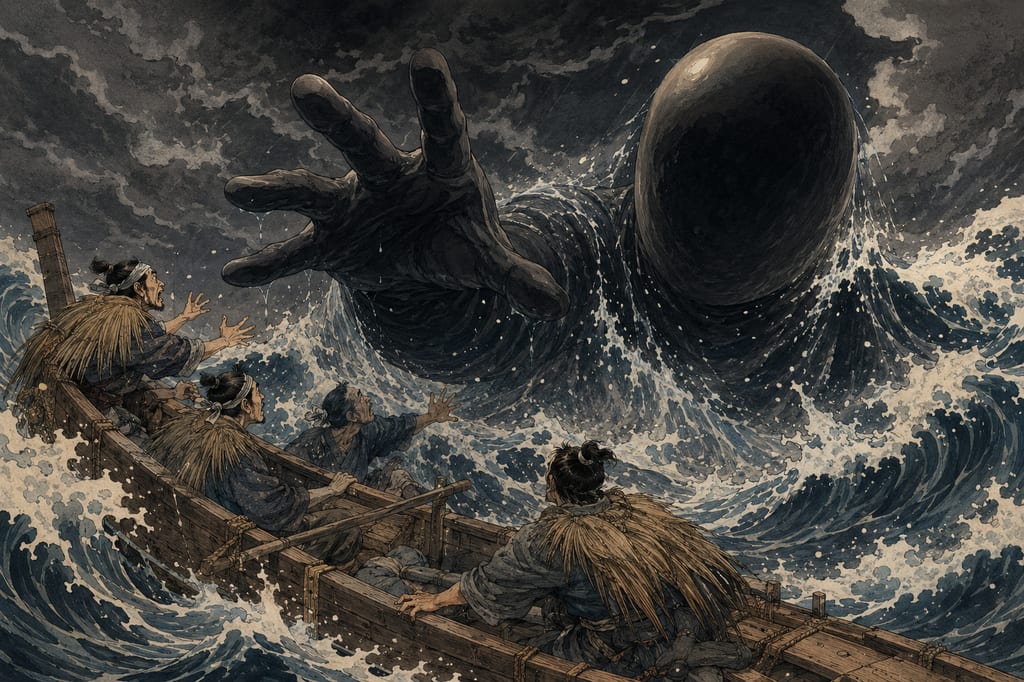
To understand this anomaly geographically, one must recall the ruggedness of Tottori's coastline. Bordered by the long arc drawn by the Yumigahama Peninsula in the west, the east is a rough, rocky shore, while the west opens to the fishing grounds of Miho Bay. In the era of traditional Japanese wooden boats, sudden storms and dense fog offshore were directly linked to death for fishermen. The experience of "something looming" on the sea when visibility was lost easily crystallized into the image of the Umibozu. During winter, when the heavy leaden clouds characteristic of the Sea of Japan hang low, the crests of the waves themselves can look like the black heads of monks ── this monster inhabited a space where natural phenomena, terror, and faith were inextricably melted together. Incidentally, Toriyama Sekien did not illustrate the Umibozu itself, but he did include the Umi-zato (a blind monk at sea) in his *Gazu Hyakki Yagyo*, showing that early modern yokai art repeatedly formalized the awe of maritime anomalies into visual imagery.
Sounds by the Riverside ── Azuki-arai and the Formless Anomaly
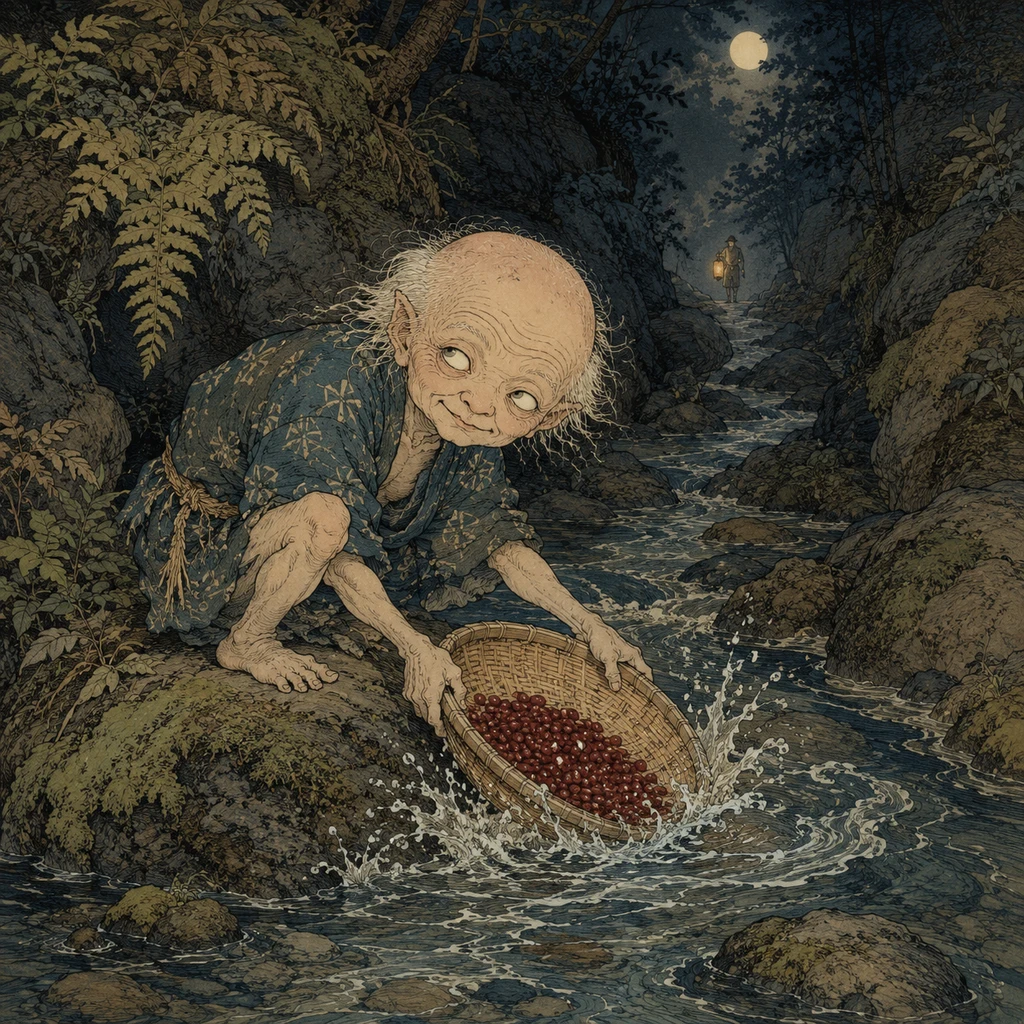
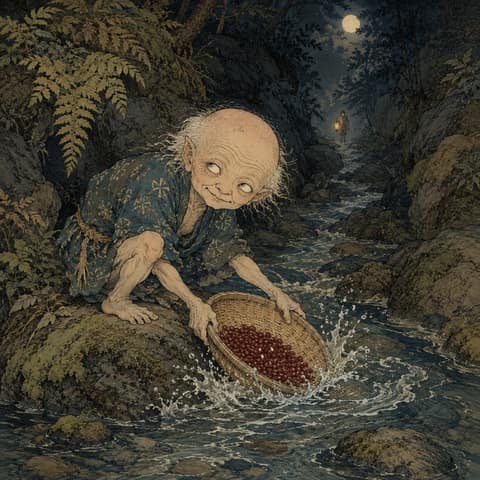
Azuki-arai (Bean Washer)
A yokai that washes red beans at streams late at night, echoing with shoki-shoki or zaku-zaku sounds. It appears near human settlements, blending into the sound of running water. Descriptions vary: a small, wizened elder or, at times, a child. Rather than direct attacks, it deceives with its presence, luring people into slipping. It appears in Edo-period strange tales and picture scrolls, with some accounts noting its habit of counting beans with exactness.
Read moreIf the sea gave birth to the monsters of the Sea of Japan, the inland mountain streams nurtured a different kind of anomaly. Azuki-arai (the bean washer) is a yokai whose true form is sound, echoing the noise of washing adzuki beans—"shoki-shoki" or "zaku-zaku"—by riversides and ravines late at night. In many legends, no figure appears; as one approaches, the sound abruptly stops, and it is said that those distracted by the noise lose their footing and fall into the river or valley.
As Kunio Yanagita discussed this as a representative "sound yokai" in his *Yokai Dangi* (Shudosha, 1956)[5], this anomaly is densely distributed in the Chugoku region ── Hiroshima, Yamaguchi, Okayama, and Tottori ── alongside Kanto and Koshin'etsu. The mountainous topography of San'in, with its many valleys and streams, provided an environment ripe for misinterpreting the sound of water or rustling bamboo leaves as the presence of a monster. The most well-known documentary source is *Ehon Hyaku Monogatari* (1841, the 12th year of Tenpo), Volume 5, "Azuki-arai"[6], which tells of a young monk at a mountain temple who was skilled at washing beans. Envied by a wicked fellow monk, he was pushed into a ravine, and ever since, his spirit has made the sound of washing beans every night. It is a pitiful origin story where the memory of meticulousness turned into an anomaly.
The Azuki-arai is often accompanied by an eerie song: "Shall I wash my beans, or shall I catch and eat a person? Shoki-shoki." The unique creepiness of this yokai lies in how the mundane domestic sound of washing beans and the violent threat of eating humans are placed side by side in the same tone. A sudden rift opens in everyday life, and an incomprehensible entity peeks through ── the unease felt by San'in villagers at the water's edge at night is accurately captured in the stark contrast of this song.
Another face of the Azuki-arai is the rationalized view of nature. In the reality of folklore, interpretations that attribute the sound to animals like weasels, raccoon dogs, or otters, or to natural phenomena like babbling brooks and rustling bamboo, have always coexisted. This monster resides in the ambiguous territory between the supernatural and nature. Appealing to hearing rather than sight, it ingrains in children the warning, "Do not go near the water at night" ── in the river-rich villages of Tottori, the sound of the Azuki-arai was a very practical terror. Tottori has three major rivers—the Sendai, Tenjin, and Hino—flowing into the Sea of Japan, with countless tributaries and ravines. For those living by the water, swollen night rivers and crumbling banks were real dangers of death, and the Azuki-arai functioned as a device to etch that danger into children's memories. As another waterside anomaly, legends of the Kawappa (kappa) lineage are also widely transmitted across San'in.
The Giant Woman of Hoki ── Nanahiro-nyobo and the Rice-Washing Song
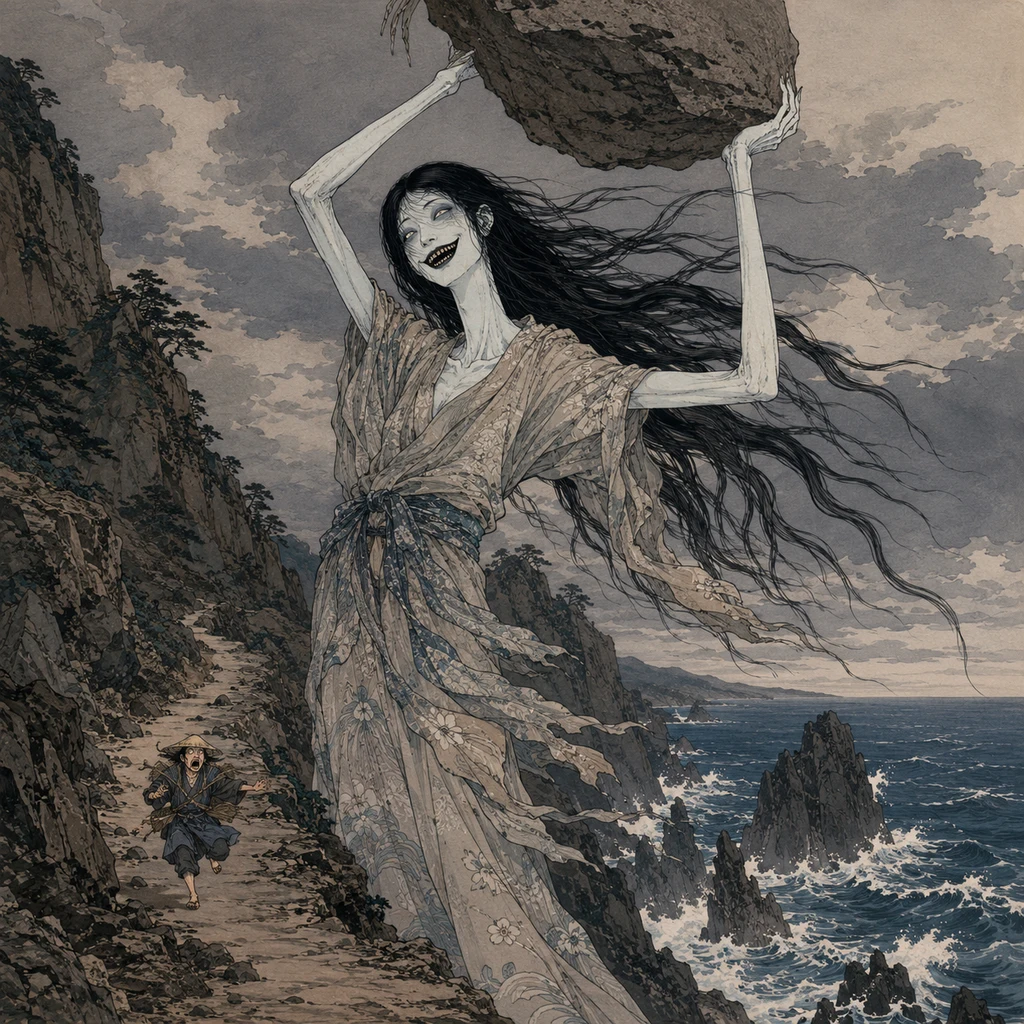
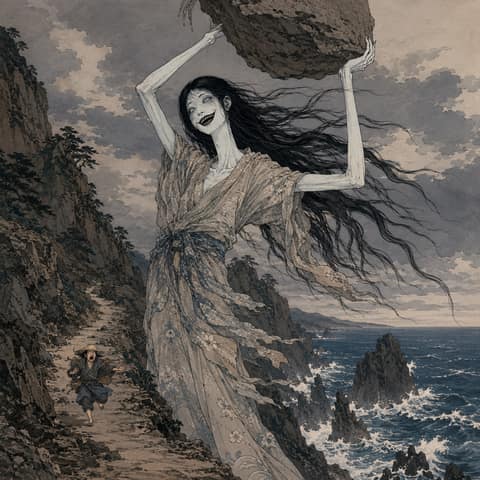
Seven-Fathom Wife
The Seven-Fathom Wife is a giant female yokai from eastern Shimane (Izumo), the Oki Islands, and Hōki in Tottori. The term “fathom” (hiro) is a unit of length, and her height—or in some tales her neck—reaches seven hiro. She appears on mountain paths or along the shore, smiling at travelers, throwing stones, or miming laundry to bewilder people. Her look and behavior vary by locale, ranging from a beggar of striking beauty to a fearsome woman with blackened teeth and disheveled hair.
Read moreThe third entity is an anomaly that carries the most distinct local color of this region. Nanahiro-nyobo is a giant female yokai passed down in Izumo (eastern Shimane), Oki, and Hoki Province in western Tottori Prefecture. The word "hiro" in her name is a unit of measurement equal to the span of outstretched arms (a fathom), and her height or neck is said to be seven hiro ── approximately 12.6 meters[7]. She appears on mountain paths or beaches, bewitching people by smiling, throwing stones, or mimicking the motions of doing laundry.
The most concrete legends remain in Oki. In Ama Town on Nakanoshima in the Oki Islands, it is said that during the time of Oda Nobunaga, a Nanahiro-nyobo threw stones at a man riding a horse along a mountain path. When the man slashed her with his sword, she suffered a wound to her face and turned to stone[8]. A strange rock called Nyobo-ga-ishi (Wife's Rock) remaining on a mountain path in Hinotsu, Ama Town, is said to be her petrified form. It measures 6 meters high and 3 meters wide, and lore claims it is still growing little by little. A yokai becoming the landscape itself ── much like the Mitarashi Pond in Inaba, the San'in storytelling pattern of legends fixing themselves to the terrain is alive here as well.
The Hoki tradition is even more characteristic of Tottori. In Umeda, Akasaki Town (now Kotoura Town) in Hoki Province, it is said that a Nanahiro-nyobo with a pale face and long hanging hair would sing in a sorrowful voice, "Three sho of beans and three go of rice, there is no rice for the honorable spirit," while washing rice[7]. Note the resonance with the Azuki-arai from the previous chapter ── the action of washing rice or beans, the water's edge at night, the elusiveness of the figure. In San'in, built upon the shared grammar of "the anomaly of grinding sounds," the immensity of the Umibozu and the sorrow of a woman overlapped to form the unique image of Nanahiro-nyobo.
This lamenting song, "there is no rice for the honorable spirit," bleeds with memories of starvation and memorial services. The repetition of never having enough rice no matter how much is washed brings to mind the regret of those who died in poverty and those who could not receive a proper burial. The sight of a giant woman continuing to wash rice at the water's edge at night is both absurd and unfathomably sad ── it can be read as the memories of famine and stillborn children borne by San'in villages being entrusted to the exaggerated image of a giant woman. The fact that her appearance varies by region, ranging from a beautiful beggar to a monstrous woman with black teeth and disheveled hair, is a trace of multiple villages handing down different anomalies under the same name. Multiple layers of memory regarding the sea, the rivers, and famine are folded beneath a single name ── Nanahiro-nyobo is the very thickness of San'in storytelling.
Mount Daisen ── The Sacred Peak Known as Hoki Fuji
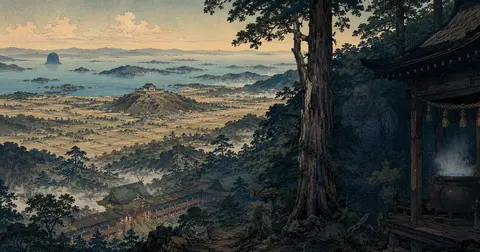
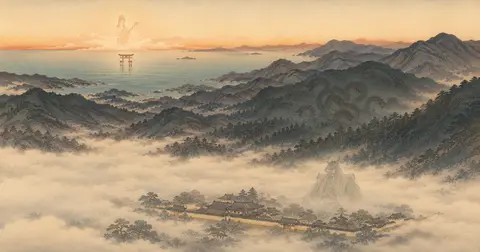
To discuss the anomalies of Tottori, one more pillar must be erected. It is Mount Daisen, standing 1,729 meters tall, also known as Hoki Fuji. Revered as a peak where gods dwell since the Yayoi period, it has flourished as a major training ground for Shugendo—incorporating mountain worship, Daoism, and Esoteric Buddhism—since the monk Konren Shonin enshrined the Jizo Gongen and founded Daisenji Temple in 718 (the 2nd year of Yoro). The temple's power grew from the Heian period onwards, becoming one of the largest Buddhist strongholds in western Japan at its peak, reportedly boasting many branch temples and warrior monks. The Shikinai-sha Ogamiyama Shrine is the Ninomiya (second highest-ranking shrine) of Hoki Province, consisting of a village shrine (main shrine) in Yonago and an inner shrine halfway up Mount Daisen. The roughly 700-meter stone-paved path of natural rocks leading to the inner shrine still conveys the awe of pilgrims today.
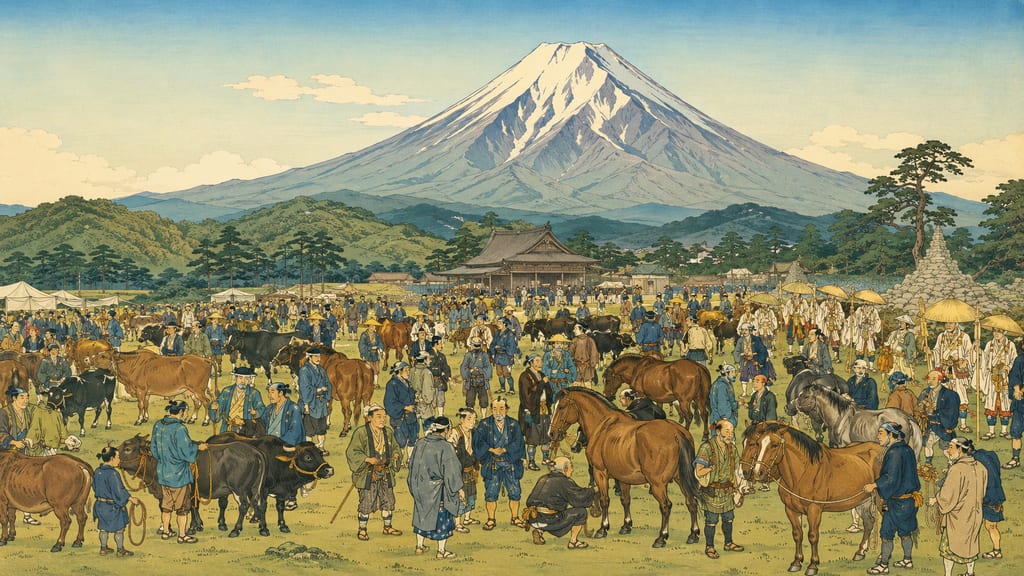
What sets Daisen apart from other sacred mountains is how its faith became deeply tied to "cattle and horses." In the Heian period, the monk Kiko Shonin spread the cattle and horse faith by praying for their protection, and people began to visit Daisenji bringing their livestock with them. Eventually, trading of cattle and horses flourished in front of the temple gates, and using the vast grassland of Bakuroza in front of the Daisenji precincts as a venue, the "Daisen Cattle and Horse Market" was established as one of Japan's three major markets, alongside Shirakawa in Fukushima and Kui in Hiroshima[9]. The organization and system were formalized in 1726 (the 11th year of Kyoho), and the grand trading reportedly continued until 1937 (the 12th year of Showa). It is a rare form of faith where Jizo worship and the agricultural livelihood were bound together on a single mountain.
A sacred mountain is also a pathway for the supernatural. Mountains of Shugendo usually harbor Tengu lore, and Daisen, with its primeval beech forests, steep northern cliff, and easily collapsing sand-slip valleys, is no exception. The deep mountains where ascetic monks ventured were feared as a realm beyond human logic, and cautionary tales of those who disrespected the mountain losing their way or being abducted by Tengu accumulated around this peak. In mountains of such faith, stories often circulate that strange things happen to those who do not observe the proper etiquette of the ascent, and Daisen, too, was a mountain of boundaries between the sacred and the profane, strictly distinguishing between areas humans could enter and those they could not. Tales questioning the attitude of those who fear the mountain and venture into it were thus passed down through generations. Due to the separation of Shinto and Buddhism (haibutsu kishaku) in 1875 (the 8th year of Meiji), Daisenji greatly declined and was converted to the Ogamiyama Shrine Inner Shrine, excluding the Jizo Bodhisattva. While the former temple complex now leaves only the main hall and a few branch temples, the stone-paved approach and ancient cedars continue to convey how the sacred peak has gathered human awe. The Umibozu of the Sea of Japan, the Azuki-arai of the ravines, and the Tengu of the mountains ── Tottori's three distinct topographies of sea, river, and mountain each had their own assigned anomalies.
Sakaiminato,
the Holy Land of Yokai ── The Nexus of Shigeru Mizuki
And then came the modern era. What decisively elevated Tottori's yokai culture was a single manga artist.
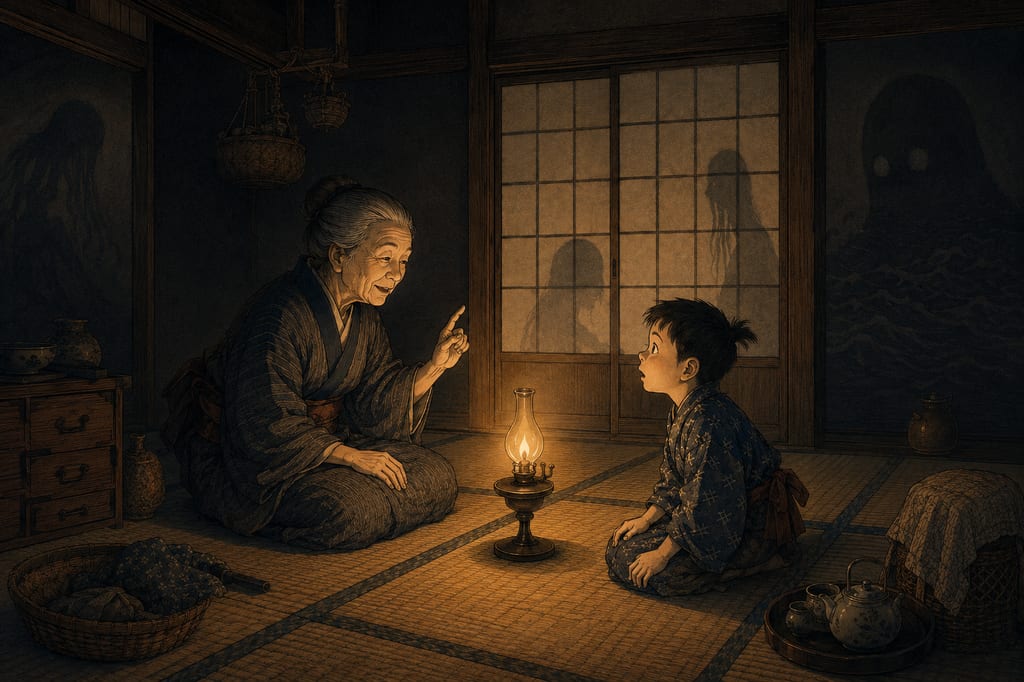
Born in Osaka in 1922 (the 11th year of Taisho), Shigeru Mura ── later known as Shigeru Mizuki ── soon moved to the port town of Sakaiminato in Hoki Province due to his father's work, and grew up there. According to Mizuki's autobiographical essay *Nonnonba to Ore* (Chikuma Shobo, 1977)[10], Fusa Kageyama, the wife of an ascetic who came to help around the house ── commonly known as "Nonnonba" ── knew countless local stories of yokai and monsters, and the boy was treated to these mysterious tales almost every night. "Nonnon" was a San'in dialect word referring to gods, Buddhas, and prayers, and was an affectionate term for those who served them. The memories of the supernatural accumulated in the port town on the Sea of Japan ── the Umibozu and the Azuki-arai were likely among those tales ── became the flesh and blood of one child.
After being drafted to the fierce battleground of Rabaul during the Pacific War and losing his left arm in a bombing, he returned home and pursued a path in kamishibai (picture-story shows) and rental manga. Following the rental manga version of *Hakaba Kitaro* (from 1960), the publication of *GeGeGe no Kitaro* in *Weekly Shonen Magazine* in 1965[11] sparked an unprecedented yokai boom in post-war Japan. Furthermore, Mizuki did not stop at creation; intersecting with the research of scholars like Kenji Murakami[7], he collected yokai lore scattered across the country and gave them visual forms one by one in works such as *Mizuki Shigeru's Yokai Encyclopedia* (Tokyodo Shuppan, 1981)[12]. The image of the Azuki-arai as a little monk that we picture today was cemented by the figure Mizuki drew alongside the onomatopoeia "shoki-shoki." To the anomalies of sound that had only been transmitted through words, he gave a face.
His hometown of Sakaiminato cultivated this connection into a tourism resource. The Mizuki Shigeru Road, which opened in 1993, is a street of about 800 meters stretching from Sakaiminato Station to the Mizuki Shigeru Museum, lined with 178 bronze yokai statues on both sides. Familiar yokai like Kitaro, Medama Oyaji, Sunakake Baba, and Konaki Jiji are arranged according to themes such as "The World of Mizuki Manga," "Yokai Lurking Close By," and "Yokai Living in Houses," starting from the station front. The JR Sakai Line (from Yonago to Sakaiminato, 16 stations in total) has all its train cars wrapped as "Kitaro Trains," and Yonago Station and Sakaiminato Station hold the yokai aliases "Nezumi Otoko Station" and "Kitaro Station," respectively. A Yokai Shrine even stands along the street.
The Mizuki Shigeru Museum, located at the end of the road, reopened in April 2024 after being rebuilt in 2023. The museum stores and exhibits Mizuki's yokai collection and original drawings for *GeGeGe no Kitaro*, tracing his life through themes like "Sakaiminato and Shigeru Mizuki," "War and Shigeru Mizuki," "Manga Artist Shigeru Mizuki," and "Yokai Researcher Shigeru Mizuki." It is also undertaking the digitization of its collections and the creation of a cultural heritage database for yokai legends and literary records, meaning that the anomalies born from oral tradition are now subjects of academic preservation. From the Hakuto Shrine that worships the ancient White Hare myth to the Yokai Shrine in Sakaiminato that worships modern yokai ── Tottori is a land that, over a thousand years, has consistently maintained its tradition of welcoming the incomprehensible. In some years, over a million tourists have visited Mizuki Shigeru Road, and the anomalies that fishermen once feared and children heard in bedtime stories have now transformed into entities that support the town's economy and pride. From awe to familiarity, from oral tradition to preservation ── achieving this turnabout in a single port town is what truly makes Sakaiminato the "Holy Land of Yokai" in name and reality.
Conclusion ── The Sea,
the Mountains,
and a Single Illustrator
Tottori's yokai are honest to the terrain. The Umibozu stands on the horizon of the Sea of Japan, the Azuki-arai in the darkness of the ravines, and the Nanahiro-nyobo on the mountain paths of Hoki. Each of these arose from the awe of nature and the memories of those who died there. The ancient stratum of the land of myths, the sacred peak of Mount Daisen, the rough Sea of Japan ── upon this soil, at a single point called Sakaiminato, Shigeru Mizuki crystallized modern yokai culture.
So when you walk in Tottori, please listen closely to the sound of the waves at Hakuto Coast and the murmuring of the valley streams. There, the presence of the anomalies that have continued for a thousand years, and the gaze of the one illustrator who loved and continued to draw them, still resonate together today.
For more details, please also explore the articles on the old provinces of Inaba Province and Hoki Province.