YOKAI.JP

Kudan (Prophetic Human-Cow Yokai)

koo-DAHN

Kudan (Prophetic Human-Cow Yokai)

Kudan (Prophetic Human-Cow Yokai)

This form can walk with you as your companion. Pick a portrait and make it your icon.

Basic Description

Kudan is a half-human, half-cow prophetic creature that spread widely in the late Edo period. It has a human face on a bovine body and is said to appear, deliver prophecies about public affairs or harvests, and soon die. Broadsheets and printed books from the Tenpō era record varying locations and appearances. Some notices claimed that displaying its image brought protection from calamity and prosperity at home, though accounts differ by region and source. The supposed link to the legal phrase ‘ken no gotoshi’ (“as stated above”) is considered a folk etymology.

Folklore & Legends

A Tenpō 7 (1836) broadsheet reports an appearance on Kurahashi Mountain in Yosa District, Tango, proclaiming several years of good harvests and the efficacy of its image as a household talisman. In Tateyama, Etchū, records from the Bunsei period onward describe a related figure called Kutabe encountered by medicinal herb gatherers; its visage varies between a long-haired woman’s face and an old man’s face. Many tales say it dies shortly after appearing, leading to depictions and talismanic prints. Attempts to connect it to the document-closing phrase ‘ken no gotoshi’ are later interpretations.

Yokai Cards2

Kudan (Prophetic Human-Cow Yokai) across multiple art-style decks

Card gallery

Maya Calendar Guardian KINs

Displaying the Maya calendar KINs that Kudan (Prophetic Human-Cow Yokai) protects.

Detailed Analysis

3 different forms of Kudan (Prophetic Human-Cow Yokai) have been confirmed. Each has unique characteristics and personality, with various ways of interacting with people. Details of each form are introduced below.

Late Edo Kawaraban Woodblock Version of the Kudan

To explain Late Edo Kawaraban Woodblock Version of the Kudan in detail: A Kudan image that spread in the late Edo period through kawaraban broadsides and printed books. Depicted as a human-faced cow, it appears, utters a prophecy, and soon dies. A Tenpō-era broadside recounts an appearance in Tango, stressing powers over harvest fortunes and averting misfortune, with cases recommending the display of its image. Meanwhile, the Kutabe of Etchū’s Mt. Tateyama appears in records from the 1820s onward, showing diverse traits such as a woman’s or elder’s face, sharp claws, and eyes drawn on the torso. Both share a reputation for prophecy and warding off epidemics, and their circulation increases during crises. The folk etymology linking the formulaic phrase “kudan no gotoshi” at the end of documents to the monster Kudan is viewed skeptically based on earlier linguistic usage. In folklore, the core pattern is appearance, proclamation, short life, and the image used as an amulet, while place names, dates, and specific efficacies vary widely by source.

Character Profile

This section is our own creative profile for storytelling. It is not historical fact or scholarship.

Rarity
Epic
Personality
taciturn, delivers announcements plainly
Compatibility
topics related to agriculture, signs of epidemics and portents
Abilities
foretelling harvests and calamities, apotropaic power against epidemics via displayed images, terse oracular pronouncements
Weaknesses
short-lived after appearing, imagery and accounts vary across sources reducing stable credibility
Habitat
Kurahashi Mountain in Yosa District Tango Province, around Mt. Tateyama in Etchū Province, circulated as images in printed books and kawaraban broadsides

🔮YBTI: Yokai Boundary Type Indicator

🔮Yokai Compatibility Test

For more detailed information and diagnosis results about Late Edo Kawaraban Woodblock Version of the Kudan, please click here.

Kurahashiyama Notice of Protective Talismans (Kudan Variant)

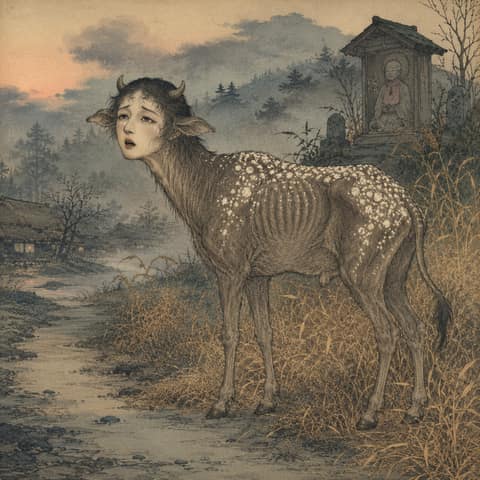
To explain Kurahashiyama Notice of Protective Talismans (Kudan Variant) in detail: Known as the Kurahashiyama Notice of Protective Talismans, this variant is said to have appeared from the mountain valleys of Yosa District after the Tenpō Famine. Though half-ox and half-human, its face looks somewhat young, with a broad brow, moist eyes, and a faintly upturned mouth. The ox body is gaunt with ribs showing, yet white flecks like morning dew scatter across its back, taken as signs that mark the year’s omens. It appears mostly between midnight and dawn, at paddy ridges along the mountain foot or before boundary shrines, witnessed typically by those on night rounds or out to relieve themselves. The kudan speaks no more than three times. First, it declares the Path of Pestilence, fixing from which direction the sickness will come and in which month it will intensify. Second, it details the Method of the Posted Image: draw its likeness on a half-sheet, paste it facing north on the inner lintel of the doorway or atop the rice bales, use fresh soot for ink and half-size paper offered at the previous autumn festival, and allow only one sheet per household. Third, it states the Year’s Aspect, leaving brief lines on bounty or scarcity and on protections within the home. When it finishes, it chews the paddy grass, bows its head, its breath thins, and it expires before sunrise. The village carries its body to the mountain’s base, covers it shallowly with earth, and sets a sprig of bamboo above. After seven days, when unearthed, the bones are soft and only the hooves remain hard; fitting a hoof to a brush shaft and tracing the edge of the charm was said to let misfortune flow out of the house. The image has fixed conventions: a single vertical crease at the center of the human brow, three white dots on the ox shoulder, and a bifurcated tail flowing to the left. Errors weaken its efficacy, and if the tail is drawn to the right, the disease’s direction reverses and brings calamity. The kudan also teaches that replacement of the posted image is limited to twice a year, at barley harvest and on the first day of the Frost Month. The artist must purify the hands with salt, keep the lamp dim at night, speak no words while drawing, and at the end write small, This extends not only to this house but to the neighboring hamlet. Homes that keep these rules know fewer domestic quarrels and lighter crop damage. The Kurahashiyama kudan closely matches the archetype of a prophetic beast in that it announces both good omens and protections from pestilence, yet it never speaks of profit in trade or victories in war, confining its words to home and field. A Kurahashiyama broadsheet states that posting its image in a storehouse or earthen-floor entry will drive out damp from the granary and keep illness from the threshold, and when sending copies to distant villages, they must circulate within three nights. Delay was thought to wither the effect, prompting village youths to run them by night. Later tales try to link a formulaic closing phrase of legal documents to the kudan, but this version forbids it, warning that using that phrase in a talisman blunts its power. Those who see it suffer a brief fever, which lightens after seven days, and they avoid serious illness for three years. Its short life is a vow not to linger in the world, and the more it returns to the earth, the deeper its words take root.

Character Profile

This section is our own creative profile for storytelling. It is not historical fact or scholarship.

Rarity
Epic
Personality
serene and dutiful, speaks only what is needed then vanishes, watches human life from afar yet is soft-hearted, lingers a breath longer for infants and the elderly
Compatibility
households that value community, families that carefully keep records and customs, people who never neglect festivals and annual rites
Abilities
announcing the direction of incoming epidemics and the months of greatest strength, instructing the proper making and posting of its self-image talisman including paper ink and orientation, divining the year’s yield of fields including insect outbreaks long rains and drought, calming household discord through protective talisman phrases
Weaknesses
if three or more households post copies with the tail flowing the wrong way its efficacy is disrupted, if it faces the sunrise directly its voice grows hoarse and one proclamation is lost
Habitat
paddy ridges at the foot of Mount Kurahashi in Yosa District of Tango Province, boundary shrines of villages, roadside wayside halls along the highway only on Frost Month nights
🔮YBTI: Yokai Boundary Type Indicator

🔮Yokai Compatibility Test

For more detailed information and diagnosis results about Kurahashiyama Notice of Protective Talismans (Kudan Variant), please click here.

Ushi-no-Ko, Entrusted Oracle Variant

To explain Ushi-no-Ko, Entrusted Oracle Variant in detail: This Entrusted Oracle variant of the Ushi-no-Ko is born with mingled human and bovine features and speaks human language the moment it emerges from its cow mother, asking to be called a kudan. It appears only in byres attached to human homes or in pens on mountain pastures, distinct from types that manifest in the open wilds. Its face ranges from a young woman’s to a gaunt elder’s, yet the eyes are always moist and fixed, piercing the listener without widening. Instead of a cry it sighs briefly, first urging that the mother cow not be slaughtered. It then foretells roughly seven years of abundance, household prosperity, or the dispersal of epidemics, and declares that in the eighth year war or calamity will cast a shadow. It ends by stating its own short life, saying it will die within three days. If the body is buried shallowly it averts misfortune, but display as a spectacle draws gloom upon the house. Even so, antiquarians have preserved it as taxidermy or portraits, and capturing its image in broadsheets or records is accepted as apotropaic. Its oracles address only large-scale matters such as harvests, plagues, drought, and war, and it remains silent on personal fortunes. This preserves the weight of its words and tests the listener’s judgment, keeping it apart from trivial divination. The truer the prophecy, the healthier the mother cow remains thereafter, and the household’s cattle and horses are said to avoid disaster. If its birth is treated as a joke and made a commotion, it bites its tongue to blood and falls silent. When drawn, give it short horns, a thick neck, and the rounded body of a calf. It has four legs, a tail thin and long like straw rope, and small hooves. A single swirl of hair sits on its brow; stamping that spot with ink and hanging the image at home was believed to ward off fire and theft for seven years. During the three days after birth it wishes to look outside once late at night. If the back door is cracked open at moonrise and it is faced northeast, its words will carry clear, according to oral lore. It does not call itself a god, only one who knows the world’s turn ahead of time. Offerings should be simple, a pinch of salt and a bowl of pure water. After death it is wrapped in a straw mat and buried in a byre’s corner or on a raised ridge of a field; setting a hat upside down to keep off rain is said to keep grain luck in the family line. It appears most in checkpoint towns by the sea and along mountain herb-gatherers’ roads, especially in border villages where travelers mingle, places thought to gather the world’s signs for it to read.

Character Profile

This section is our own creative profile for storytelling. It is not historical fact or scholarship.

Rarity
Epic
Personality
calm, introspective, aware of its brief lifespan, speaks plainly without boast, tests the listener’s resolve, deeply compassionate yet unswayed by sentiment, keeps its prophecies exact
Compatibility
those who place household fortune and hometown peace first, those who keep records and know discretion, farmers who treat cattle kindly, herb gatherers and itinerant apothecaries
Abilities
Prophetic Longevity Words: concise omens of regional bounty, pestilence, and war, Entrusted Safeguard: seven years of safety for the birth household’s cattle and horses, Talismanic Image: portraits and broadsheets act as wards, Silent Aegis: refuses frivolous questions to preserve purity of prophecy, Sense of Currents: reads worldly tides from the movement of travelers and goods
Weaknesses
brief lifespan: perishes within three days of birth, shuns commotion: crowds and mockery make its words falter and fall silent, slaughter taboo: violence against the mother cow or itself reverses household fortune and ends its efficacy
Habitat
byres in checkpoint towns of the Bōchō region near the coast, sheds by the shore, cowsheds at mountain skirts along the Hokuriku road near herb-gatherers’ lodgings, pasture pens on the outskirts of Tango Province villages

🔮YBTI: Yokai Boundary Type Indicator

🔮Yokai Compatibility Test

For more detailed information and diagnosis results about Ushi-no-Ko, Entrusted Oracle Variant, please click here.

Interested in this type of yokai?

Discover the yokai most similar to your personality with our yokai diagnosis

Start Yokai Diagnosis

Meet your guardian yokai at the shrine

Draw an omikuji fortune and discover the yokai watching over you today.