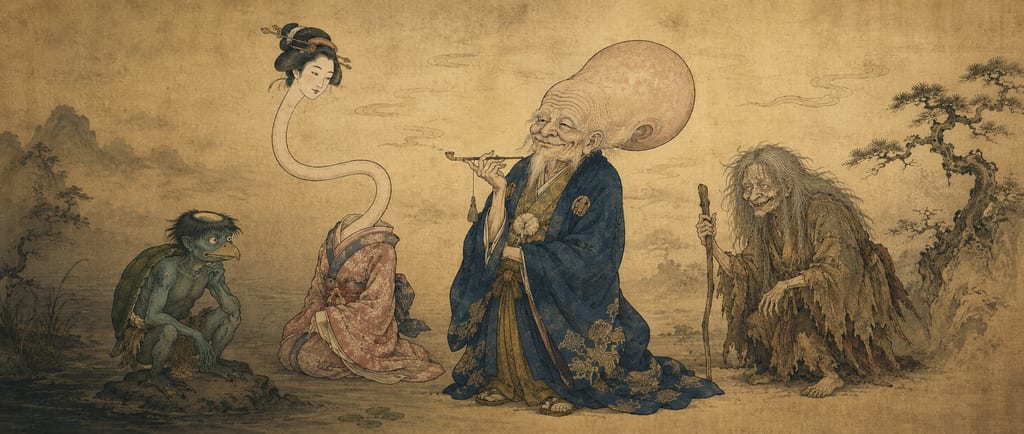
Understood as a spirit linked to dreams, it approaches sleepers at night and brings visions that portend good or ill. Some accounts depict it beckoning with a staff, but its name and character are not fixed; it is often treated as the personification of dreams themselves. It is said to be named in an Edo-period picture scroll, but no definitive image is identified, records are sparse, and its origins are unknown.
Folklore & Legends
In some dream-divination lore, a nameless old man’s shadow stands at the pillow as one dozes off; the dreams he beckons foretell the next day’s events. On nights of auspicious dreams his step is light; when ill omens loom, the tip of his staff clicks against the tatami. Details vary by telling, with no firm regional or textual basis, overlapping with general dream-omen tales and anecdotes akin to those in classical literature.
The name “spirit of dreams” found in pictorial sources is secondhand and not firmly tied to a specific image. Depictions often show an elderly figure leaning on a staff and beckoning, suggesting a symbolic guide of dreams. Some propose it arose from misread characters for a grass spirit or tree yokai, but this is uncertain. Here it is framed as a nature spirit that mediates dreams and portends good or ill, linked to the role of dreams in divination and omens. Personalization and proper names are avoided, positioning it as a numinous rank residing in the power of dreams themselves.
Character Profile
This section is our own creative profile for storytelling. It is not historical fact or scholarship.
The diagram below is a diagnostic evaluation chart for Historical Source-Critical Version. The higher the value of each item, the stronger that characteristic is expressed.