YOKAI.JP

Yokai Encyclopedia

Explore Japanese yokai by name, type, place, and theme

54 Yokai|12 Category|Page 3 of 3
Localization in Progress - More content available in Japanese version
View Japanese
Sort by: NameAscending
人妖・半人半妖
  • Tofu-kozo

    Tofu-kozo

    Uncommon

    tofu-kozo

    The Edo Clown Yokai Born from Kibyoshi: Tofu-kozo

    Humanoid Yokai / Half-human Half-yokaiTokyo

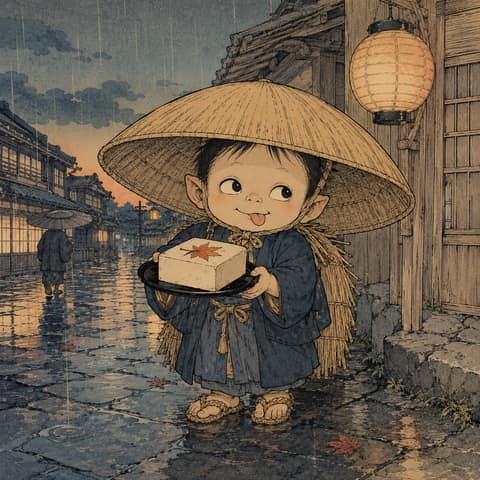
    The Tofu-kozo is a character that embodies the sensibility of the late Edo period, which shifted *yokai* from 'objects of fear' to 'objects of affection and laughter'. While ancient Japanese and Chinese *yokai* were feared in dark tales and picture scrolls, the Tofu-kozo was born from the start as a character in printed entertainment books, intended not to frighten readers but to amuse them. The core of its form lies in the fixed iconography of 'hat, tofu, tray, and stuck-out tongue'. Rather than the invention of a single author, this became standardized as it was repeated and shared across printed books. Its very powerlessness—having no real abilities, causing no harm, and simply standing with tofu—ironically generated strong semiotic power. Visual traits such as the white of the tofu against the red of the maple stamp, and the disproportion between the child's body and the large hat, provided the foundation for its spin-off into toys and kite paintings. The Tofu-kozo is an entity that demonstrated early on that *yokai* could be detached from local beliefs and circulated as urban products and brands, and can be read as a distant archetype of modern mascots (*yuru-chara*) and the character business.

  • Train Breeze Sprite

    Train Breeze Sprite

    Common

    DEN-shah FOO-doh

    Modern Variant

    Half-Human BeingsUrban commuter rail lines in major cities

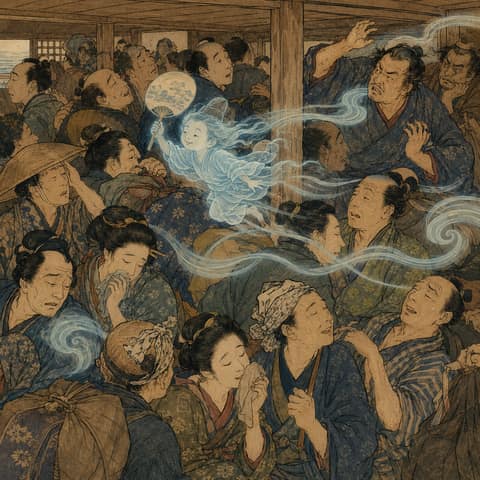
    It appears most often during rush hour, reading the carriage’s flow and shaping breezes from a whisper to a brisk draft. When crowds make the air stagnate, it slips in from the end of the car, threads through the middle, and carves a path that compensates for weak air conditioning. Odors are trapped in small vortices and vented outside the instant the doors open at the next station. It lingers beside acts of kindness, tying coolness at a passenger’s shoulder. For nuisances, it pricks the nape with a single cold point, and gently thins excessive sweat or perfume to preserve everyone’s dignity. At times it nudges ventilation buttons and AC settings as a playful “wind’s trick,” aiding the conductor’s judgment. On stormy days it avoids overblowing so hats and papers stay put. On the last train it evens the breath of sleepers and sands down harsh drunkenness to head off scuffles.

  • Watanabe no Tsuna

    Watanabe no Tsuna

    Epic

    watanabe-no-tsuna

    The Warrior Who Severed the Demon Arm of Rashomon: Watanabe no Tsuna

    Human/Half-YokaiKyotoOsaka

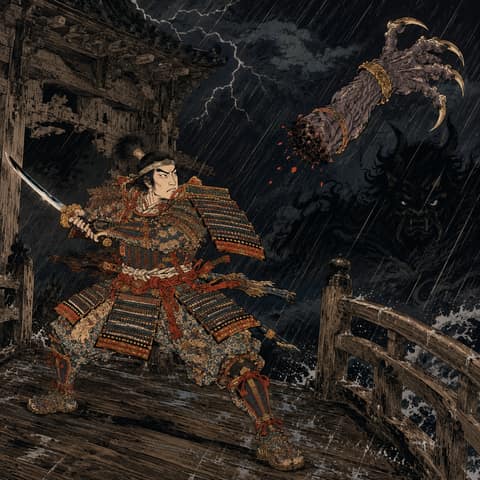
    In this version, we read Watanabe no Tsuna as "the boundary warrior who severed the demon's arm." What etched Tsuna's name most strongly in history is the story of him encountering a demon at Rashomon or Ichijo Modoribashi and cutting off its arm. It is no coincidence that the location is a gate or a bridge. A gate divides the inside and outside of the capital, and a bridge connects this shore and the other shore. The demon appears precisely at that boundary. Tsuna's bravery does not completely erase the demon with a single stroke. He can sever the arm, but the demon itself escapes. The remaining arm is both a trophy and evidence that the anomaly has not yet ended. Here lies the fascination of the demon arm tale. The severed arm enters the mansion as an object and is placed under human management, but the demon returns to the human world to take it back. The revisit by the demon disguised as an old woman reveals Tsuna's weakness. He is excellent in martial force, but he finds it hard to lose courtesy toward an opponent taking the form of a relative. The demon strikes at that point. In yokai subjugation tales, the insight to see through anomalies is just as important as martial power. While Tsuna succeeded in cutting the arm, he cannot completely fend off the disguised demon. This imperfection makes him a human-like hero. As one of Yorimitsu's Four Heavenly Kings, Tsuna also occupies an important position in the Mt. Oe subjugation. In his solitary tale, he slashes the boundary demon; in the group tale, he heads for Shuten-doji under Yorimitsu's command. In other words, Tsuna is the figure who connects individual bravery with team demon subjugation. His blade participates in both one-on-one anomaly events and grand subjugation narratives. This version of Tsuna stands between victory and letting the enemy escape. The scene of cutting the demon arm is vivid, but the development of the demon reclaiming the arm shows that anomalies cannot be simply sealed away. Even if the monster is slashed at the boundary, the monster returns inside the house, into the form of a relative, into memories. Watanabe no Tsuna's story simultaneously tells of the exhilaration of demon subjugation and the tenacity with which demons still infiltrate the human world. The demon arm is an object that has crossed boundaries. The moment it is detached from the demon's body, it remains a part of the otherworld while being kept in a human mansion. Tsuna holds the arm as proof of victory, but that arm also serves as a beacon for the demon to return. The trophy is simultaneously a cursed object. The demon disguised as an old woman attacks Tsuna's humanity. A warrior is strong against demons, but cannot discard courtesy toward relatives. Here the story shifts from a contest of strength to a contest of perception. If he knows it is a demon, he can slash it. But when the demon borrows a family member's face, a person cannot easily swing a blade. This version of Tsuna is not a flawless subjugator, but a hero who wins at the boundary and wavers inside the house. That is exactly why the folklore gains depth. Demon subjugation does not end outside; it starts over once back in daily life because of what was brought back, the person trusted, and the seal that was opened. Tsuna's charm lies in his nature as a warrior that includes this wavering. If he were simply strong, the ghost story would end quickly. But he is strong, and at the same time, deceived. Therefore, the story moves from a single stroke of the sword to a conversation in the mansion, deepening from external demon subjugation to internal suspicion. That lingering resonance keeps Tsuna's martial valor from being just a simple victory tale.

  • Yao-bikuni

    Yao-bikuni

    Rare

    yao bikuni

    Yao-bikuni from Wakasa and Beyond

    Ghosts and spiritsFukuiKyoto

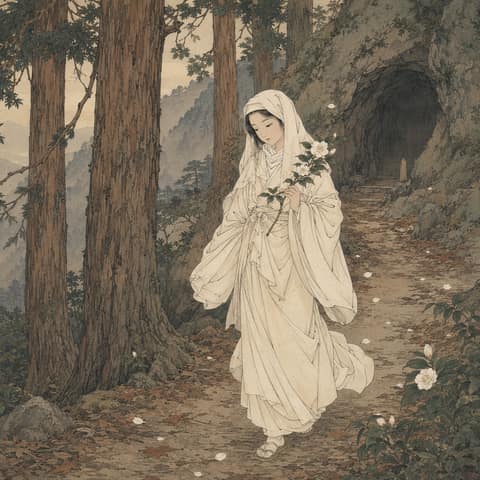
    Yao-bikuni is recorded in a 1449 diary as a long-lived nun who came from Wakasa to Kyoto; in the early modern period, she became linked to a story of a girl who ate mermaid flesh. More than two hundred years old in *Yasuyoshi-ki*, eight hundred years old in *Gaun Nikkenroku*, and more than four hundred years old in *Honchō Jinja Kō*, the shifting numbers trace the legend’s long development.

  • 尻目

    尻目

    Rare

    しりめ

    夜道で光る尻の一眼・尻目

    人妖・半人半妖Kyoto

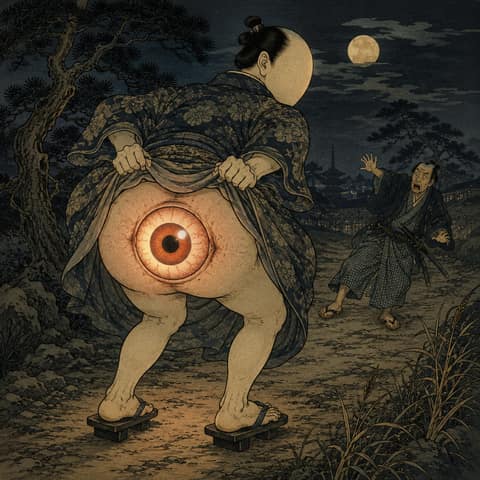
    Read as a glowing single eye on a buttock on a night road, the Shirime touches upon the core of yokai expression despite being an extremely short tale. Appearance, disrobing, exposure, luminescence, and flight. If one extracts only the plot, it ends in a few lines. Yet within those few lines, the fundamental human recognitions of looking at another person, looking at a face, and looking at eyes are sequentially betrayed. The scene where a samurai is hailed on a night road to Kyoto and shown a strong light from a single eye on a buttock is not a tale of combat, but a ghost story that uses the gaze itself as a weapon. The first trick is the lack of a face. Yokai of the Noppera-bo lineage erase the face, the center of humanity. Without a face, one cannot read the other's emotions, the intent behind their words, or the presence of hostility. The Shirime builds upon this unease of facelessness and shifts the eye to yet another location. This is why it is explained as a variant of the Noppera-bo: the eyes that should be on the face are lost and placed on the buttocks, the most defenseless and laughter-inducing part of the body. Here, terror and comedy become inseparable. The second trick is the destruction of etiquette. Being called out to by a stranger on a dark road is unsettling enough, but when the other party suddenly strips off their kimono, the scene drops from the tension of the warrior class to an obscene farce. However, in the very next instant, that farce reverses into the bizarre through the glowing eye. The Shirime is not interesting because it is vulgar. It is terrifying because it transforms a vulgar gesture into an "eye" that stares back at the human. Not only are you shown something you shouldn't see, but you are stared back at from that very spot. This reversal constitutes the Shirime's decisive strike. The third trick is its brevity. The Shirime has almost no birth tales, no extermination tales, and no long curses. It is not weak because of this; rather, it is perfectly suited for a single illustration. Small yokai preserved in picture scroll materials are remembered not for the depth of their narrative, but for their visual iconography, where meaning arises the moment they are seen. The Shirime is typical of this; before hearing an explanation, the mere composition of an eye on a buttock captures the reader. This yokai clearly demonstrates that yokai iconography sometimes travels faster than the narrative. The setting of the night road heading to Kyoto also supports the Shirime's function. The entrances and crossroads of a city are boundaries where the known and the unknown, the order of day and the anxiety of night switch places. When called out to there, a person first searches for the other's face. The very act of searching for the face becomes the Shirime's trap. The moment one understands that there is no face and no gaze, the eye returns from an entirely different place. Therefore, while being a yokai of Kyoto, the Shirime is remembered not for the historical pedigree of famous places, but as a sudden ambush in the middle of the road. The reason the Shirime became well-known again in yokai introductions after Mizuki Shigeru is also because the speed of its imagery aligns well with modern media. Yokai encyclopedias like Mizuki Shigeru's "Illustrated Encyclopedia of Japanese Yokai" transposed fragments of regional folklore and classical picture scrolls into a format where modern readers can search, compare, and remember them as pictures. The Shirime carries no moral lesson, speaks no ethics, and survives solely through a single bizarre bodily arrangement. Precisely because of this, it is easily transplanted into overseas yokai introductions and gaming reception. Fearing the Shirime does not mean fearing that something will attack. It means fearing that the arrangement of the world will instantly become wrong. A face has no face, a buttock has an eye, and that eye glows. The samurai flees not because he is a coward, but because the opponent he should cut down with his sword is not there. The Shirime appears not as an enemy, but as an accident of perception. In the darkness of the night road, the order of the body is turned inside out. Just through that comical and cruel instant, the Shirime is sufficiently a yokai. In that sense, the Shirime does not end as a vulgar whimsical fantasy. It is a yokai that bends human confidence in seeing the world correctly at the shortest possible distance. The speed of that distortion is precisely the power of this small yokai.
  • 舌長姥

    舌長姥

    Uncommon

    したながうば

    荒野の破屋に舌を伸ばす姥・舌長姥

    人妖・半人半妖NiigataTokyo

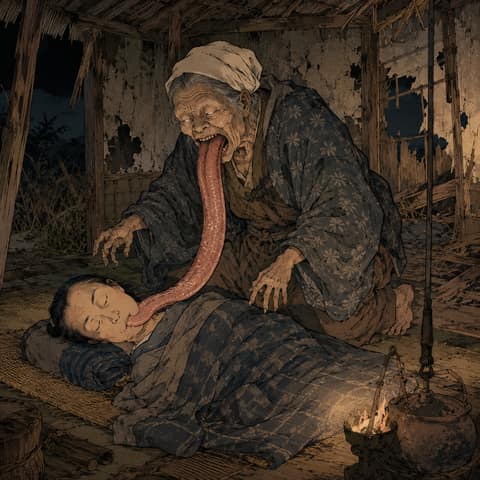
    When viewed as a hag extending her tongue in a ruined shack in the wilderness, the terror of the Shitanaga-uba lies less in the monster's appearance itself and more in the moment hospitality flips into predation. The travelers, conditioned by nightfall, getting lost, and fatigue, search for a house and believe they are saved by the old woman's invitation. However, the night's lodging is not a safe zone of the human community, but a trap waiting in a closed room for them to fall asleep. In the scene where the tongue extends to the sleeper, the everyday and soft action of "licking"—rather than the use of blades or claws—transforms into the violence of obliterating the flesh, producing a tactile terror much closer than the red face of Shu-no-banbo. This hag monster's outline becomes clearest when working as a pair with Shu-no-banbo. In the setting of the journey from Echigo to Edo, the Shitanaga-uba is placed inside the house, while Shu-no-banbo acts as a voice from the outside. It is the Shitanaga-uba whose name is called first, and Shu-no-banbo appears saying, "Shall I help?" In other words, the Shitanaga-uba is not a mere servant, but one of the principal culprits moving in front of the prey. If Shu-no-banbo is a yokai of sight, the Shitanaga-uba is a yokai of touch, and the two terrors mesh seamlessly within the same night. While the story connects Echigo Province and Edo on the map, pinning the Shitanaga-uba down solely as a "yokai of Niigata Prefecture" misses the core of the tale. What is important is that an unnamed wasteland opens its jaws halfway between a known land and a known city. The ending, where the house vanishes, suggests the possibility that the anomaly's dwelling was not permanently there, but rose up for just one night to absorb the travelers. Thus, on this page, Echigo Province is listed as the story's starting point, Edo as the destination, and "Unknown" side-by-side as the limit of her origin. In later yokai culture, while Shu-no-banbo stands out by gaining the iconography of a red face and large mouth, the Shitanaga-uba is easily compressed into the short name "the old woman with the long tongue." Yet, that very compression is the strength of this yokai. The moment you hear her name, you know her shape, and the moment you know her shape, you know what she will do. She is not a flashy protagonist, but an anomaly that lingers in the reader's bodily senses through the minimal elements of an inn, sleep, and a tongue.

Showing 49 - 54 of 54 yokai