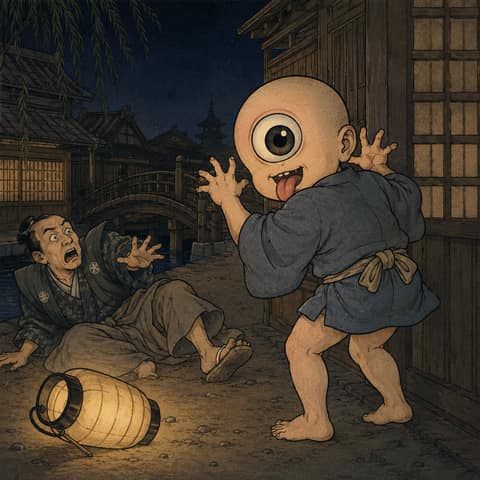
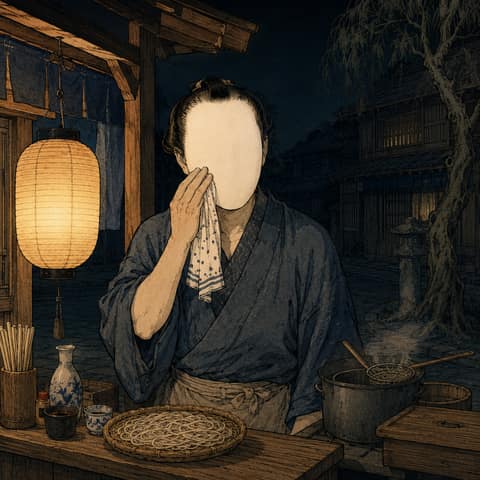
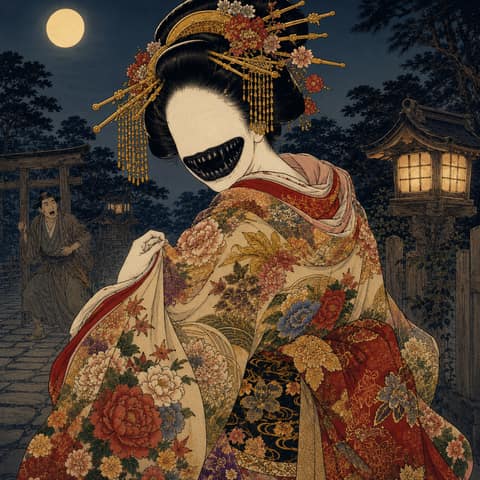
Read as a glowing single eye on a buttock on a night road, the Shirime touches upon the core of yokai expression despite being an extremely short tale. Appearance, disrobing, exposure, luminescence, and flight. If one extracts only the plot, it ends in a few lines. Yet within those few lines, the fundamental human recognitions of looking at another person, looking at a face, and looking at eyes are sequentially betrayed. The scene where a samurai is hailed on a night road to Kyoto and shown a strong light from a single eye on a buttock[1] is not a tale of combat, but a ghost story that uses the gaze itself as a weapon.
The first trick is the lack of a face. Yokai of the Noppera-bo lineage erase the face, the center of humanity. Without a face, one cannot read the other's emotions, the intent behind their words, or the presence of hostility. The Shirime builds upon this unease of facelessness and shifts the eye to yet another location. This is why it is explained as a variant of the Noppera-bo[1]: the eyes that should be on the face are lost and placed on the buttocks, the most defenseless and laughter-inducing part of the body. Here, terror and comedy become inseparable.
The second trick is the destruction of etiquette. Being called out to by a stranger on a dark road is unsettling enough, but when the other party suddenly strips off their kimono, the scene drops from the tension of the warrior class to an obscene farce. However, in the very next instant, that farce reverses into the bizarre through the glowing eye. The Shirime is not interesting because it is vulgar. It is terrifying because it transforms a vulgar gesture into an "eye" that stares back at the human. Not only are you shown something you shouldn't see, but you are stared back at from that very spot. This reversal constitutes the Shirime's decisive strike.
The third trick is its brevity. The Shirime has almost no birth tales, no extermination tales, and no long curses. It is not weak because of this; rather, it is perfectly suited for a single illustration. Small yokai preserved in picture scroll materials are remembered not for the depth of their narrative, but for their visual iconography, where meaning arises the moment they are seen[2]. The Shirime is typical of this; before hearing an explanation, the mere composition of an eye on a buttock captures the reader. This yokai clearly demonstrates that yokai iconography sometimes travels faster than the narrative.
The setting of the night road heading to Kyoto also supports the Shirime's function. The entrances and crossroads of a city are boundaries where the known and the unknown, the order of day and the anxiety of night switch places. When called out to there, a person first searches for the other's face. The very act of searching for the face becomes the Shirime's trap. The moment one understands that there is no face and no gaze, the eye returns from an entirely different place. Therefore, while being a yokai of Kyoto, the Shirime is remembered not for the historical pedigree of famous places, but as a sudden ambush in the middle of the road.
The reason the Shirime became well-known again in yokai introductions after Mizuki Shigeru is also because the speed of its imagery aligns well with modern media. Yokai encyclopedias like Mizuki Shigeru's "Illustrated Encyclopedia of Japanese Yokai"[3] transposed fragments of regional folklore and classical picture scrolls into a format where modern readers can search, compare, and remember them as pictures. The Shirime carries no moral lesson, speaks no ethics, and survives solely through a single bizarre bodily arrangement. Precisely because of this, it is easily transplanted into overseas yokai introductions and gaming reception.
Fearing the Shirime does not mean fearing that something will attack. It means fearing that the arrangement of the world will instantly become wrong. A face has no face, a buttock has an eye, and that eye glows. The samurai flees not because he is a coward, but because the opponent he should cut down with his sword is not there. The Shirime appears not as an enemy, but as an accident of perception. In the darkness of the night road, the order of the body is turned inside out. Just through that comical and cruel instant, the Shirime is sufficiently a yokai.
In that sense, the Shirime does not end as a vulgar whimsical fantasy. It is a yokai that bends human confidence in seeing the world correctly at the shortest possible distance. The speed of that distortion is precisely the power of this small yokai.
Character Profile
This section is our own creative profile for storytelling. It is not historical fact or scholarship.
Yokai Type - Traditional Yokai
Category - Half-Human Beings
Rarity - Rare
Personality - Having little malice, it intentionally breaks the order of etiquette and the gaze to freeze its target. It prefers moments of silent tension, and remains in memory through an instant of strangeness rather than pure terror.
Compatibility - Highly compatible with those who can enjoy bizarre jokes and the blank spaces of classical ghost stories. It reacts more strongly to an observer who can simply watch the surprise itself, rather than an opponent trying to banish it with logic.
Abilities - Erasing its face to disrupt the observer's perceptionEmitting a strong light from a single eye opened on its buttocksUnsettling even samurai with etiquette-breaking gesturesCausing both fear and laughter simultaneously without attackingPossessing an iconic visual power memorable from a single illustrationDelivering the double shock characteristic of the Noppera-bo lineage
Weaknesses - It lacks the power to harm people or pursue them for long. Once the instant of surprise passes and the observer switches to laughter or observation, its pressure as a supernatural phenomenon rapidly weakens.
Habitat - Night roads from Yamashiro Province heading into Kyoto. It appears in dark roads, crossroads, and sparsely populated thoroughfares—places where simply being called out to by a stranger breeds anxiety.