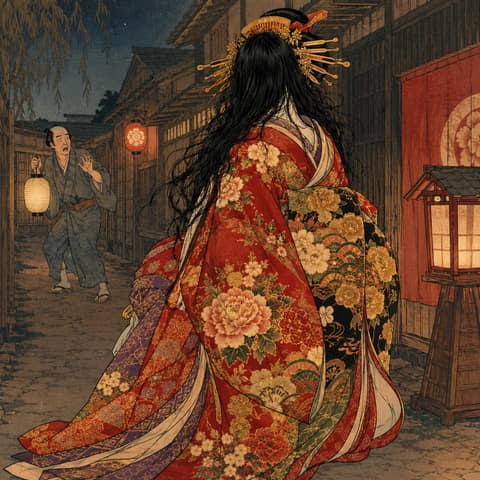
The Ohaguro-bettari, taking the form of a bride's mask with blackened teeth, is a yokai whose encounter always begins with the gesture of hiding its face. The target first sees the figure of a beautiful woman, or perhaps someone who looks like a bride. The kimono, the downcast posture, the hidden visage. Natural human curiosity kicks in, a desire to verify the face lying beneath the formal attire. But that curiosity itself becomes the trap. As is often the case with the cluster of yokai in the "Ehon Hyakumonogatari"[1], this monster establishes its terror not through lengthy explanations, but through the psychological drop between the moment before looking and the moment after.
When the face is raised, the expected beautiful features are absent. There are no eyes, no nose—only a mouth. And within that mouth, the historical bodily adornment known as ohaguro[2] manifests so thickly and darkly that it practically dominates the entire face. Tooth-blackening was originally a custom tied to beauty, maturity, and marriage, varying by era and social class. The Ohaguro-bettari does not erase these social meanings; rather, it amplifies them to an excess. That is why it is terrifying. The black teeth are not a "makeup failure"; they are a grotesque form where the makeup alone has consumed the face.
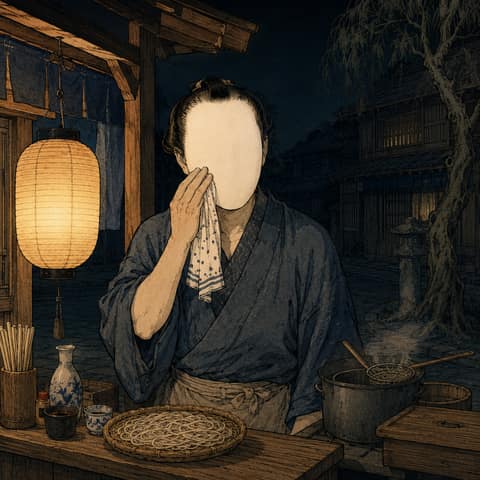
The structure of this yokai is close to the Noppera-bo, yet distinct. A Noppera-bo renders the entire face blank. The Ohaguro-bettari leaves only a mouth within that blankness. The viewer searches for the other's eyes, but there are none. They search for the source of a voice, but there is only a mouth. The center of the face presses forward not as a place to read expressions, but as a black fissure. The tools humans use to comprehend a face are stripped away one by one, leaving only the "mouth" in grotesque excess.
Its relationship with bridal attire is also vital. A bride's dress symbolizes blessing, family, union, and social approval. Yet when it appears as a yokai, that blessing becomes a trap of encounter. The gesture of hiding the face looks like modesty, but it is actually a curtain to draw the victim closer. Calling out, trying to see the face, stepping near. Once that sequence of actions is complete, the gaping maw of black teeth is revealed. In other words, the Ohaguro-bettari is not simply an ugly monster; it is a yokai that inverts etiquette and aesthetic consciousness itself.
Late Edo-period ghost story picture books handled this inversion masterfully on the page. "Ehon Hyakumonogatari: Momoyanjin Yawa"[3] combines text and illustration to give the reader both the "imagination before looking" and the "shock after seeing." The Ohaguro-bettari's strength lies precisely in this medium. One glance at the picture and it is understood immediately, but in the instant of understanding, the viewer is sharply reminded of why they tried to look at the face in the first place.
The resonance of the word "bettari" (thickly plastered/smeared) in the Ohaguro-bettari's name also aids in reading the iconography. If the black teeth were merely dyed neatly, it would just be makeup. However, when called "bettari," the blackness takes on a density that sticks to the mouth, as if staining the entire face. Edo ghost stories conjure anomalies out of everyday language through such phonetic nuances. Just by attaching a word indicating excess to the name of a custom, the reader already begins to imagine something that is no ordinary bride.
In the context of modern yokai relations, the Ohaguro-bettari stands alongside the Noppera-bo, Shirime, Kejoro, and Hone-onna as a "monster of face and attire." People judge others by looking at their face, and understand the situation by looking at their attire. Yet this yokai uses attire to provide false comfort, uses the face to betray expectations, and abnormally amplifies only the mouth. It uses the collapse of perception, not physical attack power, as its weapon. Because of this, it is not a grand boss to be exterminated, but remains as an unforgettable, single image of abnormality. The black-toothed bride's mask is a quiet, sharp mockery born when Edo aesthetics are flipped inside out in the dark.
For this reason, when drawing this creature, simply making a scary face dilutes its essence. What is crucial is that it first succeeds as a beautiful figure in formal dress; next, there must be the tense pause of the hidden face; and finally, the sudden, explosive reveal of the missing eyes/nose and the gaping black-toothed mouth. The Ohaguro-bettari is a yokai that builds expectation before it builds terror, and possesses its greatest power only in the instant it betrays that expectation.
Character Profile
This section is our own creative profile for storytelling. It is not historical fact or scholarship.
Yokai Type - Traditional Yokai
Category - Half-Human Beings
Rarity - Rare
Personality - It quietly hides its face, waiting for the victim to approach. Rather than malicious intent to harm, it possesses a mischievous, cold cruelty that exploits the human desire to 'see'.
Compatibility - Highly compatible with those who can read the culture and taboos lying behind beautiful attire. To those who approach based solely on outward appearances, it completely shatters their expectations with a black-toothed smile.
Abilities - Disarming the target's caution using bridal attireHiding its face to invite curiosityRevealing only a gaping, black-toothed mouth on a faceless visageInverting the symbols of beauty and formal dress into terrorTurning the viewer's gaze into a trapPlaying a variation on the Noppera-bo's facial erasure by transforming it into a monster of the mouth
Weaknesses - Its power is heavily skewed towards startling; folklore involving direct physical harm is sparse. If the target lacks the desire to look at its face, its strike as a supernatural anomaly weakens.
Habitat - The world of late Edo-period ghost story picture books, night roads, and alleyways or mansion entrances that evoke thoughts of weddings. It appears in the kind of darkness that makes one want to call out to a woman hiding her face.