YOKAI.JP

化け鯨

ばけくじら

化け鯨

化け鯨

Their soul is listening — speak, and they will answer.

Basic Description

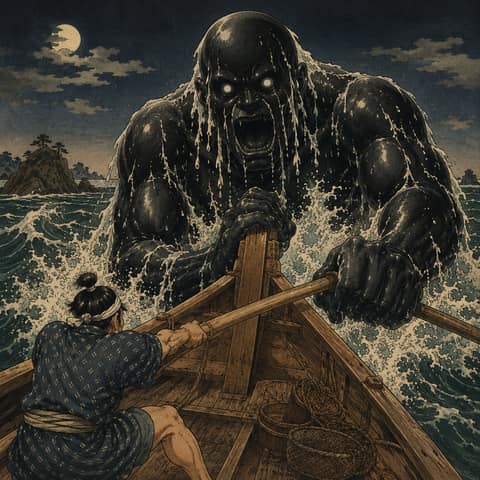
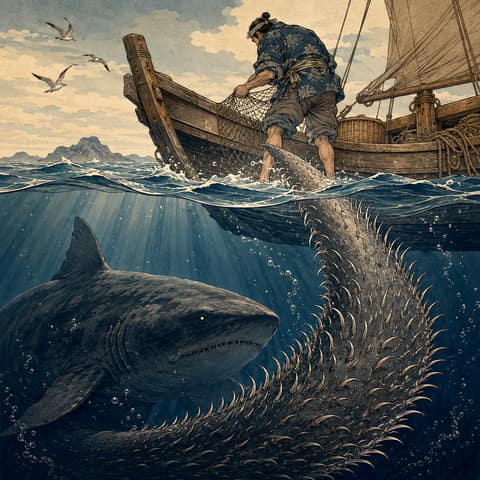
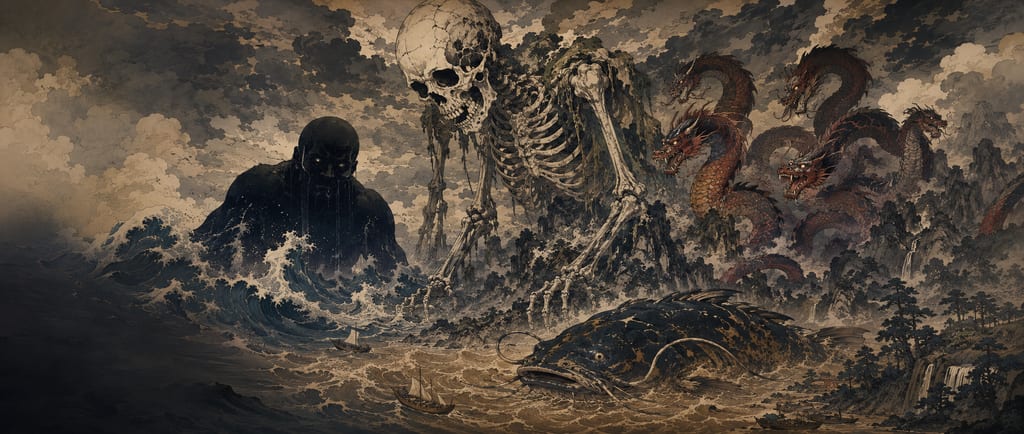
Bake-kujira (Ghost Whale) is a sea monster that appears on rainy nights as a massive, white shadow of a whale, and upon approaching, reveals itself as a skeletal figure devoid of flesh and skin. In the tale of the skeletal whale that appeared off the coast of Oki on a rainy night, fishermen set out their boats thinking it's a whale, but find no resistance when they throw their harpoons, eventually realizing it is a whale made only of bone. Unfamiliar fish school around it, strange birds fly in the sky, and the sea itself wavers as if transformed into another country. Bake-kujira is not a man-eating monstrous fish. Before coastal societies that catch whales, distribute their meat, and leave the bones, it is an apparition where a supposedly caught whale returns as something "living as mere bones."

The outline of this yokai became strongly known through modern and contemporary yokai encyclopedias and the visual memory created by Shigeru Mizuki, rather than classic yokai art collections of the early modern period. Books like Shigeru Mizuki's "Illustrated Encyclopedia of Japanese Yokai" and "Shigeru Mizuki's World Encyclopedia of Phantom Beasts" placed Bake-kujira before readers as a colossal sea beast of only bone. Whales are a blessing of the sea, and simultaneously massive lives that have been killed. Therefore, Bake-kujira is not merely a monster, but a figure where whaling, beaching, memorial services, and the abundance of schooling fish overlap into one. The skeletal whale that repels harpoons ceases to be prey and transforms into a spirit of the sea that stares back at humans.

Even among sea monsters, Bake-kujira functions differently from the Funayurei (Ship Ghost) or Umibozu. The Funayurei demands water from ships as a swarm of the dead, and the Umibozu rises above the sea surface as a massive shadow. Bake-kujira is the spirit of an animal that was once prey. The skeletal form indicates death, but simultaneously shows that the dead do not vanish from the community's memory. The skeletal whale floating in the seas of Oki and Izumo declares to the humans receiving the sea's blessings that not only gratitude, but awe is also necessary.

Folklore & Legends

The folklore of Bake-kujira is not a yokai with abundant classic variants, but a sea monster remembered through a small number of tale types and powerful imagery. In the tale of the skeletal whale that appeared off Oki, on a rainy night, a massive white object approaches the coast, and fishermen, thinking it is a whale, launch their boats. However, the harpoons do not injure its body, and upon drawing near, they find it is a whale skeleton with neither skin nor flesh. Unknown fish fill the sea surface, and monstrous birds fly in the sky. Eventually, the illusion fades like an ebbing tide, and the fishermen come to speak of it as a whale spirit or something akin to a god from the sea.

The core of Bake-kujira lies in the duality of the whale as both a "resource" and a "spirit." For seaside villages, a whale was a massive blessing whose meat, fat, bone, and baleen could all be utilized; the beaching or capture of a single whale could sometimes save a village. However, that abundance lies side-by-side with taking life. The image of a skeletal whale that repels harpoons and appears accompanied by fish and birds well expresses the sensation that the remains of a whale made into prey have returned as a spirit dominating the sea's bounty. Bake-kujira is a figure where gratitude for blessings and fear of what was killed float simultaneously on the same sea surface.

The fact that it is accompanied by the place names Oki and Izumo is also important. Along the coast of the Sea of Japan, things that wash ashore, things that drift in, and things that appear from the offing were often received as gods or apparitions. In the tale of Bake-kujira, the moment the massive white body approaches from the offing and fishermen recognize it as prey, the sea ceases to be a normal fishing ground. Unknown fish, strange birds, and an atmosphere like an unfamiliar island appear, and the illusion recedes like an ebbing tide. Here lies a terror different from the spirits of the dead that directly sink ships like Funayurei—a terror where the sea itself temporarily transforms into an otherworldly realm.

In the reception of yokai from the modern era onward, Bake-kujira gained a highly recognizable form through Shigeru Mizuki's work. As shown in the bibliography of "Illustrated Encyclopedia of Japanese Yokai" and "Shigeru Mizuki's World Encyclopedia of Phantom Beasts", yokai encyclopedias of the late Showa period converted fragmentary regional folklore into imagery that modern readers could share. Bake-kujira is a typical example. While it does not have the deep accumulation of classic paintings like the standard yokai of Toriyama Sekien, the unforgettable form at first glance—a whale of only bone—solidified its status as a sea yokai.

Viewing it from the side of ghost story materials in western Japan, Bake-kujira is easy to position as a sea monster of the San'in region. Regional ghost story collections like "Edo Shokoku Hyaku Monogatari: Collection of Strange Tales from Various Provinces, Western Japan Edition" serve as a reference frame for considering apparitions along the western Japanese coast. The Isonade is a monstrous fish that sweeps people away with its tail, and the Funayurei closes in on ships as a swarm of the dead. Bake-kujira is neither of those. A giant beast that should already be dead continues to move through the sea as mere bones. More than aggressiveness, it exerts a strong pressure that reminds those who have seen it, "What exactly have you been catching in this sea?"

Related Yokai

Yokai deeply tied to this one in legend.

Detailed Analysis

Bake-kujira, as a skeletal whale appearing on rainy nights, is an unnervingly quiet entity even among sea apparitions. Many sea yokai sink ships, pull people into the ocean, and bewilder fishermen with voices and fire. Bake-kujira, however, first appears merely as a white shadow. Fishermen think it is prey, launch their boats, and throw their harpoons. But the harpoons do not harm the skeletal body; the whale is there as something devoid of physical flesh. This moment of "being unable to catch what should be catchable" creates the terror of Bake-kujira.

The skeletal form is also the form of the whale after it has already been completely consumed by humans. The meat is consumed, the fat is used, and only the bones remain as memory. Bake-kujira looks as if those bones have returned to the sea. Therefore, this yokai is not a mere massive creature, but bears the coastal livelihood and the memories of taking life. The image of the skeletal whale appearing accompanied by fish and birds shows that the whale is tied to the very abundance of the sea. The arrival of a whale was also the arrival of schooling fish, the arrival of food, and sometimes, the arrival of a god.

Placing Bake-kujira in the seas of Oki and Izumo also clarifies its meaning on the map. The issue here is not simply whether it is a "yokai of Shimane Prefecture." It is the small boat heading out to sea, the sea surface with poor visibility in the rain, the eyes of the fishermen viewing the whale as prey, and the moment those eyes are suddenly betrayed. Oki Province is a sea of islands, and Izumo Province holds the beaches and fishing grounds of the Honshu side. Bake-kujira, as a skeletal shadow drifting between them, gives shape to the awe of things coming from across the sea.

Shigeru Mizuki's visual imagery deeply engraved this yokai into modern readers. Because there are reference points like "Illustrated Encyclopedia of Japanese Yokai" and "Shigeru Mizuki's World Encyclopedia of Phantom Beasts", Bake-kujira transformed from a "sea monster that might have appeared only once" into a skeletal whale whose form anyone can imagine. Here we can see the process by which yokai increase their power not just through old records, but by being shared as pictures.

When placed alongside Funayurei and Umibozu, the differences of Bake-kujira stand out. Funayurei are human dead, and Umibozu is a massive shadow rising on the sea surface. Bake-kujira is neither human nor shadow; it is the spirit of a massive animal that once lived and was once caught. That is exactly why memorial services suit it better than extermination, and awe suits it better than capture. When the hand throwing the harpoon cuts through the empty air, humans rotate for the first time from being the side catching the whale to the side being watched by the whale.

Furthermore, Bake-kujira is a yokai possessing the power of the material "bone." While bone is evidence of death, it remains longer than flesh and supports the memories of the land and the seaside. Whale bones are massive and can become both tools and objects of prayer within a village. The image of a skeletal whale moving across the sea shows that what has died does not vanish completely, but continues to remain within the community's life. It can be said that the fishermen who saw Bake-kujira did not see a terrifying monster, but collided with their own marine history itself.

Therefore, the charm of Bake-kujira lies not in the flashiness of its attacks, but in the weight of its silence. The massive skeletal body splitting the sea surface, the emptiness of the harpoons slipping through, the fish and birds filling the surroundings, and the otherworldly realm that suddenly vanishes. All of these simultaneously evoke the sensation of eating whales as a blessing and fearing whales as spirits. Bake-kujira is a massive question floating in the seas of the San'in region.

This reading is important to avoid pushing Bake-kujira too close to "unidentified mysterious animals (UMA)" or mere giant monsters. Certainly, the form of a massive skeletal whale fits well with modern kaiju imagination. However, at the center of the folklore is not the surprise of seeing a rare creature, but the sensation of people living by the sea being stared back at by the whale that was supposed to be their prey. Bake-kujira is an animal, a spirit, and a memory seeking memorialization. Because of that overlapping, the white skeletal form is hard to forget once seen.

If arranged in an encyclopedia, it is natural to place Bake-kujira in the position of "animal spirit" among sea monsters. By reading it in distinction from the formless awe of Umibozu, the predatory monstrous fish like Isonade, and the human ghosts like Funayurei, the outline of this skeletal whale becomes rather clear.

Character Profile

This section is our own creative profile for storytelling. It is not historical fact or scholarship.

Category
水の怪
Rarity
Epic
Personality
Taciturn and massive. Rather than chasing people, it appears on the sea surface and makes the fishermen's gazes and harpoons swing at empty air. It possesses a quiet pressure, clad simultaneously in anger and a desire for memorial services.
Compatibility
Resonates with those drawn to sea ghost stories, drift gods, whaling culture, and folklore of animal spirits. To those who view the sea's blessings only as natural prey, it questions them back with its skeletal form.
Abilities
Offshore Appearance as a Skeletal WhaleSpiritual Body that Parries HarpoonsOtherworldly Transformation Accompanied by Schooling Fish and Monstrous BirdsMassive White Shadow Bewildering Visibility on Rainy NightsSpiritual Majesty Evoking Memories of WhalingAura like a Drift God Approaching from the Offing
Weaknesses
Because it relies more on spiritual majesty as an eyewitness tale than on the power to directly attack humans, its form is hard to materialize unless the conditions of night rain, offshore waters, and the gaze of fishermen viewing whales as prey align. It possesses a nature that is appeased by memorial services and awe.
Habitat
Appears offshore of the Oki Islands, the Sea of Japan coast of Izumo and the San'in region, fishing grounds on rainy nights, and seasides where memories of beached whales and whaling remain.

For more detailed information and diagnosis results about 雨夜に浮かぶ骨だけの鯨・化け鯨, please click here.

Sources & References

4
  1. Bakekujira and Japan's Whale CultsZack Davisson(Hyakumonogatari Kaidankai, 2013) [二次解説]化け鯨の隠岐沖出現譚、骨だけの鯨、魚群と怪鳥、鯨信仰との関連を整理した英語解説。
  2. 図説日本妖怪大全水木しげる [著](講談社, 1994) [妖怪図鑑]水木しげるによる妖怪図鑑の国立国会図書館書誌。化け鯨の近現代図像受容の参照点。
  3. 水木しげるの世界幻獣事典水木しげる 著(朝日新聞社, 1994) [妖怪図鑑]水木しげるによる幻獣・妖怪事典の国立国会図書館書誌。化け鯨の図像化・現代受容の参照点。
  4. 江戸諸国百物語 : 諸国怪談奇談集成. 西日本編(人文社, 2005) [怪談集成]西日本の怪談奇談を地域的に捉えるための国立国会図書館書誌。山陰・西日本海怪の文脈整理用。

Interested in this type of yokai?

Discover the yokai most similar to your personality with our yokai diagnosis

Start Yokai Diagnosis

Meet your guardian yokai at the shrine

Draw an omikuji fortune and discover the yokai watching over you today.