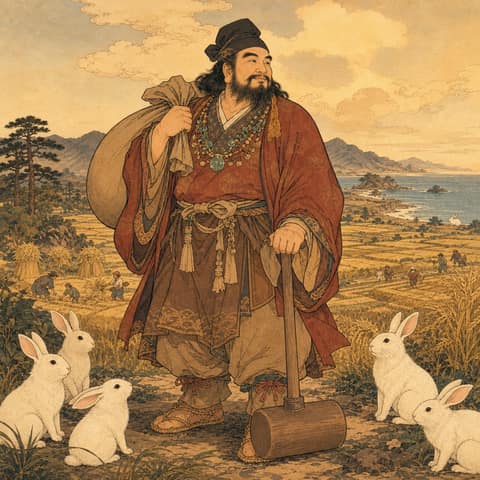
Sukunabikona is a miniature deity who, alongside Okuninushi, forged and consolidated Ashihara-no-Nakatsukuni (the Central Land of Reed Plains)[1][2]. According to the *Kojiki*, he is the son of Kamimusubi, while the *Nihon Shoki* names Takamimusubi as his parent. He is said to have washed ashore from beyond the sea, riding in a tiny boat made from a Metaplexis (milkweed) pod and wearing moth skins as his garments[2]. Despite his extremely small stature, he is a god of wisdom and healing who established the methods of medicine and *kin'en* (incantations and magic) and spread the arts of agriculture, sake brewing, and hot spring development to various provinces[2]. Commanded to become brothers with Okuninushi and solidify the land, the two gods worked together to govern Ashihara-no-Nakatsukuni. However, during the nation-building process, he climbed a millet stalk and, launched by its recoil, crossed over to Tokoyo-no-Kuni (the Eternal Land) beyond the sea[2]. In Izumo mythology, he is a crucial partner deity who supported Okuninushi's nation-building. The archetype of a tiny figure exhibiting extraordinary abilities became the distant predecessor for later tales such as Issun-boshi (the One-Inch Boy), Princess Kaguya, and Urikohime[2].
Nation-Building with Okuninushi: Medicine, Incantations, Sake, and Hot Springs. Working as a pair, Sukunabikona and Okuninushi advanced the creation of Ashihara-no-Nakatsukuni[2]. The *Nihon Shoki* records that the two deities established the laws of medicine to heal illnesses for the people and livestock, and formulated *kin'en* (incantations) to ward off disasters caused by birds, beasts, and insects. They are also said to have spread the techniques of agriculture, sake brewing, and hot spring development. Sukunabikona's name is passed down in the founding legends of hot springs such as Dogo (Iyo) and Arima. His figure, demonstrating immense wisdom from a tiny body, serves as the prototype for gods of knowledge and healing.
Sukunabikona is the "paired" deity who supported Okuninushi, the main god of Izumo Taisha, as his sole partner in nation-building. His divinity is fully realized not in isolation, but as one half of a pair with Okuninushi. The contrast between the massive earthly god (Kunitsukami) Okuninushi and his diminutive stature—small enough to ride in a milkweed pod boat—highlights their collaboration. His functions center on practical arts and civilization-building, such as medicine, incantations, agriculture, sake brewing, and hot springs. He left his mark beyond Izumo in the founding legends of hot springs like Dogo and Arima, as well as at Sukunahikona Shrine (the god of medicine in Doshomachi, Osaka), becoming a nationwide figure in medicine and hot spring worship. His departure, bouncing off a millet stalk to the Eternal Land, acts as the hinge connecting the myth to the arrival of Omononushi at Mt. Miwa, embodying the Izumo mythos structure where nation-building is achieved through the successive cooperation of multiple gods. His archetype of a small body with immense power is also the mythological origin of "tiny child" folktales like Issun-boshi.
Character Profile
This section is our own creative profile for storytelling. It is not historical fact or scholarship.
Though small enough to fit in the palm of a hand, he is a dutiful partner excelling in wisdom and skill. A hard worker who spread the arts of medicine, magic, and sake brewing across the provinces, yet also possessing an ethereal detachment, abruptly departing for the Eternal Land by bouncing off a millet stalk.
Compatibility
大国主神を筆頭に、 国造り·医薬·温泉·酒造に縁を持つ神々と、 常世·他界に通じる存在
Abilities
Methods of medicine and healingKin'en (magic and incantations)Arts of sake brewing, agriculture, and hot spring developmentNational administration (in collaboration with Okuninushi)
Weaknesses
Because of his minuscule size, his ability to manifest power alone is limited; he only demonstrates his full potential as the paired existence to Okuninushi. He bears the destiny of departing for the Eternal Land before the nation-building is complete.
Habitat
Ashihara-no-Nakatsukuni (the land centered around Izumo) and Tokoyo-no-Kuni (the Eternal Land) beyond the sea.
The diagram below is a diagnostic evaluation chart for The Tiny God of Wisdom and Nation-Building. The higher the value of each item, the stronger that characteristic is expressed.