kamiJapanese Mythology (Kojiki, Nihon Shoki), Izumo no Kuni Fudoki, Gion Beliefs / Gozu Tenno Beliefs, Izumo and Yasaka lineage shrines
The Dramatic Transformation from 'Wild God' to 'Hero God'. While the basic description traced Susanoo's primary myths, this detailed explanation delves into his dramatic personality shift from 'wild god' to 'hero god'. The Susanoo of the Kojiki and Nihon Shoki possesses diverse characteristics, having three entirely different aspects: the childishness of weeping for his mother, the ferocity in Takamagahara, and the heroism, paternity, and wisdom in granting trials after descending to Izumo. Folklorist Teiji Yoshimura (1977) pointed out that 'the Susanoo of Takamagahara mythology and Izumo mythology have different personalities.' This can be interpreted as the result of multiple different mythological traditions being integrated into a single deity. Two lineages—the Takamagahara mythological sphere (Amatsu-kami lineage) and the Izumo mythological sphere (Kunitsu-kami lineage)—were converged into the single deity 'Susanoo' during the process of political and religious integration in ancient Japan, resulting in a unique deity with a multi-layered personality.
Yearning for the 'Mother's Country' ── Ancient Motherhood Beliefs. Despite being entrusted with the rule of the sea plain by his father Izanagi, Susanoo continued to weep and howl in longing for the root country (Ne-no-Katasu-Kuni) of his deceased mother Izanami. This 'yearning for the Mother's Country (Hahanokuni)' is an important motif in ancient Japanese mythology, expressing the fundamental tension among patriarchy, matriarchy, and generational succession. Shinobu Orikuchi deciphered this motif comparatively as 'Tokoyo-no-Kuni belief' and 'Mother's Country belief'. The later tale of Okuninushi descending to Ne-no-Katasu-Kuni to undergo Susanoo's trials also reflects the structure of generational succession: 'deceased mother → father god (Susanoo himself) → son-in-law god (Okuninushi)'. It can be read as a multi-layered expression of ancient Japanese views on motherhood, fatherhood, and life and death, transcending a simple heroic myth.
Soshimori in Silla and Ancient Japan-Korea Relations. The Kojiki's account that the banished Susanoo descended to Mount Torikami in Izumo via 'Soshimori in Silla (Shiragi Soshimori)' is extremely interesting as a rare 'tale via the continent' in ancient Japanese mythology. The specific location of Soshimori in the southeastern Korean Peninsula is debated, and it can be interpreted as a passage mythologizing ancient Japan's history of continental immigrant culture and exchanges with the Korean Peninsula. It has been pointed out that Shinto of the Izumo Kuni-no-Miyatsuko lineage likely developed within the maritime trade network with the Korean Peninsula and the continent since ancient times, and Susanoo's tale via Silla can be read as a memory layer mythologizing this history of maritime exchange. It serves as documentary evidence showing that ancient Japan was not an isolated cultural sphere but formed through close interaction with the continent and peninsula.
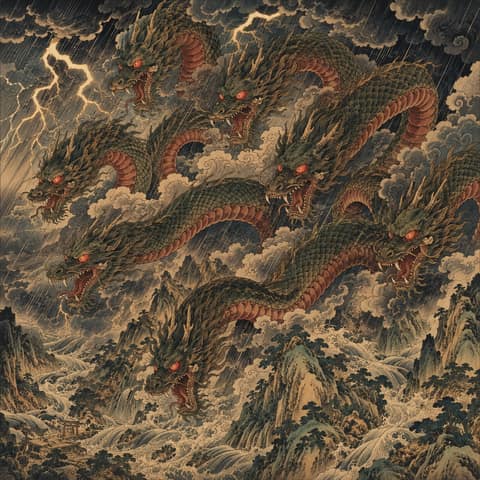
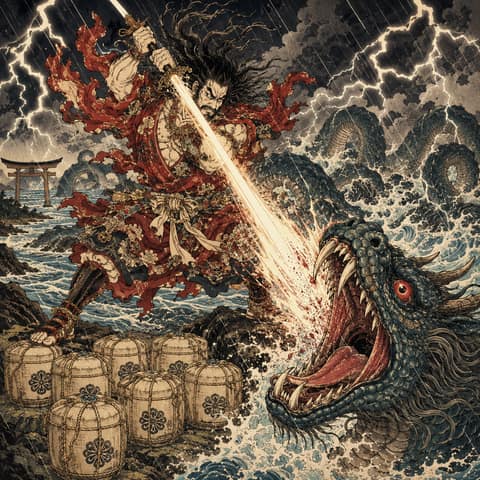
Social Historical Interpretation of Slaying Yamata-no-Orochi. The tale of slaying Yamata-no-Orochi has been interpreted as a multi-layered story reflecting the socio-historical situation of ancient Japan, going beyond a simple heroic monster-slaying myth. The specific descriptions—'eight heads, eight tails, along the Hii River, blood flowing from the belly, an iron sword from the tail'—strongly support the 'iron-making origin theory' (proposed by Takeshi Matsumae, Shohei Mishina, etc.), which suggests that the ancient Izumo tatara iron-making, the iron content of the Hii River, river flooding, and the social organization of iron-making communities were mythologized. Susanoo's heroic tale was formed in intense dialogue with the iron culture of ancient Japan and the nature and society of the Hii River basin, re-evaluated not as a simple myth but containing valuable record layers of ancient social history.
'Eight Clouds Arise' ── Japan's Oldest Waka. The poem Susanoo composed when he built a palace in Suga, Izumo after slaying Yamata-no-Orochi—'Eight clouds arise, the eightfold fence of Izumo creates an eightfold fence to keep my wife in, oh that eightfold fence'—is positioned as the origin of the history of Japanese literature and waka. The basic format of the thirty-one syllables (5-7-5-7-7) was already established here, demonstrating the identification of the birth of songs with mythological heroism in ancient Japan. The fact that the starting point of the entire Japanese waka culture, leading to the Man'yoshu, Kokinshu, and Shin-Kokinshu, is attributed to the mythic hero-god Susanoo symbolizes the inseparability of poetry and mythology in Japanese culture. The opening phrase 'Eight clouds arise' remains a sacred cultural resource repeatedly cited in the world of waka and tanka today.
Syncretism with Gozu Tenno and Medieval Gion Beliefs. From the Middle Ages onward, Susanoo syncretized with Gozu Tenno, derived from Buddhism, Taoism, and the Korean Peninsula, becoming the guardian deity of dispelling epidemics and warding off disasters as the principal deity of the Kyoto Gion Shrine (now Yasaka Shrine). Gozu Tenno is considered a plague god originating from Silla and the Korean Peninsula, and has a complex religious history where Chinese beliefs of the guardian deity of Jetavana Monastery and Japanese Susanoo beliefs syncretized in the Middle Ages. The history of the Gion Goryo-e, initiated in 869 (Jogan 11) to pray for the end of an epidemic spreading in the capital, exceeds a millennium, and was inherited as the largest religious festival for dispelling epidemics nationwide throughout the Edo period, early modern, and modern eras. It continues to be inherited in the 21st century as the Kyoto Gion Festival (a nationally designated Important Intangible Folk Cultural Property) and a UNESCO Intangible Cultural Heritage, showing that the multi-layered overlap of ancient myth and medieval Buddhism continues to exert a sustained influence on the religious life of modern Japan.
Resurgence in Modern Culture. Susanoo has been repeatedly re-sculpted in post-war Japanese subculture works. He frequently appears as one of the strongest demons in the 'Megami Tensei' series, in the portrayal of Susanoo and Kushinadahime in the game 'Okami', as a motif like 'Sun Breathing' in the manga 'Demon Slayer', and in anime such as 'Nura: Rise of the Yokai Clan' and works like 'Touhou Project'. His multi-layered attributes as a 'wild god', hero, ancestor of poetry, and guardian deity against epidemics have high affinity with modern character creation. He is a symbolic figure of ancient mythology who continues to drive the mythological imagination of the Japanese people for over two thousand years.