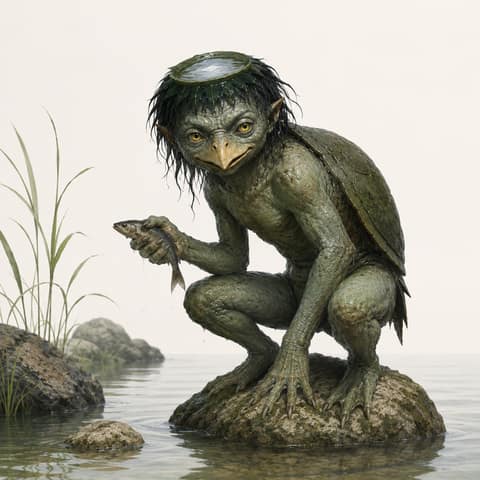
Kappa
KAH-pah
The Dish-Headed River Spirit – Kappa
"Kappa" is not, in truth, the name of any single creature. It is a collective term—the word by which the whole of Japan, each region in its own dialect, has called the water spirits that dwell in rivers and ponds. In southern Kyushu it is the Garappa; in Tōhoku, the Medochi; in Shikoku, the Enko; in Chūbu, the Kawaranbe; in Kinki, the Gataro; in Kyushu again, the Hyosube. From place to place the name and the form shift a little, and the total is said to exceed eighty. Some are close to monkeys, some shaggy with fur, some moving in troops. Yet all share a common core: they live by the water, hold water in the dish on their heads, and drag away people and horses. The kappa, in other words, is the shared name of a vast clan into which all the water spirits of the land have gathered. It is the reading of folklore studies that binds these many variants into one. Yanagita Kunio and Orikuchi Shinobu held that the kappa was originally a god who governed water—a water deity—who declined into a yokai as belief in it faded. The fact that in the komahiki legends the kappa always tries to pull a horse or ox into the water may itself be a memory of festivals in which horses and oxen were offered to a water deity in prayer for a good harvest. In Kappa Komahiki Kō (1948), Ishida Eiichirō compared this bond between horse and water deity with myths from across Eurasia. Precisely because it is a god of water, the kappa draws water to the fields, grants fish, and even hands down bone-setting remedies—while also drowning people and pulling out their shirikodama. Its twin aspects, blessing and curse, are the two sides of a fallen water deity. Traces of the water deity show even in the turning of the seasons. Across western Japan it is widely told that at the autumn equinox the kappa goes up into the mountains to become a yamawaro, and at the spring equinox comes down again to the river to return to being a kappa. The field god who descends from the mountains to the villages in spring, the mountain god who returns to the peaks in autumn—that idea of coming and going maps exactly onto the exchange between kappa and yamawaro. In this way the clan’s variants, too, are bound to one another as a single continuous terrain. The clan even has its legend of a chieftain. On the Kuma River in Kyushu the tale survives of Kusenbō, a kappa general who crossed over from the continent at the head of nine thousand kindred. Having drawn the wrath of Katō Kiyomasa, he was driven from the region, moved to the Chikugo River, and became one of the retainers of the Suitengū shrine in Kurume. That a kappa was imagined not as a lone monster but as a clan linked from river to river is plainly expressed in this tale of a boss. Places tied to the kappa are found all over the country. At Tōno in Iwate there is a "Kappa Pool" (Kappa-buchi) where kappa are said to appear, and at Jōken-ji temple, in honor of a kappa that put out a fire with the water from its head-dish, stand "kappa guardian lions" whose heads are shaped like a dish. At Lake Ushiku in Ibaraki the painter Ogawa Usen, who depicted kappa all his life, was called "Usen of the Kappa," and Tanushimaru in Fukuoka styles itself "the birthplace of the kappa clan." In the Kappabashi district of Tokyo a legend tells of Sumida River kappa who came each night to help a merchant pressing ahead with flood-control works. To this day kappa festivals are held in many places, and the kappa lends its name to sake brands and town mascots alike—remaining the most beloved of all Japan’s water yokai.