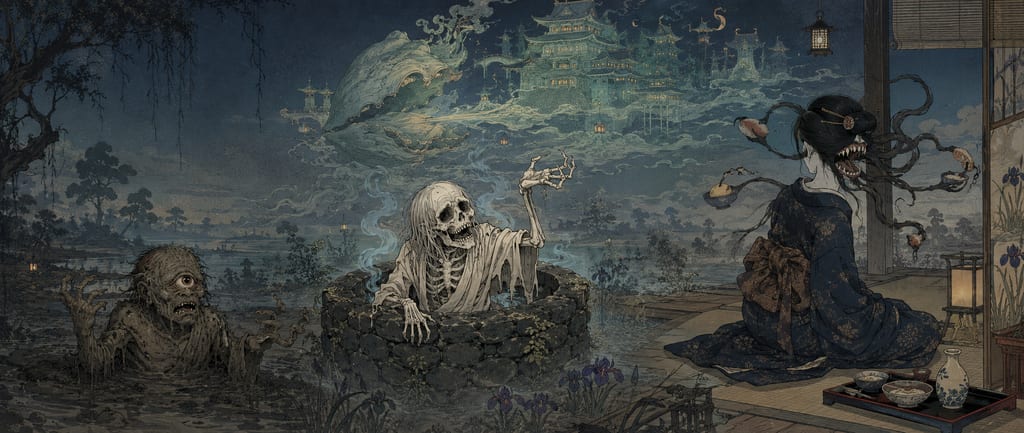
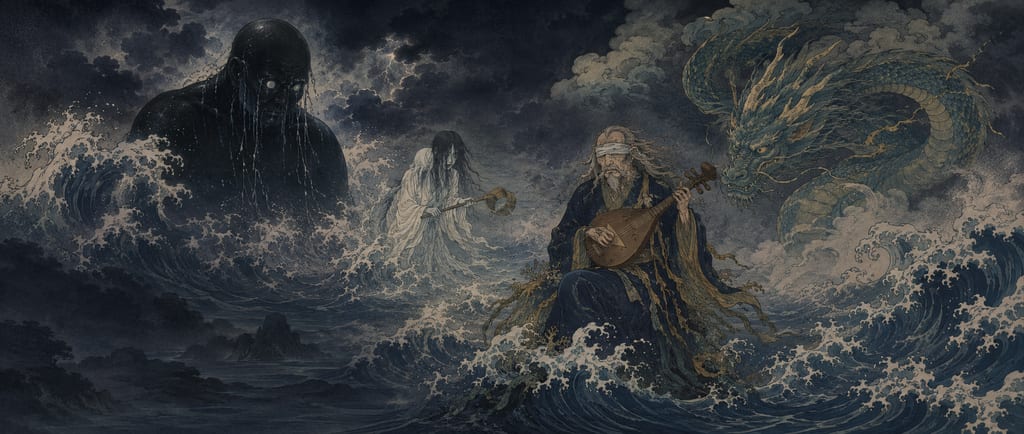
Ayakashi is a broad name for uncanny phenomena and yokai encountered at sea. Its meaning shifts from one region to another, encompassing ghost lights, Funayūrei, and mirages over the water. In Nagasaki it can refer to eerie lights at sea; in Yamaguchi and Saga, to boat-haunting spirits that endanger vessels. On Tsushima, a great fire is said to rise on the shore and then become a mountain offshore, blocking a ship's course. Some communities also connected the name with folk beliefs about the remora, a real fish. Ayakashi stories gave sailors a way to speak about shipwrecks and other dangers whose causes were hard to see.
Folklore & Legends
On Tsushima, a great fire is said to stand on the shore at dusk, with something inside it that looks like a child walking. Offshore, the light becomes the silhouette of a mountain and brings a ship to a halt; if the crew refuses to turn aside and sails straight toward it, the apparition disappears. An Edo-period tale from Bōsō tells of a sailor who asked a beautiful woman beside a well for water. Later, the woman appeared as a creature clinging to his hull, and he escaped only by beating her away with an oar. In the western seas, Ayakashi are also described as the dead of the ocean returning in search of companions. Their forms and names vary because the traditions arose in different coastal communities.
Ayakashi is a name applied to many different maritime apparitions connected with shipwrecks and danger at sea. It may appear as a ghost light, a phantom woman, a sea serpent, or an illusory barrier. Across these forms, the recurring threat is confusion: it distracts a crew, blocks a course, lures people closer, or makes a ship seem unable to advance. On Tsushima, a ghost light is said to become a mountain offshore. Local advice is unexpectedly direct—do not turn away, but sail straight toward it until it dissolves.
In Nagasaki, Ayakashi often means a light drifting over the sea; in Yamaguchi and Saga, the word may refer to Funayūrei. A Bōsō tale instead describes a woman first seen beside a well who later clings to a ship's hull. Folk belief also associated the name with the remora, which was thought to attach itself to a vessel and slow it down. These stories helped coastal communities make sense of strange sights, difficult currents, and the fear of losing one's way at sea. Toriyama Sekien gave the unstable idea a vivid form by depicting Ayakashi as an enormous sea serpent.
Character Profile
This section is our own creative profile for storytelling. It is not historical fact or scholarship.
Persistent and difficult to shake, but unpredictable in when and how it appears.
Compatibility
It is associated with misfortune for sailors and coastal communities, especially when a crew loses its nerve or sense of direction.
Abilities
Appearing as a ghost light that clouds sight and judgmentCreating the illusion of a mountain or barrier across a ship's courseTaking the form of a woman or human figure to lure people closerClinging to a hull and supposedly slowing the vessel
Weaknesses
Decisive action—sailing straight through an apparition or shaking it from the hull—is said to break its hold; crews may also drive it away together with oars or poles.
Habitat
The coasts of Tsushima and Nagasaki, the seas off Yamaguchi and Saga, waters off the Bōsō Peninsula, and the western seas of Japan.
Interested in this type of yokai?
Discover the yokai most similar to your personality with our yokai diagnosis
The diagram below is a diagnostic evaluation chart for Ayakashi: Ghost Lights and Phantoms of the Western Seas. The higher the value of each item, the stronger that characteristic is expressed.
Meet your guardian yokai at the shrine
Draw an omikuji fortune and discover the yokai watching over you today.