Yokai Encyclopedia

Encyclopedia of Japanese Yokai

112 Yokai|14 Category|Page 2 of 5
Localization in Progress - More content available in Japanese version
View Japanese
Sort by: NameAscending
Rare
  • Fuguruma Yōhi (Letter-Carriage Enchantress)

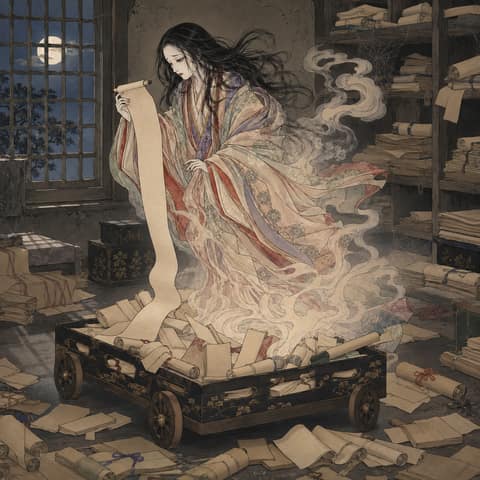
    Fuguruma Yōhi (Letter-Carriage Enchantress)

    Rare

    FOO-goo-ROO-mah YOH-hee

    Iconographic Edition, Sekien Toriyama Source

    Animated Objects & UndeadEdo period

    An interpretation grounded in the imagery and captions of Toriyama Sekien’s Hyakki Tsurezure Bukuro. The document cart was a conveyance for papers in the imperial court, temples, and aristocratic residences, kept ready for emergencies. The accumulated sentiments within long-kept love letters are thought to congeal and manifest as a lady-in-waiting–like apparition. With little basis in oral tradition, this is a conceptual yokai born of early modern literature and painting, more often told as a presence that displays and summons remorse than as one causing concrete harm. The customary name is Fumikuruma Yohi, though later sources sometimes confuse it with Fumikuruma Yoki.

  • Fukuro Mujina (Bag Badger)

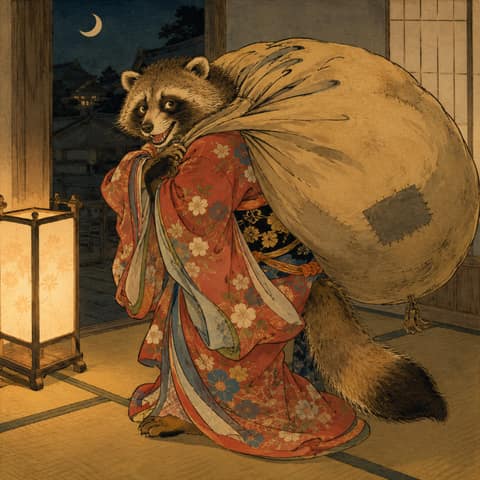
    Fukuro Mujina (Bag Badger)

    Rare

    FOO-koo-roh MOO-jee-nah

    Annotated Iconography Edition (Seiyan-Toriyama Based)

    Animated Objects & UndeadEdo period

    A version grounded in the image and brief annotation from Toriyama Sekien’s Hyakki Tsurezure Bukuro. It appears as a womanly mujina carrying a night-duty bag over her shoulder, yet from another angle the bag itself may be the yokai, with the porter’s pose serving as a metaphor. Its conduct lures people into rash judgments and lays bare the absurdity of empty speculation. Actual harm is slight, limited to confronting those who “rummage in the bag” of guesswork on night roads or in parlors and leaving them disgraced. True to picture-scroll lineage, no fixed era or locale is given, favoring witty identification and playful satire.

  • Furaku-Furaku (The Dangling Lantern Spirit)

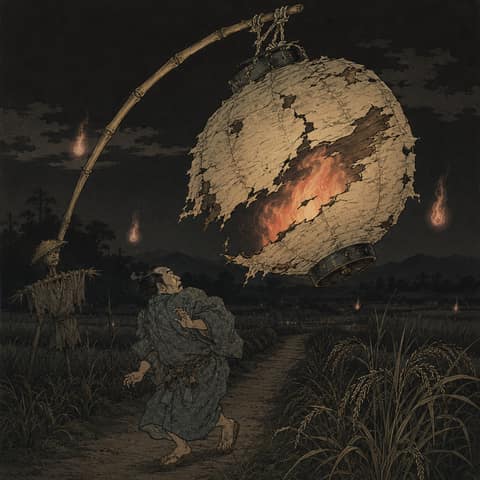
    Furaku-Furaku (The Dangling Lantern Spirit)

    Rare

    boo-RAH-boo-RAH

    Sekien Plate Standard

    Animated Objects & UndeadJapanese folklore

    An arrangement of Furafurabu based on the depiction in Toriyama Sekien’s Hyakki Tsurezure Bukuro. The lantern is tied to bamboo, its torn paper resembling a mouth, tilting as it looms over the road. The scene evokes rice field ridges and scarecrows, and while the caption mentions “the lantern fire of Yamada,” it also muses that it might be foxfire. This yields competing readings—either a fox in disguise or a transformed implement—but since the volume files it among tool-spirits, understanding it as a tsukumogami is appropriate. The name varies between “Fufuraku” on the image and “Furakaku” in the catalog, though “Furafurabu” is generally accepted. No fixed local legends or concrete curse tales survive; it is received as a subtype of the generic lantern yōkai, a visual fright that startles travelers at night.

  • Furari-bi (Wandering Flame)

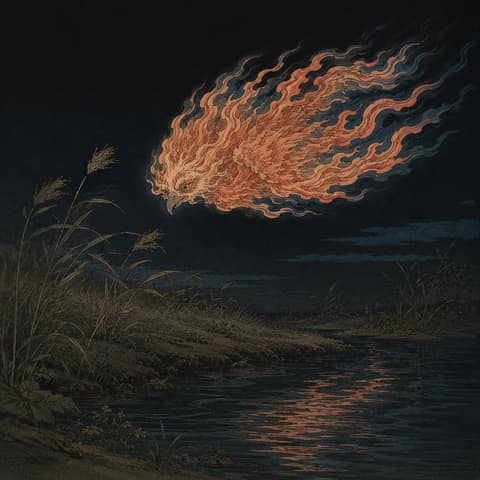
    Furari-bi (Wandering Flame)

    Rare

    foo-RAH-ree-bee

    Furari-bi

    Natural Phenomena SpiritsJapanese folklore

    Based on Edo-period picture scrolls, this version standardizes Furari-bi as a bird-shaped eerie flame wreathed in fire. It behaves more like a phenomenon than a corporeal being, with sightings reported from dusk through midnight. Confirmed cases of causing harm are scarce, and it shares common will-o’-the-wisp traits such as vanishing when approached and reappearing when one retreats. In Toyama it is called “Burari-bi,” often explained as a ghostly fire born from grudges or the unclaimed dead, though interpretations vary by region. The avian visage in the iconography is ambivalent, serving as a symbolic sign of the soul’s metamorphosis.

  • Furisode-no-kai

    Furisode-no-kai

    Rare

    furisode-no-kai

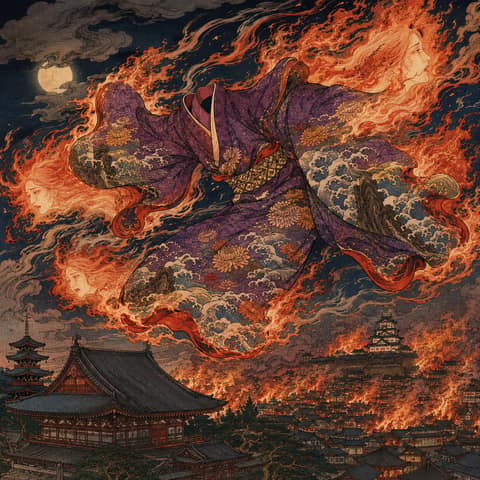
    The Furisode That Burned Edo: The Furisode Fire

    Dwelling / ObjectTokyo

    The *Furisode-no-kai* is characterized by the fact that it is an "anomaly where an object and a disaster become one," lacking the form of a specific yokai. Its core consists of a dual structure: on the inside, there is the curse of an object where a *furisode* imbued with the thoughts of the dead takes the life of its new owner (a passion akin to a *tsukumogami*); on the outside, there is the great disaster where the fire burning the *furisode* loses control and burns down the entire city. The former is a typical example of the many "cursed garments and mementos" tales in Edo, while the latter is the real historical tragedy of the Great Fire of Meireki. The originality of this ghost story lies in stitching the two together. For the residents of Edo, fires were the greatest terror. While praised as "Fires and brawls are the flowers of Edo," once a fire spread, the wooden cityscape easily turned to ashes. The *Furisode-no-kai* can be said to be a product of imagination unique to urban ghost stories, translating that terror into an easily digestible tale of a single garment's fate, giving a face and a reason to an indiscriminate disaster.

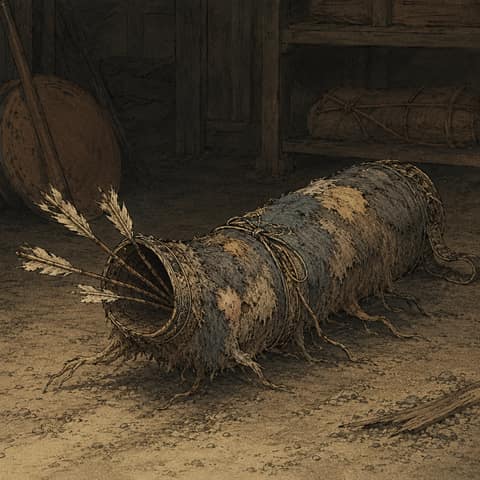
  • Furu-Utsubo (Aged Quiver Spirit)

    Furu-Utsubo (Aged Quiver Spirit)

    Rare

    FOO-roo OOT-soh-boh

    Toriyama Sekien Iconography Standard

    Animated Objects & UndeadJapanese folklore

    Grounded in the classic image from Toriyama Sekien’s Hyakki Tsurezure Bukuro, it is understood as an aged leather or fur-covered utsubo quiver that raises its mouth and creeps along the ground. Its origin is not from a clear oral tale but from the tsukumogami belief that objects become ensouled with age. The accompanying text names the warrior who shot the field fox of Nasu no Hara (Tamamo-no-Mae), hinting that a quiver once emblematic of martial glory turns yokai after being forgotten. An earlier prototype is presumed in Muromachi-period Night Parade scrolls depicting object-spirits bearing bow and arrows, which Sekien reinterpreted and named. By night it slowly roams deserted roadsides and house shadows, said to make a sound like fletchings brushing. It is not strongly malicious, but when treated roughly it creaks and cries in warning, stirring memories of its former master.

  • Futon-kabuse

    Futon-kabuse

    Rare

    Futon-kabuse

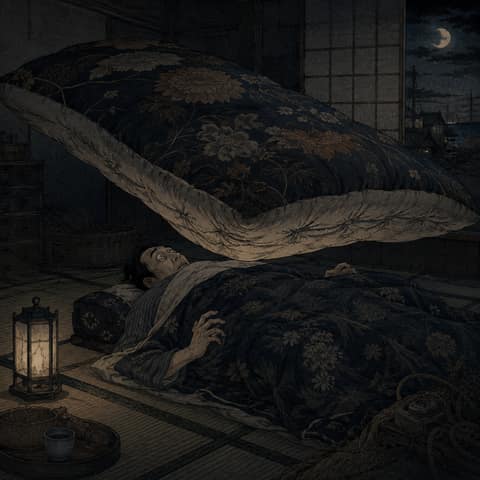
    Weight Falling on the Bed: Sakushima Futon-kabuse

    Dwelling / household objectAichi

    This version focuses on the process of retelling through which modern yokai encyclopedias have shaped this apparition. The primary source preserves only the bare structure: "it comes softly, slips over the person, and suffocates them." Postwar yokai encyclopedias, including lines descending from Mizuki Shigeru's Nihon Yōkai Taizen and illustrated references edited by Kyōgoku Natsuhiko and Tada Katsumi, took that single sentence as a starting point and added details such as "a futon that feels light gradually becomes heavy" or "it falls silently while the person is asleep." These are later embellishments not grounded in the primary record. At the same time, they work well as a way to convey to modern readers the nighttime bodily sensations of a fishing village: the weight of bedding dampened by sea wind, sleep paralysis from exhaustion, and the cold dampness of the tide creeping in from the sea. The fact that it has no counterpart in Toriyama Sekien - a modern coastal-folklore apparition that does not fit inside Edo picture-scroll yokai - has also left later artists and writers room to imagine its form freely. That openness is part of Futon-kabuse's modern character.

  • Goho-doji (Ototen & Wakaten)

    Goho-doji (Ototen & Wakaten)

    Rare

    ごほうどうじ(おとてん・わかてん)

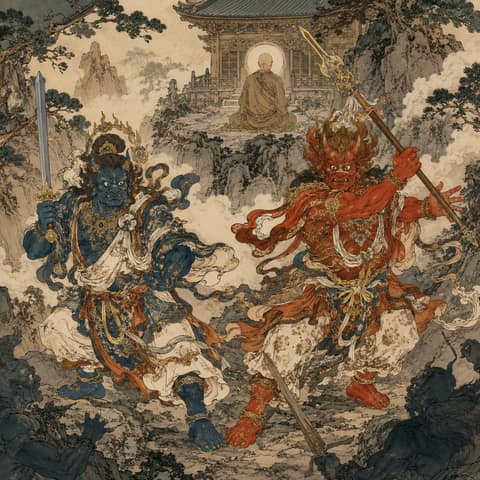
    The Two Youths Protecting Shoku Shonin: Ototen and Wakaten

    Deities / Divine SpiritsHyogo

    Ototen and Wakaten are a pair of *Goho-doji* (Dharma-protecting youths) who attended Shoku Shonin, the founder of Engyoji Temple on Mount Shosha. Ototen is said to be an incarnation of Fudo Myoo and Wakaten an incarnation of Bishamonten. In the forms of a blue ogre and a red ogre respectively, they protected the holy man on his left and right, fetching firewood and water and repelling enemies during his mountain asceticism. They embody the inherent duality of *Goho-doji*—fierce ogre-deities who nevertheless submit to a holy monk and protect the Buddhist teachings—within the context of Harima's mountain Buddhism. They are still enshrined today in the Ototen Shrine and Wakaten Shrine (built in 1559, Important Cultural Properties) next to the Okunoin of Engyoji Temple. Subjugating fierce power and turning it toward good—these child-formed ogre-deities commanded by highly virtuous ascetics reflect the religious imagination of medieval Japan.

  • Golden Crow

    Golden Crow

    Rare

    KEEN-oo (Kin-ū)

    Golden Crow

    Animal ShapeshiftersChinese origin; transmitted to Japan

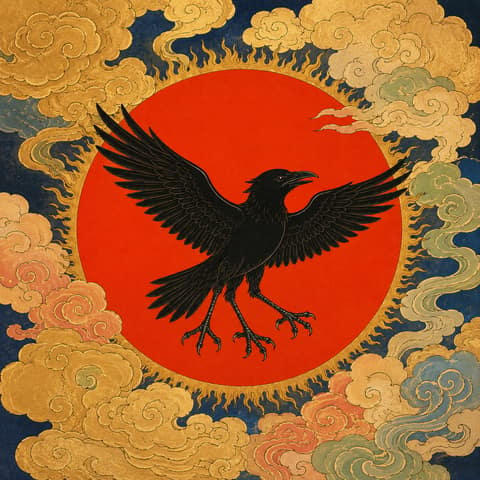
    Rooted in ancient China, this iconographic Golden Crow took hold in Japan from the medieval period through religious art and Onmyōdō interpretations. It rarely appears in concrete怪談 and functions chiefly as a symbol. Its three legs are read as the yang number three, marking the sun’s course, authority, and auspice. In Japanese examples, a black crow is placed upon the solar disk held by the Sun Deva, with vermilion and gold backgrounds. Early modern texts sometimes liken it to solar sunspots, but its original nature is mythic and ritual. It recurs on imperial ceremonial garments, temple and shrine banners, and paintings, and in folk events crows may be used with archery targets or sun emblems. Later explanations sometimes confuse it with Yatagarasu, but their origins and roles are distinct.

  • Gongo

    Gongo

    Rare

    ごんご

    The Water Deity of Nozoki-buchi: Gongo

    Water ApparitionsOkayama

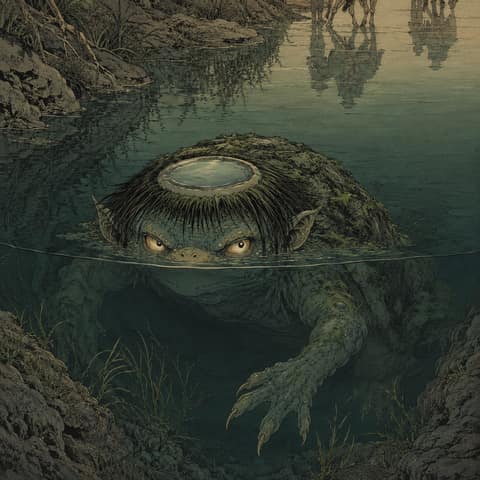
    Gongo is a kappa whose home territory is "Nozoki-buchi" in the Yoshii River of Tsuyama. While possessing the general characteristics of a kappa (a dish on its head, a shell, a love for sumo, and a habit of dragging people and horses underwater), it is distinguished from kappa of other regions by its Mimasaka dialect name and the local lore of Nozoki-buchi. Its name is said to be either a corruption of "Kawako" (river child) or derived from the water deity "Kongo," embodying both the divine nature of governing water and the monstrous nature of causing drowning accidents. By dwelling in the river pools that flow through the castle town, it stands on the boundary between the urban space of Tsuyama and the waterside, acting as the narrator of taboos that keep children away from water hazards. Since the modern era, it has transformed into a festival icon and a mascot-like symbol, becoming the face of the local region.

  • Gooseflesh Specter

    Gooseflesh Specter

    Rare

    MEE-no-keh-DAH-chee

    Emaki Iconographic Type: Hair-Raising Figure

    Household SpiritsJapanese folklore

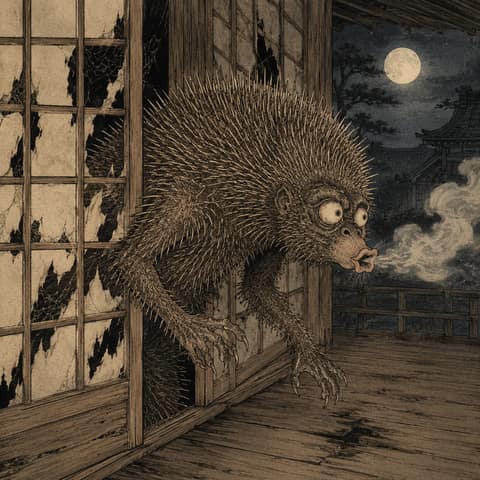
    An image-based yokai originating from picture scrolls without accompanying text, making its function and temperament hard to define. Its bristling, hair-standing posture suggests a visual motif of fear or dread, yet sources provide no explanation and no firm conclusion can be drawn. Names vary by source, and related figures may appear under different titles. Here, characterization is kept minimal, grounded only in the image’s form and the extant manuscripts.

  • Gotoku Neko (Trivet Cat)

    Gotoku Neko (Trivet Cat)

    Rare

    GOH-toh-koo NEH-koh

    Iconographic Tradition, Sekien-Centered Version

    Animal ShapeshiftersJapanese folklore

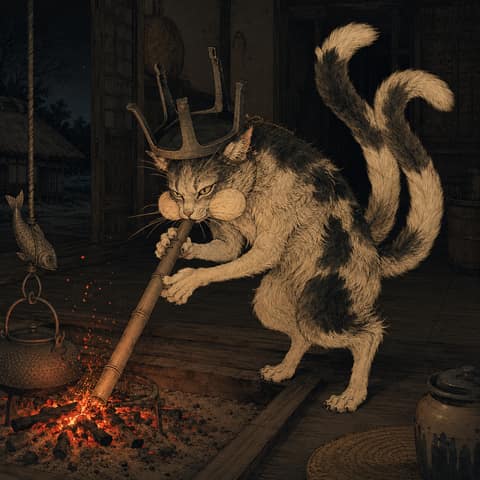
    This version reconstructs the Gotoku-neko based on Toriyama Sekien’s original image and earlier iconography. An aged cat with a forked tail wears a trivet like a crown and lingers at the hearth’s edge. In Hyakki Tsurezure Bukuro, Sekien plays with the boundary between tool-spirits and animal-spirits, citing Tsurezuregusa’s “Crowned Trivet” and offering a punning interpretation. Thus the Gotoku-neko is not merely a monster cat but a symbolic being linking utensils and literary sources. The Muromachi-period Night Parade scrolls show a yokai bearing a trivet among figures balancing tools on their heads; Sekien follows that lineage while giving it a feline form. The postwar notion that it “kindles fire by itself” derives from later guesses about the depicted blowpipe; older records do not specify such acts. Accordingly, in this version it is restrainedly treated as an apparition seen by the hearth, attended by the presence of fire.

  • Grave Fire

    Grave Fire

    Rare

    HAH-kah-noh HEE

    Traditional Iconography Edition

    Natural Phenomena SpiritsGraveyards across Japan, notably Kyoto Prefecture

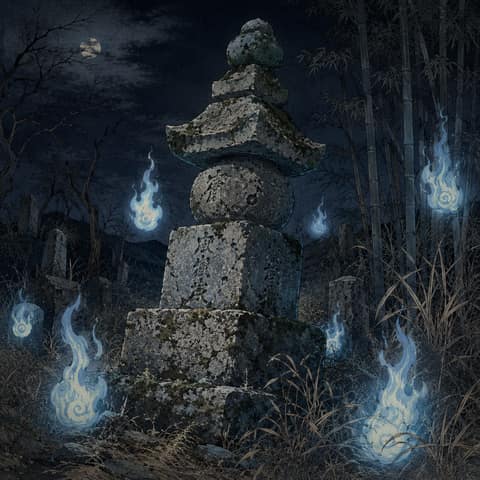
    A grave-fire image based on Sekien’s iconography. The pairing of a ruined graveyard, overgrown thickets, and a five-ring stupa with worn Sanskrit letters symbolizes the idea of fire dwelling in places without kin or proper memorials. Early modern tales describe it as a phosphorescent flame rising from human fat or grave soil, yet also tell of cases where chanting sutras or repairing the stupa makes it vanish, showing the overlap of religious practice and naturalistic views. The flame drifts as if following human silhouettes, but slips away when touched. Malice is rare, and it is rumored to light the path ahead like a guide.

  • Great Tonsure

    Great Tonsure

    Rare

    OH-kah-BOO-roh

    Sekien Iconography Standard

    General ClassificationsEdo period

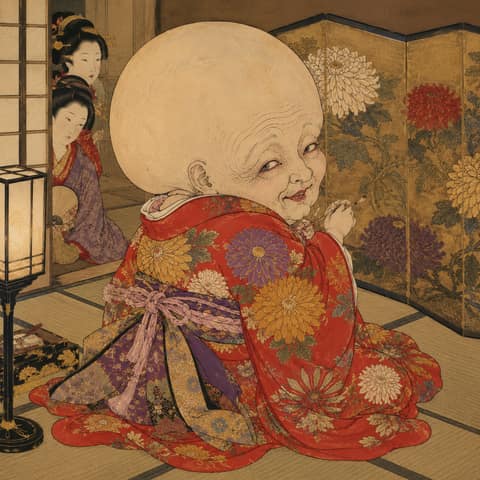
    A Daikatsura interpreted strictly through Toriyama Sekien’s original imagery. Rather than a concrete monster, it functions as a satirical figure borrowing the iconography of brothel pages and the immortal youth Kikujidō. The chrysanthemum-patterned long-sleeved robe evokes tales of longevity and coded slang, while the shaved scalp suggests a paradox of childlike form and senescent decay. Mentions of Nachi and Kōya serve as metaphors for the contradiction between ascetic rule and transgression. The oversized childlike body in the picture imparts an uncanny yet comic effect. Historical sources list no specific powers or harms, and its appearances are confined to the pictorial frame. Despite the similar name, it is a different lineage from the later “Ōkamuro.”

  • Hair Oni (Kamikki)

    Hair Oni (Kamikki)

    Rare

    KAH-mee-oh-nee

    Sekien Zukai Edition

    Animated Objects & UndeadJapanese folklore

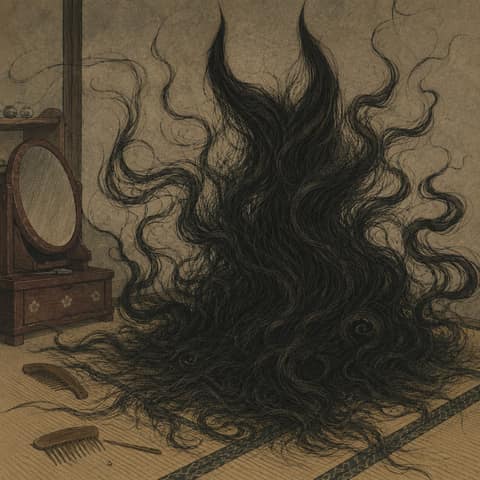
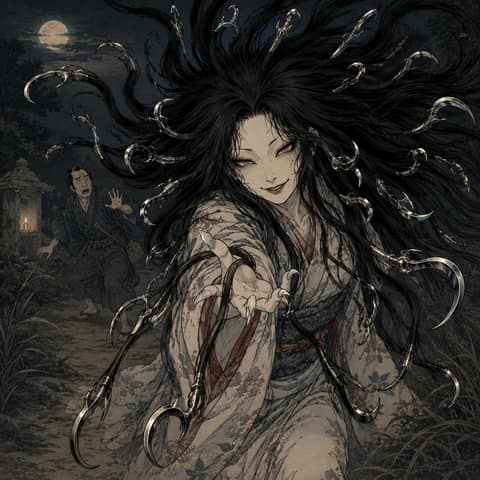
    An iconographic reading of the Hair Demon as depicted in Toriyama Sekien’s Hyakki Tsurezure Bukuro. A woman’s hair, infused with its owner’s passions, becomes autonomous, standing on end at midnight as its locks extend and contract like living things. Cutting it offers only brief respite, for it regrows and multiplies at once. Rooted in a dual folk view that both sanctifies and shuns hair, it is shown as a being where tsukumogami traits cross with vengeful-spirit nature. Its body is a mass of hair without face or limbs, asserting menace through motion and shifting length. Memorial offerings and proper hair-cutting rites are said to calm it, yet no certain banishment method is recorded.

  • Hand from a Kosode Sleeve

    Hand from a Kosode Sleeve

    Rare

    koh-SOH-deh no TEH

    Iconographic Tradition, Based on Sekien Toriyama

    住居・器物Edo period

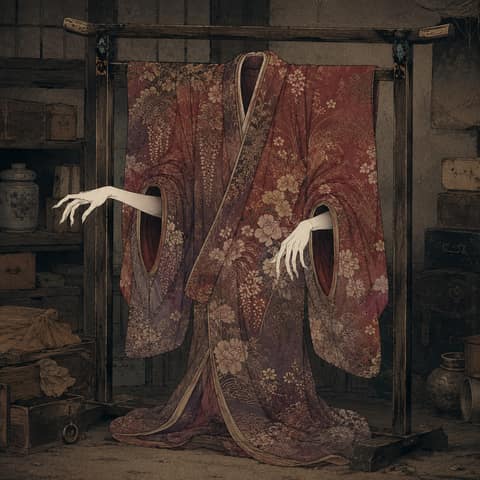
    An interpretation aligned with Toriyama Sekien’s imagery and accompanying text. Only a white feminine hand emerges from the sleeve opening, while the absent owner is signified by the garment itself as the main subject. The kosode was a fine everyday robe of the time; whether it became a keepsake, was dedicated to a temple, or sold marks the branching fate, with spiritual disturbance manifesting as attachment residing in the clothing. It layers commentary on courtesans’ circumstances and the irony of buyout money with an aesthetic for dress and a sense of impermanence, functioning less as a concrete monster than as a “visible metaphor.” In folktales, illness after acquiring secondhand clothes and nightly apparitions of a white hand often cease once the robe is offered to a temple and sutras are chanted. Situated at the crossroads of possessed objects and ghost lore, it can be read as tsukumogami, yet its focus remains the emotions of the garment’s former owner.

  • Hanzaki Daimyojin

    Hanzaki Daimyojin

    Rare

    はんざきだいみょうじん

    The Curse-Deity of Ryuzu no Fuchi: Hanzaki Daimyojin

    Water YokaiOkayama

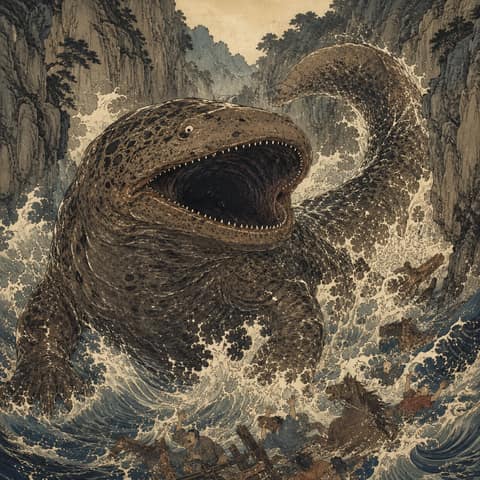
    It is not a half-human, half-yokai, but rather a "half-god, half-beast" monster whose core is a highly realistic slaying tale recorded in the Mimasaka topography *Sakuyo-shi*. The biological Japanese giant salamander is an actual Special Natural Monument inhabiting the Asahi River system; its bizarre appearance and longevity sparked the imaginative belief that it was immortal and "wouldn't die even if torn in half." Its gigantified form was feared as the master of Ryuzu no Fuchi. The causal chain wherein the slain creature's curse wiped out the Mitsui family speaks of the beast's grudge destroying even the victorious slayer, ultimately only quieted by enshrinement. It possesses a rare structure combining a monster-slaying tale, a curse tale, a deification tale, and a festival origin. At the Hanzaki Center in Yubara Onsen, live giant salamanders are still protected and exhibited today, making it a land where legend and reality exist side-by-side.

  • Hatahiro

    Hatahiro

    Rare

    HAH-tah-HEE-roh

    Emaki Source – Sekien Edition

    付喪神・骸怪Japanese folklore

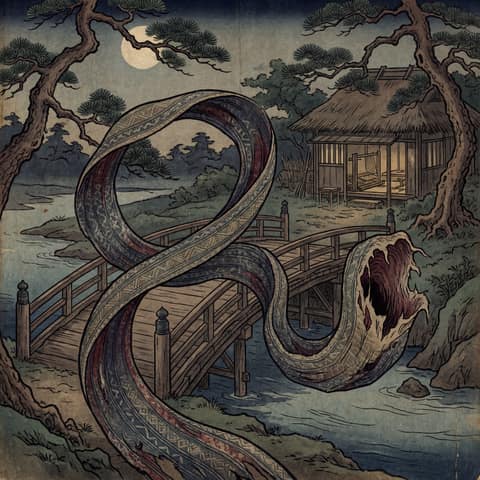
    A version based on the conceptual monster Toriyama Sekien presented through painting and notes. Resentment dwelling in a cloth takes serpentine form and wanders in search of its master, merging the symbolism of tool-spirits and snakes. As folklore data, independent oral accounts are scarce, so it remains a pictorial taxonomy that links tsukumogami tales with legends of loom sounds heard near water. Etymological notes mention associations with the performance term “nijūhiro” and wordplay, but firm sources are limited. Visually, a long bolt of cloth writhes into a snake shape, its tip commonly rendered like a tongue or a slit.

  • Heiroku

    Heiroku

    Rare

    HAY-roh-koo

    Iconography-Concordant Version

    Animated Objects & UndeadJapanese folklore

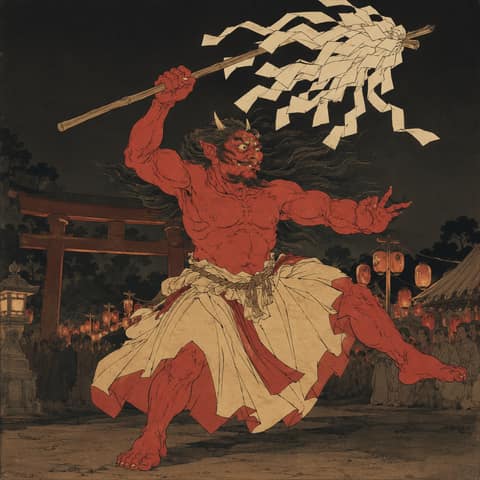
    An interpretation grounded in Toriyama Sekien’s examples and Muromachi picture scrolls, taking the aberrant figure bearing a gohei as its standard. The paper-streamer wand signals ritual purity, yet Henroku brandishes it as an emblem of turmoil. It is not tied to any specific land or person, and is understood as an allegorical presence that appears where festivals or shrine order falter. Later traditions sometimes read it as a tsukumogami inhabiting the gohei, but firsthand accounts are scarce, and it is discussed chiefly within the lineage of visual iconography.

  • Hichigee

    Hichigee

    Rare

    hichigee

    The Visiting God Touring the Island at the Turn of Seasons: Hichigee

    Gods / SpiritsKagoshima

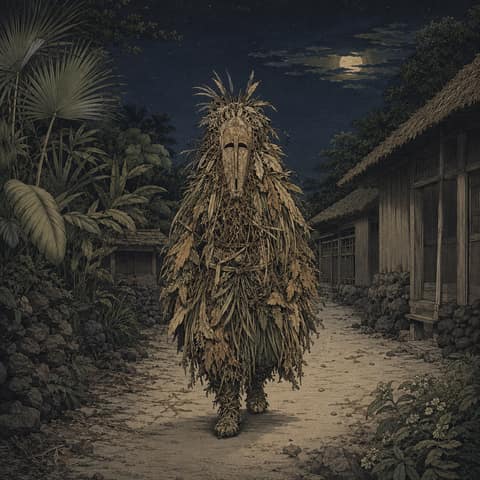
    Rather than a specific singular *yokai*, *Hichigee* is a concept that collectively refers to the time, the phenomenon, and the divine spirit itself when 'gods come to the island at the change of seasons'. In the Tokara calendar, there are several turning points in a year, and on those nights, the boundary between the human realm and the divine realm was said to thin, and the gods would silently tour the island. The reason people refrained from going out, lowered their voices, and purified fire and doorways was to avoid hindering the unseen visitors and to prevent impurities from being brought in. On Akusekijima, this time of awe took the form of a masked god, surviving to this day as *Boze* appearing on Bon nights. While *Boze* is a 'visible' visiting god with Livistona leaves and grotesque masks, *Hichigee* was originally an 'invisible' god to be feared, situated in the oldest geological layer of the Tokara visiting god beliefs. The duality of entertaining while fearing the gods, and the structure of ancestral spirits (*Shichito Shogatsu*) and gods (*Hichigee*) visiting the island alternately, resonates deeply with the maritime worldview of the otherworld found in the southern islands.

  • Hidden Hamlet

    Hidden Hamlet

    Rare

    kah-koo-reh-ZAH-toh

    Sekien Zue Version: Hidden Village

    山野の怪Japanese folklore

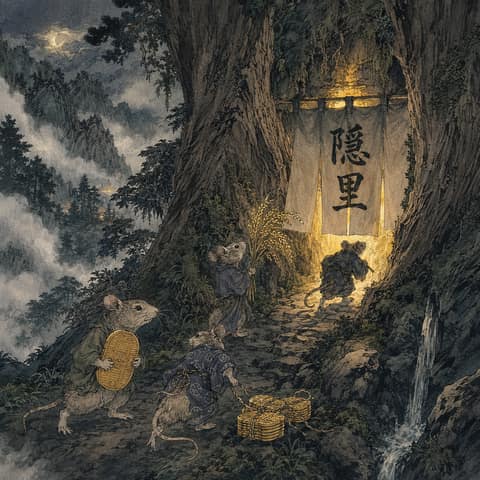
    An interpretation based on Toriyama Sekien’s Konjaku Hyakki Shūi entry “Kakurezato” (Hidden Village). The mouse and koban coins at the lower right recall tales in which subterranean mice carry wealth (the so‑called Nezumi Jōdo legend), hinting at ties between the village and chthonic or underworld realms. The shop curtain reads “Kakurezato,” expressing a boundary that opens suddenly as an extension of the everyday. The Hidden Village is not a single yokai but a boundary acting as if it has will, repeating wayfinding confusion, temporal slippage, the granting of fortune, and cycles of manifestation and disappearance. Outcomes swing with a visitor’s conduct and greed, from generous hospitality to wealth turning into leaf-litter, resonating with mountain otherworld tales and views of the beyond.

  • Hienma

    Hienma

    Rare

    hee-EN-mah

    Didactic Tale, Classical Iconography Adherent

    Half-Human BeingsEdo period

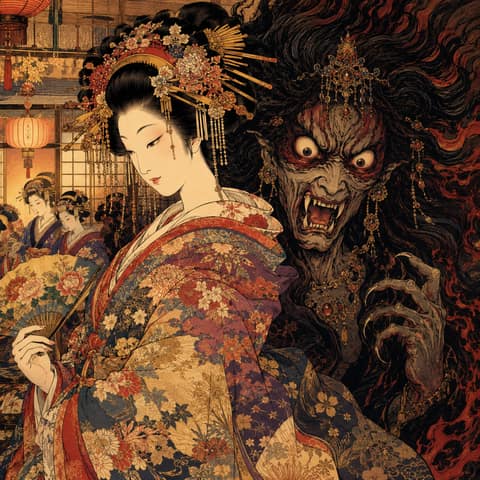
    Rather than a concrete monster, the Hienma is a name that visualizes ruin born of lust. It belongs to the lineage of religious admonitions found in early modern yomihon and kaidan, and is often depicted in two aspects, bodhisattva-like and yaksha-like. More than appearing directly before a person, the original usage names incidents in which demonic hindrance intrudes upon human bonds. Later ages sometimes conflated it with vampiric or life-draining femme fatales, but in classical sources the moral lesson is central, and few fixed tales tie it to specific places or persons. Here it is framed within the classical scope as a symbolic presence that triggers a chain of temptation, delusion, and the decline of household fortunes.

  • Himamushi Nyūdō

    Himamushi Nyūdō

    Rare

    HEE-mah-moo-shee nyoo-DOH

    Toriyama Sekien Iconography Reference

    Household SpiritsEdo period

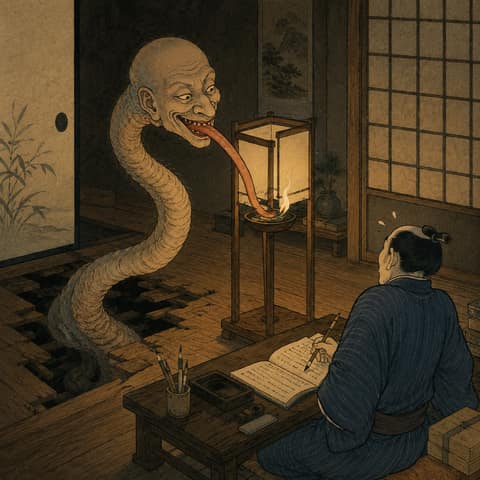
    A reference edition compiled from the illustration and note in Toriyama Sekien’s Konjaku Hyakki Shūi. From beneath the floorboards extends the gaunt upper body of a nyūdō, lips slick, tongue reaching toward the saucer of an andon lamp. Its core origin is a didactic reading: the spirit of one who shirked labor appears nightly to lick the lamp oil, weakening the flame and hindering brushwork and needlework. The name connects to the letter-picture pun “Hemamushiyo Nyūdō,” suggesting a background in doodle play. In lived experience it overlaps with oil-loving bugs seen around hearths and kitchens, told as a being lured by darkness and the smell of oil. It causes no grave harm, preferring to make the flame waver, dampen the wick, and sap one’s focus. When spotted and scolded it shrinks back, a creature strongly inclined to hide in the shadows.

  • Hiyori-bō (Fair-Weather Monk)

    Hiyori-bō (Fair-Weather Monk)

    Rare

    hee-YOH-ree-boh

    Sekien’s Illustrated Edition: Hiyori-bō

    Weather & Calamity SpiritsIbaraki

    An interpretation based on Toriyama Sekien’s image in Konjaku Gazu Zoku Hyakki of a yokai that governs fair weather. Said to be sighted in the mountains during sunny days and absent when it rains. Historical field lore is scant; the figure seems to layer folk weather prayers (teru-teru-bōzu, hiyori-bōzu) and the image of weather-working ascetics or monks onto a yokai form. Identification with Chinese drought deities is a modern scholarly view without direct evidence. Thus its form is told as a simple monk-like silhouette, a symbolic bearer of prayer for clear skies and the act of watching for good weather.

Showing 25 - 48 of 112 yokai