Yokai Encyclopedia

Encyclopedia of Japanese Yokai

112 Yokai|14 Category|Page 4 of 5
Localization in Progress - More content available in Japanese version
View Japanese
Sort by: NameAscending
Rare
  • Momongaa

    Momongaa

    Rare

    moh-mohn-GAH-ah

    Momongaa (Print-Illustration Variant)

    General ClassificationsJapanese folklore

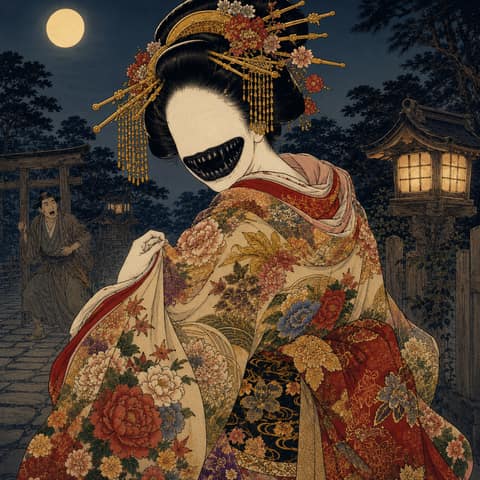
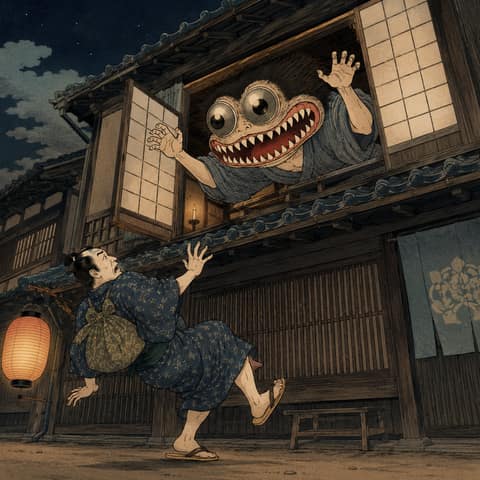
    An image based on what appears in Edo-period prints. It thrusts out huge round eyes and a split mouth from an upstairs doorway or by a paper screen, baring sharp teeth to bluff and frighten, or writhes on all fours as a white lump of flesh with stubby limbs. Its name has the ring of a shouted call, and it is depicted as a specter that turns away nighttime visitors. It claims no personal name or lineage, emphasizing a showy display of monstrous features.

  • Momonji (the Hundred-Old Man)

    Momonji (the Hundred-Old Man)

    Rare

    MOH-mohn-jee

    Iconographic and Textual Standard (Sekien Line)

    Mountain & Wilderness SpiritsUncertain; depicted in Edo-period picture scrolls

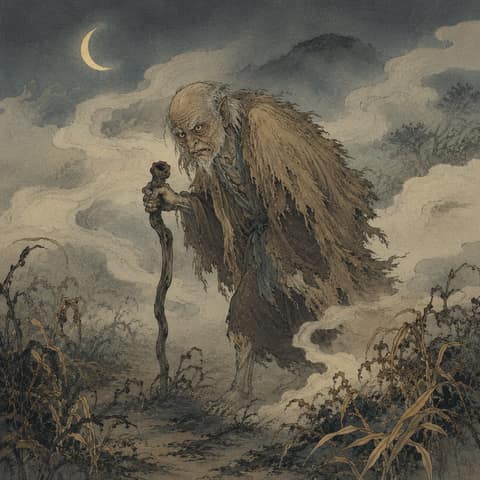
    Based on Toriyama Sekien’s image and notes, this version frames the entity as an old man–shaped specter appearing on open fields at midnight. Its name is taken as a blended form of child language like “momon-ga” and “gagoji,” embodying generalized fear of monsters. The belief that witnesses fall ill aligns with older notions that contact with the uncanny brings impurity and sickness, with no concrete acts of harm described. Early modern taboos against eating game and the euphemism “momonjii” may have encouraged its visualization through name association. Later readings place it as dwelling in mountains yet appearing at street corners to startle people, or as the city-going form of the nobusuma, but primary tradition is scant and no broad folktale type is attested. Accordingly, this version treats specifics as unclear, emphasizing its scenic traits—encounters on nighttime fields, fog, and wind—and its feared power to bring illness.

  • Mountain Sprite (Sansei)

    Mountain Sprite (Sansei)

    Rare

    SAHN-say

    Traditional Account (Wakan Sansai Zue and Sekien Lineage)

    Mountain & Wilderness SpiritsChina – around Anguo County, Hebei Province

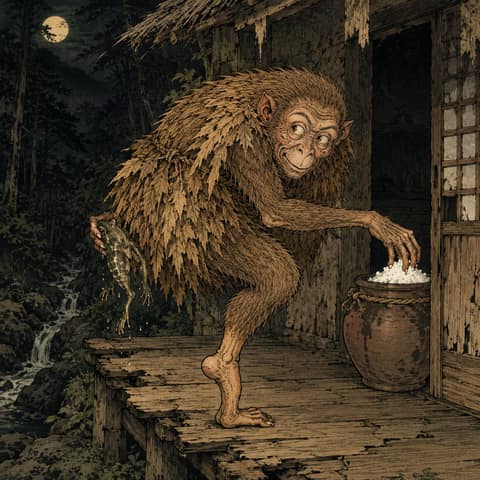
    This version draws on Chinese materials cited in the Edo-period encyclopedic Wakan Sansai Zue and on Toriyama Sekien’s pictorial interpretation. The mountain spirit lurks in the hills, watching mountain huts where salt is set out for cooking or work and edging closer to them. Sources differ on size, some saying about one shaku while others claim three to four shaku. Its hallmark is a single leg with a heel set backward, making its tracks hard to read. It favors small wetland creatures like crabs and frogs and appears along stream gullies. It is said to bring lustful harm at night, but will retreat if the drought deity’s name “Batsu” (Hatsu/Boatsu, the Chinese demoness Ba) is spoken, a type of name-utterance apotropaic. Those who harm or consort with it suffer illness or fires, functioning as a cautionary taboo against contact. In Japan, Sekien labeled it “Yamaki” (mountain demon) and depicted it peering into a hut with a crab in hand, providing visual cues; local oral lore is scant, and treatment remains largely bibliographic. Modern reinterpretation is restrained, keeping to the contours of old records.

  • Myobu

    Myobu

    Rare

    myobu

    The White Divine Messenger of Inari Okami, Myobu

    Animal TransformationKyoto

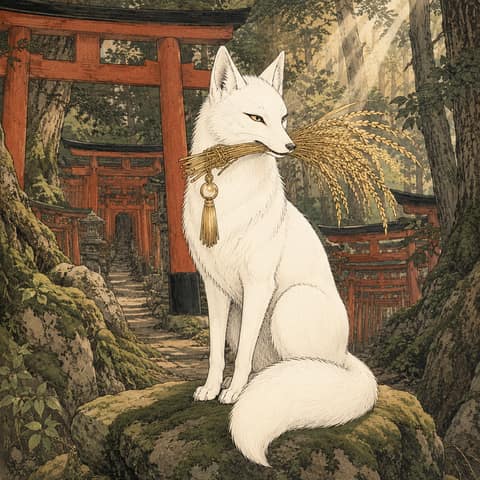
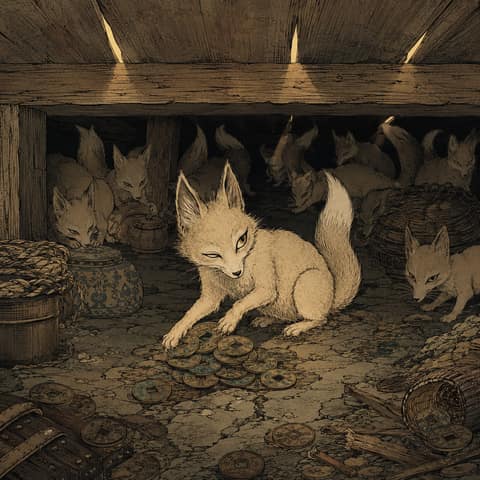
    Myobu is the deified form of the white foxes serving as the familiars of Inari Okami, enshrined as "Myobu Tome-no-Kami" at Byakkosha, a subordinate shrine of Fushimi Inari Taisha. Unlike secular beliefs that worship foxes themselves as gods, the essence of Myobu lies in its reference to white foxes acting as divine messengers attending closely to the deity. "Myobu" is a title derived from the ranks of court ladies under the Ritsuryo system. Because they serve Inari Okami, who holds the Senior First Rank, the white foxes were likened to high-ranking court ladies of the imperial palace. The shrine building of Byakkosha, built during the Kan'ei era in the one-bay Kasuga-zukuri style with a cypress bark roof, is an Important Cultural Property. Initially called "Oku-no-Myobu" or "Myobusha," it is said in Harumitsu Harada's "Inari Jinja Engi" to enshrine Akomachi and Osusukiroku, originating from a court lady named Susumu Myobu. The statues of white foxes holding rice ears, scrolls, keys, and jewels in their mouths are an iconographic expression showing that Myobu is a pure divine messenger mediating the harvest of fields, words, storehouses, and treasures.

  • Nadezatō (the “Smoothing” Blind Monk)

    Nadezatō (the “Smoothing” Blind Monk)

    Rare

    NAH-deh-zah-TOH

    Iconography-Based Version

    General ClassificationsYatsushiro, Kumamoto Prefecture (Matsui Collection)

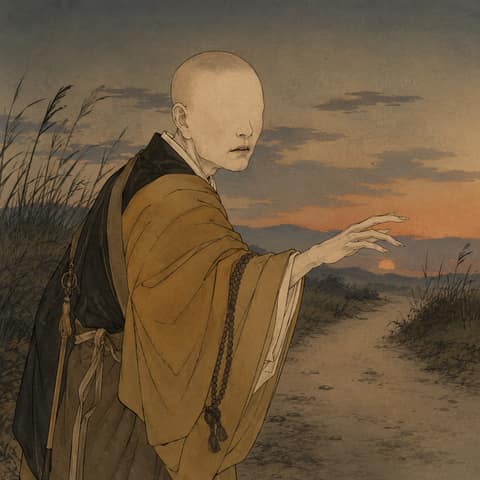
    This version relies solely on images from picture scrolls with minimal notes. Nade-zato has a transmitted name and appearance, but the textual account is missing, so its nature and conduct cannot be fixed. The iconography shows a shaven-headed, blind masseur-like figure with eyes left undrawn; some depictions emphasize long fingers or claw-like hands. Related imagery includes an identical type titled “Mugan” (No-Eyes) in Edo-period Hyakki-zu, suggesting variant naming. Tada Katsumi notes that nade may connect to nademono, which transfers defilement by touch, and to an old byname for “cat,” hinting at a being that feigns meekness to hide its true nature; however, this is scholarly interpretation, not a firm local tradition. Accordingly, abilities, weaknesses, and habits are scarcely recorded and should be treated as unknown.

  • Net-Cutter

    Net-Cutter

    Rare

    AH-mee-kee-ree

    Iconographic Standard, Traditional Interpretation

    General ClassificationsJapanese folklore

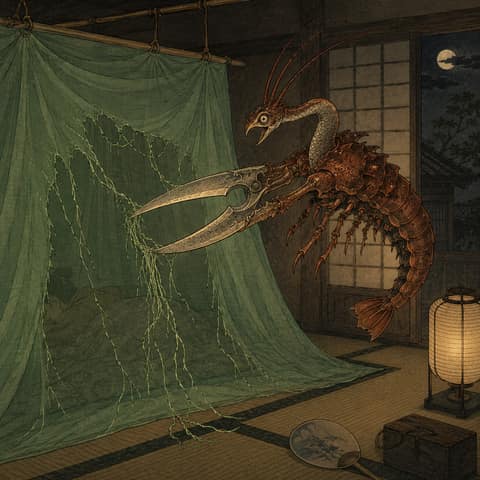
    An interpretation grounded in Sekien’s depiction, tempered by later commentaries that popularized the trait of cutting nets and mosquito screens. Concrete behaviors are sparsely recorded in local sources, and it is often understood as a personification of wear, tear, and fraying. It appears with a carapace-like body and large pincers, shows up at night, and quietly severs its target, with no clear evidence of direct harm to people.

  • Ningyo

    Ningyo

    Rare

    ningyo

    The Water Yokai Evolving from Ancient to Modern Times

    水の怪FukuiShiga

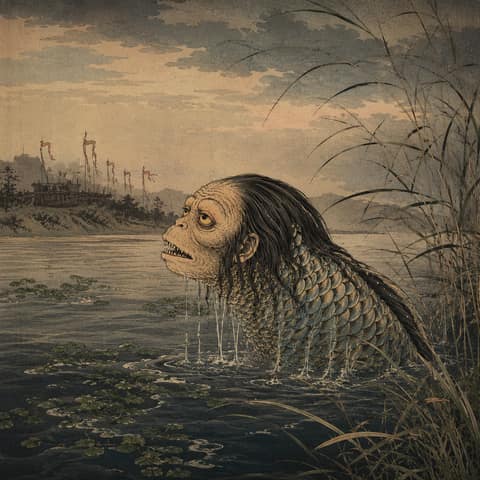
    Iconographic Disconnect from Western Mermaids. The image of a Ningyo that modern Japanese people envision—a "beautiful female upper body and a fish lower body"—is a product of Western mermaid legends (such as Hans Christian Andersen's *The Little Mermaid*) being imported and taking root from the modern era onward. Prior to this, traditional Japanese Ningyo iconography, as depicted in texts like the *Kaikoku Heidan*, was exceedingly bizarre and grotesque: "a human-like (or monkey-like) face on a scale-covered fish body." The facial features were not necessarily those of a beautiful woman; they were generally depicted as terrifying men, women, young, or old, bearing sharp fangs. The sheer ugliness of this design emphasized the visceral reality of the Ningyo as a "creature from the Other World" and the taboo, grotesque nature of the act of eating its flesh. Biological Models and the Natural History Perspective. The core of Japanese Ningyo folklore is believed to contain no small amount of misidentification of actual biological creatures. For example, a prevalent theory suggests that sirenians like dugongs and manatees, or pinnipeds like sea lions and seals, served as the models for the Umibozu and Ningyo. Additionally, in inland (river or swamp) Ningyo legends, there are cases where the true identity is speculated to have been the Japanese giant salamander. Edo period herbalists (Honzogakusha) meticulously collected and classified records of these unknown marine creatures washing ashore, attempting to re-examine yokai through the lens of "science" (natural history). The Curse of "Eternal Life". The "eternal youth and longevity" brought about by Ningyo meat is a universal human desire, yet in Japanese folklore, it is always depicted as two sides of the same coin alongside "tragedy." As the legend of Yao-bikuni demonstrates, one who obtains eternal youth by eating Ningyo meat must repeatedly watch their beloved family members and husbands age and die, forcing them to experience unbearable loneliness and despair (temporal isolation). The Ningyo is a yokai that acts as a cruel mirror, thrusting the "terror of escaping death" directly in humanity's face.

  • Nyūbachibō

    Nyūbachibō

    Rare

    nyoo-bah-chee-BOH

    Emaki Seigan Iconography Version

    Household SpiritsJapanese folklore

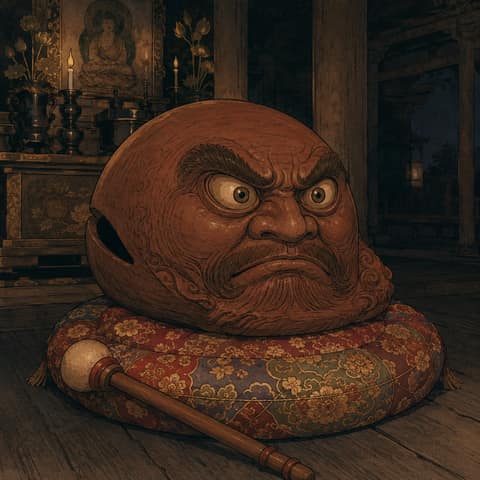
    Taking as precedent the disc-like apparition found in Muromachi-period Night Parade of One Hundred Demons scrolls, the Edo artist Toriyama Sekien shaped it in Hyakki Tsurezure Bukuro as a human figure bearing a bronze plate. Sekien frequently depicted utensils turned yokai, and Nyūchibō is one of these, yet the textual notes are brief and its conduct remains undefined. Amid overlapping names and forms—nao-bachi, dōbachi, and surigane used in temple rites and theater orchestration—later commentators supplied the trait of startling people by sounding. No specific regional lore is attached; it is recognized iconographically within the broader class of utensil-spirits. Its qualities today largely reflect fragments of folk materials and modern reinterpretations in yokai handbooks.

  • Oboroguruma (The Hazy Carriage)

    Oboroguruma (The Hazy Carriage)

    Rare

    oh-BOH-roh-goo-ROO-mah

    Oboroguruma (after Sekien’s Iconography)

    Household SpiritsKyoto

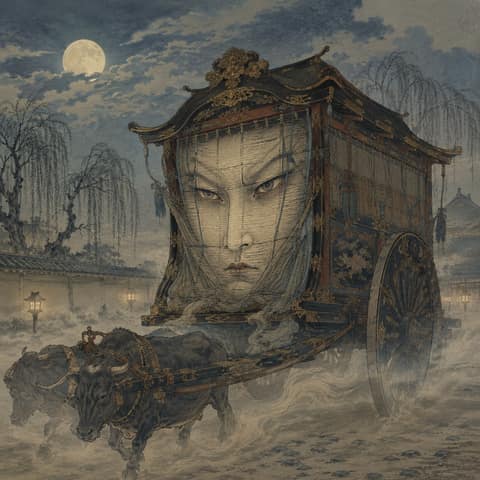
    A depiction of the Oboroguruma based on Toriyama Sekien’s image and Edo-period readings: a half-transparent ox-drawn carriage appears on a hazy night, its blinds blocked by an enormous face. It is said to echo rancor from Heian-era carriage quarrels, yet avoids naming individuals or tying to single incidents, instead embodying social tensions from festivals and spectacles that possess objects. It is also understood as part of the Night Parade of One Hundred Demons, startling people through a double sign of sound (creaking wheels) and form (an ox cart with a face). Direct harm is not always told; it manifests as a token of dread and ill omen, prompting witnesses to recoil. As an object-yokai, old carts and festival gear set the stage, and disputes over space or viewing cause the tale to arise. Excess specifics are avoided, with the hazy night and cart sounds serving as its marks of appearance.

  • Oil Baby

    Oil Baby

    Rare

    AH-boo-rah AH-kah-go

    Sekien Iconography Edition

    Household SpiritsShiga

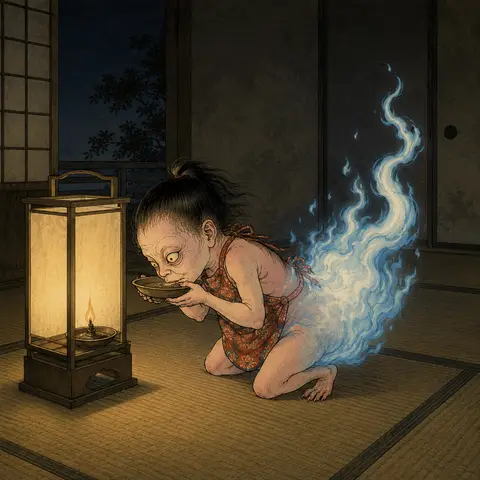
    This version is grounded in Toriyama Sekien’s imagery and the Edo-period essays cited in his notes, interpreting the infant form as a minimal personification of a ghostly fire. Its core is the idea of an oil-thieving flame, with the baby figure best read as Sekien’s visual cue. Lamp oil was a daily necessity, and offerings of oil at temples and shrines were held in special regard. Stealing oil violated religious and ethical taboos and was told as a fire that wanders after death. Later handbooks retell it as a fireball entering a house, becoming a baby, and licking oil, but region-specific oral examples are scarce and no widespread template is certain. Accordingly, this version presents a three-step pattern—phantom fire appears (at crossroads or within shrine-temple precincts), the infant image manifests (gesturing as if licking oil before a lamp), then departs again as flame—while avoiding unverified details and foregrounding its symbolism as a warning against defiling offered oil.

  • Oni of Hemp Fiber (O-uni)

    Oni of Hemp Fiber (O-uni)

    Rare

    OH-oo-NEE

    Iconographic Tradition, Sekien Lineage

    Mountain & Wilderness SpiritsUncertain (derived from an Edo-period picture scroll)

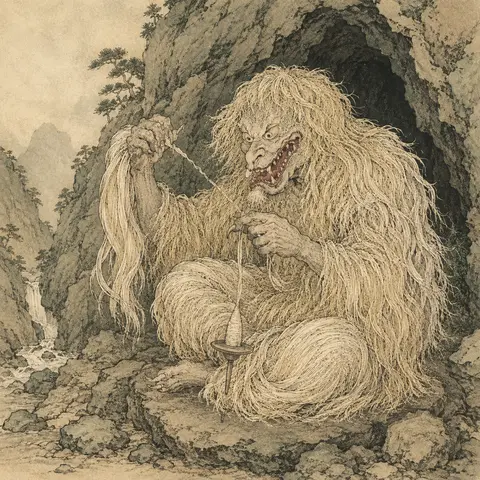
    Rather than arising chiefly from oral accounts, Ouni has been recognized through a lineage of images in picture scrolls. A precursor appears as the “Wau-wau” type in Sawaki Suushi’s Hyakkai Zukan (1737), and in the late Edo Hyakki Yagyō Emaki (Oda Gōchō, 1832) it is rendered as “Uwan-uwan.” Toriyama Sekien drew on this visual genealogy, exaggerating the hair and emphasizing a fiber-bundle texture suggestive of o, then named the figure accordingly. The term o denotes a tufted bundle of ramie or hemp fibers, serving as a visual sign tied to the creature’s mass of body hair. From the Heisei era onward, commentators increasingly connected Ouni with folktales of mountain hags who comb and spin fibers, treating it as a subtype of yama-uba. Yet Sekien gives no locality or deeds, and evidence for attaching it to specific place-based traditions is scant. It is safest to regard Ouni as a yokai defined by the iconographic core of a shaggy demon-woman appearing in the mountains, loosely linked to ideas surrounding women’s fiber work in upland communities.

  • Onmoraki

    Onmoraki

    Rare

    ohn-moh-RAH-kee

    Onmoraki

    Animal ShapeshiftersJapan (tradition derived from Chinese sources)

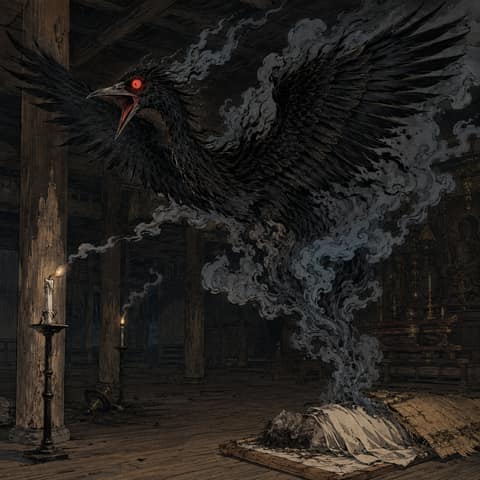
    Following Toriyama Sekien’s Konjaku Gazu Zoku Hyakki, it bears a crane-like black body, eyes that gleam like lamplight, and a cry that trembles through its wings. Said to arise from the qi of a fresh corpse, it appears when sutra recitations or memorial services are neglected at temples. Framed by Chinese lore adapted in Japan and retold in Edo-period strange tales, it manifests less from rancor than from circumstances such as unfinished rites or temporarily laid-out bodies, serving as a cautionary apparition upholding temple norms. Sightings are momentary, vanish when approached, and leave scant trace. Its very form is an alarm, understood as a sign of improper or incomplete memorial observances.

  • Raised-Collar Robe

    Raised-Collar Robe

    Rare

    eh-ree-TAH-teh-goh-ROH-moh

    Ittan of Sekien Iconography

    Household SpiritsJapanese folklore

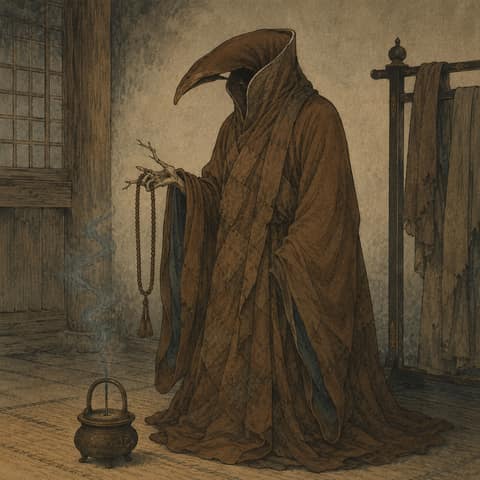
    A reconstruction based on the designs in Toriyama Sekien’s Hyakki Tsurezure Bukuro. The monk’s robes are a dull brown, layered thickly, with the collar hanging before the face to cast a beaklike shadow. Beads are held in one hand, a censer is set before it. Movements are unhurried; with each step the rustle of cloth sounds and a faint scent of incense drifts. Hints linking it to tengu remain only in the captions of the image, with no direct wings or long nose. It maintains autonomy as a tsukumogami, its tears and seams perceived as bearing will. It appears not where reverence for sacred implements is lacking, but shows signs near neglected robes and ritual tools, prompting awe rather than harm.

  • Rokuemon

    Rokuemon

    Rare

    Rokuemon

    Rokuemon, Supreme Commander of the Awa Tanuki

    ShapeshifterTokushima

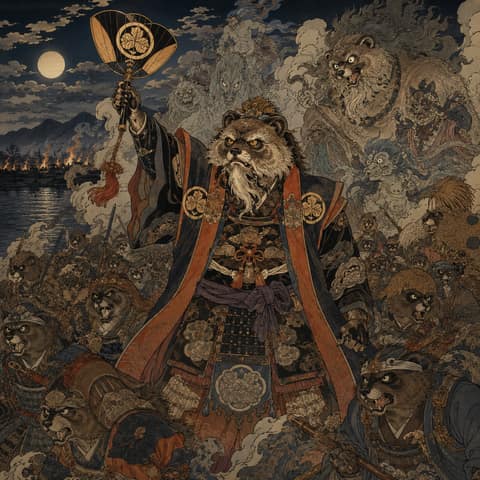
    This is Rokuemon, the supreme commander of the Awa tanuki residing in Tsuda-ura. Ruling as the grand general over all tanuki in Shikoku, he stands as the veteran leader at the pinnacle of the tanuki hierarchy, where they fiercely compete for the title of "Senior First Rank." He once took in Kincho as his disciple and attempted to have him inherit his legacy through a marriage to his daughter. However, after Kincho fled, Rokuemon eventually faced him as a mortal enemy on the banks of the Katsuura River. Following a massive three-day and three-night battle involving over six hundred tanuki, it is said he fell in a final one-on-one duel. Yet his name has been passed down through storytelling, films, and animation, and he remains vividly remembered today as the indispensable co-protagonist of the Awa Tanuki War.

  • Ryujashin

    Ryujashin

    Rare

    ryujashin

    Ryuja-sama, the Guiding Messenger of the Kamiari Festival

    Divine Spirit / DeityShimane

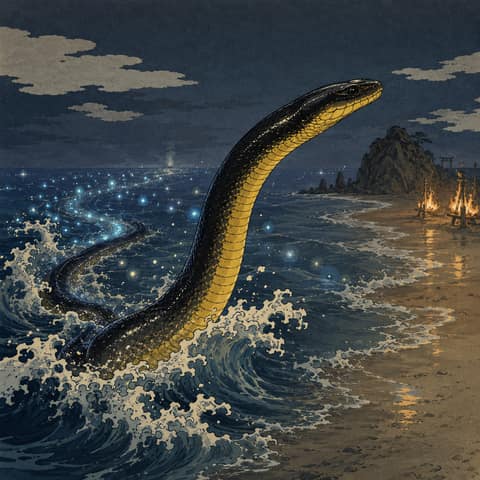
    Ryujashin occupies a unique position as a "divine messenger" functioning within the specific ritual context of Izumo's Kamiari Festival. While general dragon gods (composite water deities governing water, rain, and the sea) are based on nationwide rain-making and rain-stopping beliefs, Ryujashin is strictly a functional deity acting as the guide for the eight million gods, limited to the Kamiari rituals of shrines like Izumo Taisha and Sada Shrine. Its essence is not an abstract concept of faith, but a real marine animal—the yellow-bellied sea snake—that actually washes ashore on the Izumo coast in late autumn. The perfect alignment of a natural phenomenon (warm-water sea snakes drifting on the Tsushima Current) with mythological time (the gathering of gods in the Kamiari month) forms the core of a rare seasonal ritual. The washed-ashore individuals are dedicated to the Grand Shrine, and through the Ryuja-ko of Izumo Taishakyo, it developed into an independent object of worship, with talismans distributed to the common people for protection against fire, water disasters, theft, and for good fortune. By visiting from the Eternal Land and the otherworld beyond the sea, it embodies the ancient worldview that saw Izumo as a passageway to the otherworld.

  • Saddle Fiend

    Saddle Fiend

    Rare

    KOO-rah-yah-ROH

    Toriyama Sekien Plate Conformant

    Animated Objects & UndeadJapanese folklore

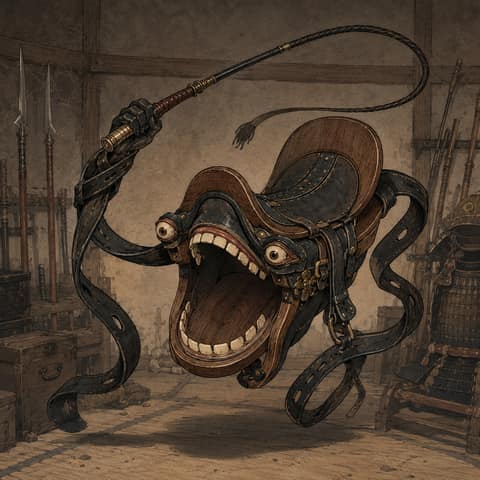
    An image based on Toriyama Sekien’s Hyakki Tsurezurebukuro. The saddle itself forms the torso, accompanied by a caption indicating damage around the front bow. Eyes peer from the base of the stirrup leathers, and the mouth splits at the front bridge to reveal fangs. The hands are rendered as extended girth straps, grasping a whip at the tip. As a tsukumogami, it follows the early modern idea that old implements gain spirit through long use or resentment. The saddle, a nexus between lord and retainer and a vessel of battlefield memory, serves as a moral emblem warning against wrongful deaths and negligence. Paired with the stirrup mouth, it thematizes preparedness and care for one’s tack, with its monstrosity reflecting carelessness and impropriety like a mirror.

  • Sea Zato (Blind Lute Priest of the Sea)

    Sea Zato (Blind Lute Priest of the Sea)

    Rare

    OO-mee-zah-TOH

    Iconography-Based Tradition

    Aquatic SpiritsJapanese folklore

    Umizatō survives only as an image in Edo-period picture scrolls and yokai paintings, with no transmitted nature or behavior. The motif shows a blind lute player standing upright amid waves, emphasizing the biwa and cane. From its visual traits, it is often read as representing the uncanny of encounters at sea and the absurdity of standing on unstable water. Kenji Murakami classifies it as a “yokai existing only in paintings,” noting possible overlap with sea-monk imagery. Accordingly, this entry is limited to iconographic details; concrete harms, benefits, rites, or banishment methods are not recorded.

  • Seto General

    Seto General

    Rare

    SEH-toh TIE-shoh

    Iconographic and Mitate-Derived Version

    Animated Objects & UndeadUncertain (Edo-period pictorial works)

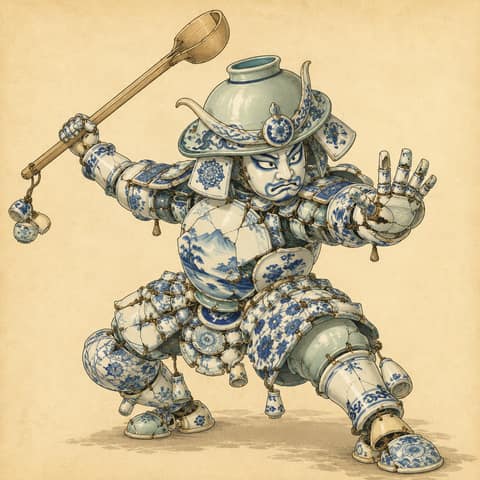
    Rooted in Sekien’s picture manuals, this tsukumogami-style portrayal recasts rivalry among ceramic centers like Seto and Karatsu into the guise of a warrior effigy. The body is a composite of cups, sake flasks, warming pans, and plates arranged as armor, while the accompanying text brims with wit, blending diction from Chinese classics and military tales. Rather than a field-sighted apparition, it crystallizes the idea of spirits inhabiting objects and the Edo-period literacy that likened trends and the prestige of named masterpieces to a “battle.” The motif continued into Meiji-era ukiyo-e and is viewed as a classic in the lineage of the Night Parade of One Hundred Demons.

  • Shell Child

    Shell Child

    Rare

    KAI-chee-go

    Iconographic and Encyclopedic Interpretation

    Household SpiritsJapanese folklore

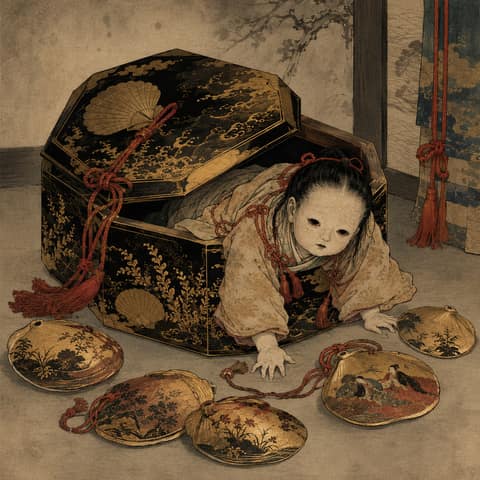
    Rooted in Toriyama Sekien’s illustration and brief caption, this lineage reads the shell box through the history of kaiawase shells and bridal trousseau chests. Lacking firsthand anecdotes, it stays within the general tsukumogami frame, overlaying the folk view that long-serving objects acquire feeling. Its form is childlike, with a key association to crawling baby dolls. Late at night in a silent tatami room, the lid of the shell box is said to open slightly, and a small childlike figure peeks out. It causes little harm, and is said to vanish when household goods are treated carelessly.

  • Shojo

    Shojo

    Rare

    しょうじょう

    Wine-loving Red-haired Beast, Noh Master of Dance, Shojo

    Animal YokaiChinese Classics (Classic of Mountains and Seas, Book of Rites, Chuci, Huainanzi, Commentary on the Water Classic - legendary beast) / Introduced to Japan (Wakan Sansai Zue 1712, Noh play Shojo Muromachi period) / Nagoya, Arimatsu, Tokai City (Shojo giant doll festival, first appearance 1779)

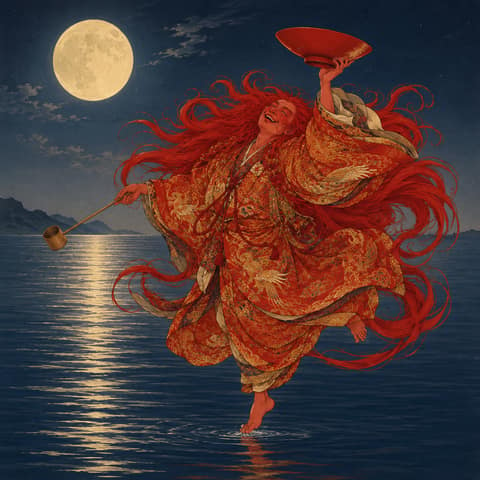
    The origins of the Shojo lie in two lineages of lore from Chinese classics. ① The "Speaking Beast" Lineage — In the "Quli" section of the "Book of Rites", it is stated: "The parrot can speak, but it still belongs to the birds; the shojo can speak, but it still belongs to the beasts" (a moralistic quote meaning that even if it understands human speech, it does not transcend the realm of beasts). The "Erya" describes it as "small and fond of howling," while the "Classic of Mountains and Seas" states: "On Mount Zhaoyao, there is a beast whose shape resembles a macaque with white ears; it crouches to walk and runs like a human. Its name is xingxing (=shojo), and eating it makes one a good runner." ② The "Beast Fond of Wine and Blood" Lineage — The "Commentary on the Water Classic" notes that the shojo of Pingdao County in Jiaozhi "looks like a yellow dog or a badger, has a human face with regular features, is good at talking with people, and its voice is as beautiful as a fine woman's." The "Lüshi Chunqiu" considers "the lips of the shojo" a great delicacy, while Li Shizhen's "Bencao Gangmu" (1596) details it as a creature from Jiaozhi (modern-day northern Vietnam) with a human face, beast's body, yellow hair, and a fondness for wine. The modern associations with the orangutan or palm civet are later identifications; academically, the classical shojo is best understood not as a real animal but as a composite image of a legendary sacred beast. Its introduction to Japan occurred before the Middle Ages via Chinese texts and Buddhist scriptures. The "Wamyō Ruijushō" (10th century) introduced it as a "speaking beast" citing the "Erya", and it appeared indirectly in the "Konjaku Monogatarishu". Terajima Ryoan's "Wakan Sansai Zue" (1712) was groundbreaking — it explicitly pointed out that "yellow hair is correct, and the 'red hair' theory circulating in Japan is mistaken." Nevertheless, the image of "red hair" became entrenched in Japan due to the influence of Noh theater, a divergence that forms an interesting point of debate in art history and folklore. The uniquely Japanese image of red hair flowed backward from Noh costumes and became fixed. The Noh play "Shojo" (established in the Muromachi period, author unknown) is a current repertoire piece for all five schools, and is one of the most beloved plays, serving as a fifth-group play and kiri-Noh. Set at the Xunyang River in Tang China, it tells the story of Kofu, a filial son who sells wine in the village of Yangzi, and succeeds after a dream revelation. A red-faced customer who frequents Kofu's shop daily introduces himself as the "Shojo who lives in the sea." Waiting at the Xunyang River on a moonlit night, the Shojo appears, drinks wine, performs a dance, and bestows an "inexhaustible wine jar" — a celebratory theme of rewarding filial piety. The play fuses sources like the "Tang Guo Shi Bu", the "Chuci" (The Fisherman), and Li Bai's poem about the Xunyang River. The costume features a red wig, red Karaori robe, scarlet divided skirts, and a dedicated Shojo mask (painted red, with a smiling mouth and eyes). Its highlight is the "chu-no-mai" dance, or the special performance (kogaki) "midare" — a highly advanced technique where the performer glides over the water with erratic, flowing steps. In the Edo period, because Jurojin and Fukurokuju of the Seven Lucky Gods were identical, a variant Seven Lucky Gods circulated where Jurojin was replaced by the Shojo. Kita Sadakichi's "Study of the Gods of Fortune" (1920) cites primary sources like the "Genroku Gorui Setsuyo", making it academically robust. This variant form also appears in treasure ship paintings by Hokusai, Kuniyoshi, and Yoshitoshi. A "Shojo" giant doll festival has been passed down since the mid-Edo period in Arimatsu and Tokai City in Nagoya. Spreading along the old Tokaido highway, it already appeared in the "Narumi Festival Picture" of 1779. Giant red Shojo dolls chase children, and being tapped by one is believed to ward off summer diseases and epidemics. There are also local legends across the country, such as oral traditions of small Shojo appearing at sea in Toyama, or a ship-ghost variant demanding "give me a barrel" in Yamaguchi. "Shojohi" (Shojo scarlet) is a deep crimson color originating from the red costumes of the Noh play "Shojo". Though popularly called the "color of Shojo's blood," the actual dye was cochineal/kermes, and the "Shojo's blood" is merely a myth. Scarlet woolen cloth imported via the Nanban trade in the late Muromachi to early Edo periods was highly prized by Sengoku warlords for their surcoats. During the Edo period, it was such a rare luxury that the shogunate would confiscate it from merchants, making it a symbol of martial prowess and authority. In modern times, it appeared in Hayao Miyazaki's "Princess Mononoke" (1997) as the "sages of the forest," trying to replant trees to restore the forest but unable to keep up with humans, begging San to "let us eat humans, we want human strength". The red image of the Shojo is also inherited in biological names like the fruit fly (Drosophila, named for its attraction to alcohol), the Shojo dragonfly, and the Shojo-bakama flower.
  • Shōgorō (the Gong Spirit)

    Shōgorō (the Gong Spirit)

    Rare

    SHOH-goh-ROH

    Sekien Plate Edition (Toriyama Sekien-Inspired)

    Animated Objects & UndeadEdo period, Kamigata tradition (Osaka)

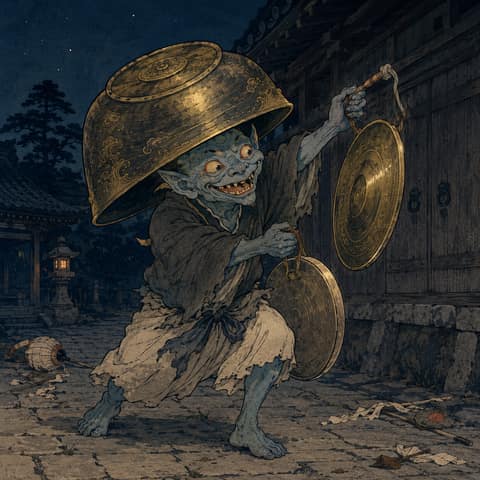
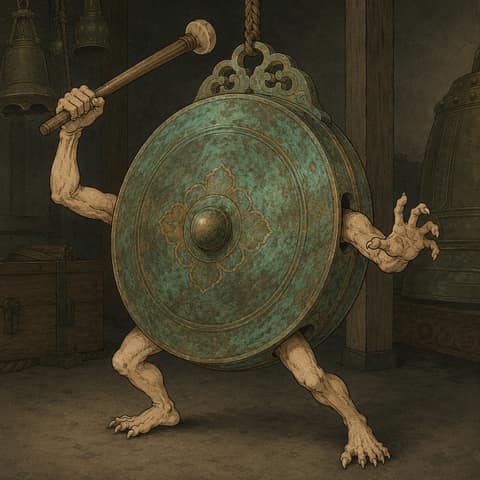
    An interpretive reconstruction based on Shōgorō from Toriyama Sekien’s Hyakki Tsurezure Bukuro, linking the tsukumogami notion of spirits inhabiting tools with the muromachi-era Waniguchi bell monster seen in Night Parade picture scrolls. Because the name plays on words, it cannot be conclusively read as the vengeful spirit of any specific person. In the Kansai region it has been read against the Yodoya “Golden Rooster” legend, serving as an image that warns against the pursuit of wealth and fame. It is depicted as a round temple gong or waniguchi bell sprouting limbs, sounding of its own accord to give warning. No field sightings survive, and primary sources are picture scrolls, yokai paintings, and their notes.

  • Snake-Obi

    Snake-Obi

    Rare

    jah-TIE

    Sekien Zukai Version

    住居・器物Edo period; derived from painted sources

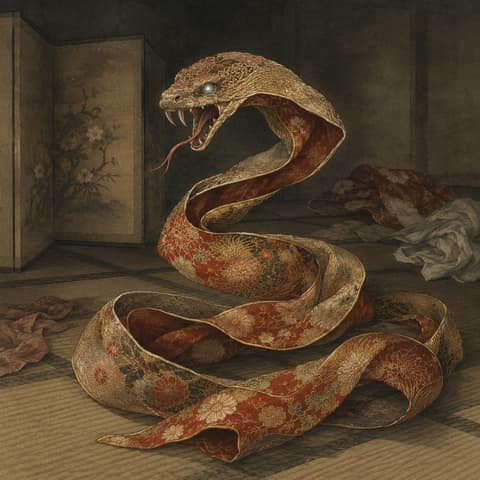
    A version based on Toriyama Sekien’s interpretation of the obi in Konjaku Hyakki Shūi. Though an everyday garment, the obi was said to turn into a serpent at the threshold of sleep and dream. This draws on the Natural History note that sleeping on a sash brings dreams of snakes, a belief also known in Japan. Sekien further composed that the triple sash of a jealous woman coils into a sevenfold venomous snake, punning on the kinship of malice and serpent-body, and presenting a visual reading in which emotion is projected onto objects. In folk terms, it warns that keeping a sash by the pillow invites ominous dreams, admonishes jealousy, and entwines concepts of sleep, dreams, and taboo. Rather than a literal attacker, the Snake-Obi is a symbolic specter that mirrors the viewer’s heart and reminds proper handling of sashes and bedding within the home.

  • Straw-Raincoat Sandals

    Straw-Raincoat Sandals

    Rare

    MEE-noh WAH-rah-jee

    Iconographic Tradition Edition

    Animated Objects & UndeadJapanese folklore

    A reimagining of the straw raincoat and straw sandals yokai based on Toriyama Sekien’s imagery. The straw raincoat serves as a protective emblem akin to visiting-deity garb, while the sandals take on the role of roadside boundary charms. Weathered by long use and harsh storms, they are believed to have gained spiritual potency and slipped into the human world. The act of shouldering a hoe evokes farm labor and service to local land deities, and the snowy bamboo grove setting suggests purity and deep quiet. Specific deeds go unrecorded, but it was likely feared as creaking sandal steps at midnight or a walking cloak’s silhouette in a blizzard, with little emphasis on malice. An emblematic member of the early modern tsukumogami ensemble, it reflects reverence for the lifespan and toil of tools.

  • Suzu-hiko-hime

    Suzu-hiko-hime

    Rare

    SOO-zoo-HEE-koh-hee-meh

    Based on Sekien Toriyama Plates

    Household SpiritsJapanese folklore

    A reconstruction grounded in Toriyama Sekien’s illustration and notes. Shown as a woman bearing a kagura suzu, she serves as a symbolic presence moving between summoning spirits and soothing souls. Rather than a concrete monster, she personifies the numinous power tied to the ritual bell, evoking the Ama-no-Iwato myth while remaining distinct from its deities. Edo painters placed her within the Night Parade lineage, and Tsukioka Yoshitoshi offered a comparable image to Suzuhiko-hime. No fixed haunt is recorded; she is thought to appear in the imagination at kagura offerings, festival floats, and shrine fairgrounds.

Showing 73 - 96 of 112 yokai