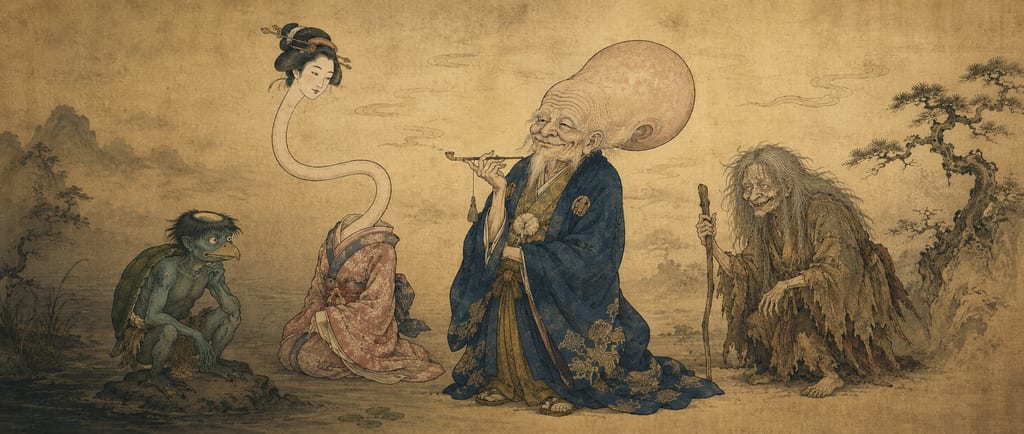
Rather than arising chiefly from oral accounts, Ouni has been recognized through a lineage of images in picture scrolls. A precursor appears as the “Wau-wau” type in Sawaki Suushi’s Hyakkai Zukan (1737), and in the late Edo Hyakki Yagyō Emaki (Oda Gōchō, 1832) it is rendered as “Uwan-uwan.” Toriyama Sekien drew on this visual genealogy, exaggerating the hair and emphasizing a fiber-bundle texture suggestive of o, then named the figure accordingly. The term o denotes a tufted bundle of ramie or hemp fibers, serving as a visual sign tied to the creature’s mass of body hair. From the Heisei era onward, commentators increasingly connected Ouni with folktales of mountain hags who comb and spin fibers, treating it as a subtype of yama-uba. Yet Sekien gives no locality or deeds, and evidence for attaching it to specific place-based traditions is scant. It is safest to regard Ouni as a yokai defined by the iconographic core of a shaggy demon-woman appearing in the mountains, loosely linked to ideas surrounding women’s fiber work in upland communities.
Character Profile
This section is our own creative profile for storytelling. It is not historical fact or scholarship.
Yokai Type - Traditional Yokai
Category - Mountain & Wilderness Spirits
Rarity - Rare
Personality - unknown, evokes ferocity and severity
Compatibility - connected to mountain-village women’s work, linked to flax and ramie fiber-spinning lore
Abilities - unknownlater interpretations claim skill in combing ramie or hemp fibers and spinning thread
Weaknesses - unknown
Habitat - mountain regions, ravines, mountain hamlets