Not a Single Biography,
but Overlapping Traditions of the Spider Woman
The jorōgumo familiar today does not emerge as a fully formed creature from any single classical work. Its long hair, female torso, sprawling spider legs, and surrounding brood of spiderlings derive primarily from Toriyama Sekien’s woodblock print. The guise of a mother cradling a child and the wounded giant spider in the attic come from *Tonoigusa*, while the spectral apparitions of an older woman and a marriage-minded maiden belong to *Taihei Hyaku Monogatari*. The recurring motif of casting silk threads around a person's foot at the water’s edge stems from regional legends of spider-haunted pools (*kumobuchi*). Only through the historical convergence of these disparate accounts across different eras and settings did the composite figure of a "spider woman" take shape.
A Mother and Child Vanish into the Attic
In *Tonoigusa*, the jorōgumo appears at a house at night in the guise of a young woman holding an infant[2]. She instructs the child to address a samurai as its father, but the warrior grows suspicious of the unexpected pair, keeps his wits about him in the emergency, and strikes with his sword. The wounded woman flees into the ceiling space; what is discovered in the crawl space the next morning is a huge spider dead from a sword cut, surrounded by the grisly remains of devoured human victims. The intimate guise of mother and child, the uncanny retreat into the upper recesses of the home, and the chilling evidence of prior predation define the supernatural horror of this tale. Rather than a story of romantic enchantment or the draining of life energy, it centers on human vigilance unmasking a monster that has infiltrated ordinary domestic life.
An Illusory Marriage Cast by a Tiny Spider
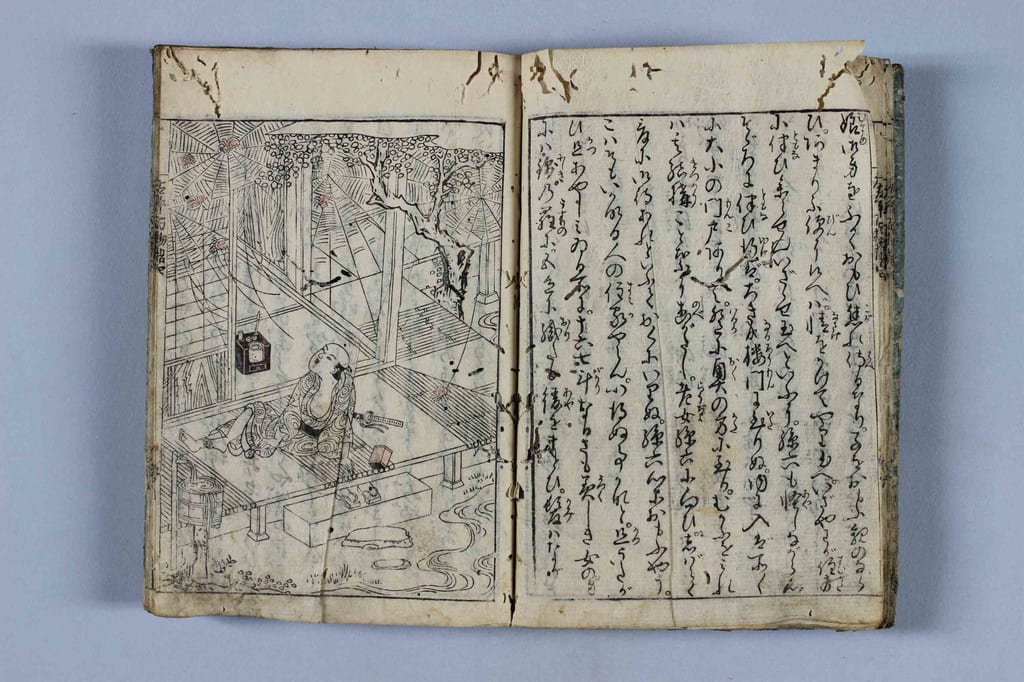
The tale of Magoroku in *Taihei Hyaku Monogatari* explores the wavering threshold between dreams and waking reality rather than martial combat[3]. As Magoroku dozes on his veranda, an older woman leads his sleeping mind into an opulent mansion, where a lovely young maiden proposes marriage. The girl's grievance—accusing him of having nearly killed her mother—corresponds directly to an incident in waking life where Magoroku had brushed away a small spider with his tobacco pipe. When Magoroku flees, the phantom estate vanishes, leaving only a tiny *jorōgumo* and a thick tangle of webs under the eaves. Here, the creature wields no tough binding silk; instead, its power lies in translating a trivial human action into an elaborate illusion of family, estate, and betrothal.
Sekien’s Convergence of Woman and Spider in a Single Print
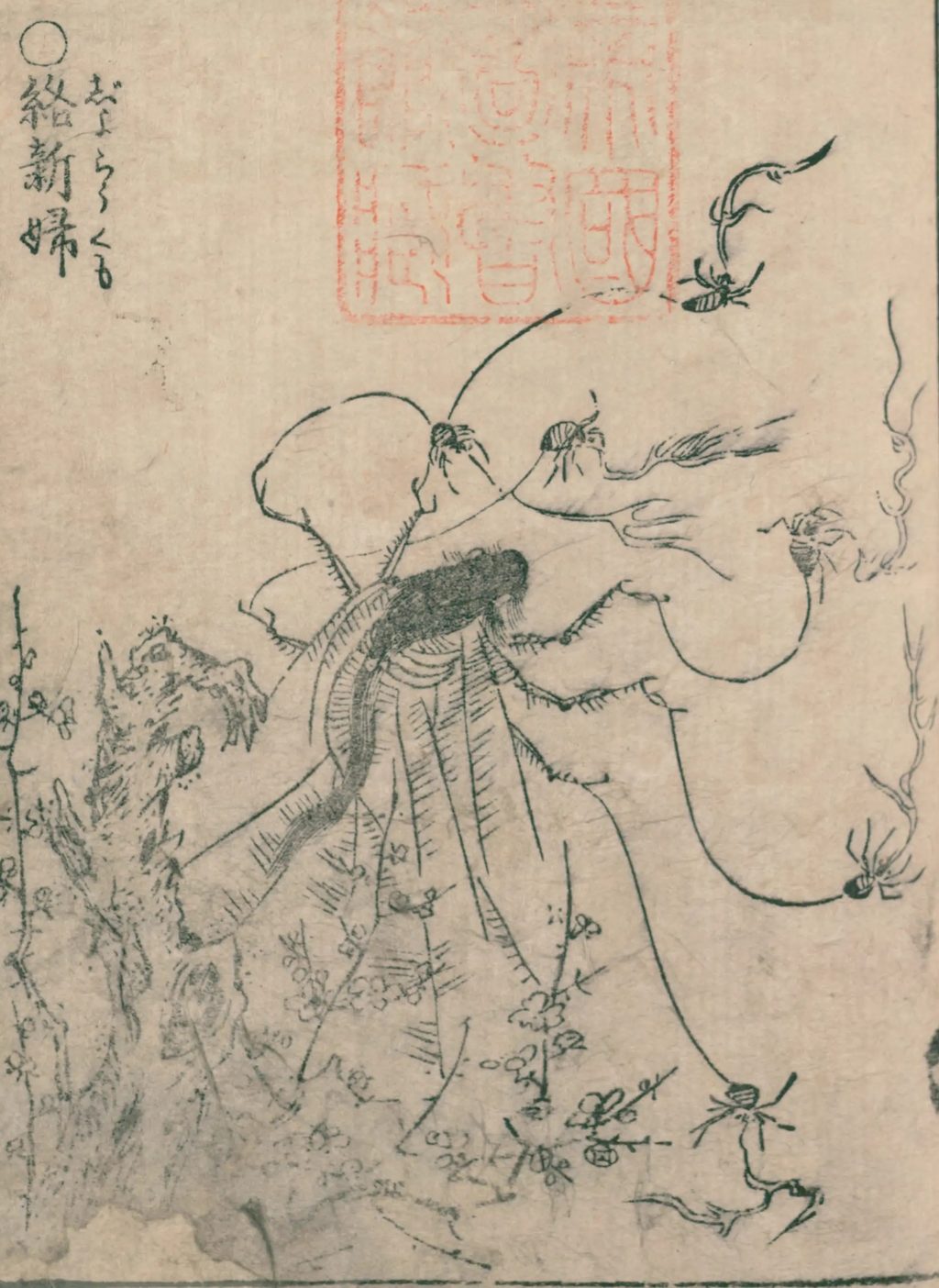
Toriyama Sekien’s "Jorōgumo" offers no narrative plot, capturing the hybrid nature of woman and spider in a single iconic composition[4]. Multiple spindly legs radiate from behind the woman’s face and robes, while the surrounding swarm of tiny spiders emits wavy lines that could be read as silk, smoke, or bursts of fire. Although later commentaries sometimes describe these spiderlings as breathing fire, Sekien provided no accompanying text outlining supernatural abilities. Nor does the illustration specify whether the spiderlings are offspring, spirits, or obedient servants. What the image conveys is an ominous atmosphere: a human female silhouette unable to contain the sprawling limbs, surrounded by a dense, unsettling swarm of spiders.
A Slender Thread and Escape at the Water’s Edge
The motif of waterside spider silk derives from a folklore layer entirely separate from early modern ghost tales. In the "spider pool" (*kumobuchi*) tradition, a spider repeatedly loops strands of silk around a person’s foot or body; when the person transfers the thread onto a nearby tree or stump, the heavy timber is dragged violently into the deep water with a roaring splash, serving as a surrogate victim[6]. Survival here hinges not on drawn blades or esoteric incantations, but on the quick wit needed to notice an almost imperceptible filament and redirect it. Rather than celebrating the destruction of a monster, these legends center on discerning a faint physical cue in time to evade an unseen aquatic menace.
Two Legends Entwined at Jōren Falls
The beautiful woman associated with Jōren Falls did not originate solely from thread-snaring lore. It reflects an amalgamation with another tale: a woodcutter accidentally drops his hatchet into the plunge pool, receives it back from an enchanting woman at the water’s edge, and swears never to speak of the encounter. This sequence—the retrieved hatchet, the mysterious woman, the vow of secrecy, and the fatal punishment for breaking the silence—belongs to an independent folklore lineage concerning water spirits and taboos[6]. By uniting the underwater force symbolized by spider silk with the taboo imposed by the water woman at a single landmark, the Jōren Falls jorōgumo acquired its modern identity. The deadly fate that befalls the oath-breaker is not an inherent trait of all jorōgumo, but an element native to the local taboo tradition of this specific waterfall.

Kashikobuchi:
From Supernatural Threat to Protection from Drowning
At Kashikobuchi in Sendai, the cultural significance of the spider shifted over local history. In an early recorded account, the creature that wraps silk around an angler’s foot is not a beautiful woman, but simply a "spider" of the deep pool; after the man shifts the thread onto a willow tree that is subsequently dragged under, an eerie voice echoes from the depths: "Clever!" (*kashikoi*)[8]. In the Hachiman 5-chōme district of Aoba Ward, Sendai, local residents eventually enshrined the spider, erecting a stone monument venerating it as a deity of protection against drowning[11]. The spider thus evolved from an aquatic threat into an object of veneration that commemorated the perils of the deep pool and warded off waterborne tragedy. This local history demonstrates how a community could reframe a terrifying encounter into protective civic memory rather than a quest to slay a monster.
Behavior Beyond Simple Seduction
The spider's deportment varies remarkably across historical sources. In *Tonoigusa*, the entity approaches boldly as a mother holding a child; in *Taihei Hyaku Monogatari*, the maiden pleads her case through direct speech, urging marriage. In Sekien’s illustration, the robed figure remains entirely mute, while in spider-pool legends, the creature signals its presence through a delicate thread long before showing its face. Synthesizing these portrayals yields something far more subtle than a generic, relentlessly seductive temptress: it evokes a watchful observer that pauses for the other party’s reaction, altering the entire encounter through the slightest initial contact. Rather than representing an explicit, unified personality defined in antiquity, this cohesive persona is a modern interpretation born where distinct textual traditions intersect.
The Web of the Living Jorōgumo Spider
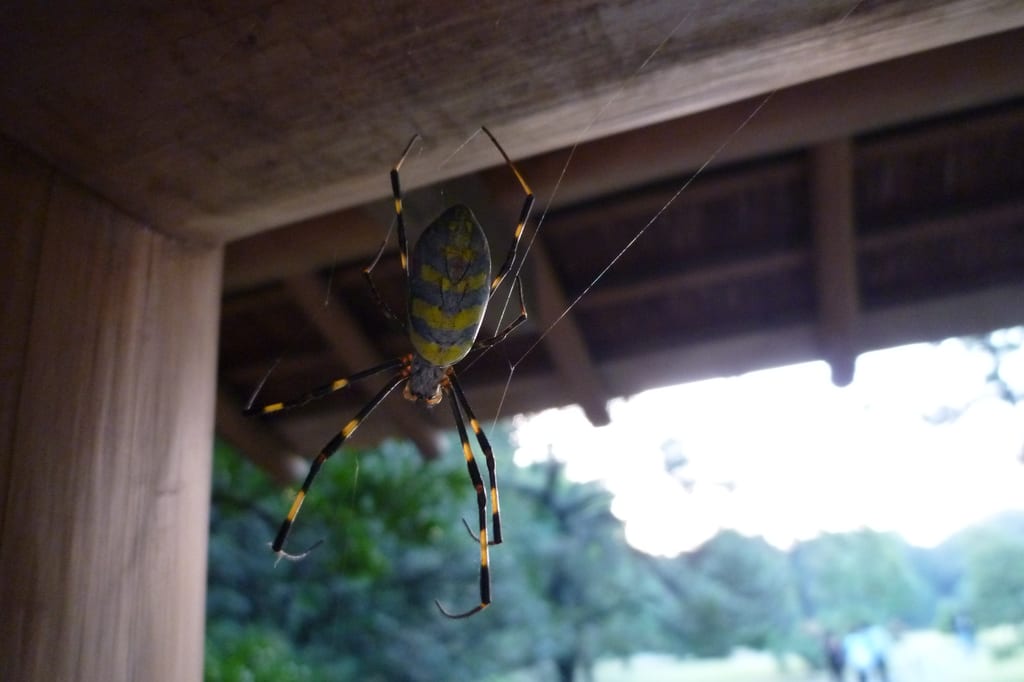
In nature, female jorōgumo spiders grow conspicuous and vividly colored in autumn, spinning elaborate three-dimensional webs supported by auxiliary barrier webs in front and behind[10]. These dense, multilayered silk structures, coupled with dramatic size differences between males and females and seasonal color shifts, lend the folklore of the jorōgumo a visual resonance quite distinct from generic human-faced arachnids. Nevertheless, the living spider does not prey on human beings. The creature of the natural world and the spirit of ghost lore share a name and silk threads, yet they inhabit entirely separate realms.
Threads That Never Fully Merge
No single historical record provides a universal account of the jorōgumo’s dwelling, weaponry, weaknesses, romantic desires, diet, or age. Even the celebrated modern narrative of a beauty luring men with a biwa lute before consuming them appears in neither *Tonoigusa* nor *Taihei Hyaku Monogatari* in that form[5]. Over the centuries, a small common arachnid was reimagined as a mother cradling a child, a dream of courtship, a hidden underwater force, and an unforgettable composite illustration of woman and spider. Tracing these distinct, unmerged threads reveals the true cultural character of this multifaceted yokai.
Character Profile
This section is our own creative profile for storytelling. It is not historical fact or scholarship.
Yokai Type - Traditional Yokai
Category - Animal Shapeshifters
Rarity - Legendary
Personality - A patient observer who watches for an opponent's reaction, transforming the encounter through the faintest contact. Multiple contrasting depictions converge here: a bold mother holding a child, an entreating young maiden, and a silent spider woman.
Compatibility - Maintains a quiet distance with those who notice subtle incongruities, resist reducing folklore to a single formula, and appreciate the lingering resonances among divergent traditions.
Abilities - Assuming the form of a young woman or a mother carrying a child (*Tonoigusa*)Projecting an illusion of an older woman, a maiden, and an estate to propose marriage (*Taihei Hyaku Monogatari*)Repeatedly attaching fine silk threads to draw people into deep water (spider-pool legends)Appearing as a woman's body overlaid with spider legs (Toriyama Sekien's illustration)Manifesting alongside a surrounding swarm of tiny spiders (Toriyama Sekien's illustration)
Weaknesses - No universal weakness is documented across sources. Instead, escape depends on individual circumstances: a samurai’s calm judgment and drawn sword in *Tonoigusa*, Magoroku’s flight and clearing of the webs under the eaves in *Taihei Hyaku Monogatari*, and the quick presence of mind to transfer the silk thread onto a tree or stump in spider-pool legends.
Habitat - Varies by narrative: a house at night and its ceiling crawl space in *Tonoigusa*; the veranda, eaves, and phantom estate of Sakushū Takada in *Taihei Hyaku Monogatari*; and river pools or waterfall plunge pools in spider-pool lore.