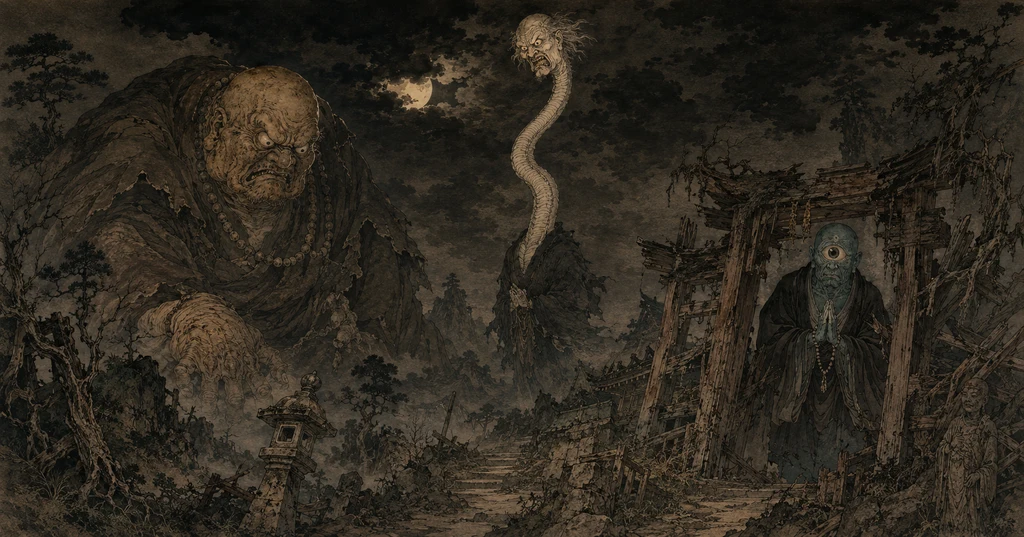
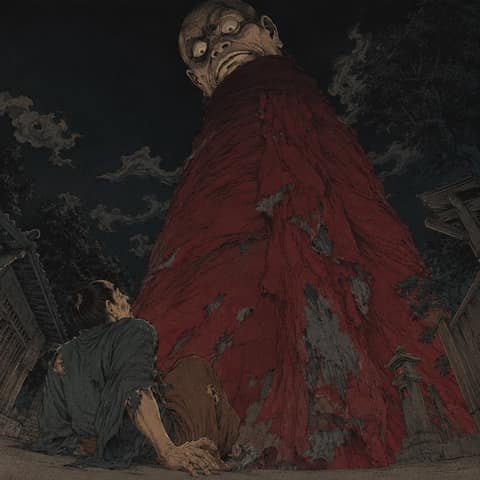
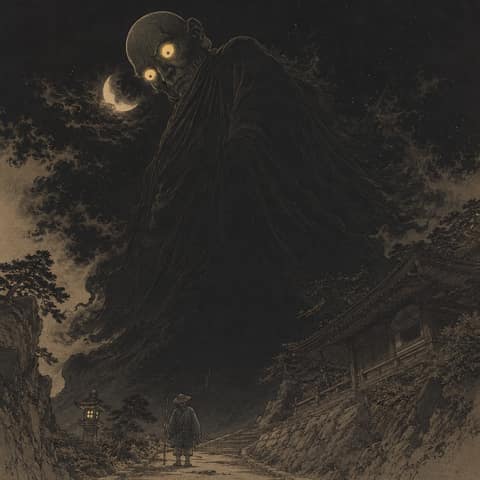
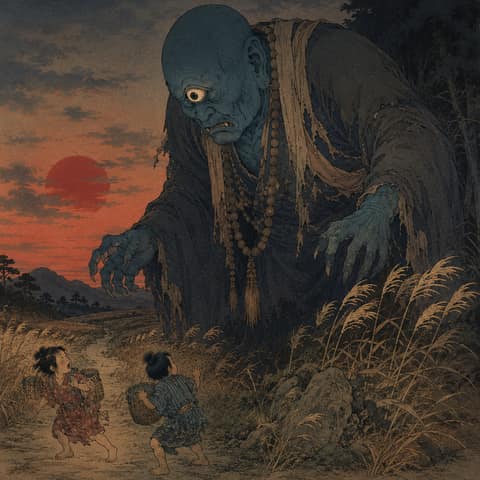
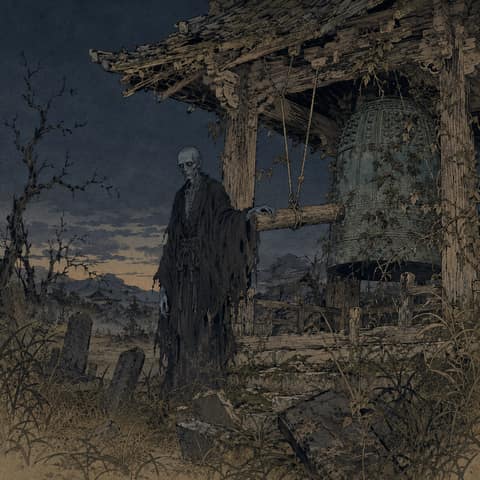
Aobōzu is a catch-all name recorded across Japan for several kinds of yokai; its appearance and nature vary by region. It is often described as a large monk-like figure, a blue-skinned priest, or a one-eyed monk. Toriyama Sekien depicts it in Gazu Hyakki Yagyō without commentary, leaving details uncertain. Traditions range widely, including animal shapeshifters, beings linked to mountain deities, and figures used to warn or discipline children.
Folklore & Legends
In Wakayama, people speak of a towering, blue, shadowy monk. In Fukushima, Gifu, and Hiroshima, it is said to be a transformed weasel or tanuki. In Shizuoka, a springtime twilight taboo tale warns that it abducts children from fields. In Nagano, it appears if one circles a pine seven times while holding their breath, declaring, “Don’t step on stones; don’t break pines.” In Okayama, it is a great monk haunting vacant houses. In Yamaguchi, a small monk serving the mountain god challenges people to sumo. In Kagawa, it tempts women toward suicide. Sekien’s image shows a one-eyed monk; scholars point to the hitotsume-bō (one-eyed monk) as a likely source.
Yokai Cards1
Aobōzu (Blue Monk) across multiple art-style decks
An Aobōzu type based on images in Edo-period picture scrolls and regional field collections. Depicted as a monk with a bluish hue or as a one-eyed priest, it may be told as an animal in disguise, a manifestation of a mountain deity, or an uncanny being of uncertain nature. It serves to warn children against wandering, anchors tales of hauntings in fields, mountains, and vacant houses, and conveys oral taboos. No fixed proper name or origin is agreed upon, and its conditions of appearance and behavior vary by region. Because Sekien’s print lacks commentary, notes from other sources list it alongside the “One-Eyed Monk” or as an allegory for an unseasoned priest, but neither view is definitive. In premodern oral accounts, concrete images coexist under multiple labels such as “Blue Priest,” “Great Monk,” and “Little Monk.”
Character Profile
This section is our own creative profile for storytelling. It is not historical fact or scholarship.
shifts with locale and origin, inconsistent, context dependent
Compatibility
encountered at night, prone to appear in deserted places
Abilities
appearing to frighten peoplebeguiling humans as an animal shapeshifterdeclaring taboos or set phrases as warningsthrowing humans in tests of strength such as sumo
Weaknesses
details uncertain, calling its name, ignoring it, banishing formulas vary by region
Habitat
mountains and fields, ridges by vegetable or wheat fields, vacant houses and ruins, riverbanks and deep pools, village borders and around shrines
The diagram below is a diagnostic evaluation chart for Aobōzu of Traditional Iconography and Provincial Tales. The higher the value of each item, the stronger that characteristic is expressed.