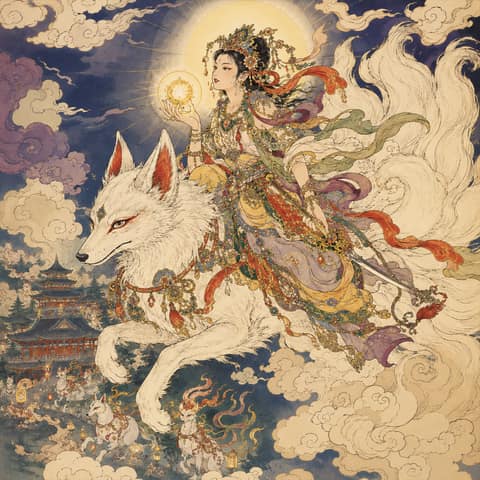
Myobu is the title given to the white foxes that serve as the divine familiars (kenzoku) of Inari Okami. They are deified divine messengers (shinshi) enshrined at Byakkosha, a subordinate shrine (massha) of Fushimi Inari Taisha, as the deity "Myobu Tome-no-Kami"[1]. Distinguishable from folk beliefs that regard foxes themselves as gods, Myobu strictly refers to the white foxes functioning as divine messengers who convey the god's will.
Originally, "Myobu" was a term indicating the rank of court ladies who served in the imperial palace under the Ritsuryo system, a title bestowed upon women of the fifth rank or higher, or the wives of officials of the fifth rank or higher. This title was crowned upon Inari's white foxes likely because the Inari shrine was a high-ranking deity that received the highest divine rank of Sho-ichii (Senior First Rank) from the imperial court. The foxes serving in close attendance to this deity were likened to court ladies and conceptually elevated to noble beings[2]. The concept of a divine messenger holding a court rank illustrates that the Inari faith matured in deep connection with the imperial court and the Shinto administrative system.
The "white" of the white fox is said to indicate a pure, transparent existence, invisible to the eye, just like the deity itself. At Inari shrines, fox statues are placed at the shrine fronts instead of Komainu (guardian dogs). White foxes as Myobu have been iconographically depicted holding rice ears, scrolls, keys, and wish-fulfilling jewels in their mouths, serving as mediums for the harvest of fields, words, storehouses, and treasures.
Folklore & Legends
The enshrined deity of Byakkosha, Myobu Tome-no-Kami, refers to the white fox, and at the time of its founding, it was also called "Oku-no-Myobu" and "Myobusha"[1]. According to Harumitsu Harada's "Inari Jinja Engi" (Origin of Inari Shrine), the enshrined deities of Oku-no-Myobu (now Byakkosha) are Akomachi and Osusukiroku, conveying a legend that it originated from a court lady called Susumu Myobu[1]. The shrine building was constructed in the Kan'ei era (1624–1644) during the early Edo period. It is a one-bay Kasuga-zukuri style building with a cypress bark roof, designated as an Important Cultural Property of Japan. Until the 7th year of the Genroku era (1694), it was located around the present-day Tamayama Inari Shrine[1].
The background for the white foxes of Inari being called "Myobu" lies in the fact that the Inari shrine was bestowed the highest divine rank of Sho-ichii in the 5th year of Tengyo (942). The foxes serving Inari, whose divine status was at its peak, were treated with the rank of Myobu, the court ladies of the imperial palace[2]. The custom of enshrining the familiar foxes of Inari shrines nationwide alongside banners reading "Sho-ichii Inari Daimyojin" and calling the white foxes Myobu or Tome is a result of this imperial ranking concept spreading among the common people.
White foxes as Myobu are clearly distinguished from the lineages of wild foxes (yako) or pipe foxes (kudagitsune) that bewitch humans. Despite being foxes, Inari's familiar Myobu are pure divine messengers who bring good fortune and divine authority. As pairs of white fox statues placed in front of shrines, they remain ubiquitous at Inari shrines across the country today.
Myobu is the deified form of the white foxes serving as the familiars of Inari Okami, enshrined as "Myobu Tome-no-Kami" at Byakkosha, a subordinate shrine of Fushimi Inari Taisha. Unlike secular beliefs that worship foxes themselves as gods, the essence of Myobu lies in its reference to white foxes acting as divine messengers attending closely to the deity.
"Myobu" is a title derived from the ranks of court ladies under the Ritsuryo system. Because they serve Inari Okami, who holds the Senior First Rank, the white foxes were likened to high-ranking court ladies of the imperial palace. The shrine building of Byakkosha, built during the Kan'ei era in the one-bay Kasuga-zukuri style with a cypress bark roof, is an Important Cultural Property. Initially called "Oku-no-Myobu" or "Myobusha," it is said in Harumitsu Harada's "Inari Jinja Engi" to enshrine Akomachi and Osusukiroku, originating from a court lady named Susumu Myobu. The statues of white foxes holding rice ears, scrolls, keys, and jewels in their mouths are an iconographic expression showing that Myobu is a pure divine messenger mediating the harvest of fields, words, storehouses, and treasures.
Character Profile
This section is our own creative profile for storytelling. It is not historical fact or scholarship.
Pure, loyal, and noble. Holds the pride of a divine messenger who unfailingly conveys the will of the deity.
Compatibility
稲荷神 (主神)·宇迦之御魂神と強く結ぶ。野狐·管狐とは対極
Abilities
Conveying divine will (carrying the intentions of Inari Okami as a divine messenger)Mediating bountiful harvests and business prosperityPurity and warding off evil (keeping evil away through the purity of white)
Weaknesses
Because they are familiars and messengers rather than the deity itself, their independent divine authority is subordinate to Inari Okami.
Habitat
The front of Inari shrines, Byakkosha, and Mount Inari.
The diagram below is a diagnostic evaluation chart for The White Divine Messenger of Inari Okami, Myobu. The higher the value of each item, the stronger that characteristic is expressed.