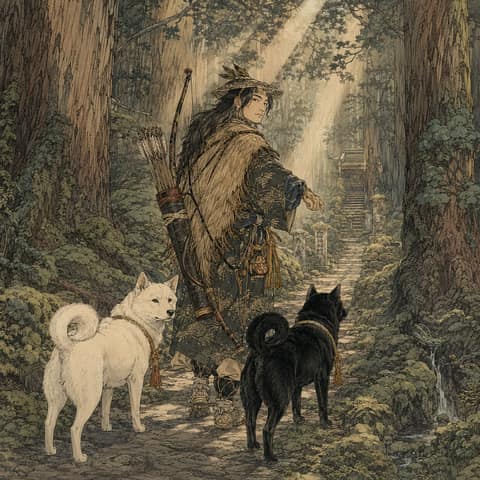
Niutsuhime is the principal deity of Niutsuhime Shrine, the highest-ranking shrine (ichinomiya) of Kii Province[1]. She is an earth mother goddess who has been worshipped as the guardian deity of the Mount Koya region since before Kukai (Kobo Daishi) founded his monastic complex there. According to shrine traditions, she is said to be the younger sister of Amaterasu Omikami, or a child of Izanagi and Izanami (identified with Wakahirume no Mikoto)[1]. The "Niu" in her name refers to cinnabar (mercury sulfide), whose vivid vermilion color has been believed since ancient times to possess the power to ward off evil. There are theories that she was the deity worshipped by the immigrant Niu clan who mined the mercury veins around Mount Koya (a mercury god), and theories that she is a water god because she is enshrined at the headwaters of the Kinokawa River system[1]. Both theories demonstrate her character as an earth mother who governs the wealth and life of the land.
Folklore & Legends
Mentions of Niutsuhime date back to fragments of the "Harima no Kuni Fudoki," where she appears as "Nihotsuhime no Mikoto"[1]. In historical records, the "Nihon Sandai Jitsuroku" documents her receiving a divine rank in the first year of Jogan (859), and the "Engishiki" Jinmyocho (Register of Deities) of the fifth year of Engi (927) lists the shrine as an ancient and eminent shrine (Myojin Taisha) receiving offerings from the imperial court[1]. At the core of the legend of Mount Koya's founding is the story that when Kukai, returning from Tang China, sought a fundamental training ground for Shingon esoteric Buddhism, her child deity, Takanomiko no Okami (Kariba Myojin), guided him in the guise of a hunter with two dogs. At Amano, Niutsuhime herself appeared and granted the divine territory of Mount Koya to Kukai[2]. This legend is recorded in the "Kongobuji Konryu Shugyo Engi," compiled in the 11th to 12th centuries[2], and since then, Mount Koya has devoutly enshrined both Niu and Takano Myojin as the guardian deities within the mountain (at the Amano-sha and Miyashiro shrines). Niutsuhime Shrine was registered as a World Cultural Heritage site in 2004 as part of the "Sacred Sites and Pilgrimage Routes in the Kii Mountain Range"[1].
Niutsuhime is the "god of the land" at the foundation of Mount Koya's religious landscape. Although the sacred site of Shingon esoteric Buddhism is known as the mountain of the Buddha (Dainichi Nyorai), its foundation is a land governed by local deities from before Kukai's arrival. The founding legend establishes the indispensable role of both Niu and Takano Myojin through a narrative of yielding this territory (dedication of divine land). The cinnabar indicated by the name "Niu" has been highly valued since ancient times as a mineral for preservation, warding off evil, and magic. The distribution of mercury veins at the foot of Mount Koya corroborates the existence of the Niu clan mining group and the deity they worshipped. Simultaneously, due to her location controlling the headwaters of the Kinokawa River, she is also revered as a water god, extending her protection to agriculture and irrigation. Under the syncretism of Shinto and Buddhism, she was considered a manifestation (suijaku) of the Womb Realm Dainichi Nyorai, and was enshrined in the Miyashiro and Amano-sha shrines within Mount Koya as the mountain's guardian. The romon gate and main sanctuary of the World Heritage Niutsuhime Shrine continue to convey that this goddess is the starting point of Mount Koya's 1,200 years of faith.
Character Profile
This section is our own creative profile for storytelling. It is not historical fact or scholarship.
A magnanimous earth mother who protects the wealth and life of the land. She possesses the deep generosity to willingly yield her divine territory to the outsider Kukai, while also holding the strictness to repel evil through the protective power of cinnabar.
Protection of the land and water sourcesWarding off evil and disasters using cinnabarGranting divine territory (governing the foundation of the sacred site)Blessings for abundant harvests and irrigation
Weaknesses
As an indigenous deity of the land, it is difficult for her to exert power separated from the rites and connection to the earth; her divine power is strongly tied to the sanctuaries of Mount Koya and Amano.
Habitat
The forests of the Mount Koya region, the headwaters of the Kinokawa River, and the Amano basin. The sacred groves of Niutsuhime Shrine.
The diagram below is a diagnostic evaluation chart for The Guardian Deity of Mount Koya, Niu Myojin. The higher the value of each item, the stronger that characteristic is expressed.
Meet your guardian yokai at the shrine
Draw an omikuji fortune and discover the yokai watching over you today.