YOKAI.JP
Mt. Koya 弘法大師の山に棲む神と天狗。高野山の妖怪事典

狩場明神・丹生都比売・天狗。聖地を守る地主神と魔縁の系譜

弘法大師の山に棲む神と天狗。
高野山の妖怪事典

Mt. Koya · こうやさん

Also known as: 金剛峯寺 / 覚海坊
View on map

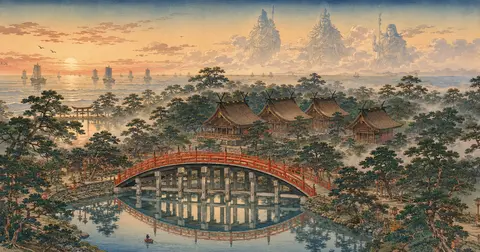
紀伊山地のもっとも深い襞、標高八百メートルの盆地に、八葉の峰々に蓮華のごとく囲まれて高野山は開かれている。弘仁七年 (816年)、唐から真言密教を持ち帰った空海が嵯峨天皇よりこの地を賜り、根本道場を起こした[1]山上の宗教都市である。一山がまるごと寺院であり、千二百年のあいだ祈りだけが営まれてきたこの土地を語るとき、妖怪とは何かという問いは独特の屈折を帯びる。ここでは怪異が、仏法に敵対する魔としてではなく、むしろ聖地を守護する側へと反転していくからだ。

高野山の異界を貫く糸は二本ある。一本は「地主神」── 空海がこの山を開くより前から、ここを領していた神々である。山へ分け入る空海を白黒二匹の犬を連れた狩人が導き、その母神が山を譲り授けたという開創縁起は、外来の密教が在地の神を取り込んでいく過程そのものを物語る。いまひとつは「魔縁の守護者」── 慢心ゆえに天狗道へ堕ちながら、なお弘法大師の山を護ると誓った高僧たちの伝説である。神と魔、その両極が「弘法大師の山」という一点で結ばれるところに、高野山の怪異の核がある。

空海を導いた地主神 ── 狩場明神

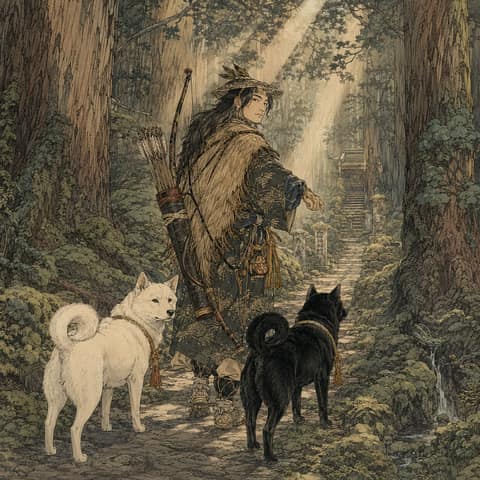
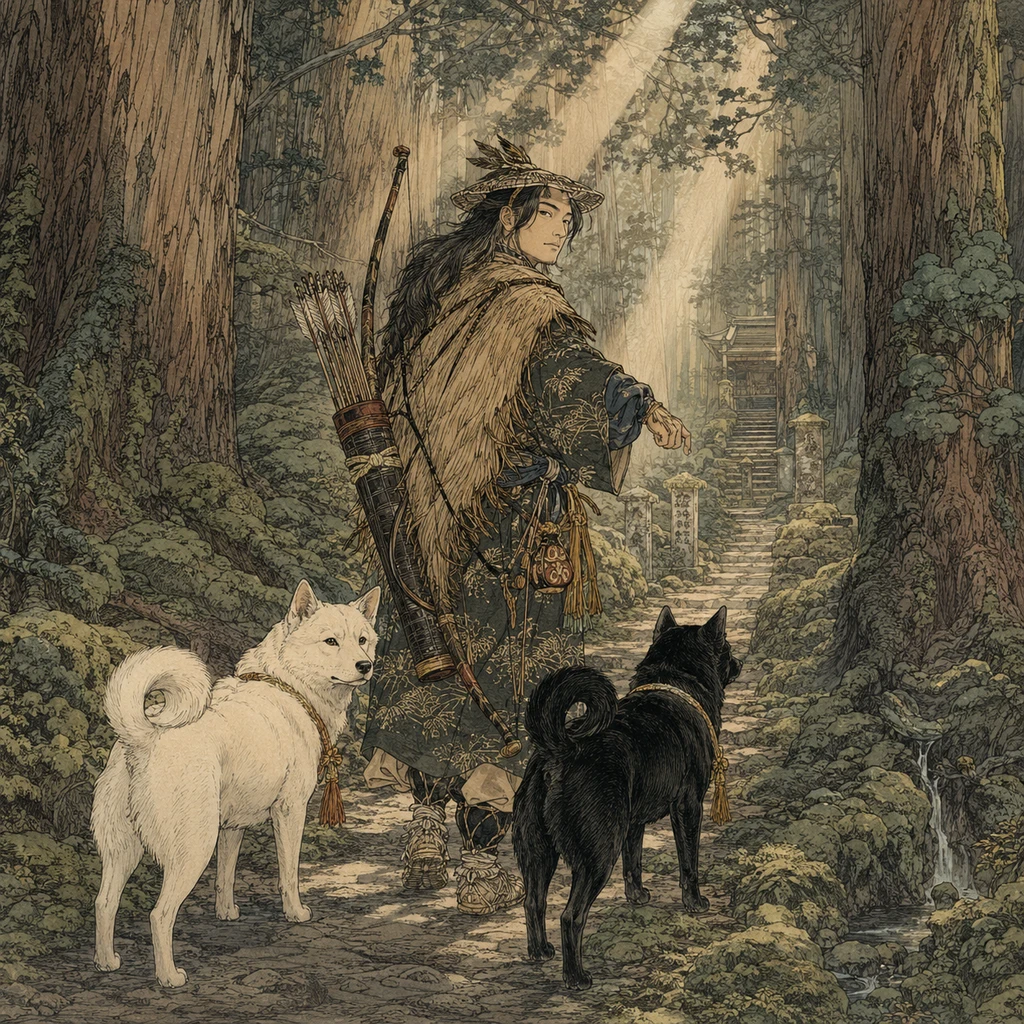
高野山の物語は、一人の猟師との出会いから始まる。唐から帰朝した空海が真言密教の根本道場にふさわしい地を求めて大和から紀伊の山中をさまよっていたとき、白と黒、二匹の犬を連れた背の高い狩人が現れた。狩人は犬を放ち、空海を山深くへと導いていく ── これが 狩場明神 (かりばみょうじん) の縁起である。
Kariba Myojin

kariba-myojin

Kariba Myojin is an alias for Takanomiko no Okami, the child deity of Niutsuhime and the god of hunting. According to the legend of the founding of Mount Koya, he appeared before Kukai, who had returned from Tang China, in the guise of a hunter accompanied by two dogs, one black and one white. He is said to have guided Kukai to Mount Koya, revealing it as a suitable land for the fundamental training ground of Shingon esoteric Buddhism. The hunter was actually an incarnation of Takanomiko no Okami, and it is said that the two divine dogs guided Kukai to Amano, where the mother deity, Niutsuhime, granted him the divine territory. He is depicted in the attire of a mountain hunter, wearing a kariginu (hunting cloak), carrying a bow and arrows, and accompanied by dogs. At Niutsuhime Shrine, he is enshrined alongside Niu Myojin as the deity of the Second Shrine, "Kariba Myojin".

Read more

狩場明神は 高野御子大神 (たかのみこのおおかみ) の異名で、後に述べる丹生都比売の子神とされる。その正体は山の神であり、二匹の神犬を従えて聖地への道を示す霊獣であった。縁起の最古の典拠は十一〜十二世紀に成立した 『金剛峯寺建立修行縁起』 で、弘仁七年 (816年) ごろ大和国宇智郡から紀伊国境にかけて空海を導いた狩人を高野御子大神とする。同様の説話は平安後期の 『今昔物語集』 にも語り継がれ、白黒の犬が聖地への道を照らす霊獣として描かれている。

この説話の背後には、土地の歴史が透けて見える。丹生氏の伝える『丹生祝氏本系帳』では、丹生一族はもと狩猟を生業とし、神への供犠のために二匹の犬を伴った猟人であったとされ、その記憶が高野山開創譚に流れ込んだと考えられている[4]。すなわち狩場明神とは、外来の空海を迎え入れた在地の狩猟の神の人格化にほかならない。二匹の神犬はやがて「みちびきのご神犬」として人を幸福と良縁へ導く霊獣と信じられ、丹生都比売神社では今も白丸・黒丸と名づけられた紀州犬が飼われている[4]。空海ゆかりの丹生官省符神社 (九度山町) もこの神を祀り、高野山参詣の入口の鎮守となっている。

山を譲り授けた母神 ── 丹生都比売

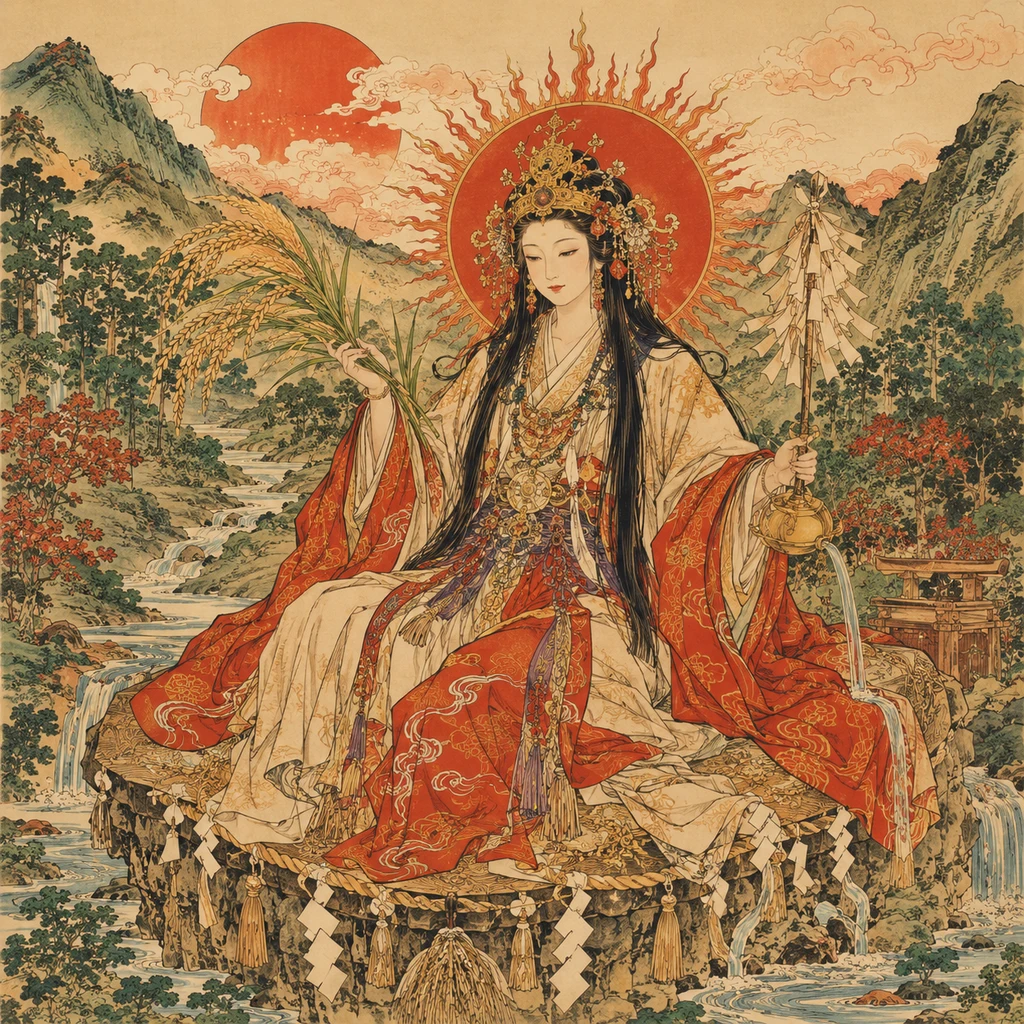
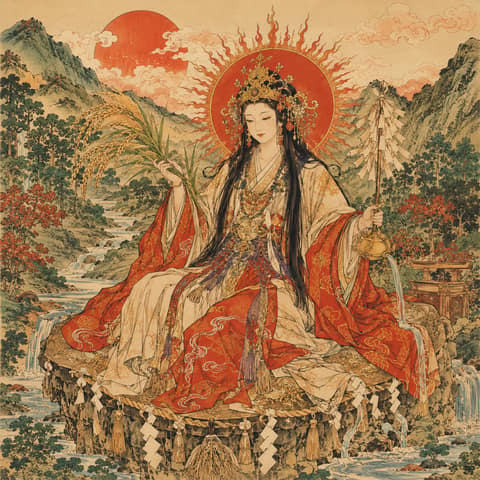
狩場明神が空海を山へ導いたなら、その奥で空海を待ち受け、山そのものを譲り授けたのが母神 丹生都比売 (にうつひめ) である。狩人に導かれた空海は天野の地でこの女神と相見え、丹生都比売は高野山一帯の神領を空海に与えたと縁起は語る[2]

丹生都比売は 紀伊国一宮 丹生都比売神社の主祭神であり、空海の開創以前からこの山を領していた地主神である。神名の「丹生 (にう)」は朱砂すなわち辰砂 ── 硫化水銀を指す。その鮮烈な朱は古来魔除けの力を持つとされ、高野山周辺の水銀鉱脈を採掘した渡来系の丹生氏が奉じた水銀の神とする説と、紀ノ川水系の水源に鎮座することから水の神とする説がある[4]。いずれも、土地の富と生命を司る地母神的な性格を示している。

その来歴は古い。丹生都比売神への言及は 『播磨国風土記』 逸文の「爾保都比売命」にさかのぼり、貞観元年 (859年) の『日本三代実録』に神階奉授の記録があり、延喜五年 (927年) 撰進の『延喜式』神名帳には名神大社として載る[4]。空海の登場よりはるか前から、この女神は朝廷の幣帛にあずかる古社の主だったのである。

ここに高野山開創縁起の核心が見える。外来の真言密教が、在地の神を退けて山を奪うのではなく、地主神みずからが土地を譲り、子神が道を導くという形をとったこと ── この縁起は、密教と土着信仰が衝突ではなく融合によって結ばれた稀有な記憶である。以後、高野山は丹生・高野の両明神を山内の鎮守 (天野社・御社) として篤く祀り続けた。丹生都比売神社は平成十六年 (2004年) に「紀伊山地の霊場と参詣道」の構成資産として世界文化遺産に登録されている[4]

弘法大師の山に棲む天狗 ── 覚海坊と魔縁の守護

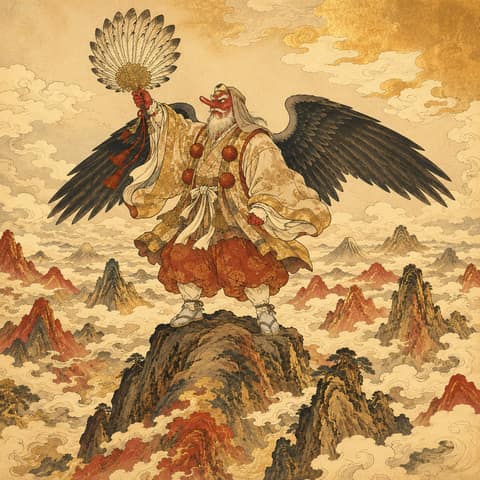
高野山にもう一柱、忘れてはならない異界の住人がいる。山の霊峰につきものの 天狗 (てんぐ) である。だが高野の天狗は、ただ山を荒らす魔ではない。仏法の山に棲む天狗は、その両義性 ── 仏法を妨げる魔でありながら、調伏されれば護法神に転じる ── を極端なまでに体現する。

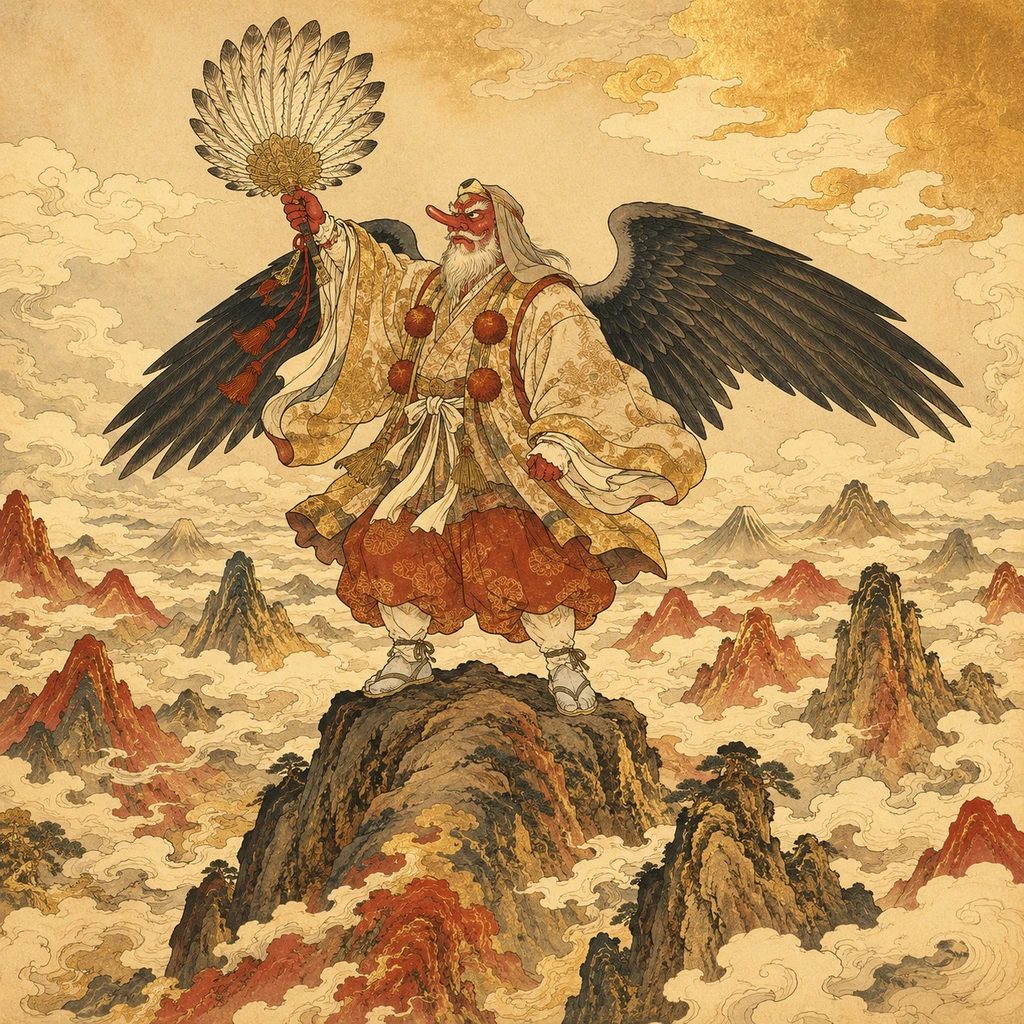
そもそも天狗には大きく二つの系統がある。赤ら顔に高い鼻、山伏の装束をまとい羽団扇と一本歯の高下駄を具えた 鼻高天狗、いまひとつは鴉のくちばしと翼をもつ烏天狗で、さらにその下に木の葉天狗・木っ端天狗といった下位の眷属が連なる[6]。古くは鳶のごとき鳥の姿で観念されたものが、中世を通じて長鼻の山伏像へと固まっていったのである。慢心した高僧が堕ちて天狗になるという観念は、仏教の説く「天狗道」と結びつき、鎌倉末の 『天狗草紙』 にも風刺として描かれた。この絵巻では南都北嶺の名だたる寺の驕れる僧たちが天狗に擬えられ、人に化けた天狗が正体を現すとき鼻が伸びるように描かれて、長鼻の像が形づくられていった。諸国の霊山にはそれぞれの大天狗が座すとされ、その総数を 四十八天狗 に数える伝もある。天狗研究を集大成した 知切光歳 は、これら諸山の天狗を一つの体系として整理した。

天狗が山岳信仰のなかで山伏 ── 修験者と分かちがたく結びついてきたことも見落とせない。修行のために深山に分け入り、常人離れした法力と武芸を身につけた山伏の姿は、そのまま天狗の像と重なっていく。山に棲み、修行者を試し、あるいは導く存在としての天狗は、聖地の山を行場とする修験の文化が生んだ影でもあった。仏法の根本道場である高野山もまた、そうした山の力の宿る場であったことを、覚海坊の伝説は逆照射している。

検校覚海、
天狗となる

高野山の天狗を語るうえで欠かせないのが、覚海坊 (かくかいぼう) の伝説である。覚海 (1142〜1223年) は高野山に上って華王院を開き講学に努めた真言宗の僧で、建保五年 (1217年) には一山を統べる高野山検校に任じられた実在の高僧であった。

その覚海をめぐって、鎌倉中期に無住が編んだ仏教説話集 『沙石集』 は不思議な伝説を伝える。覚海は弘法大師より、自らが七たびの生まれ変わり (七生) を経てきた宿縁を教えられたという ── 蛤、犬、牛、馬、熊野の薪採り、奥之院の仕侍、そして高野山検校の覚海へと。そして没後、覚海は秘法を守る天狗となると告げられた[7]

伝説によれば、貞応二年 (1223年) に世を去った覚海は、増福院の山門前に立つ杉の木から飛び立ち、壇上伽藍の中門の扉を翼として天に翔け上がり、天狗となって高野山を守護したという。この杉は今に「昇天の杉」と呼ばれて山内に残る。覚海はやがて高野山四大天狗の一人に数えられ、近代には谷崎潤一郎がこの伝説に取材して『覚海大徳の昇天』を著している。

ここに高野の天狗の本質がある。山を脅かす魔ではなく、慢心を超えて魔縁の身となりながら、なお弘法大師の秘法を守ると誓った守護者へと反転していくこと ── 聖地に密着した天狗だけが帯びうる、特異な性格である。室町期の謡曲 『鞍馬天狗』 が諸山の大天狗を列ねる枠組みのなかでも、高野の天狗は「弘法大師の山を守る」という一点で他山の大天狗と一線を画している。

女人禁制と奥之院 ── 結界がつくる異界

高野山の怪異を成り立たせているのは、一山を覆う結界の感覚である。空海はこの山を開くにあたり女人禁制を定め、その禁は明治五年 (1872年) に解かれるまで、およそ千年のあいだ守られた。山へ通じる七つの登り口 ── 高野七口 には、それぞれ女人堂が設けられ、女性はそこから先へ立ち入ることを許されなかった。現在は不動坂口の女人堂ただ一つが残っている。

この禁制は、ひとつの哀しい物語を山の麓に刻んだ。空海の母玉依御前は、讃岐の善通寺から子に会いに来たが、結界に阻まれて山に登れず、麓の慈尊院に迎えられた。空海は月に九度も山を下りて母のもとへ通ったと伝えられ、ゆえにこの地は「九度山 (くどやま)」と呼ばれるようになったという。慈尊院は女性も参詣できることから「女人高野」とも称される。

山上へ至る正式の参道 町石道 には、慈尊院から壇上伽藍まで一町 (約109メートル) ごとに百八十基、さらに伽藍から奥之院まで三十六基、あわせて二百十六基の五輪塔形の石柱 ── 町石が立てられ、参詣者を導いてきた。一歩ごとに数を減らしていく町石は、俗界から聖域へと近づく距離を可視化する結界の標である。

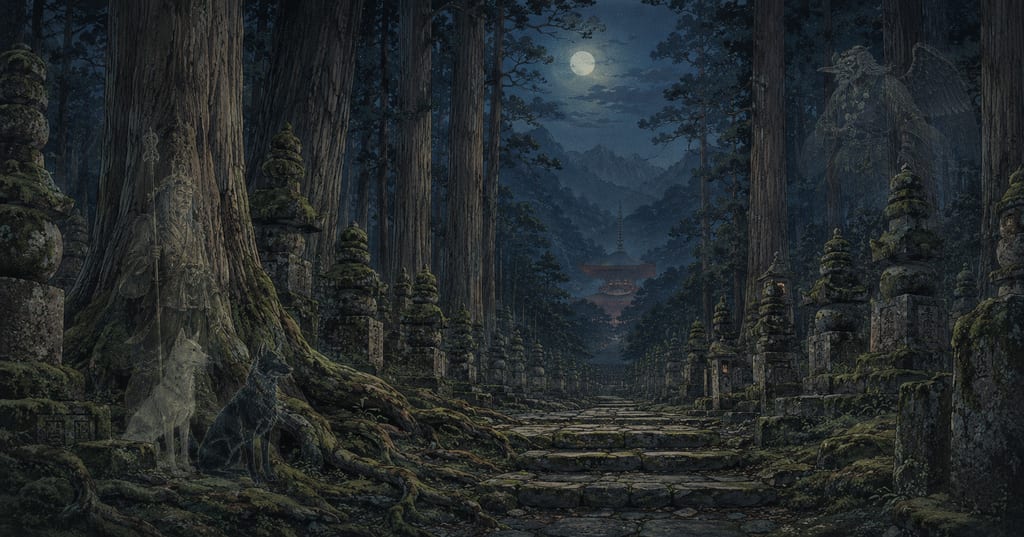
そして山の最奥、樹齢千年に及ぶ杉木立の闇に、奥之院の弘法大師御廟がある。空海は承和二年 (835年) にここで入定したと伝えられ、十世紀後期からは「弘法大師は今も生身のまま御廟で瞑想を続けている」とする入定信仰が広まった[1]。その信仰は今日まで途切れず、維那 (ゆいな) と呼ばれる僧が毎日朝六時と十時半の二度、御廟へ食事を運ぶ生身供 (しょうじんぐ) の儀が、千二百年近く一日も欠かさず続けられている。一の橋から御廟まで二キロの参道には、戦国の武将から庶民まで二十万基を超える墓碑が苔むして並ぶ ── 死者の眠るこの杉の闇こそ、生者の都とは隔たれた、もうひとつの結界の内である。

結界に囲い込まれた山であればこそ、ここに棲む神も天狗も、外の世界とは異なる相貌をもつ。境界の外から侵してくる魔ではなく、境界の内を守るために在る ── 高野山の異界は、この反転のうえに成り立っている。

紀伊の二大霊場のなかで

高野山の怪異は、より広い紀伊国の宗教地理のなかに置くとき、その輪郭がいっそう際立つ。紀伊半島には、死者の往く他界でありながら蘇りの浄土でもある熊野三山と、空海の開いた高野山という、性格を異にする二大霊場が並び立っていた。

熊野が、霊場へ通う巡礼の夜道に怪異を生み、裏切られた女が大蛇に変じる道成寺の情念を孕んだ「道の聖地」だとすれば、高野山は一山すべてが結界に囲われた「閉じた聖地」である。前者では人の情念が怪へ転じ、後者では神と高僧が守護者へと反転する。同じ紀伊の聖地でありながら、怪異の生まれ方そのものが対照をなしている。高野山を含む紀伊国全体の妖怪文化については、和歌山県の妖怪事典 でより広い視野から辿ることができる。

千二百年のあいだ祈りだけが営まれてきた山。その奥に棲むのは、空海を迎え入れた在地の神々と、慢心を超えて秘法を守ると誓った天狗たちであった。高野山の異界とは、聖なるものが極限まで濃く凝った場所にこそ生まれる、守護する怪異の系譜なのである。
All yokai of Mt. Koya3

Complete list of yokai linked to Mt. Koya, including those not featured in the article above.

  • Kariba Myojin

    Kariba Myojin

    Divine

    kariba-myojin

    The God of Hunting Who Guided Kukai to Koya, Takanomiko no Okami

    Divine Spirit/DeityMount Koya (Present-day Koya-cho, Ito District, Wakayama Prefecture) / Niukanshofu Shrine (Present-day Kudoyama-cho, Ito District, Wakayama Prefecture) / Niutsuhime Shrine (Present-day Amano, Katsuragi-cho, Ito District, Wakayama Prefecture)

    Kariba Myojin is the guardian deity of Mount Koya who most purely embodies the nature of a "God of Guidance." The religious logic that sacred sites are not found by humans but revealed by gods was narrativized into the legend of a hunter and divine dogs guiding an esoteric Buddhist practitioner into the mountains. His true name, Takanomiko no Okami, means the child deity of Niutsuhime. By both mother and son deities yielding the divine territory to Kukai, it represents the local pantheon's approval of the site becoming a sacred ground for Shingon esoteric Buddhism. The iconography of the kariginu, bow and arrows, and two dogs preserves the form of an ancient mountain god presiding over mountain livelihoods (hunting) and resonates with the historical fact that the Niu clan was a group of hunters accompanied by sacrificial dogs. The divine dogs generated a belief as "guiding divine dogs" leading people to good matches and happiness, a motif carried on by the modern Kishu dogs, Shiromaru and Kuromaru, at Niutsuhime Shrine. The footprints of this guiding deity are carved throughout the pilgrimage routes, such as the Mount Koya Choishi-michi and Niukanshofu Shrine.

  • Niutsuhime

    Niutsuhime

    Divine

    niutsuhime

    The Guardian Deity of Mount Koya, Niu Myojin

    Divine Spirit/DeityNiutsuhime Shrine (Present-day Amano, Katsuragi-cho, Ito District, Wakayama Prefecture) / Mount Koya (Present-day Koya-cho, Ito District, Wakayama Prefecture)

    Niutsuhime is the "god of the land" at the foundation of Mount Koya's religious landscape. Although the sacred site of Shingon esoteric Buddhism is known as the mountain of the Buddha (Dainichi Nyorai), its foundation is a land governed by local deities from before Kukai's arrival. The founding legend establishes the indispensable role of both Niu and Takano Myojin through a narrative of yielding this territory (dedication of divine land). The cinnabar indicated by the name "Niu" has been highly valued since ancient times as a mineral for preservation, warding off evil, and magic. The distribution of mercury veins at the foot of Mount Koya corroborates the existence of the Niu clan mining group and the deity they worshipped. Simultaneously, due to her location controlling the headwaters of the Kinokawa River, she is also revered as a water god, extending her protection to agriculture and irrigation. Under the syncretism of Shinto and Buddhism, she was considered a manifestation (suijaku) of the Womb Realm Dainichi Nyorai, and was enshrined in the Miyashiro and Amano-sha shrines within Mount Koya as the mountain's guardian. The romon gate and main sanctuary of the World Heritage Niutsuhime Shrine continue to convey that this goddess is the starting point of Mount Koya's 1,200 years of faith.

  • Tengu

    Tengu

    Legendary

    Tengu

    What Is a Tengu? An Overview of Types and Iconography

    Mountain & Wilderness SpiritsKyoto, Shiga, and Wakayama Prefectures (the seats of the great tengu on the various sacred mountains)

    This edition is not about a single seat on a particular sacred mountain, but a general treatise that thoroughly unravels "what a tengu is" from the history of its iconography and types. The individual traditions of each seat are left to the page of each great tengu. The form of the tengu is not uniform. The first type is the long-nosed tengu—ruddy face and high nose, clad in the ascetic's headcloth (tokin) and the suzukake robe, a feather fan in hand and one-toothed high clogs on the feet. The second is the crow tengu, with a crow's beak and wings, grasping a sword or a vajra staff. The third are the lesser tengu called leaf tengu and wood-chip tengu, held to be weak and numerous kin. Rather than a fixed classification, these reflect the breadth of the tengu image across eras and regions. The iconography shifted over time. The Heian-period tengu was first conceived as a bird like a black kite, and the image of the crow tengu retains that vestige. The long nose grows prominent only from the late Kamakura period; the Zegaibō Emaki depicts a scene in which a tengu that had disguised itself as a human has its nose lengthen as it returns to bird form. As for the origin of the long nose, there are theories that derive it from the high-nosed Jidō mask of gigaku and link the crow tengu to the Karura (Garuda) mask, and a view that sees the long nose as an iconographic vestige of a bird's beak—but none can be called settled doctrine. It was overlaid with the god Sarutahiko, described in the Nihon Shoki as having a nose seven hand-spans long, and the custom arose of using a tengu mask for the role of Sarutahiko in festivals. The tengu's dual nature is rooted in the Buddhist notion of the way of the tengu. Because it studies the Buddhist path it does not fall into hell, and because it handles heterodox arts it cannot reach paradise either—an intermediate state, and the one who falls there was held to be the arrogant monk. The Tengu Zōshi depicts this notion as satire of the monks of the seven great temples, yet Chigiri Kōsai too warns that the simplification "only arrogant monks become tengu" goes too far. Demon though it is, once subdued it turns to guardianship, and it was held that if a Shugendō practitioner recites the Tengu Sutra he may summon the tengu of the various provinces to grant his wishes—this amplitude between guardian and demon is the very core of the tengu. The certain medieval source for the grouping called the "Eight Great Tengu" lies in the libretto of the Muromachi-period Noh play Kurama Tengu. The passage in which the great tengu calls up the tengu of the provinces he commands in geographical order—"In Tsukushi, Buzenbō of Hiko-san; in the four provinces of Shikoku, Sagamibō of Shiramine; Hōkibō of Ōyama; Saburō of Iizuna… the host of Zenki of Ōmine, Takama of Katsuragi"—shows that the Eight Great Tengu were rooted in medieval belief and performing arts, not an Edo invention. Still, the composition wavers by source, with a variant that adds Hōkibō of Ishizuchi-san; it is no fixed roster.

Read on ── other regions