Yokai Encyclopedia

Encyclopedia of Japanese Yokai

148 Yokai|14 Category|Page 5 of 7
Localization in Progress - More content available in Japanese version
View Japanese
Sort by: NameAscending
Uncommon
  • Salmon Daisuke

    Salmon Daisuke

    Uncommon

    SAH-keh noh OH-oh-skay

    Legendary Tale: Daisuke of the Salmon

    Aquatic SpiritsTohoku region; Shinano River basin (Niigata Prefecture) and across eastern Japan

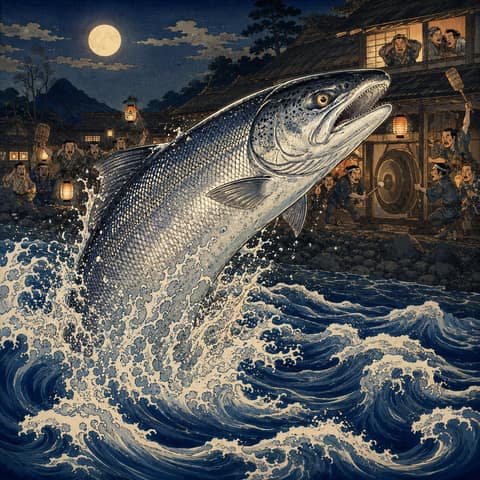
    Known as the King of the River, Daisuke of the Salmon marks forbidden periods and seasonal rites during the salmon run. On set dates—such as the fifteenth of the Frost Month and the twentieth of the Twelfth Month—Daisuke and his consort Kosuke are said to proclaim in loud voices. Anyone who directly hears them dies three days later, so riverside communities kept those days as no-fishing days, ringing gongs, singing, and pounding rice cakes to block out the sound. In tales along the Shinano River, a powerful elder who forces taboo-breaking meets a water authority in the guise of an old woman and dies suddenly with the run’s onset, embodying awe of nature and adherence to proper conduct. The old woman is read as a personified river spirit or Daisuke’s avatar, though never revealed outright. The name varies between “Daisuke of the Salmon” and “Daisuke the Salmon,” and his wife is called Kosuke. Recorded from the early modern period in surveys and folktale collections, this motif spreads across the salmon culture zone of eastern Japan beyond specific locales. Creative variants are few, and the core points—voice, dates, taboo, and fatal retribution—remain consistent.

  • Sandworm

    Sandworm

    Uncommon

    SAHND-wohrm

    Giant Worm Advancing Through Sand - Sandworm

    General TermFictional / Imported Giant Worm Advancing Through Sand (Sandworm)

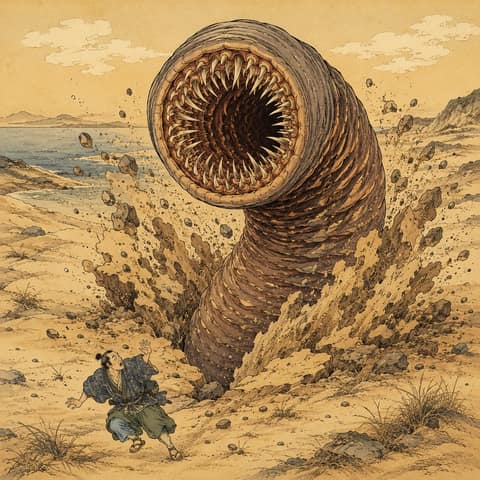
    This is an interpretation of the "apex predator of the sand sea that attacks upon detecting vibrations," burned into the minds of modern people through games and fantasy works. The Sandworm in this version lacks sight; instead, it acutely senses the slightest "footsteps (vibrations)" of humans walking on the surface, embodying the ultimate panic horror as it suddenly opens its massive jaws from underfoot to swallow its prey whole. Speaking of Japan's indigenous subterranean anomalies, there are the "Giant Catfish (Oonamazu)" and "Giant Earthworm" that cause earthquakes, but while they are symbols of "the disaster itself," the Sandworm is strictly set as a "creature reigning at the apex of a harsh ecosystem," reflecting the rationalism of an imported monster. Layers of sharp concentric fangs, an armor-like hard body surface, and overwhelming mass that even swords and magic (or modern weaponry) cannot penetrate. It is the crystallization of the unfathomable terror and romance that the Japanese, living in an island nation surrounded by the sea, harbor toward the "endless desert" they have never once stepped foot in. Precisely because it lacks the background of a local indigenous spirit, it continues to evolve and grow larger in new creative works today as a purely "desperate foe in the struggle for survival."

  • Sanmai Tarō

    Sanmai Tarō

    Uncommon

    SAHN-mai tah-ROH

    Zammai Taro (Folkloric Type)

    Ghosts & SpiritsIshikawa

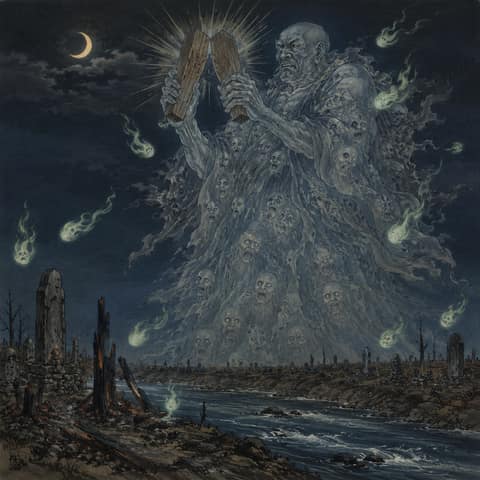
    A figure based on local lore in which death-spirits amassed at a burial ground (zammai) congeal and manifest as a single monster. In Toyama it appears as a humanlike specter that performs ominous signs, while in Ishikawa it is feared as a giant priest-like ogre. It is bound to human life, death, and the order of funerary practice, often marked by nighttime sounds and prescribed etiquette. Widely said to be unable to cross running water, a belief linked to folk practices of digging trenches around the zammai. Its form and stature are not fixed and vary with the density of gathered spirits. Folklore records note collections from the early Showa era, with regional spellings such as “Zammai” and “Zanmai.”

  • Sanuki Heike Crab

    Sanuki Heike Crab

    Uncommon

    sah-NOO-kee HAY-keh-gah-nee

    Sanuki Heike Crab (Linked to Yashimaura)

    Household SpiritsKagawa

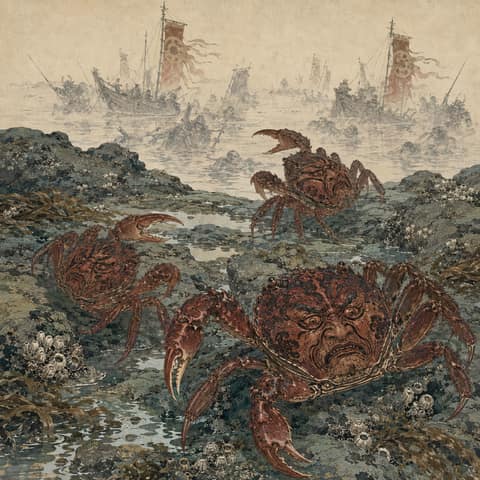
    An image based on folk belief that crabs with human-like patterns on their carapaces washed up on Sanuki shores embody the vengeful spirits of the defeated Taira clan. Historical sources tie these crabs to various locales, with Sanuki famed due to memories of the Battle of Yashima. As a yokai, it is said not to harm people directly, but to make onlookers recall the karma of the battle and feel awe. It is distinctly linked with acts of memorial service and consolation for the dead, and differences from other regional names are considered nominal only.

  • Saru-oni (Ape Ogre)

    Saru-oni (Ape Ogre)

    Uncommon

    SAH-roo-OH-nee

    Legend-Conform Noto Saru-oni

    Demons & GiantsIshikawa

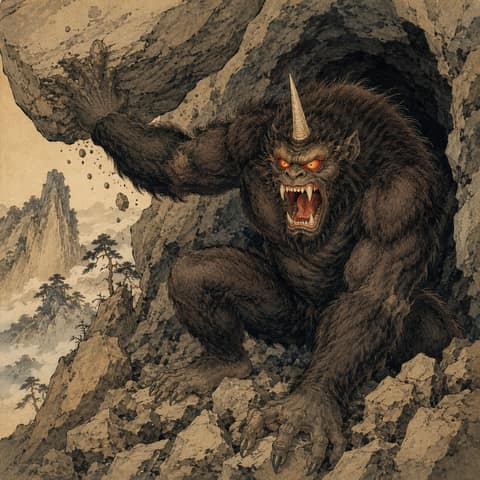
    Based on the Noto region’s distinctive image of the saru-oni. It has an ape-like body crowned with a single horn and dwells in rock caves, menacing livestock and people near settlements. It appears under cover of night and is feared as a boundary breaker between the mountains and the village. Communities sought the protection of local tutelary deities, and tales of subjugation by bow and arrow are tied to place-name origins. After its defeat, its horn is said to have been enshrined, and memorial shrines were established, pairing awe with appeasement. The saru-oni is told as a singular creature rather than a pack. Its range centers on cave mouths and the satoyama borderlands, its presence marked by a bestial stench and legends of black blood.

  • Sea Person (Kaijin)

    Sea Person (Kaijin)

    Uncommon

    KAI-jin

    Textual Tradition Version Amajin (Sea Person)

    Aquatic SpiritsNagasaki

    The image of the Amajin took shape where early modern Japanese natural histories intersected with imported Western reports. Accounts describe a figure largely human in form, marked by webbing between the fingers and loose hanging skin over the body, repeatedly noting draped folds around the waist that resemble a hakama. Speech is uncertain: some say it neither understands nor responds to human language, though variant tales claim survival on land for extended periods. Its diet is unclear, and it often refuses food offered by people. Captured specimens reportedly weaken when kept away from water and die within a few days. Explanations range from misidentified sea mammals such as sea lions or seals to seaweed accretions mistaken for clothing, but none are conclusive. The tradition blends shipborne reports through Nagasaki with local observations, and specifics such as names and dates vary by source, defying firm generalization. It is treated as a typical case of encounters with uncanny beings along the shore.

  • Serpent Queen Princess

    Serpent Queen Princess

    Uncommon

    jah-OH-hee-meh

    Chokeiji Tradition: The Serpent Queen Princess

    Half-Human BeingsOsaka

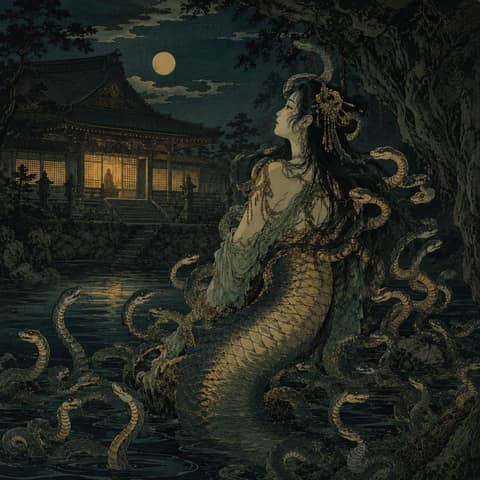
    Said to be a female great serpent dwelling in the pond of Chokeiji in Izumi Province. Leading many snakes, she was styled the “Serpent King,” quietly watching over people near the temple grounds. Around the Bunsei era, she fell for the beauty of the abbot, Zen monk Shoyama, and slipped into the temple disguised as a lost woman. Sensing something amiss, the abbot struck her with a blade. As she lay dying, the serpent vowed to protect Chokeiji. Thereafter the pond became a place of memorial offerings and reverence, tied to taboos against harming snakes and to prayers for rain and abundant harvests. The origin of her title and its rank remain unclear, likely influenced by regional worship of serpent kings (Ja-o, Ja-o Gongen). Though the pond was later filled in and no visible remains survive, her image endures in local oral tradition and temple lore.

  • Seven-Fathom Wife

    Seven-Fathom Wife

    Uncommon

    NAH-nah-hee-roh NYOH-boh

    Composite Folklore Edition

    Half-Human BeingsShimaneTottori

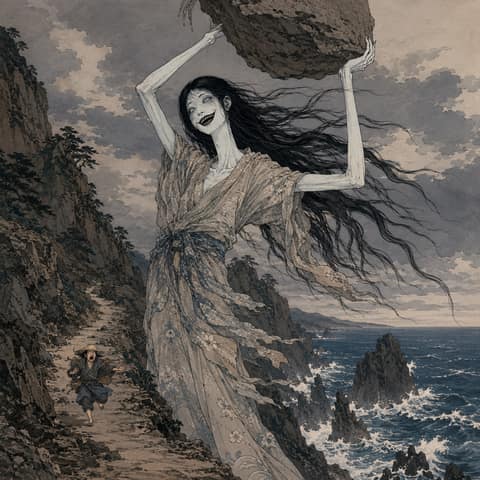
    Shichihiro Nyōbō is a giant-woman tale widely told in Izumo, Oki, and Hōki, appearing at boundary places such as mountain paths, riverbanks, and shores. Her form shifts by locale: in Ama on Oki she is a wild-haired mocker who hurls stones, along the Shimane coast a sea-wind woman flashing blackened teeth, in Yasugi a beggar beauty trailing a long robe, and in Hōki a pallid grinder-woman who sharpens while singing grain songs. Common threads are excessive length of body or neck and the way laughter, gestures, or song serve as lures. In banishment tales, sword wounds link to petrification, with odd stones, mounds, or ancient trees named as origins, and some lineages claim heirloom swords or tack from these encounters. The cycle is not pure horror; beauty, begging for alms, and the humble fear tied to the sound of grinding grain mingle together, encoding folk lessons about handling boundary anxieties: do not meet the gaze, do not answer voices, avoid night roads. It is comparable to early modern long-faced demon-maidens, yet Shichihiro Nyōbō is marked by ties to local sacred landscapes of mountains and coasts.

  • Seven-Step Viper

    Seven-Step Viper

    Uncommon

    SHEE-chee-hoh-jah

    Tradition-Faithful Seven-Step Viper

    Animal ShapeshiftersKyoto

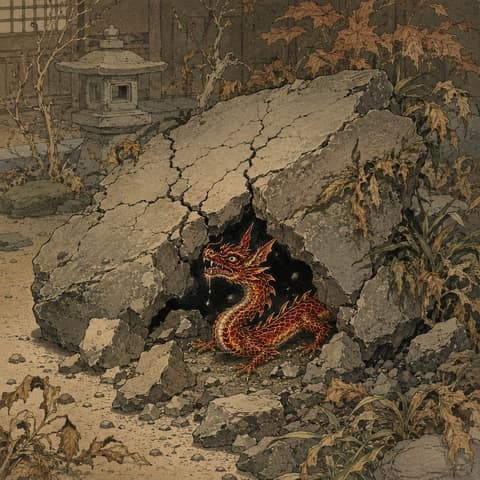
    Based on the account in Kabhiko, it is framed as a small dragon-serpent linked to a manor in Kyoto’s Higashiyama. It resembles a dragon yet is not deified, lurking beneath the soil and under stones, and manifests alongside ominous signs such as withering garden trees and cracked garden stones. Its defining trait is an extreme toxicity said to kill within moments of a bite, echoing ancient lore and fear of deadly vipers. Sightings are rare, with tales in which swarms of strange snakes appear first, and at the end the Seven-Step Viper reveals itself as the true body. It bears four legs, upright ears, and red scales edged in gold—colors read as both auspicious and baleful—and is often taken as a sign of a household’s decline or a disturbance in the land. In folk practice it is tied to neglected stones on mountain skirts and old gardens, and locals would pray before moving stones to avert calamity.

  • Shadow Woman

    Shadow Woman

    Uncommon

    KAH-geh-OHN-nah

    Kage-onna (Traditional Depiction)

    Half-Human BeingsUncertain (pictorial sources point to Edo–Kyoto area)

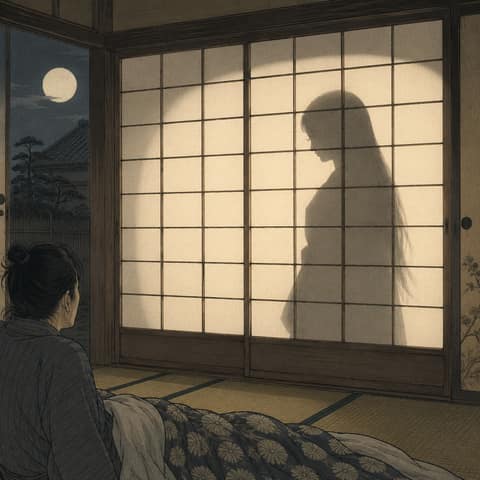
    The image of the Kage-onna traces back to Sekien’s prints and has been understood as a “woman of shadow alone,” appearing where houses meet moon-cast light. In early modern homes, shoji and wooden doors let light pass, creating a boundary between outside brightness and interior dimness where a woman’s outline emerges. Lore says her visit is fleeting, more a portent of household unrest than a threat. Whether she is the shadow of the living or a trace of the dead is uncertain, and she is sometimes linked to family misfortune or the mood of the local deity. Proper conduct is to refrain from pursuit, lower the fire, close the doors, and speak no words. The next day, households often cleanse the well, garden trees, and crawlspace, seeking rites to calm the omen. The shadow makes no footsteps and shifts its shape in the wind. Dogs and cats are said to react keenly, yet harm is rarely told, and she seldom lingers.

  • Shibiru-biru (Buru-buru) – The Quiver Spirit

    Shibiru-biru (Buru-buru) – The Quiver Spirit

    Uncommon

    boo-roo-BOO-roo

    Shindanda (Tradition-Faithful)

    Ghosts & SpiritsJapanese folklore

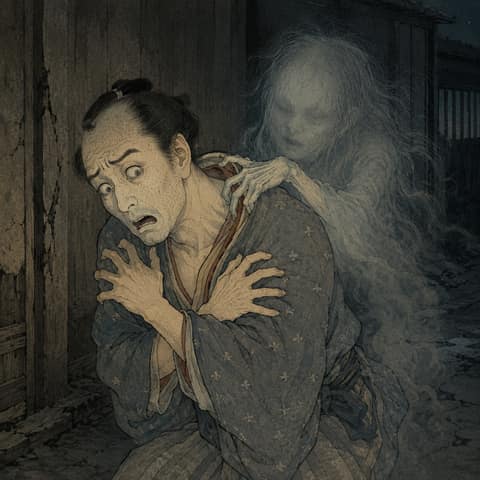
    Reconstructed around the conceptual yokai image based on Sekien’s illustration. Shindanda does not fix its form, appearing as a presence in lonely places or as something at one’s back. It brushes a person’s collar, sending a chill that freezes the heart and guts. Its alternate names, “Coward-Spirit” and “Zozogami,” personify the psychological and physiological reactions that arise on battlefields or night roads, reflecting a premodern view that treated the signs of fear themselves as a kind of possession. Specific methods of exorcism are not standardized; folk practice records distractions such as fire, light, or traveling with companions, but no systematic rite is known. Lacking a physical body, it is rarely a target for capture or slaying, and has been explained mainly as the cause of chills and gooseflesh that overtake the mind and body.

  • Shidai-daka (Ever-Rising Tall One)

    Shidai-daka (Ever-Rising Tall One)

    Uncommon

    SHEE-dye-DAH-kah

    Canonical Folkloric Type

    Mountain & Wilderness SpiritsShimane

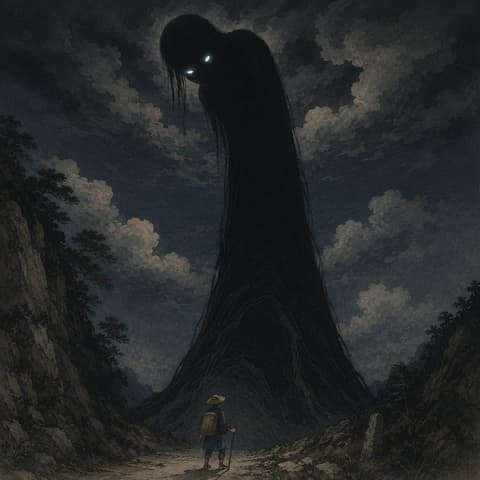
    A baseline profile of Shidaidaka as a roadside, look-up-type apparition recorded across the Chugoku region. It resembles a human silhouette with head and shoulders dissolving into darkness, and its height stretches or shrinks in response to one’s gaze. Harmfulness varies by tale, but fear intensifies through the act of looking up. Countermeasures include keeping your gaze lowered, watching the ground, or peering between your legs, which causes the figure to diminish and dissipate. It is linked to the Mikoshi-nyudo, and tales of the similarly named “Shidai-zaka” are viewed as slope or mountain-path variants. Hunter stories connect it with the nekomata, and identifications differ by locale. Creative embellishments are common, but the core taboo warns that one’s gaze amplifies the phenomenon.

  • Shiranui (Mysterious Sea Fires)

    Shiranui (Mysterious Sea Fires)

    Uncommon

    shee-rah-NOO-ee

    Parent Fire Guide of Hassaku

    Aquatic SpiritsKumamotoSaga

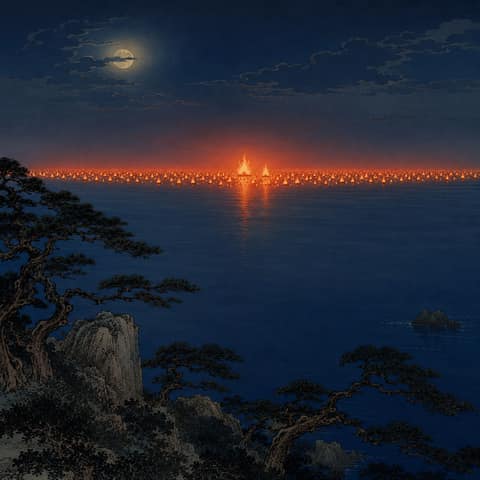
    Among the shiranui, the Parent Fire Guide of Hassaku is a high-ranking variant that appears before dawn on the first day of the eighth lunar month. A single reddish light, sometimes two, first kindles several kilometers offshore, called the parent fire by villagers. It then splits to either side birthing child lights, until hundreds and thousands form a single horizontal line. People say the line may stretch four to eight ri, invisible from the surf but clearly seen from headlands or heights a few ken above the tide wind. When the ebb runs deepest, about the hour around midnight, the flames breathe in unison, and distant watchers see a shimmer like dragon scales flickering beneath the waves. If chased the lights retreat, if neared they draw away. Launch a boat to seize them and they slip aside with the shadow of the current, allowing no approach while indicating only the heading home. Old records tell that when Emperor Keikō’s boat was wrapped in darkness, this parent fire rose far ahead and turned his prow toward shore. For this reason villagers revered the nameless fire, ceasing their nets and resting their oars at midnight on Hassaku, waiting for the line to unspool. The Parent Fire Guide is linked to the presence of a stormy dragon god, yet it shuns harming people and instead warns against arrogance and haste. Boats that grasp for quick profit wander bewildered along the line and must furl their sails, while those who heed the tide climb a shore pine to read the fire’s breathing and slip out quietly with the break in the lights. Offshore shoals then prove gentler than expected, and on the return the embers sway by the coastal shadow to welcome the boat. So pure is the parent fire that villagers murmur Thousand Lanterns or Dragon Lantern and press their hands in prayer, but if people call it coarsely and jeer, the line breaks at once and scatters into beach fog. Wind does not fan it larger, it waxes and wanes only by the pulse of the tide. Thus from capes and mounds it appears a tidy band, while from the wave edge it cannot be seen. They say the Parent Fire Guide can even shift the angle of shrine shimenawa by the sea and the hue of lighthouse flames, and when the sacred rope bows slightly seaward at night, it is a sign that far offshore the lights are being born. Elders who know this tell young crews, Today the tide falls and the fire will rise, refrain from sailing. Unlike man-made flames it leaves no ash or smoke. Only at one hour after dawn do shells on the flats shine pale rose, and dew on reed tips holds the fire’s afterglow. On such mornings villagers cast salt upon the beach and give thanks for the lives guided by the fire. The Parent Fire Guide opens the way to those who know awe and courtesy, withdraws from the overproud, and quietly redraws the boundary between sea and humankind.

  • Shrine Princess

    Shrine Princess

    Uncommon

    JEEN-jah-HEH-meh

    Traditional Lore Version (Hizen, Bunsei Appearance)

    Aquatic SpiritsSaga

    An image based on a block-printed text copied in Kato Hekioan’s Warekoromo. It bears a human face, two horns, a crimson belly, and a triple-sword tail, and is said to have appeared as a messenger from the Dragon Palace to foretell abundance and the spread of disease. Copies of its likeness were promoted as amulets for averting calamity and prolonging life when pasted on doorways or viewed in devotion, leading to widespread circulation of the image. Parallels from Hirado’s “Himeuo” and cases in Echigo show close similarities in iconography and captions, marking a nexus of popular epidemic countermeasures, folk practice, and print distribution. Some propose origins in specific animals, but no proof exists; folklorically it functions alongside prophetic beasts like Amabie and Amabiko.

  • Shu no Ban

    Shu no Ban

    Uncommon

    SHOO noh BAHN

    Classical Sources Version: Vermilion Tray (Watcher of Necks)

    Ghosts & SpiritsFukushima

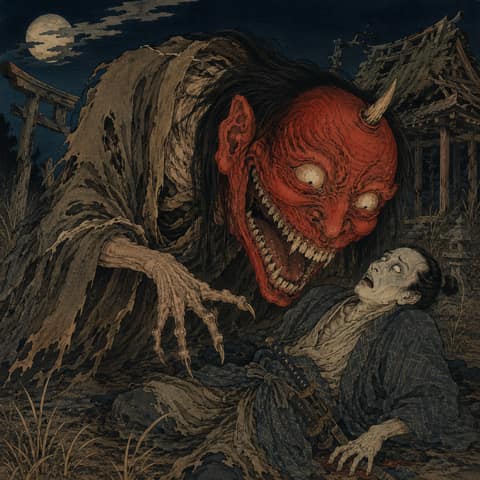
    In early modern tales, the Vermilion Tray is depicted as a red-faced monk-like figure, appearing as an accomplice of the Long-Tongued Crone or showing its visage alone, reappearing to unnerve and harm people. The name varies between “Watcher of Necks” and “Vermilion Tray,” commonly read as Shunoban. Classic illustrations and yokai prints note a red face, horns, a split mouth, and a fiery aura, though details differ by source. Encounters occur mainly at night at shrine gates, in wastelands, and in tumbledown shacks, and the harm is told as loss of spirit leading to fainting, lingering illness, or death. Reports span regions such as Aizu and Echigo, not as a fixed local deity but as a circulating tale-type of the uncanny.

  • Shōkichi Kappa

    Shōkichi Kappa

    Uncommon

    shō-kichi kappa

    Shōkichi Kappa, the Sumo-Loving Kappa of Bungo

    Water spiritOita

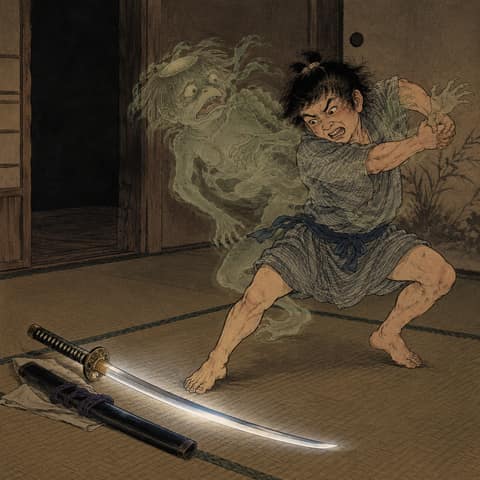
    This version turns to the phenomenon of "kappa possession" that the Shōkichi tale conveys. Most kappa stories play out at the water’s edge, but here the river sumo is carried right into the home. Brought back by his family, Shōkichi went on raging as if locked in a grapple with an unseen opponent—exactly the work, people said, of a kappa that had possessed a human being. A water-spirit climbing onto dry land by borrowing a human body: there lies the spine-chilling fascination of this tale. The means of quelling it, too, reflects the faith of the land. What first took effect was the power of Gō Yoshihiro’s signed blade. The belief that the kappa dreads a keen edge is found in many regions, and the detail that it raged again once the sword was removed shows that power plainly. What finally settled the disturbance was the prayer of a shugenja, an ascetic who trains secluded in the mountains. Quelling kappa possession with these two—the power of the blade and the ascetic’s spiritual force—is a hallmark of Kyushu kappa tales. Hita has gathered many kappa stories, the Hita Gunshi foremost among them, and together with the "Bungo Kawatarō" of the same Bungo, they attest to the depth of this region’s kappa beliefs.

  • Shōrōkaze (Spirit-Wind)

    Shōrōkaze (Spirit-Wind)

    Uncommon

    SHOH-roh-kah-zeh

    Spirit Wind (Folkloric Version)

    Weather & Calamity SpiritsSaga

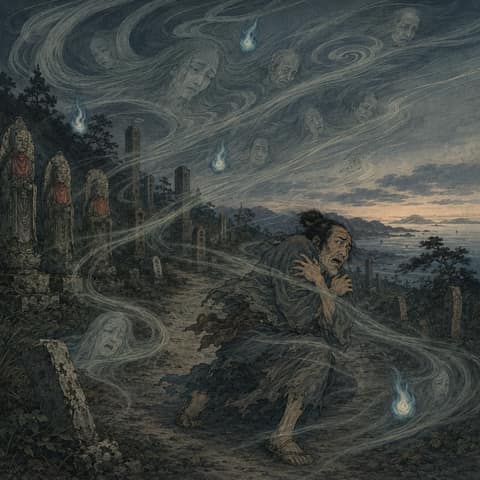
    Spirit Wind is spoken of as an invisible wind that brings sudden chills, fever, and lightheadedness to those it touches. Its timing on the morning of the sixteenth day of Bon is emphasized, and the “spirits” here are the souls of ancestors or the unconnected dead. The wind is understood as carrying the aura of spirits crossing the boundary between return and departure. In the Goto Islands, people strictly avoid graves and grave roads on that day and refrain from going out. On Iki Island, illness is seen as a possessing wind, with graveyard-origin termed dead-spirit wind and grievance-origin termed living-spirit wind. It aligns with regional beliefs in malign winds, where seasonal fatigue and sudden gusts intersect with folk explanations and are remembered as spirit afflictions. It is not told as a yokai with active malice, but as a taboo that warns of misfortune for those who mistake the date or place.

  • Smiling Hannya

    Smiling Hannya

    Uncommon

    wah-RAH-ee HAHN-nyah

    Edo Painting Traditions Edition

    Demons & GiantsNagano

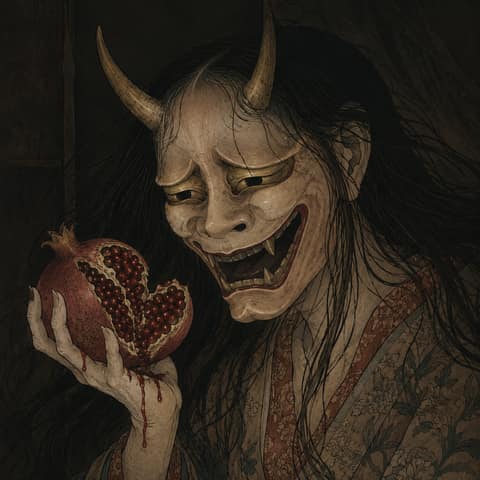
    An edition distilled from late Edo-period ukiyo-e and comic prints depicting the smiling Hannya. Horns, fangs, bristling hair, wide staring eyes, and a strained grin form its core. Objects in its hands often allude to life and death, unsettling viewers with deliberate motifs. The demon-woman is understood to have once been human, transformed by accumulated jealousy, resentment, and attachment, aligning with the concept behind the Hannya mask. Specific local legends are sparse, yet it was treated in night-time tales and picture books as a symbol of fear and admonition, preserved as an image of the extreme of a woman’s grudge. In local oral tradition sometimes only the name remains, with the transmission of its form relying mainly on pictorial sources.

  • Snow Elder

    Snow Elder

    Uncommon

    YOO-kee-jee-jee

    Elder of Snow Standing in the Mountains

    Natural Phenomena SpiritsMountain regions of Tohoku, Hokuriku, and Koshin (uncertain)

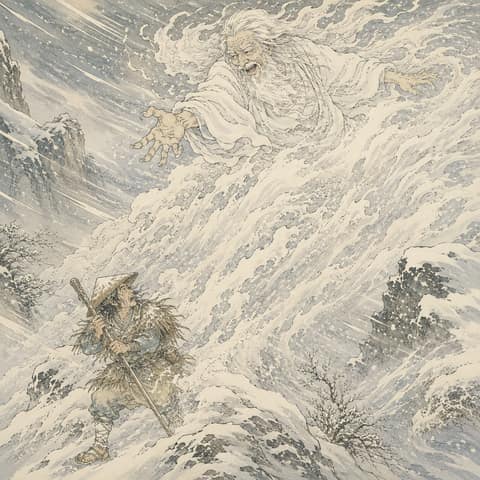
    When the curtain of a blizzard falls, the Snow Elder appears as an old man in white robes, calling from afar to strip travelers of their sense of direction. He belongs to the lineage of snow-related apparitions, overlapping in role with Yuki-onna and Yuki-nyūdō, yet marked by his elder form. His figure is indistinct, fading the closer one approaches, while only his voice is said to echo from behind. In folklore he is understood as a symbolic warning against the perils of winter weather.

  • Spirit of Dreams

    Spirit of Dreams

    Uncommon

    YOO-meh no say-RAY-ee

    Historical Source-Critical Version

    自然現象・自然霊Japanese folklore

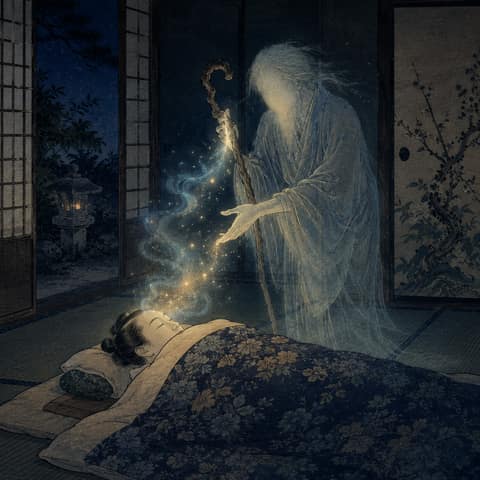
    The name “spirit of dreams” found in pictorial sources is secondhand and not firmly tied to a specific image. Depictions often show an elderly figure leaning on a staff and beckoning, suggesting a symbolic guide of dreams. Some propose it arose from misread characters for a grass spirit or tree yokai, but this is uncertain. Here it is framed as a nature spirit that mediates dreams and portends good or ill, linked to the role of dreams in divination and omens. Personalization and proper names are avoided, positioning it as a numinous rank residing in the power of dreams themselves.

  • Spirit of the Ema Plaque

    Spirit of the Ema Plaque

    Uncommon

    EH-mah no SAY

    Ema Spirit (Traditional Tale)

    Household SpiritsKyoto

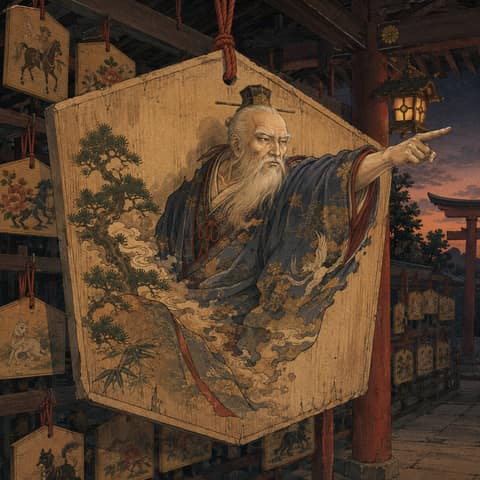
    A spiritual presence dwelling in votive ema plaques, known from shrine and temple origin tales and ghost stories. It appears most often at dusk or in dreams, and its form is thought to reflect the donor’s wish or the plaque’s artwork. As an old man it teaches or warns, and as a woman it may invite or manifest. It is not a deity itself, but a spirit residing in an offering, revealed through the power of the sacred precinct. It shuns being taken home without cause, defiled, or thrown into fire, and favors proper return or ritual burning. Encounters can be auspicious or ominous, with fortune depending on one’s conduct.

  • Suiton

    Suiton

    Uncommon

    すいとん

    The One-Legged Yokai of Hiruzen: Suiton

    Mountain / Field YokaiHiruzen in Mimasaka Province (Present-day Hiruzen, Maniwa City, Okayama Prefecture)

    *Suiton* is a one-legged yokai unique to the Hiruzen Highlands, based on local folklore recorded in the *Yatsuka-son Shi*. Its name derives from the way it flies in with a "*sui*" and lands on its single leg with a "*ton*". It belongs to the lineage of mind-reading yokai like the *Satori*, reading human hearts to tear apart and devour only the wicked. On the other hand, it has functioned as a moral guardian of the land, protecting the good and keeping the evil away. The anecdote of it fleeing in terror from the sound of bamboo bursting in a fire adds a touch of comedy—showing that despite its powerful mind-reading ability, it is easily frightened by sudden noises. This perfectly illustrates its character as a local yokai that serves as both a warning and a beloved figure. Today, statues of the *Suiton* are erected in various places as a symbol of Hiruzen tourism.

  • Taiba, the Horse-Killing Wind

    Taiba, the Horse-Killing Wind

    Uncommon

    TAI-bah

    Taiba (Traditional Record Edition)

    Weather & Calamity SpiritsVarious regions across Honshu and Shikoku

    Taiba is recorded as a sudden apparition arriving with wind and blowing sand. It appears from April to July, especially May to June, and travelers were warned on days that shift between sun and cloud. Accounts vary by region regarding the victim horse’s coat and sex: in Mino white horses were targeted, in Enshu chestnut and bay, while old women and mares were said to be spared. Eyewitnesses tell of each mane hair standing on end, a red gleam shining, and when the horse collapses the wind falls still. The Owari and Mino “Giba” is regarded as a personification of Taiba, a small girl who descends from the sky, ensnares a horse, then vanishes with a smile; the chosen horse spins rightward several times and dies. Folk countermeasures include covering the horse’s neck with cloth, fitting deerfly-proof belly guards or bells, and in emergencies letting a little blood from the ear, needling the center of the tailbone, or cutting the air ahead with a sword while reciting the Komyo Mantra. Temples and shrines fostered prayers for quelling horse-plagues, and talismans to horse deities and belly wraps were used as Taiba wards.

  • Tamehachi Fox

    Tamehachi Fox

    Uncommon

    tah-meh-HAH-chee GEE-tsue-neh

    Kitayama Village Tradition Version

    Animal ShapeshiftersWakayama

    A form rooted in the topographic legends of Kitayama Village. A fox is said to possess a person and display uncanny lightness, leaping across sheer cliffs. Variant tales pit it against serpents or yamabushi ascetics, so rivals and techniques differ by account. Anchored to cliff-line marks cited as physical proof, it serves to evoke the village boundary’s numinous authority and taboos. Ritual details and personal names are not preserved, and narratives remain general in outline.

Showing 97 - 120 of 148 yokai