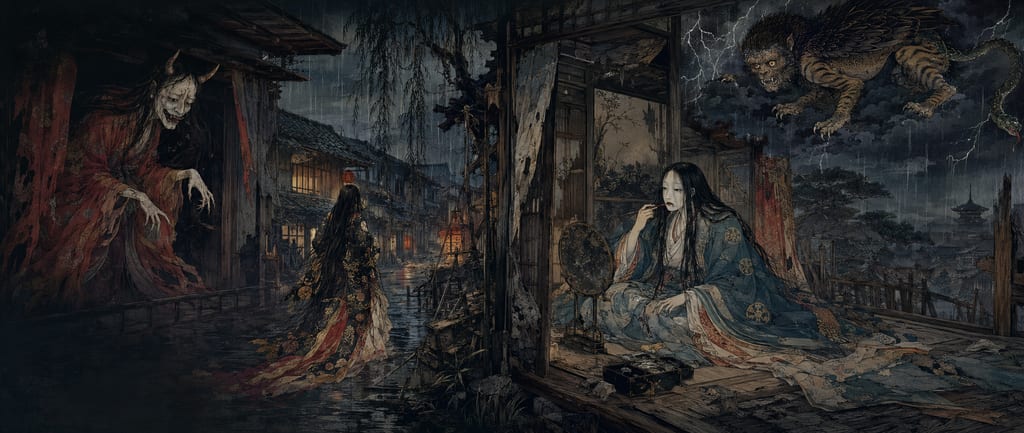
Shibiru-biru, commonly called Buru-buru, is a yokai personifying the omen of fear, depicted by Toriyama Sekien in Konjaku Gazu Zoku Hyakki. When a chill creeps in at the collar and gooseflesh prickles the nape at a sudden fright, it is said this spirit has attached itself. Also known as the Coward God (okubyō-gami) or Zozogami, it symbolizes how fear manifests as bodily sensation. Its form and provenance are undefined, resembling a deified concept of dread.
Folklore & Legends
In illustrations it slips up behind a person and settles at the collar; a touch from it makes one’s hair stand on end and a shiver run down the spine. The Coward God weakens resolve in battle, turning people away from conflict, while Zozogami explains the godlike force behind goosebumps and bristling hair. Lacking strong regional oral tales, it is chiefly known through picture books and encyclopedic notes as a conceptual yokai.
Yokai Cards2
Shibiru-biru (Buru-buru) – The Quiver Spirit across multiple art-style decks
Reconstructed around the conceptual yokai image based on Sekien’s illustration. Shindanda does not fix its form, appearing as a presence in lonely places or as something at one’s back. It brushes a person’s collar, sending a chill that freezes the heart and guts. Its alternate names, “Coward-Spirit” and “Zozogami,” personify the psychological and physiological reactions that arise on battlefields or night roads, reflecting a premodern view that treated the signs of fear themselves as a kind of possession. Specific methods of exorcism are not standardized; folk practice records distractions such as fire, light, or traveling with companions, but no systematic rite is known. Lacking a physical body, it is rarely a target for capture or slaying, and has been explained mainly as the cause of chills and gooseflesh that overtake the mind and body.
Character Profile
This section is our own creative profile for storytelling. It is not historical fact or scholarship.
The diagram below is a diagnostic evaluation chart for Shindanda (Tradition-Faithful). The higher the value of each item, the stronger that characteristic is expressed.