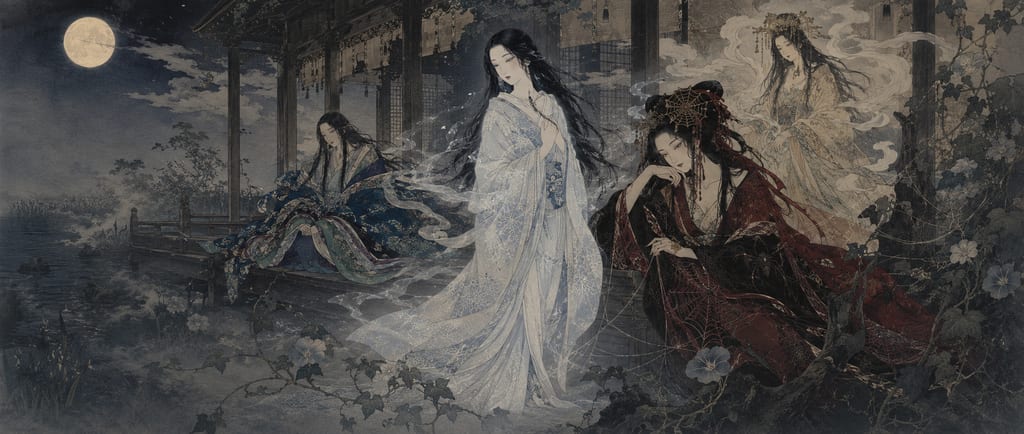
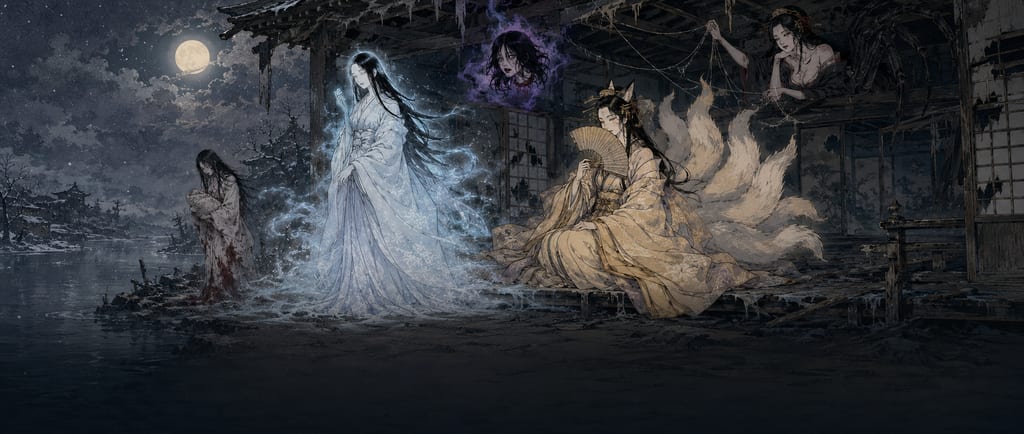
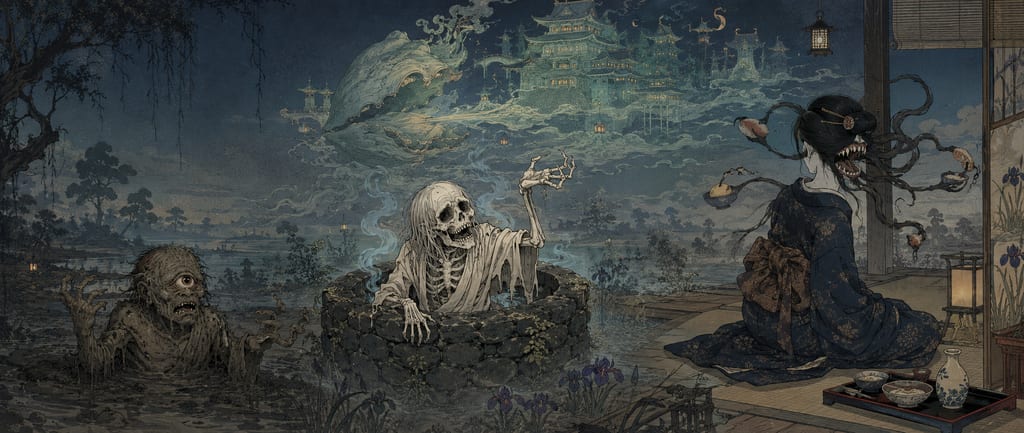
The Shadow Woman is a feminine apparition drawn by Toriyama Sekien in Konjaku Hyakki Shūi. In houses haunted by spirits, only the silhouette of a woman appears on the shoji under moonlight. She manifests as a shadow, with no clear physical body. Sightings occur at night—especially in strong moonlight—and are described less as attacks and more as an ominous sign. Explanations vary: a restless ghost, a house-bound entity, or a spirit of moonlight; her true nature remains unknown.
Folklore & Legends
Beyond Sekien’s artwork, modern-era collections tell of a woman’s shadow cast on shoji or windows; she may show herself in the garden yet never enter the house. On moonlit nights, sometimes during a drinking party, the shadow appears, taken as a bad omen or a mark of a resident spirit. It speaks no words, fades when approached, and may return the following night. Stories hint at ties to the land or household, but real names or detailed origins are seldom known.
The image of the Kage-onna traces back to Sekien’s prints and has been understood as a “woman of shadow alone,” appearing where houses meet moon-cast light. In early modern homes, shoji and wooden doors let light pass, creating a boundary between outside brightness and interior dimness where a woman’s outline emerges. Lore says her visit is fleeting, more a portent of household unrest than a threat. Whether she is the shadow of the living or a trace of the dead is uncertain, and she is sometimes linked to family misfortune or the mood of the local deity. Proper conduct is to refrain from pursuit, lower the fire, close the doors, and speak no words. The next day, households often cleanse the well, garden trees, and crawlspace, seeking rites to calm the omen. The shadow makes no footsteps and shifts its shape in the wind. Dogs and cats are said to react keenly, yet harm is rarely told, and she seldom lingers.
Character Profile
This section is our own creative profile for storytelling. It is not historical fact or scholarship.
The diagram below is a diagnostic evaluation chart for Kage-onna (Traditional Depiction). The higher the value of each item, the stronger that characteristic is expressed.