Yokai Encyclopedia

Encyclopedia of Japanese Yokai

148 Yokai|14 Category|Page 2 of 7
Localization in Progress - More content available in Japanese version
View Japanese
Sort by: NameAscending
Uncommon
  • Female Tengu

    Female Tengu

    Uncommon

    OHN-nah TEN-goo

    Annotated Tradition Edition: Female Tengu

    Mountain & Wilderness SpiritsTokyoYamanashi

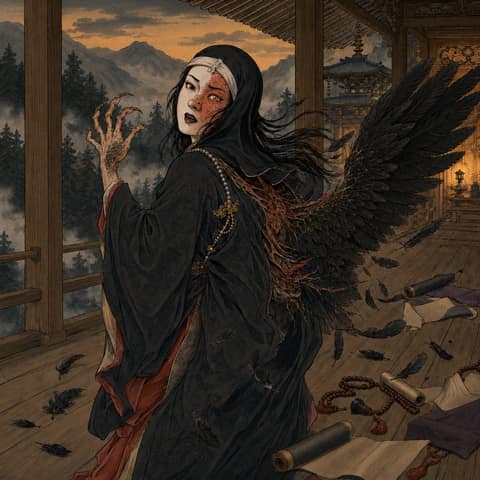
    The Female Tengu is a strand within the broader image of tengu sporadically referenced in texts and oral lore. She is depicted in women’s attire such as kosode, light robes, or scarlet hakama, yet her back-borne wings and supernatural power mark her as a tengu. In The Tale of the Heike and its offshoots, the nun-tengu appears as a metamorphosis born from religious decline, providing a female counterpart to the monk-tengu. Edo-period mountain-encounter tales often stress prohibitions against women, noting the absence of female tengu, while river-tengu lore sporadically mentions married pairs or feminine features. Claims tracing their lineage to the goddess Amanozakoyahime appear in early modern natural-history writings but remain interpretive rather than doctrinal. Regional variation is great and no single image dominates, yet they share the general tengu attributes of might, illusion, and flight. Stripped of creative exaggeration, the Female Tengu is best seen as a projection of womanhood within the tengu world, with specific names and genealogies largely unknown.
  • Field Matchlock (Nodeppō)

    Field Matchlock (Nodeppō)

    Uncommon

    noh-DEHP-poh

    Canonical Folklore Version

    Animal ShapeshiftersMountain forests of Japan’s northern provinces

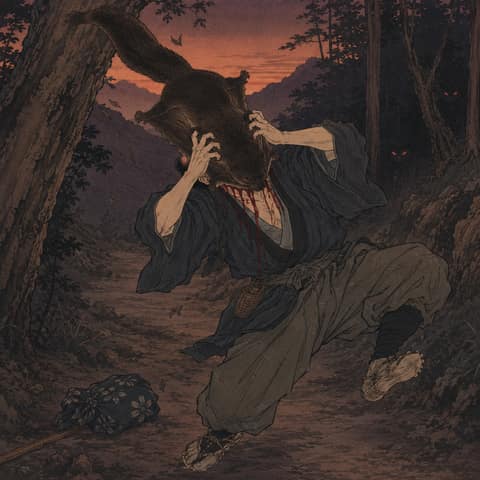
    Based on images from illustrated Edo-period strange tales. It hides in northern mountains and fields and moves from twilight into early night. It appears as a small beast like a badger or a giant flying squirrel, and when attacking it blinds a person to sow confusion. Sources describe two modes: one covers the victim’s face with its whole body, the other spits a bat-like thing that clings to the face. Some accounts say it drinks blood, while later interpretations suggest it steals carried food while the victim’s sight is blocked. Historical conflation with badgers, tanuki, nobusuma, and bats led to shifting names and traits. A simple defense recorded is to keep rolled ear-shaped leaves in one’s bosom, though details vary by region and era. Avoids modern embellishment and follows classical picture compendia.

  • Fire of the Akuro-gami

    Fire of the Akuro-gami

    Uncommon

    AH-koo-roh-gah-mee no HEE

    Canonical Folklore Version

    Natural Phenomena SpiritsMie

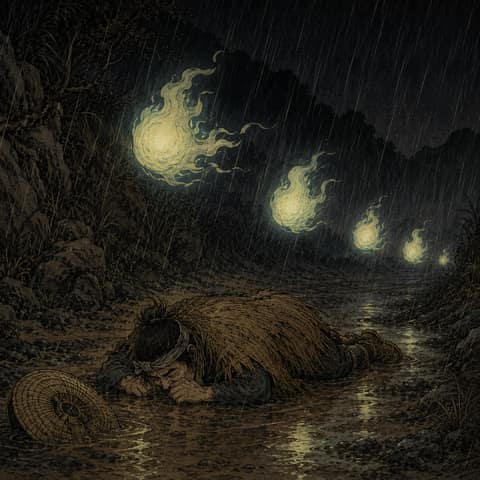
    A figure based on Edo-period records. On rainy nights it drifts low, coming and going like a procession of lantern lights. Rather than misleading travelers, it was dreaded for bringing illness to anyone who drew near, and the only recourse was to lie flat on the ground until it passed. Local names vary, and it is classed as one type of strange fire from Ise Province. Its substance is unknown, it makes little sound, and reports note few sensory details such as heat or odor even at close range.

  • Foot-Washing Manor

    Foot-Washing Manor

    Uncommon

    ah-shee-AH-rah-ee yah-SHEE-kee

    Ashiarai Mansion (Edo Odd Tale Traditional Type)

    Household SpiritsTokyo

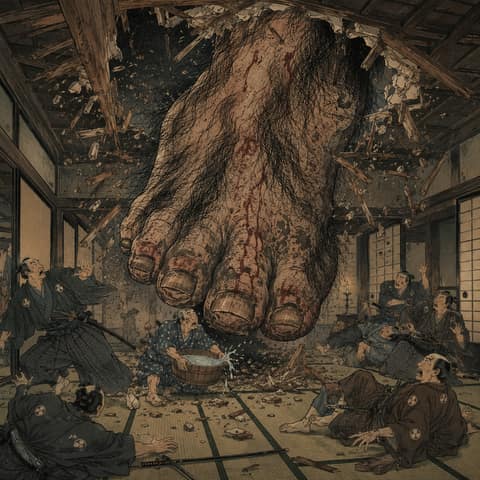
    In Honjo, Edo, this house-bound tsukumogami-like apparition manifests as a single gigantic foot descending from the ceiling to demand washing. It speaks human words and subsides when the ritual act of washing is performed, aligning with household notions of purification. Its true identity is left undefined and has been variously told as demon, monster, beastly shapeshifter, or a transformed house deity. Though threatening, some variants include a protective role that crushes thieves, and tales warn that forced exorcism angers it, reflecting urban ghost lore that prizes proper response over rash banishment. Regional lore varies—ending after a house change, or requiring a woman to do the washing—but the core remains: only the foot appears, and washing makes it withdraw.

  • Fujiwara no Chikata’s Four Oni

    Fujiwara no Chikata’s Four Oni

    Uncommon

    fooj-ee-WAH-rah no chee-KAH-tah no yohn-kee

    Taiheiki Tradition Version: The Four Oni

    Demons & GiantsMieIwate

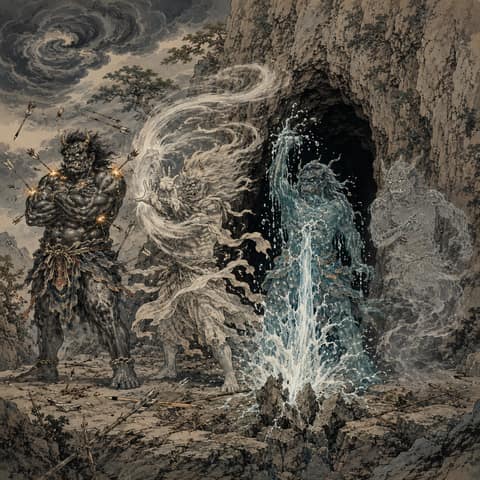
    This version follows the Taiheiki, Book 16 “Affairs of Japan’s Enemies.” The Four Oni serve under Fujiwara no Chikata with clearly divided roles, complementing each other’s arts in battle. The Gold Oni forms the vanguard with a body that repels blades and arrows, the Wind Oni scatters ranks with gales, the Water Oni summons flood and torrent across any terrain, and the Hidden Oni erases form and presence to handle scouting and ambush. Their might is framed less as stratagem than as a tendency to yield before kotodama and prayer, epitomized by their dispersal through a waka by Ki no Asao. Later legends of Sakanoue no Tamuramaro and Kumano slayings alter their order and exploits, yet the core remains: four disparate powers combine to overmatch human effort, but bow to righteous words. The notion of ninja origins is a later reading; in folklore studies this is a case of war-epic demon tales binding to local toponymic lore. Creative variants abound, but this version keeps to gunki conventions and limits places and figures to sources within the epic.

  • Fusuma

    Fusuma

    Uncommon

    Fusuma

    The White Cloth of the Night Road: Sado Fusuma

    Dwelling / household objectSado Island, Niigata Prefecture (main form) / Tosa, Kōchi Prefecture (variant)

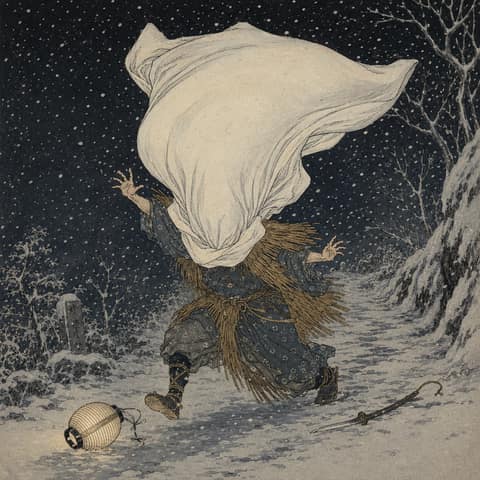
    This version focuses on the better-known white-cloth type from Sado, rather than the Tosa form. It centers on the circumstances in which Fusuma appears on night roads, the method of resisting it with ohaguro, and the legendary connection to the custom of men using kane tooth dye. In Sado, on night roads, snowy paths, or around inns, a white cloth about the size of a wrapping cloth is said to drift down without sound, as if floating in the moonlight, and cover a person from head to shoulders. Blades cannot cut it. Only when someone with ohaguro in their mouth bites through one edge does the apparition wither and fall away. It is true that some men on Sado used kane tooth dye into the Meiji period, and elders preserved the explanation that this was a remnant of measures against Fusuma. Yet the male ohaguro custom also has other possible motives, including festival dress and rites of adulthood. The claim that it existed specifically to defeat Fusuma should be read as partly containing later rationalization. In winter Sado, when wind rises over snowy fields, white cloth from eaves or drying racks can be swept up and blown across one's view. Such natural experiences may also have been retold locally under the name Fusuma.

  • Fūri (Wind Tanuki)

    Fūri (Wind Tanuki)

    Uncommon

    FOO-ree

    Bibliographic-Transmission Composite (Edo Natural History Lineage)

    動物変化Imported from China (accounts found across Japan)

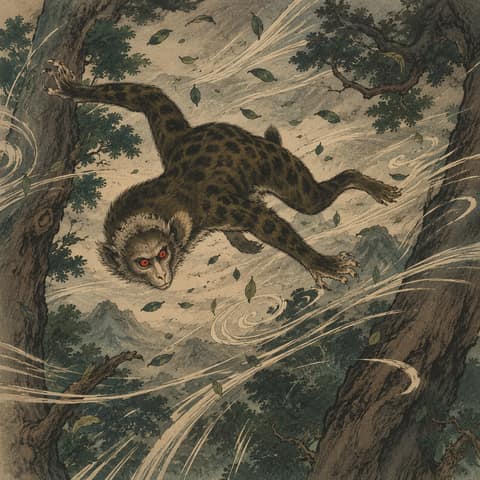
    A synthesis based on Chinese natural-history accounts transmitted in the Edo period, organized against Japanese essays and illustrated compendia. Said to be the size of a small monkey or a marten or tanuki, with a short tail, red eyes, and a dark coat mottled with spots. It appears with the wind to startle people and livestock or leave sudden grazing wounds, without the heavy harm stressed for demons. Its existence wavered in Japan: Wakan Sansai Zue argued it was unborn, Mimi-nashi Hoichi’s Miminashi? (Mimibukuro) recorded rare encounters, and Kō Wahonzō compared the creature 狤𤟎 to the kamaitachi. Thus, though the name is foreign, early modern scholars’ efforts at comparison and identification converged on the idea of a wind-borne beastly apparition, an unseen thing that inflicts slashing grazes. Details of ecology and form vary by text, likely arising from layered readings of local animals—marten, tanuki, monkey, otter—and wind-related mishaps.

  • Gaki Possession (Starving-Ghost Affliction)

    Gaki Possession (Starving-Ghost Affliction)

    Uncommon

    GAH-kee TSOO-kee

    Traditional Version: Gaki Possession of the Mountain Pass

    Demons & GiantsVarious regions (Kanagawa, Wakayama, Kochi, Niigata, and elsewhere)

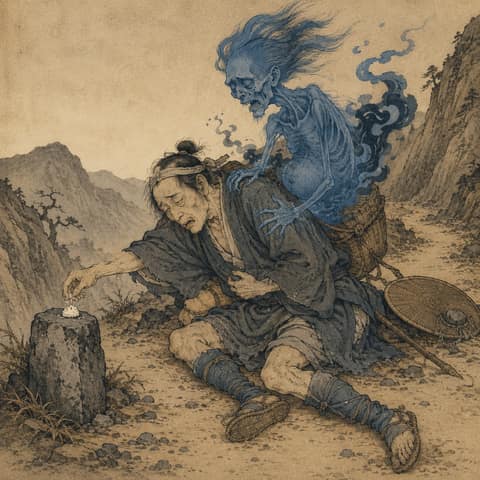
    A classic image of gaki possession said to occur on mountain passes and in the hills. It is understood to stem from the spirits of those starved to death in battles or as wayfarers, so travelers carried a little food and offered it to the pass before crossing to avert harm. Onset is sudden, marked by fierce hunger, weakness in the limbs, and feet that refuse to move, often leaving one unable to rise in shade or where wind passes through. The remedy is simple: even a single grain of rice, a pinch from a salty rice ball, or a scrap of dried fish in the mouth is said to loosen the grip. As prevention, people scattered a bite of their lunch to the mountain deity or the spirits of the unburied dead, or made offerings at roadside Jizo. One should avoid heavy meals at once, easing the stomach with rice porridge or zosui. Though names vary—Iso-gaki on the coast, Hidarugami in basins and farm villages, Jikitori in Shikoku—the symptoms and remedies are nearly identical and closely tied to local practices of memorial and roadside offerings for the dead.

  • Gambari Nyūdō

    Gambari Nyūdō

    Uncommon

    GAHN-bah-ree nyoo-DOH

    Tradition-Concordant Version

    Aquatic SpiritsVarious regions (Edo, Kinai, Sanyōdō, etc.)

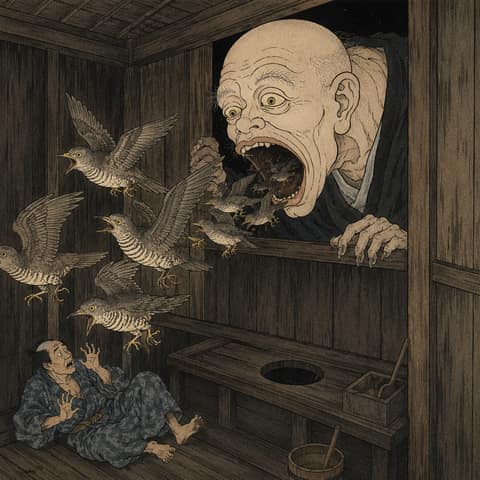
    A synthesis based on Toriyama Sekien’s imagery and regional taboos and chants tied to privies. Since antiquity, latrines were seen as thresholds where impurity and boundary meet, with apparitions said to appear at liminal times such as midnight and New Year’s Eve. Sekien depicts a monk-like figure vomiting a bird and notes a charm invoking “Gambari Nyūdō Cuckoo.” Folklore records chants that decide fortune or misfortune, tales of transmutation to gold or koban alongside ominous encounters marked by hearing the cuckoo. Scholars note punning links with the graph for cuckoo and Chinese toilet deities, and strong regional variation and name fluidity, including Wakayama’s “Setsuin-bō” and blending with Okayama’s Mikoshi-nyūdō. Practices on how and when to enter the privy, cautions on time, and children’s nerve-testing customs intertwine with taboos over what to say and tales of invited luck.

  • Gangi Kozō

    Gangi Kozō

    Uncommon

    GAHN-ghee koh-ZOH

    Archaic Illustration-Concordant Form

    Aquatic SpiritsUncertain (appears in Edo-period picture books)

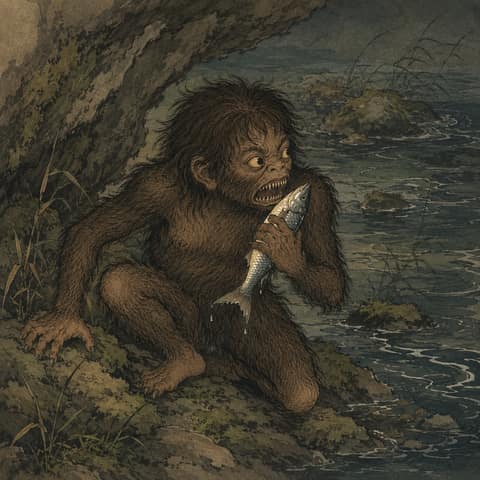
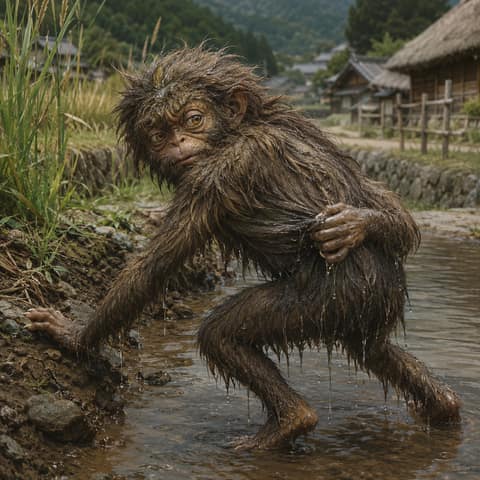
    A reconstruction based on Toriyama Sekien’s image and its brief note. It lurks along riverbanks and in shallow pools beneath cliffs, seizing fish when the moment is right. Its body is close to a small boy’s in build but covered in coarse hair, and its teeth are file-like, said to rasp flesh from its catch. While traits recalling the kappa (such as webbing and a waterside life) come to mind, definitive attributes like a carapace or head-dish are not attested and are therefore omitted. The “bank” and “cliff” elements in the name are read as descriptive of its haunt, not a regional or clan identifier. Modern commentary notes a cautious link to beings bearing “cliff” in mountain-怪 lexicon (e.g., Takiwaro), but stops short of identification. Extant primary sources are Sekien’s picture and text; no behavior, curse, or offering rites are transmitted. Here it is treated as a small waterside uncanny, silently stalking fish.

  • Garei (Spirit of the Painting)

    Garei (Spirit of the Painting)

    Uncommon

    GAH-ray

    Garei (Ochikuri Monogatari Edition)

    Animated Objects & UndeadKyoto (anecdote from the Kanjuji household)

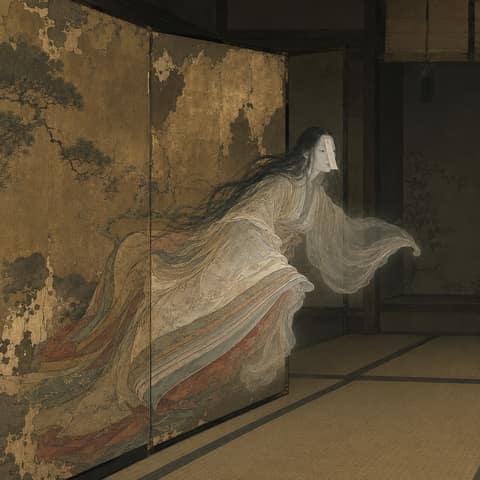
    An image-spirit as portrayed in a late Edo essay. A woman steps forth from an old screen painting, and any treatment applied to the picture manifests as real-world phenomena—the core motif is the linkage between image and reality. Signs caused by the aging of the object are perceived as hauntings, yet they subside through repair and reverent care, fitting within tsukumogami tradition. The writer names specific places and households, but the entity’s purpose is unstated, its warnings and appearances are brief, and the events end once the piece is appraised and restored. Rather than the painter’s fame empowering a spirit, the tale chiefly cautions against mistreating fine works. Harm to people is rare; its hallmarks are visual manifestation and a return to its locus, vanishing before the screen. Later readings cite it as an exemplar underscoring the importance of memorial rites for objects.

  • Gataro

    Gataro

    Uncommon

    gataro

    The Kappa of Goto that Became a God of Fire Prevention: Gataro

    Water YokaiNagasaki

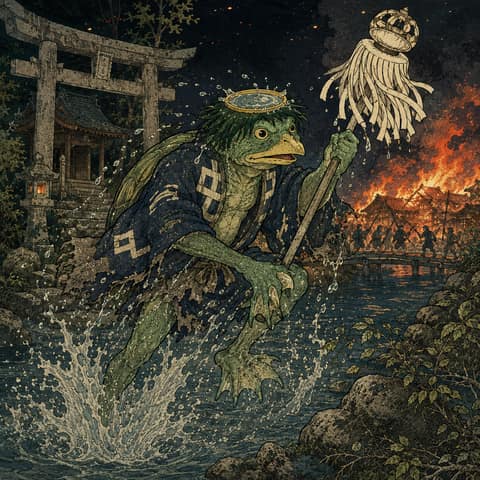
    While the *Gataro* is a lineage of the Kyushu *kappa*, its image unique to Goto lies in the fact that it formed an independent belief as a guardian deity of fire prevention. The legend that the general of the *kappa* of Goto dwells in the Mizu-jinja on the Daienji River in Fukue Island, and that *kappa* firefighters protected the Goto domain's mansion in Edo during a fire in Kyoho 8 (1723), connected with the nationwide Suitengu belief of 'water god = fire prevention,' and became known even in Edo via the Goto domain's mansion. Its form possesses the typical features of Kyushu *kappa*, such as the dish on the head, detachable arms, love of sumo, and human possession. However, it has thick traditions linked to local place names, such as the differences in island names like Gaataro, Kyataro, and Gappadon, and the kappa footprints remaining on Bentenjima in Shiraragahama, Miiraku. Sometimes spoken of as the alter ego of the *Yamawaro* that switches places seasonally, the *Gataro*, in Goto—surrounded by the sea and with limited clear streams—is a *kappa* rooted in island life, harboring the contrasts of water and fire, mischief and protection within a single body.

  • Guiding Lantern (Okuri-chōchin)

    Guiding Lantern (Okuri-chōchin)

    Uncommon

    oh-KOO-ree CHOH-cheen

    Honjo Seven Wonders Tale: Okuri-Chochin (Guiding Lantern)

    Mountain & Wilderness SpiritsTokyo

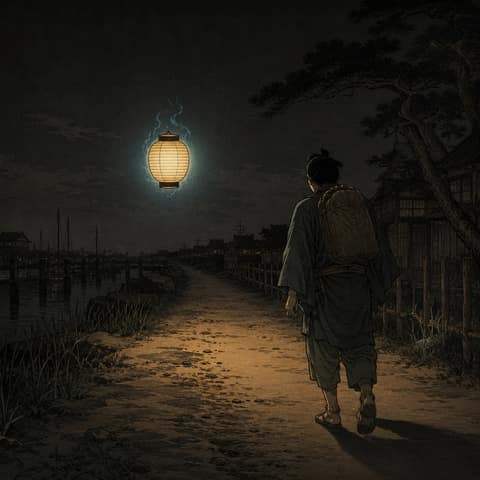
    Passed down around Edo’s Honjo district, the Okuri-Chochin is understood as a strange guiding fire that appears between safety and dread on night roads. Its light sways with a person’s steps and breath, keeps its distance while leading ahead, yet never allows touch. At times it slips to one’s rear or flank to upset direction, and when accompanied by a clapper-like sound it is recorded under the alias “Okuri Hyojiki.” The “Lantern Boy” of Ishihara Warigesui is a formless Odawara-lantern flame that circles on all sides and vanishes when approached, regarded as the same phenomenon as the Okuri-Chochin. In Mukojima it is called the “Okuri-Chochin Fire,” believed to light one’s footing and ensure safe passage, with cases linked to offerings at Ushijima Myojin. Though it rarely causes direct harm, it can lead travelers astray, so locals advise not to chase it, to keep a set distance and pass it by, or to bow at a shrine or temple to seek protection.

  • Hair in the Hemp Bucket

    Hair in the Hemp Bucket

    Uncommon

    ah-sah-OH-keh-no-keh

    Traditional Record Edition (Awa Curious Tales)

    Household SpiritsTokushima

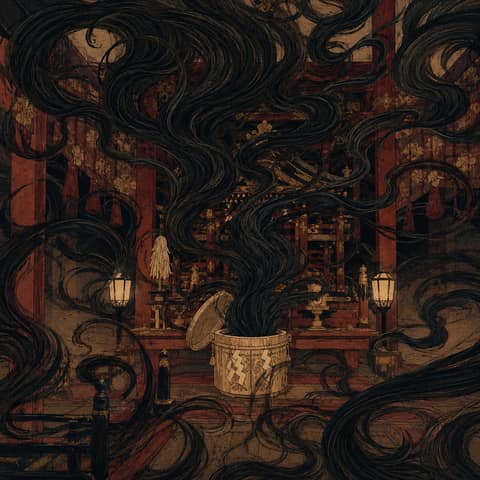
    Based on an old Awa record. Hair kept in a hemp bucket acts as part of the deity’s body or a manifestation of divine power, restraining anyone who disrupts shrine order. It is understood to activate within the shrine precincts rather than roaming independently. The core image is hair that quietly elongates, splits into strands, and entangles targets one by one, reacting to acts like defilement or theft rather than attacking onlookers indiscriminately. Shigeru Mizuki depicted it as a massive hair mass under the name “Asaokege,” but the actual tradition emphasizes function over appearance. Often read as a symbol of in-shrine norms encouraging observance of faith and taboos.

  • Hair-Cutter

    Hair-Cutter

    Uncommon

    KAH-mee-KEE-ree

    The Hair-Cutter of Edo Streets

    山野の怪MieTokyo

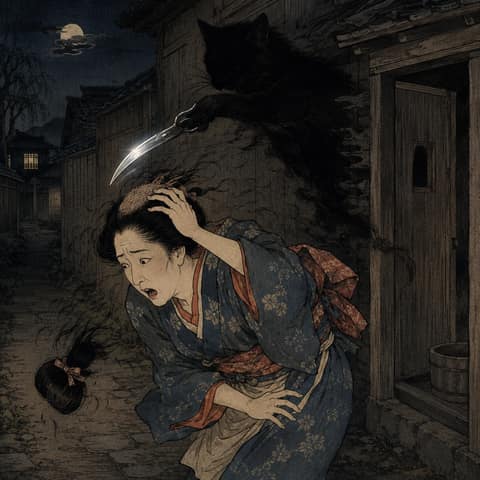
    An amalgam of hair-cutting incidents reported from Edo and other early modern towns. At night, in the street or at the threshold of an indoor privy, there is a sudden brush of contact, and moments later the victim’s hair falls away still neatly tied, without their noticing. Witnesses describe a figure black from head to toe, catlike, or with the feel of velvet, yet its true form remains uncertain. Servant girls and maids were often noted as victims, with rumor-mongering and official crackdowns recorded side by side. Folklorically, taboos surrounding hair as part of the body overlap with notions of impurity tied to night roads and privies, casting an unseen assailant as a yokai. Its method and motive are never stated in tradition, placing it among urban horrors shaped by fear and unease.

  • Hand-Eyes

    Hand-Eyes

    Uncommon

    TEH-no-meh

    Traditional Picture-Scroll Reference Edition

    Mountain & Wilderness SpiritsKyoto

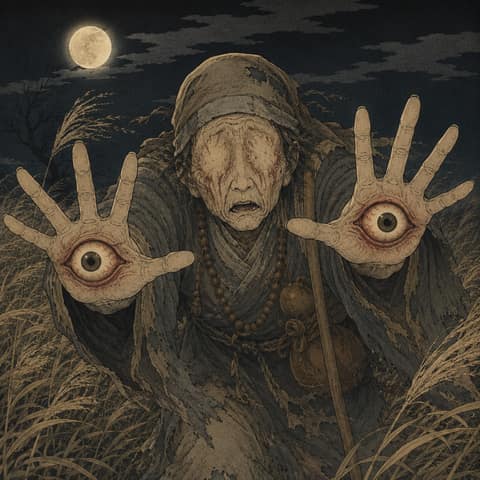
    An interpretation grounded in the imagery found in Sekien’s Gazu Hyakki Yagyō and night-parade picture scrolls from the Tenpō era onward. It is depicted as a shaven-headed figure like a blind monk, with large eyeballs set in both palms, standing in a moonlit wasteland. Narrative explanations are sparse, but linked to the illustration and tale in Shokoku Hyaku Monogatari, it is assumed to locate targets in darkness with the eyes in its hands and to sniff out those who have fled and hidden. In collected folklore it sometimes connects to vengeful spirits of the blind, and is often read as a symbol of exchanged sight and touch, witnessing and exposure. Etymological wordplay has been suggested (raising a hand-eye, bald monk), but none is definitive.

  • Heaven-Descending Maiden

    Heaven-Descending Maiden

    Uncommon

    AH-moh-roh-nah-goo

    Lore-Faithful Version

    Ghosts & SpiritsKagoshima

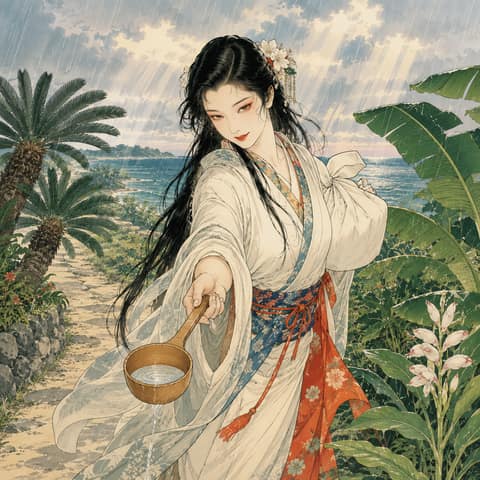
    Amakudari-Onna is recorded in Amami Ōshima as a variant of celestial maiden tales, emphasizing the visiting woman who steals human souls. She may appear even under clear skies with a light drizzle, marked by unusual attire carrying a white furoshiki. Her targets are mainly young men; she approaches with smiles and sensual allure, and if they comply, she takes their life or soul. A ladle of water serves as the medium, with taboos warning that drinking it lets her carry victims to the heavens. Folk defenses include staring her down and observing proper drinking etiquette, tying the tale not only to the uncanny but also to admonitions against nighttime wandering, illicit affairs, and improper hosting. Names vary—Amagari-onna, Amore-onna, Hagoromo beauty—reflecting regional shifts, yet the core remains consistent: a woman descending from heaven, fine rain, seduction, soul theft. Though mingled with later hagoromo legends, it strongly retains the imprint of Amami’s visiting-deity beliefs.

  • Hidden Zato (Kakurezatō)

    Hidden Zato (Kakurezatō)

    Uncommon

    kah-KOO-reh-zah-TOH

    Tradition-Faithful

    Mountain & Wilderness SpiritsŌu and Kantō regions (Hokkaidō, Akita, Kantō)

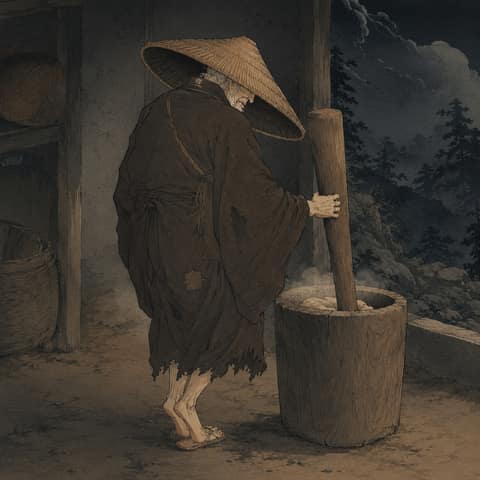
    This version frames the Hidden Zato as a blind minstrel-yokai lurking in the mountains and caverns of Tohoku and Kanto. At midnight it pounds out sounds like a foot-operated mortar or rapid rice polishing, yet the source stays unseen and household tools are said to be “borrowed.” In some tales, peeking reveals the noise coming from a neighbor’s house. Some regions call it a child-snatcher, while others give it a benevolent face as a dispenser of mochi or treasure to the honest, making them prosperous. From early modern times, the idea of hidden villages merged with a mystique around blind guilds, recasting it as an unseen people dwelling in caves. Modern folk explanations liken the racket to insect wingbeats, but as a bearer of the uncanny it endures as a spirit in the form of a zato.

  • Horse Possession

    Horse Possession

    Uncommon

    OO-mah-TSOO-kee

    Tradition-Tale Variant

    Ghosts & SpiritsAcross Japan (Mikawa, Tōtōmi, Awa, Musashi, and elsewhere)

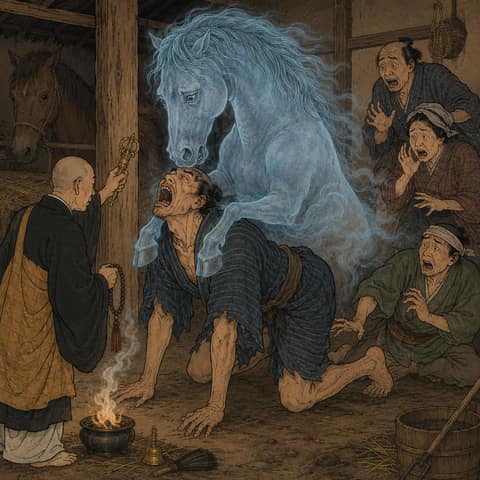
    A collective term found in early modern anecdotes and essays for possessions by the vengeful spirits of horses. It warns against violating precepts against killing and neglecting animal care ethics, with triggers including abuse, death from overwork, and callous disposal. Symptoms include neighing, involuntary movements of the limbs, craving foul water, self-biting, reports of seeing as a horse sees, and voicing curses against abusers. The possessing agent may be the spirit of a specific horse or generalized as retribution within the realm of beasts. Recorded remedies include esoteric rites, posthumous memorial services, tending graves and making offerings, though efficacy varies by case. Cases appear in Mikawa, Tōtōmi, Awa, Musashi, and Harima, affecting horse-handlers, samurai, and farmers. While some tales are highly embellished, overall they function as didactic narratives promoting animal memorials and ethics.

  • Houki (Fengxi)

    Houki (Fengxi)

    Uncommon

    FOO-kee

    Houki, the Foreign Beast of Sanglin

    Animal ShapeshifterA foreign beast originating from the Chinese "Classic of Mountains and Seas" (Shanhaijing). Mentioned only by name in Edo-period tales of foreign lands, without tying into Japanese geographical folklore.

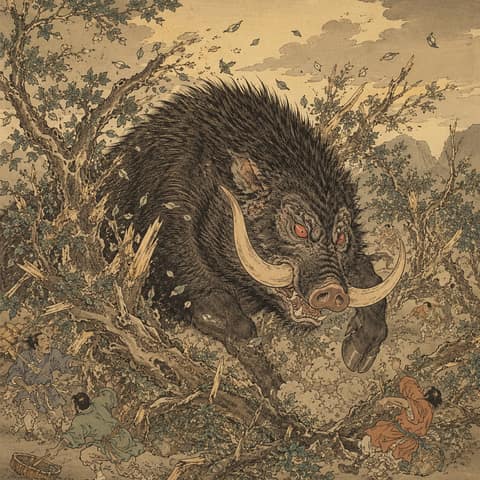
    This is an interpretation of the "foreign beast of Sanglin," imported from Chinese classics and long dormant within natural histories. In this version, Houki is not a human-sized anomaly like Japanese yokai that "frighten people on dark roads" or "settle in homes to bring wealth," but is positioned as a "mythological-scale raging god (symbol of natural disasters)" that brings destruction on a national scale. Its thick, hard skin repels all physical attacks; its charges can flatten forests into plains; and it summons torrential rains when immersed in water. In ancient China, the uncontrollable fury of nature itself (such as floods and beast plagues) manifested in the form of a "gigantic boar." The legend of its extermination by Hou Yi functions as a mythological device narrating the victory of civilization—humanity's hero subjugating overwhelming natural violence through "culture (archery)" and bringing it completely under human control by "eating it (making it an offering)." In Japan, such continental-scale monsters were difficult to localize and were merely filed away as "bizarre foreign beasts." However, when modern entertainment unearthed its attributes of being "hard, gigantic, and possessing near-invincible charging power" to reinterpret it as a motif for the ultimate enemy character, the "despair and awe toward overwhelming violence" held by ancient Chinese toward Houki was inadvertently shared as genuine terror by modern people. It is a highly dramatic case in the history of yokai reception, where a monster with a severed lineage reclaimed its original intimidation through the power of pop culture.

  • Hyōsube

    Hyōsube

    Uncommon

    hyō-su-be

    Hyōsube, the Hairy Riverside Kappa of Kyushu

    Water spiritSagaKumamoto

    This version looks at Hyōsube as a distinctly Kyushu kind of kappa, one tightly bound to the taboos of the home. Where most kappa tales unfold at rivers and deep pools, Hyōsube's stories push indoors—into the bathroom, the bathhouse, and the stable. The water a hairy Hyōsube has used is held to be defiled, fouled with floating hair; a horse that touches it collapses, and anyone who drains the water without leave is cursed and loses his horse. Stories of this kind are told all across the region. When to drain the bath, who may use it—such admonitions about the manners of everyday life were voiced in the form of Hyōsube's curse. In the fields it is said to love and ravage eggplant, and people offered the first of the crop to keep it content. Its birdlike cry of "hyō-hyō" is said to be the very origin of its name. The hairy, bald-crowned, comical figure drawn in the Edo-period Hyakkai Zukan and Gazu Hyakki Yagyō conveys less a thing of terror than a familiar creature living right beside human life.

  • Ijū (Strange Beast)

    Ijū (Strange Beast)

    Uncommon

    ee-JOO

    Ijū (Hokuetsu Seppu Version)

    Animal ShapeshiftersNiigata

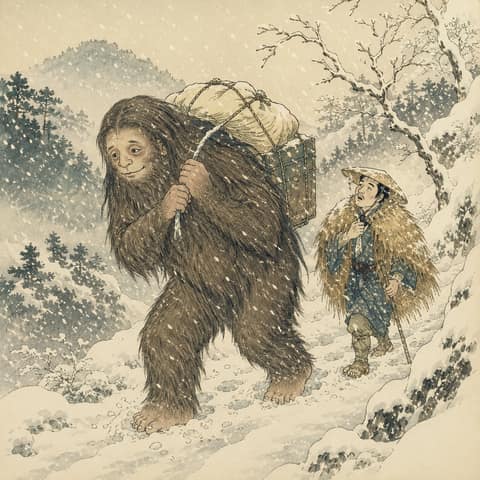
    This version follows the figure recorded in the Tenpō-era compendium Hokuetsu Seppu. Its form is ape-like yet larger than a human, with long hair flowing from crown to back, appearing after parting the dwarf bamboo in mountain ravines. It shows no intent to attack homes, chiefly begs for cooked rice, and repays alms by carrying loads and similar deeds. It is closely tied to the weaving culture of Echigo-chijimi, and in tales of loom maidens it intervenes amid household work rules and notions of ritual purity, turning the tide so deadlines are met. Such accounts treat it as a mountain spirit observing human industry and bringing harmony to cycles of trade and production, akin to food offerings made to mountain deities or guest spirits. Later it was reportedly seen at times but returned to the mountains, leaving only its name. Though an unidentified beast, its refusal to harm and habit of repaying kindness place it on the boundary between uncanny and blessed in local lore.

  • Ikijama (Living Jinx)

    Ikijama (Living Jinx)

    Uncommon

    EE-chee-JAH-mah

    Nama-Jama (Folkloric Sketch)

    Ghosts & SpiritsOkinawa Prefecture

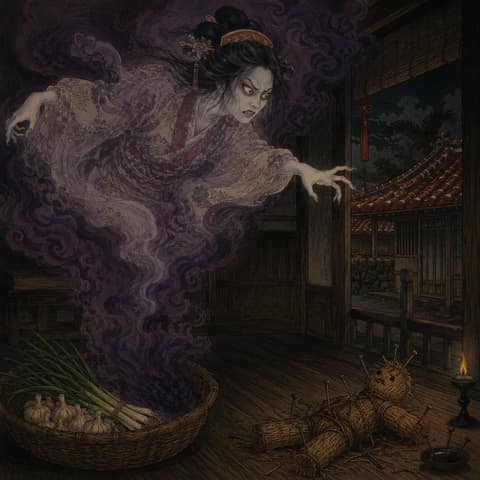
    A strand of Okinawan beliefs about living spirits. When hatred or envy swells, a person’s spirit may slip out while retaining their form and afflict the target with illness or malaise. Reports describe several modes: possession via gifts, attachment through a curse-doll known as the Nama-Jama Buddha, and even obsession achieved by will alone. Harm was said to strike not only people but also livestock and fields. Communities responded with yuta prayers, apotropaic fouling, and even driving it off through scolding and insults. Some accounts say the lineage passes matrilineally, leading to recorded cases of avoided marriages. Early modern records note accusations, lawsuits, and punishments for alleged use.

  • Inugami Gyōbu

    Inugami Gyōbu

    Uncommon

    EE-noo-GAH-mee GYOH-boo

    Kodan Tradition Version

    Animal ShapeshiftersEhime

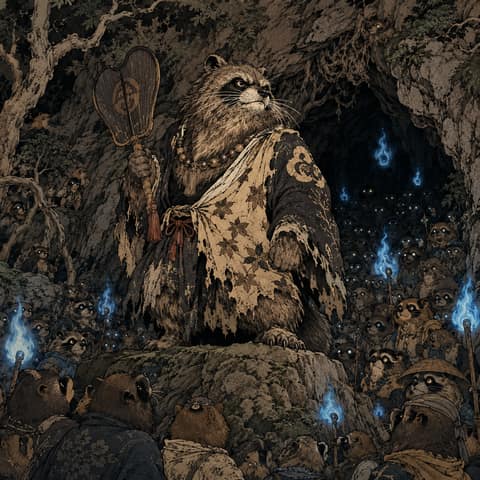
    The image of Inugami Gyobu should be understood through the lens of how the Matsuyama tanuki tales were reshaped by kodan storytelling. Across Shikoku, dense beliefs in tanuki and transformation legends spread, and in Matsuyama both “guardian” and “trickster” aspects were told of beings dwelling at the boundary between the castle town and the wilds. The title Gyobu signals a bond with the castle, emphasizing a guardian role, while kodan added favored conflicts—such as inviolable pacts and ambushes during internal clan strife—producing varied plotlines. In every variant, the rock shelters and caves of Mt. Kuma form the final stage, where sealing or pacification brings closure. The appearance of Ino Budayu also became standard, linking in a known monster-slaying tale from other sources and lending a higher authority of supernatural judgment to the Matsuyama tanuki narrative. His spiritual power and many retainers match regional views of a tanuki chieftain leading a band, serving as a framework to explain wonders at annual castle-town events and at passes or shrine precincts. Though today’s lore bears kodan embellishments, at its core remains the figure of a tanuki lord guarding the liminal zone between castle and mountain.

Showing 25 - 48 of 148 yokai