Yokai Encyclopedia

Encyclopedia of Japanese Yokai

56 Yokai|14 Category|Page 3 of 3
Localization in Progress - More content available in Japanese version
View Japanese
Sort by: NameAscending
山野の怪
  • Yamamoto Gorōzaemon

    Yamamoto Gorōzaemon

    Uncommon

    yah-mah-MOH-toh goh-ROH-zah-eh-mon

    Inō Mononoke-roku: Variorum Tradition

    Mountain & Wilderness SpiritsHiroshima

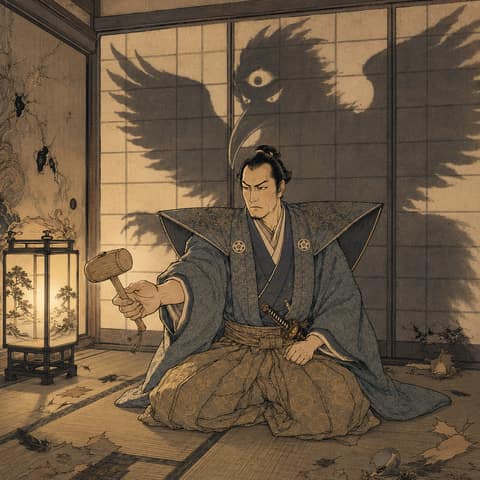
    This version builds on a record narrative centering on the Miyoshi anomalies of Kan’en 2. The chieftain declares himself in samurai guise at the close of the thirty days of hauntings, mentioning a wager with Kamino Akugorō. He states he is neither tengu nor fox spirit, yet some paintings depict him as a three-eyed crow-tengu, revealing a gap between text and image. Across manuscripts his name varies—Yamamoto Gorōzaemon, Yaman-moto Gorōzaemon, Yamamoto Tarōzaemon—and in alternate strands he bestows different gifts, such as a mallet or a scroll of rites. Around Miyoshi, multiple “trial of the brave” tales persist, sharing a sequence of fixed-term hauntings, the master of the house remaining unshaken, the leader’s appearance and words of praise, and a token left upon departure. His concrete nature and origin remain unsettled, while his role as a demon-king-like commander is emphasized. Given differences among early modern essays and picture scrolls, proper names and details should be treated as variant by text.

  • Yamanoke

    Yamanoke

    Epic

    Yamanoke

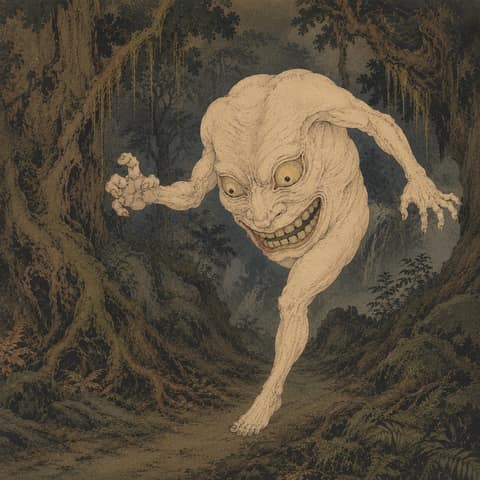
    The Headless One-Legged Entity Possessing Women

    山野の怪2007年2ちゃんねる発祥の創作怪談

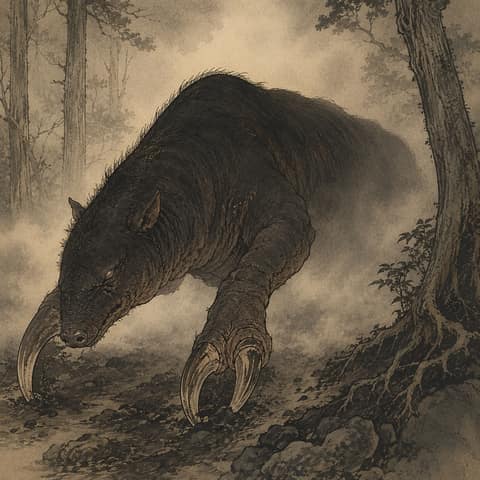
    The Literary Prowess of the "ShareKowa" Golden Age. As mentioned in the base description, Yamanoke is a masterpiece from the golden age of 2channel's occult board. In this deep dive, we will explore the specific literary mechanisms that make this story so effective. The 'ShareKowa' (Scary Stories You Can't Laugh At) thread produced numerous internet legends, but Yamano Keita's Yamanoke stands out for its exceptional narrative pacing. The story transitions seamlessly from a mundane, slightly mischievous act by a father (driving down an unpaved mountain road to scare his daughter) into a sudden encounter with the incomprehensible. The pacing of the escape, the creeping realization of the daughter's abnormal behavior, and the dramatic diagnosis by a temple priest are woven together with the precision of a professional horror short story, elevating it far beyond a simple forum post. The Psychological Horror of Possession. Unlike monsters that simply attack or kill, Yamanoke's terror lies in "possession." When the daughter is afflicted, she loses her sanity and begins mimicking the monster's eerie "Ten-sou-metsu" chant. The horror is twofold: the physical danger of the encounter, and the psychological devastation of watching a loved one's mind be erased and replaced by something alien. The ticking clock element introduced by the priest—"if not exorcised within 49 days, she will never recover"—adds a desperate, suspenseful tension to the narrative that mirrors classical demonic possession tropes while rooting them firmly in Japanese folk Buddhism. The Resonance with Classical Mythology: Xing Tian. The morphological similarity between Yamanoke and the Chinese mythological figure Xing Tian (from the *Classic of Mountains and Seas*) is a subject of endless fascination among folklore enthusiasts. Xing Tian, the headless giant who fought the Yellow Emperor using his chest as a face, represents relentless, unyielding willpower in Chinese mythology. Whether Yamano Keita intentionally borrowed this imagery or arrived at it independently, transplanting this bizarre, ancient anatomy onto a modern Japanese mountain spirit creates a visual that is both absurd and deeply unsettling. The juxtaposition of a mythological warrior's body with the behavior of a grinning, muttering stalker is a masterclass in character design. The Linguistic Genius of "Ten-sou-metsu". The phrase "Ten-sou-metsu" is a brilliant piece of horror writing. In Japanese, the syllables "ten," "sou," and "metsu" evoke kanji related to heaven (天), sending/transferring (送), and destruction/annihilation (滅). It sounds like a fragmented Buddhist incantation or a curse. Because the author never provided a canonical kanji spelling or translation, readers are forced to imagine what this entity is trying to convey. Is it a threat? A countdown? A prayer? This linguistic ambiguity forces the reader's imagination to do the heavy lifting, ensuring the monster remains truly incomprehensible and, therefore, terrifying. The 2025 Resurgence and Sequel. The landscape of internet horror was shaken in late 2024 when Yamano Keita, the original author, re-emerged on social media after nearly two decades. The release of the sequel, *Zange* (Confession), in March 2025 proved that the author's ability to craft atmospheric dread remained entirely intact. The fact that an internet legend born in 2007 could receive a direct, canonical continuation 18 years later—and that the internet community reacted with such fervor—demonstrates that entities like Yamanoke are not just disposable forum posts, but enduring pieces of modern digital folklore that command genuine cultural legacy.
  • Yamauba

    Yamauba

    Legendary

    yah-mah-OO-bah

    Yamanba (Traditional Folkloric Form)

    Mountain & Wilderness SpiritsKanagawa

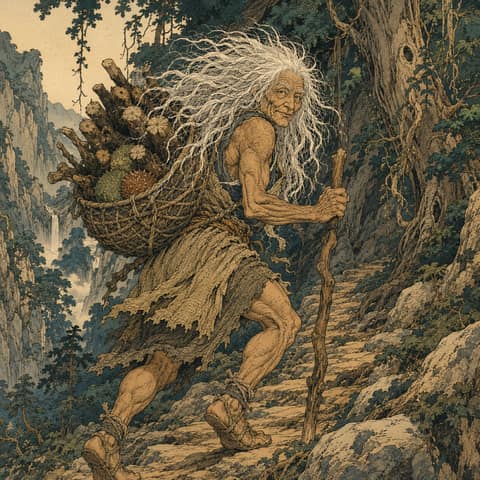
    An elderly woman with white hair and a body hardened by life in the mountains, she is famed as the nurturing figure who raised Kintaro. Her deeply lined face reflects priceless life experience, and she offers precise guidance to the lost. Though she may appear strict, a profound love resides beneath the stern exterior.

  • Yamauba

    Yamauba

    Legendary

    yah-mah-OO-bah

    Mother of Kintaro

    Mountain & Wilderness SpiritsKanagawa

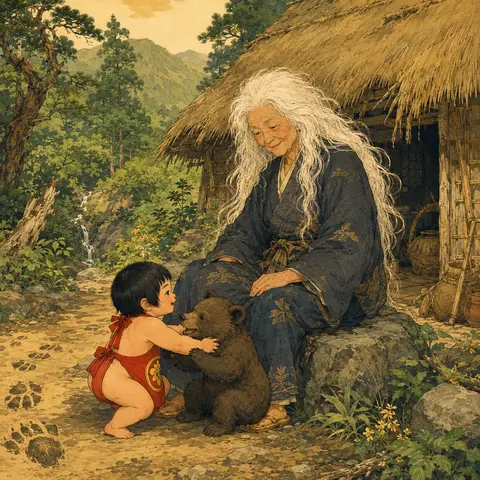
    Deep in the Ashigara Mountains, in a secluded hollow along bamboo ridgelines untrodden by humans, dwells a lineage of yama-uba known as the Yae-giri Mother Form. Bathed at birth in dew gathered on layered paulownia leaves and nourished by the breath of the mountains, this line is said to conceive children through union in dreams with an akairyū—an “red dragon” that appears on nights when crimson vapors gather. They rarely mingle with the human world, opening paths for those who keep the mountain’s order and baring fangs at those who trample its law. The Ashigara Yae-giri Mother Form takes as her charge the raising of children, favoring those with especially strong vital spirit. With few words she teaches how to split firewood, read the presence of beasts, ford streams, follow the courses of stars, and use the virtues of roots, leaves, and bark. When a child stumbles on a stone she watches and smiles, and when blood is drawn she silently applies moss juice. It is not pampering but passing on the mountain’s severity as it is. The crimson vapor seen in the Konjaku Monogatari is her warding veil, a barrier that blinds the eyes of outside gods. When Yorimitsu ascended from Kazusa, he recognized that vapor and sent Watanabe no Tsuna, an act born of the ancients’ intuition about this Mother Form’s power. In a thatched hut lived an old woman and a youth not yet twenty. The old woman called herself a demon-woman and felt no shame for her bond with the dream-red dragon, saying only that the child was born according to the mountain’s law. The boy she raised was later named Sakata Kintoki and became famed, yet once a child enters the world the Yae-giri Mother Form releases attachment and fades like mountain mist, caring nothing for wealth or honor, wishing only that the mountain’s balance remain unbroken. In Edo times, when the Kimpira jōruri was popular, she was portrayed as an ogress, but in old tales of Ashigara, oni signifies awe-inspiring power and is not confined to evil. Stories of bearing a thunder child and of a red dragon entrusting a child to the paulownia atop Mount Kintoki show this lineage’s dual nature of receiving from heaven and nurturing on earth. When sharing the mountain’s bounty she wears the face of an old mother, against ravagers she takes the aspect of a peak-dwelling oni. At midnight, when crimson vapor drapes the ridge, she consults the stars over a child’s fate and, if needed, commands beasts and trees to open the way. She leaves no treasure, only marks carved in wood grain and the remembered weight of a hand-axe in a child’s palm. Even now, on mist-laden mornings deep beyond the Ashigara Pass, she is said to listen for the breath of those who are meant to be raised, hidden within the rustle of bamboo wrens.

  • Yamawaro

    Yamawaro

    Rare

    yamawaro

    The Mountain Child of Kyushu Migrating Between Mountains and Rivers: Yamawaro

    Mountain / Field YokaiNagasakiFukuoka

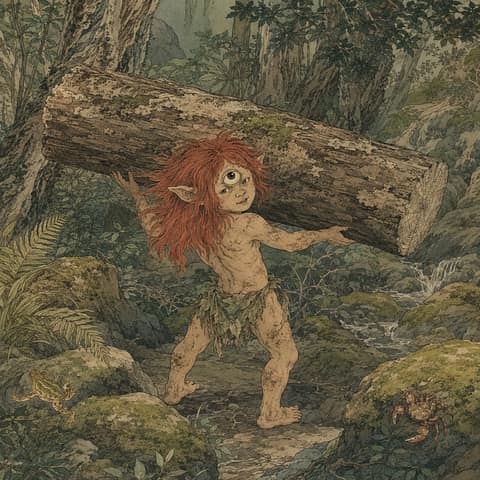
    While the *Yamawaro* is a mountain monster unique to the mountainous regions of Kyushu, its greatest originality lies in the fact that it forms two aspects of a single body with the *kappa*. The fact that Terajima Ryoan noted the habitation of *Yamawaro* in Chikuzen and Goto in *Wakan Sansai Zue* is evidence that early modern intellectuals incorporated the folklore of grotesque beings from the western mountains into the framework of natural history, showing that the Goto Islands were designated early on as a land of *Yamawaro* traditions. In the migration belief, it is said that the *kappa* of the river and the *Yamawaro* of the mountain switch places at the boundary of the spring and autumn equinoxes, which is thought to be a crystallization of the agricultural calendar, water god worship, and mountain god worship into a single existential image. Its assistance to woodcutters and the reward of rice balls, its love of sumo, its dietary preference for salt and crabs, and its grotesque form with dog ears, red hair, and a single eye are all supported by the *Wakan Sansai Zue* and the oral traditions of various parts of Kyushu. Amidst life in the Goto Islands, surrounded by sea and mountains, the *Yamawaro* has become inextricably linked to the *kappa* (*gataro*), becoming an entity that embodies the local spirituality penetrating both the waterside and the mountains.

  • Yamawaro (Mountain Child)

    Yamawaro (Mountain Child)

    Epic

    ya-ma-wa-ro

    The Mountain Boy of Western Japan, the Yamawaro

    Mountain & Wilderness SpiritsKyushu (yamawaro; mountains of western Japan)

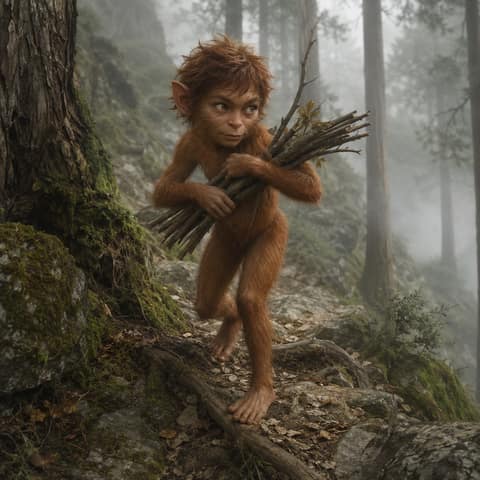
    This version looks at the yamawaro — the kappa's "other half" — from the side of life in the mountains. If the kappa is the being that menaces people at the water's edge, the yamawaro is the one that appears at the worksites of mountain labor. It helps woodcutters and charcoal burners haul their timber, taking sake or rice balls in return. Yet the exchange follows a strict code: hand over the promised goods first and it runs off without working, and break a promise and it flies into a furious rage and brings down misfortune. To those who worked the mountains, the yamawaro was at once a dependable partner and a neighbor not to be trusted, one that bared its fangs at any lapse of courtesy. The tales of the yamawaro are packed tight with the eeriness of the mountains: the "tengu-fell," the sound of a great tree crashing down when no one is there; a voice that mimics human songs and the strokes of an axe to the life; and the strange weakness of disliking the line of a carpenter's ink pot. These are the very dread felt by those who venture deep into the hills. And the legend of the "crossing of the kappa" — entering the mountains at the autumn equinox and returning to the rivers at the spring equinox — ties the yamawaro and the kappa together with a single thread. A single water god that passes between mountain and river — its mountain face is the yamawaro.

  • Ōmine Zenkibō

    Ōmine Zenkibō

    Legendary

    Ōmine Zenkibō

    The Dharma-Guarding Tengu Turned from an Oni — Ōmine Zenkibō

    Mountain & Wilderness SpiritsNara

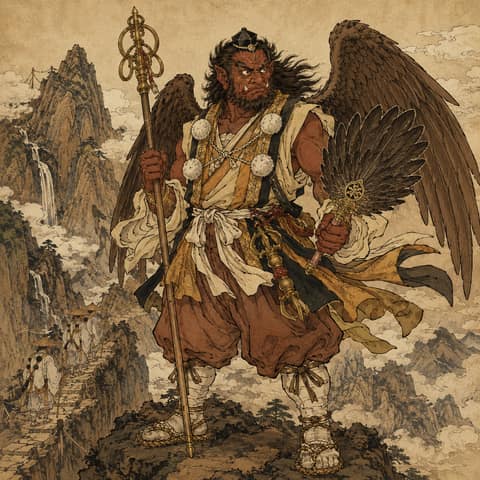
    The essence of Ōmine Zenkibō lies in the structure of rebirth: "an oni turning into a tengu." It is a tale that embodies the heart of Shugendō in a single being. His source lies in the old tales of En no Gyōja and the oni. The oldest extant text depicting En no Ozunu is the Nihon Ryōiki (early Heian), which portrays him as a thaumaturge who flew through the air commanding demons. The Konjaku Monogatarishū, Book 11 carries the tale of En no Gyōja having demons build a bridge across the mountains, showing the fixing of the image of En no Gyōja as one who commands demons. Zenki was originally a violent oni who carried off human children. En no Gyōja captured him with the secret rite of Fudō Myōō and reformed him into an attendant. By one account, En no Gyōja hid the youngest child of the Zenki couple in an iron cauldron and, through the grief of having one's own child taken, brought them to realize the sin of carrying off the children of others. The reformed Zenki and Goki became dharma-protecting oni and supported En no Gyōja's practice. This Zenki, sublimated into a great tengu at the end of long austerities, is Ōmine Zenkibō. This plot, of a violent being turning into a guardian of the Buddhist law, shows most clearly that the dread of a child-snatching tengu and the faith in a tengu who guards people share a single root. The Ōmine on which Zenkibō sits is the holy ground of Shugendō. The Ōmine training ground founded by En no Gyōja, and the Ōmine Okugake-michi registered as World Heritage, is a perilous route that ascetics still tread at the risk of their lives, and Zenkibō was conceived as its guardian. He is chanted as "the band of Zenki of Ōmine" in the Muromachi Noh play Kurama Tengu, and stands among the forty-eight tengu of the Tengu-kyō (some sources give "Nachi Takimoto Zenkibō"). And the heaviest single point of this lore is that the bloodline of Zenki is said to live on into the present. Of the five lodges kept by the five children of Zenki and Goki, only the Onakabō of the Gokijo family remains today, and the present-day Gokijo Yoshiyuki continues to receive the ascetics of the Ōmine Okugake-michi. This genealogy is hard to source explicitly in old documents and is transmitted as the oral lore of the surviving lodge; yet this real continuity—descendants of a reformed oni guarding the path of Shugendō beyond thirteen hundred years—makes Ōmine Zenkibō not a mere legend but a symbol of living faith. Chigiri Kōsai of tengu scholarship, too, placed him within the system of the great tengu of the many mountains.

  • Ōyama Hōkibō

    Ōyama Hōkibō

    Legendary

    Ōyama Hōkibō

    The Great Tengu of the Transferred Seat — Ōyama Hōkibō

    Mountain & Wilderness SpiritsKanagawa

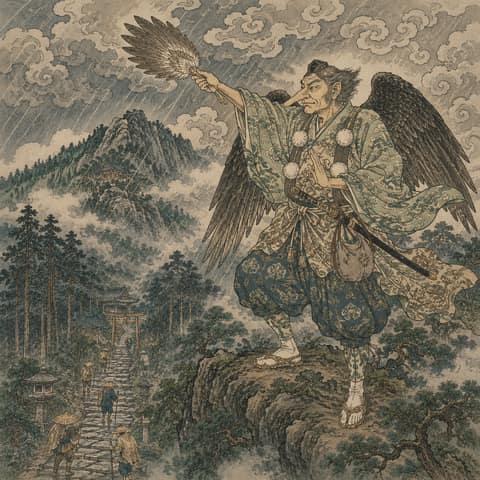
    The core of Ōyama Hōkibō lies in a tale of succession to a seat within the tengu world—the "seat transfer." Yet the Mt. Ōyama on which he sits was a sacred mountain established in antiquity, without need of the transfer legend. The Engishiki Jinmyōchō (927) ranks the Afuri Shrine among the official shrines of Sagami Province, showing that Ōyama's divinity was recognized by the ancient state. On the Buddhist side, the Ōyama-dera engi emaki depicts how Rōben—carried off by an eagle and raised in Nara—opened Ōyama-dera and enshrined Fudō Myōō (the Sagami version; a different work from the engi of Hōki's Daisen-ji). And in early-modern times the official gazetteer the Shinpen Sagami no Kuni Fudoki-kō (1841) conveys the summer ascent season and the bustle of pilgrims from many provinces. The manners of pilgrimage—purifying oneself at the waterfalls under a sendatsu's guidance before climbing—and the Ōyama confraternities everywhere: this density of faith gave Hōkibō, the successor tengu, the character of a guardian watching over the common people. The seat-transfer tradition overlays this sacred-mountain history. According to the arrangement of Chigiri Kōsai of tengu scholarship, Sagami Ōyama originally had a great tengu named Sagamibō. But when the Retired Emperor Sutoku—defeated in the Hōgen Rebellion (1156) and exiled to Sanuki—passed away, Sagamibō removed to Shiramine in Sanuki to console and guard his bitter spirit (= Shiramine Sagamibō). The one who succeeded to the vacant seat of Sagami Ōyama was Hōkibō, come from Mt. Daisen in Hōki. This symmetrical transfer—"Sagamibō to the west, Hōkibō to the east"—is a Chigiri-derived arrangement lacking explicit sources in the classical literature, and should be read not as historical fact but as lore that mirrors the notion that a tengu's seat is succeeded through mountain and bond (en) rather than being a fixed individual. Chanted as "Hōkibō of Ōyama" in the Muromachi Noh play Kurama Tengu, and standing among the forty-eight tengu of the Tengu-kyō, his seat continues to be remembered, together with this distinctive engi, as one of the Eight Great Tengu.

Showing 49 - 56 of 56 yokai