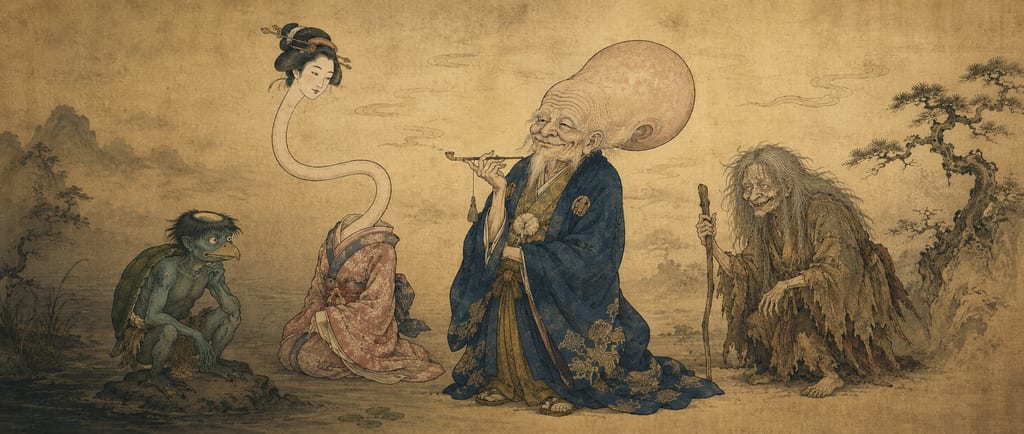
The Old Man Who Began in a Picture
Nurarihyon’s early form emerges from a single picture rather than a long story. Sawaki Sūshi’s Hyakkai Zukan of 1737[1] and Toriyama Sekien’s Gazu Hyakki Yagyō, first published in 1776[2], show an old-man-like figure with an enlarged, bald head. Because neither work says much about his behavior or character, viewers have imagined where he is going and what he is thinking from his bent back, lowered face, and passage beside a house.
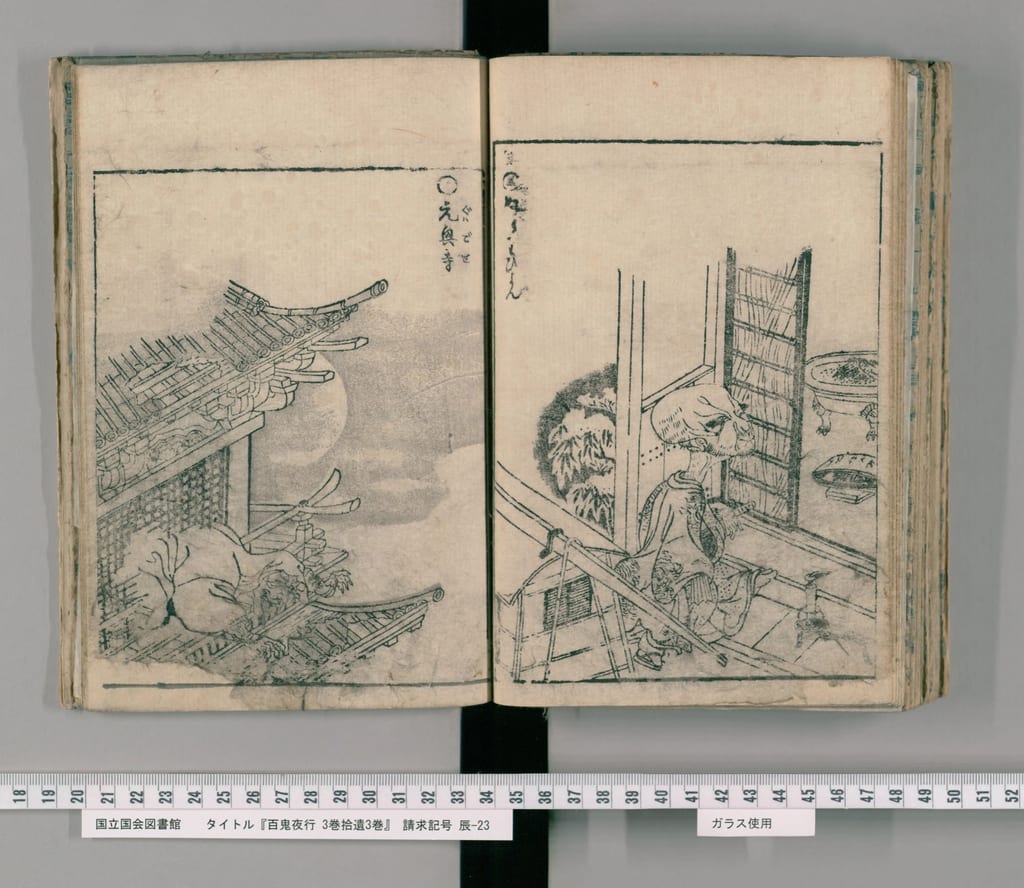
In Sekien’s image, the old man does not stand frontally as a resplendent king of yokai. He moves outside a building with his body lowered. The picture offers the name “Nurarihyon” and an elusive figure; that quiet image became capacious enough to bear a grand title in later years.
From “Ringleader” to “Commander-in-Chief”
In the modern period, the old man in the pictures was given a role. Fujisawa Morihiko’s Yōkai Gadan Zenshū: Nihon-hen, Part 1, published in 1929, preserves an early modern description of Nurarihyon as a “ringleader of monsters”[3]. Ryū Tanabe traces the development of this leadership image through children’s encyclopedias and television animation[8].
Arifumi Satō’s 1972 Ichiban Kuwashii Nihon Yōkai Zukan tells a specific story of an old man who enters a busy household uninvited at year’s end[4]. While the household rushes about with its work, he slips into the zashiki reception room and settles down, seeming neither guest nor master of the house. He needs neither a shout nor brute force: the way he quietly becomes the center of the room suits both the sound of Nurarihyon’s name and the appearance of the old man, and gave later creators a rich cue.
A Leader at the Heart of the Story
The third television series of GeGeGe no Kitarō, broadcast from 1985 to 1988, depicts the conflict between Kitarō and Nurarihyon’s faction, which plots to exclude humans[5]. Here the old man changes from an enigmatic presence into a figure at the heart of the story, leading companions and devising schemes. Roles such as leader, strategist, political figure, and formidable opponent spread through manga, animation, and games in changing forms, making “commander-in-chief of the yokai” one of the best-known images of Nurarihyon today.
Details associated with the old man who enters homes—tea, a smoking pipe, and a power to fall outside recognition—have also been reworked from one work to another. Classical yokai pictures left silence; modern works supplied dialogue, cunning, organization, and conflict. The greater the distance between them, the more clearly Nurarihyon’s capacity to draw new stories in every era comes into view.
Different Places,
One Name
In a regional record from Akita, Nurarihyon is listed as one of the names that join a hyakki yagyō procession on Bakemono-zaka in Sawaguchi Village[7]. By contrast, the Bisan Strait has a report of a spherical “Nurarihyon” that rises and sinks at sea and escapes capture[8]. The old-man image, Akita’s hyakki yagyō procession, and the spherical marine apparition share a name while taking different forms.
Nurarihyon’s interest lies not in declaring one of these the only true identity, but in seeing how the open spaces left by a name and an image have gathered different stories as they traveled through places and media. The old man in an early picture, the visitor who slips into the seat of honor in a house, and the leader of yokai are all faces of Nurarihyon discovered by their respective eras.
Character Profile
This section is our own creative profile for storytelling. It is not historical fact or scholarship.
Yokai Type - Traditional Yokai
Category - Half-Human Beings
Rarity - Legendary
Personality - Classical sources do not describe a personality in detail. The unflappable, shrewd image of a leader is a modern characterization developed in children’s encyclopedias, manga, and animation.
Compatibility - Historical sources offer no basis for a compatibility claim. It suits readers who enjoy the changing meaning of the title “leader” and move easily between classical material and creative retellings.
Abilities - No particular abilities are recorded in classical sourcesLeads organizations as a leader in modern worksAppears as a scheming adversary in modern worksIs depicted as the familiar old man who appears in homesIs portrayed as the head of differing yokai groups from one medium to another
Weaknesses - Classical sources record no distinctive weakness. The leader image differs across sources and works and cannot be fixed to a single personality or set of abilities.
Habitat - Classical images record no nationwide habitat. The household belongs to a familiar modern image, while Bakemono-zaka in Akita and the Bisan Strait belong to separate regional records and should be considered individually.