YOKAI.JP

Ubume(ubume)

Basic Description

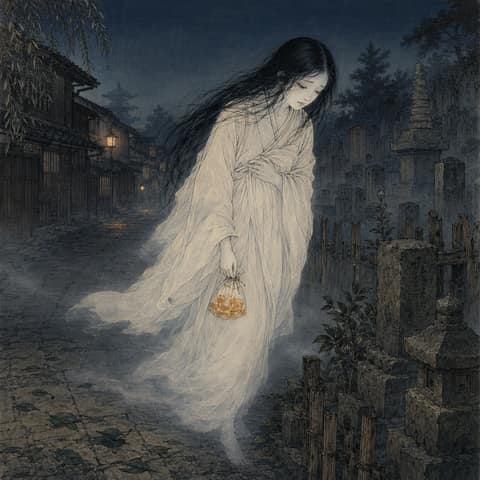
Ubume is a Japanese supernatural phenomenon (yokai) widely believed to be the spirit of a woman who died during childbirth or shortly after, appearing in the form of a woman cradling an infant. In many tales, she stops passersby at night at river crossings, bridges, and crossroads, pleading with them, "Please hold this child." The outcome varies depending on the region and the source: the baby received might suddenly become heavy, turn into leaves or a stone, or the person who manages to hold onto it until the end might be granted superhuman strength or wealth. Therefore, the Ubume is not merely an evil spirit that attacks people. She is an entity that gathers the severed bond between mother and child, the fear of the dead, and the courage and compassion of those who accept her plea into a single tale of an encounter.

A famous surviving early example is found in the first half of the 12th century in *Konjaku Monogatari Shu* (Tales of Times Now Past), Scroll 27, Tale 43, "How Minamoto no Yorimitsu's Retainer, Taira no Suetake, Met an Ubume." When Minamoto no Yorimitsu was the Governor of Mino, his retainer Taira no Suetake went to a dark river crossing at night as a test of courage, where he was entrusted with a baby by a woman in the river. Upon returning to the mansion and opening his sleeve, he found only a few tree leaves. At the end of the tale, the narrator juxtaposes the theory that the Ubume is a shape-shifting fox with the theory that she is the spirit of a woman who died in childbirth, without deciding on her true identity. At this stage, the blood-stained waistcloth and bird feathers that became famous in later eras had not yet been depicted.

On the other hand, care must be taken with the notation that writes "Kōkakuchō" (Guhō bird) but pronounces it "Ubume." The "nocturnal roaming woman" described in Scroll 16 of the Tang dynasty text *Youyang Zazu* (Miscellaneous Morsels from Youyang) is a Chinese monster bird that becomes a bird when wearing feathers and a woman when taking them off, and has a habit of snatching people's children. Because it involved babies and women who died in childbirth, it was conflated with the Japanese Ubume, but they originally belonged to different lineages. According to the research of Manami Yasui, Hayashi Razan, who assigned the Japanese name to the Chinese Kōkakuchō, first specified in the 1631 *Shinkan Tashikihen* that "Kōkakuchō" is the "Ubume-dori" (Ubume bird) or Nue. While the Japanese Ubume has as its core "a mother's spirit entrusting her own baby to someone else," the Chinese Kōkakuchō has as its core "a bird monster that snatches other people's children." Understanding this difference reveals how the yokai known as Ubume changed its form by layering medieval tales, memorials for those who died in childbirth, knowledge of monster birds from China, and early modern yokai illustrations.

Folklore & Legends

The older stratum of the Ubume tradition lies not in her appearance, but in the event of "receiving a baby at the boundary of the night." The setting of *Konjaku Monogatari Shu* was a nameless river crossing in Mino Province, and the season was late September on a moonless, dark night. As Taira no Suetake crossed the river, a woman's voice pressed him, "Hold this," and the sound of a baby crying and a strong reek of raw blood reached him. Suetake received the baby on his sleeve, shook off the woman who chased after him asking for it back, and returned to his mansion, but only tree leaves remained inside his sleeve. What is praised here is not the power to slay a monster, but Suetake's courage in not succumbing to fear. Moreover, the narrator concludes by listing both the fox theory and the dead mother spirit theory side by side. The medieval Ubume was not so much a yokai with a fixed identity like in a field guide, but rather an inexplicable supernatural encounter that occurred during a night river crossing.

In the early modern period (Edo period), the Ubume's body and cause of death gained a visible form. According to "The Depiction of Ubume" compiled by the Art Research Center at Ritsumeikan University, *Hyaku Monogatari Hyōban* (Volume 2, "Concerning the Ubume and Ghosts"), published in 1686, notes that the lingering attachment of a woman who died "upon giving birth" becomes the Ubume, who cries with her body from the waist down dyed in blood. In the following year, *Kii Zōdanshū* ("The Origin of the Ubume," 1687) tells a story where the soul of a mother whose child was born after she died and was abandoned in a field walks at night carrying the child, and enriches those who carry the child on their back without refusing her plea. The depiction of blood made the death in childbirth visible, and the act of receiving the baby took on the meaning not just of a test of courage, but of a choice to show compassion to the dead.

In local folklore, the true identity of the received baby and the outcome diverge further. In a 1939 recording from Niigata City included in the International Research Center for Japanese Studies (Nichibun-ken) database, a woman holding a child on a bridge pleaded with a passerby, and when they timidly accepted the child, the woman disappeared, and the child, which had become slightly heavier, had turned into a stone. In a 1929 recording from the Naoiri region of Bungo Province, there remains a summary that the child was a mallet or a stone. Conversely, in the "Ubume's Gift" type categorized by the *Nihon Mukashibanashi Meii* (Glossary of Japanese Folktales), the person who took charge of the child is bestowed with a great sword or other gifts. Tree leaves, stones, mallets, a heavy baby, and gifts are not interchangeable details. Each indicates a different focal point of the narrative: a test of courage for the encounterer, a request from the dead, or the bestowal of good fortune.

When the knowledge of the "Kōkakuchō" was overlaid, the Ubume acquired bird-like characteristics that could not be explained solely by a Japanese childbirth spirit. The nocturnal roaming woman in *Youyang Zazu* flies by night and hides by day; wearing feathers makes her a bird, taking them off makes her a woman. Because she has no children of her own, she takes the children of others, and it is said that if her feathers fall on children's clothes left outside to dry, she curses them, and she even leaves a mark with blood. Because the same book also records a theory that they are "transformed from women who died in childbirth," there is certainly a point of connection that linked them with the Ubume on the Japanese side. However, the Chinese bird monster that snatches other people's children and the Japanese mother's spirit that entrusts the child she holds to a passerby have opposite directions of action. As Yasui's paper shows, Hayashi Razan linked the two under the name "Ubume-dori" in 1631, and subsequent encyclopedias and yokai imagery spread the amalgamated image. Even after the notation became the same, it is necessary to read the two lineages prior to that point separately.

Illustrations cemented this overlap in each era. Sawaki Suushi's *Hyakkai Zukan* (The Illustrated Scroll of a Hundred Demons) from 1737 includes the Ubume as one of the named yokai illustrations. In 1776, Toriyama Sekien depicted her in *Gazu Hyakki Yagyō* (The Illustrated Night Parade of a Hundred Demons) wearing a blood-stained white cloth around her waist, cradling a baby on a rainy riverbank. Furthermore, Tsukioka Yoshitoshi, in his 1865 *Wakan Hyaku Monogatari* (One Hundred Tales of China and Japan), "Shume-no-Suke Urabe Suetake," took the medieval Suetake tale as his subject but gave the woman wings on her back, superimposing the image of the Chinese bird monster. Since the original text mentions no wings, this is not a faithful illustration, but a reinterpretation that returned the "Ubume" understood by 19th-century viewers to a medieval tale. Viewing the iconography chronologically reveals that the appearance of the Ubume was not the starting point of the folklore, but was created through the accumulation of reading, publishing, and painting.

There are also specific examples where the Ubume transformed from an object of terror into a guardian deity of safe childbirth. According to the origin story of the Ubume Reijin (Ubume Spirit Deity), "Onmesama," handed down at Daigyōji Temple in Kamakura, in 1532, Priest Nichitō saved a woman who died in a difficult childbirth by chanting sutras, built a pagoda for the Ubume, and enshrined her. Folklore materials also recount that the woman pleaded for help from the priest on the bridge over the Namerigawa River, saying "I cannot cross the river, and it is painful because the child is sucking on my breasts," and later asked him to build a pagoda to save those suffering from difficult childbirth. Even today, Daigyōji enshrines the Ubume Reijin as a deity protecting safe childbirth. This single example shows that the spirit of a woman who died in childbirth, after receiving memorial services, could flip from an entity that threatens people to an entity that protects childbirth.

To summarize the Ubume solely as a "yokai of maternal love" would be to lose half of her history. Within the narratives coexist supernatural encounters where it is unclear whether she is a fox or a ghost, the fear of blood and impurity, the trial of taking charge of a child, a fortune-god-like aspect that bestows gifts, syncretism with Chinese bird monsters, and memorial services aiming to save those who died in childbirth. Precisely because terror and sorrow, calamity and gift-giving can hold true simultaneously, the Ubume has been passed down for a long time, from medieval tales to early modern ghost stories and yokai paintings, and into the oral traditions of various regions.

Yokai Cards1

Ubume across multiple art-style decks

Card gallery

Related Yokai

Yokai deeply tied to this one in legend.

Detailed Analysis

The core of this version is not to view the Ubume as a completed "blood-soaked female yokai," but to trace how the relationship between humans and the supernatural changes the moment the baby is received. In *Konjaku Monogatari Shu*, Scroll 27, Tale 43, Taira no Suetake makes a bet in a test of courage with his fellow retainers of Minamoto no Yorimitsu. On a dark night in late September, fully equipped with armor, helmet, and bow, he heads alone to a river crossing in Mino Province to plant an arrow on the opposite shore as proof. On his way back, he is stopped by a woman's voice in the river. The woman presses him, "Hold this," the baby cries, and a strong, fishy stench of blood reaches the guards on the shore. Suetake receives the child on his sleeve, repels the woman who now chases him demanding it back, and takes it straight back to his mansion. When he opened his sleeve, what remained was neither a baby nor a stone, but a few tree leaves.

What this scene shows is not the true identity of the Ubume, but the human attitude in the face of the supernatural. Suetake does not slash the woman, nor does he drive her away with prayers; he accepts her request and holds the child. His companions praise his courage, but the end of the tale merely juxtaposes the theory that the Ubume is a shape-shifting fox with the theory that she is the spirit of a woman who died in childbirth, without settling the matter. The fixed tropes of later eras, such as the blood-stained waistcloth, long black hair, and bird wings, are nowhere in the text. In other words, what is fixed in the oldest class of Ubume tales is the dark river crossing, the woman's voice, the crying baby, the stench of blood, the demand to hold it, and the transformation into leaves—not the yokai's appearance.

It is in the early modern period that the physical bodies of women who died in childbirth came to the forefront. *Hyaku Monogatari Hyōban* explains that the lingering attachment of a woman who died "upon giving birth" becomes the Ubume, who cries with her lower body dyed in blood. *Kii Zōdanshū* tells the origin story where a pregnant woman who died was abandoned in a field, the child in her womb was born, and the mother's soul walks at night holding the child; it states that those who accept her request to carry the child on their back will be given wealth. Here, the blood of the Ubume is not merely a cruel depiction, but a sign that explicitly carves the cause of death onto the body. At the same time, the act of the encounterer holding the baby is reinterpreted from a test of courage to an act of temporarily taking on the unfulfilled childbirth and child-rearing of the dead.

The transformation of the baby rearranges the conclusion of the story depending on the region. In a recording from Niigata City, the child received on the bridge gradually becomes heavier, and upon looking, it has turned into a stone. In a recording from the Naoiri region of Bungo Province, it is said to become a mallet or a stone. On the other hand, in the "Ubume's Gift" type, those who withstand the weight or do not refuse the request are bestowed with superhuman strength, a great sword, and wealth. The baby becoming heavier is not a uniform attack capability, but also a device to test the one holding it. If they cannot bear it, it becomes a horror story; if they hold it all the way through, it becomes a tale of bestowed fortune. This reversal makes it impossible to classify the Ubume purely as an aggressor or purely as a guardian spirit.

The waterside functions as the boundary where the Ubume passes her request to the living. The river crossing in *Konjaku Monogatari Shu*, the bridge in Niigata, and the riverbank illustrations of later eras are all places that connect "this side" and "that side." Manami Yasui's iconographic research points out that the *nagare-kanjō*—a custom of hanging a cloth by a river for a woman who died in childbirth and asking passersby to pour water over it to hold a memorial service—is also depicted in Sekien's drawing. While it cannot be definitively concluded that memorial services by water were the origin of all Ubume tales, the structures of "asking a favor of an unknown passerby" and "the dead and the living making contact at the waterside" resonate strongly. The Ubume's request can be read as a story of handing over not only the baby, but also the duty of the memorial service to the next person.

The syncretism with the Kōkakuchō (Guhō bird) added wings and the nature of snatching children to the mother's spirit. The nocturnal roaming woman in *Youyang Zazu* becomes a bird when wearing feathers and a woman when taking them off. Because she has no children, she takes the children of others, and it is a bird monster that warns against leaving children's clothes exposed to the night dew. In contrast, the Japanese Ubume tries to entrust the child she is already holding to someone else. Both share the explanation of being a woman who died in childbirth and an attachment to babies, but the direction of action is "snatching" for one and "entrusting" for the other. As Hayashi Razan applying "Kōkakuchō" to the "Ubume-dori" or Nue in the 1631 *Shinkan Tashikihen* shows, this became a major node that folded two stories with opposite directions into a single name.

Painters visualized this folding together. In *Hyakkai Zukan*, the Ubume became a member of the named yokai illustrations, and Toriyama Sekien's *Gazu Hyakki Yagyō* consolidated the blood-stained white cloth, the baby, the rain, and the waterside into a single image. Tsukioka Yoshitoshi's *Wakan Hyaku Monogatari*, "Shume-no-Suke Urabe Suetake," takes the medieval Suetake tale as its subject but gives the woman wings on her back, superimposing the image of the Chinese bird monster. Because the original text has no wings, this is not a faithful illustration, but a reinterpretation that returned the "Ubume" understood by 19th-century audiences to the medieval tale. Looking at the iconography chronologically, we can see that the appearance of the Ubume was not the starting point of the folklore, but was created through the accumulation of reading, publishing, and painting.

The "Onmesama" handed down at Daigyōji Temple in Kamakura demonstrates another reversal of the Ubume. According to temple legend, in 1532, Priest Nichitō saved a woman who died in a difficult childbirth by chanting sutras, and he built a pagoda for the Ubume to enshrine her as a guardian deity of safe childbirth. Folklore materials recount that the woman appealed to the priest on the bridge over the Namerigawa River, saying, "I cannot cross the river, and the child is sucking on my breasts, causing me pain," and later she requested a pagoda to save people suffering from difficult childbirth. Here, the Ubume who passes her request to the living on a bridge at night moves to the side of helping childbirth after receiving a memorial service. Terror and safe-childbirth beliefs are not separate attributes, but a continuous story of an unsaved spirit transforming into an enshrined deity.

Even compared to the closely related Kosodate Yūrei (child-rearing ghost), they cannot be equated simply because of the theme of the death of a mother and child. The core of the Kosodate Yūrei is the story of a mother coming to buy candy to feed her child in the grave even after death; the nurturing continues from mother to child. The Ubume stops others on night roads and temporarily transfers the role of holding the baby. The former is a story of "the dead raising," while the latter is a story of "entrusting to the living." If we relate them while maintaining this difference, we can read the Ubume neither as a beautiful tale of maternal love nor as a punishment for death in childbirth, but as a supernatural encounter where the fear surrounding death in childbirth, memorial services, gift-giving, and the memory of society intersect.

Character Profile

This section is our own creative profile for storytelling. It is not historical fact or scholarship.

Rarity
Epic
Personality
Exhibits a deep attachment to the baby, but her behavior is not uniform. While she terrifies passersby, variant tales describe her bestowing superhuman strength, wealth, or a great sword upon those who accept her request, thereby possessing both the aspects of an entreaty and a trial.
Compatibility
She has a deep connection with those who do not simply reject her out of fear, but who possess the courage and compassion to face her request to hold the baby. However, the bestowal of fortune is part of certain variant tales, and not all Ubume grant blessings.
Abilities
Stopping passersby at night river crossings, bridges, and crossroadsPleading with others to hold the baby and entrusting it to themVariant tales where the received baby turns into tree leaves, stones, or malletsIncreasing the weight of the baby being heldVariant tales of bestowing superhuman strength, wealth, or a great sword upon those who hold the baby to the endIn imagery syncretized with the Kōkakuchō, wearing feathers and transforming into a birdChinese-lineage variant tales of leaving a blood mark on children's clothing
Weaknesses
It is difficult to identify a unified method of exorcism common to all folklore. In many tales, rather than slaying or exorcising her, accepting the baby without refusal turns the hardship into good fortune. The dissipation of the spirit at dawn or the revelation of her true identity are also limited to variant tales from specific regions and texts.
Habitat
Appears at the boundary between the realm of the living and the otherworld, such as night river crossings, bridges, riverbanks, crossroads, and village borders. Although early modern tales also mention her appearing around graveyards and in fields, the different tale types are distributed across various regions rather than being limited to a specific prefecture.
Sources & References

10
  1. 今昔物語集(巻二十七)編者未詳((平安末期の説話集), 12世紀前半(平安末期)) [古典文献]『今昔物語集』巻二十七第四十三話。平季武が美濃国の渡しで産女から赤子を受け取り、館で袖を開くと木の葉だったとする。該当話は第58〜60コマ。
  2. 酉陽雑俎段成式((唐代の博物・志怪随筆), 9世紀(唐代)) [古典文献]『酉陽雑俎』巻十六に見える夜行遊女・姑獲鳥。羽毛を着れば鳥、脱げば女となり、人の子を取る中国系鳥怪の記述。
  3. Imagining the Spirits of Deceased Pregnant Women: An Analysis of Illustrations of Ubume in Early Modern JapanYASUI Manami(Japan Review 35/国際日本文化研究センター, 2020) [学術論文]近世日本の産女図像、中国の姑獲鳥、林羅山『新刊多識編』、流れ灌頂、妊婦の葬送習俗を横断的に検討した学術論文。
  4. 産女の描かれ方立命館大学アート・リサーチセンター(立命館大学アート・リサーチセンターArtWiki) [研究データベース]『百物語評判』『奇異雑談集』など、産女の近世本文と図像の変遷を整理した研究データベース項目。
  5. 産女(新潟県新潟市・1939年採録資料)(国際日本文化研究センター怪異・妖怪伝承データベース, 1939) [民俗資料]橋で女から子を預かると、女が消え、少し重くなった子が石になっていたとする新潟市の採録例。
  6. 産女(豊後国直入地方の民間伝承)長山源雄(『民俗学』第1巻第5号/国際日本文化研究センター, 1929) [民俗資料]産女が通行人へ子を抱くよう頼み、受け取った子が槌または石だったとする豊後国直入地方の民間伝承。
  7. 百怪図巻佐脇嵩之(福岡市博物館(DNPアートコミュニケーションズ画像提供), 元文2年(1737年)) [古典図像]佐脇嵩之『百怪図巻』所収の産女図。元文2年(1737年)。
  8. 鳥山石燕『画図百鬼夜行』前篇陰之巻「絡新婦」鳥山石燕(国立国会図書館デジタルコレクション, 安永5年(1776)初刊/文化2年(1805)求版本) [古典籍・一次図像]19コマ左頁に、女体へ蜘蛛脚を重ね、多数の小蜘蛛を配した「絡新婦」図がある。能力を説明する詞書や、琵琶を奏でる場面はない。
  9. A3-3 産女(姑獲鳥)―『和漢百物語』主馬介卜部季武立命館大学アート・リサーチセンター(立命館大学アート・リサーチセンター, 2017) [研究展示]月岡芳年『和漢百物語』「主馬介卜部季武」(1865年)の作品情報と産女・姑獲鳥解説。
  10. 産女、おんめ様(鎌倉市)大藤ゆき(『民俗』通巻76号/国際日本文化研究センター, 1970) [民俗資料]大巧寺の日棟上人が難産死した女を読経で救い、産女霊神「おんめさま」として祀ったとする鎌倉市の伝承。

Interested in this type of yokai?

Discover the yokai most similar to your personality with our yokai diagnosis

Start Yokai Diagnosis

Yokai Compatibility Test

The diagram below is a diagnostic evaluation chart for Ubume (Traditional Form). The higher the value of each item, the stronger that characteristic is expressed.

Meet your guardian yokai at the shrine

Draw an omikuji fortune and discover the yokai watching over you today.