YOKAI.JP

Ōmagatoki

Ōmagatoki

Ōmagatoki

Ōmagatoki

Their soul is listening — speak, and they will answer.

Basic Description

Ōmagatoki (逢魔時) is a term that designates the dim twilight just before and after the sun sets as a "bad hour" when one is prone to encountering the uncanny. Rather than a single yōkai with a distinct form or will, it refers to the shifting boundary between day and night itself, when it becomes difficult to distinguish human faces or distant objects. The *Seisen-ban Nihon Kokugo Daijiten* (Concise Edition of the Comprehensive Dictionary of the Japanese Language) defines it as the dim hour of dusk, namely twilight. It is not a fixed timeframe of "from this hour to that hour," but rather shifts according to the season and location based on the time of sunset. The variable hour system (futei jihō) widely used during the Edo period also divided day and night based on sunrise and sunset, meaning Ōmagatoki cannot be uniformly converted to a modern time like 17:00–19:00 or exactly 18:00. [2]

There are multiple layers to its reading and written forms. Dictionaries list variations such as Ōmagatoki (大禍時 - Hour of Great Calamity), Ōmaji (大魔時 - Hour of the Great Demon), Ōmagatoki (逢魔時 - Hour of Meeting Demons), and Ōmōji (王莽時 - Hour of Wang Mang), recording phonetic variants like *ōmagatoki*, *ōmagadoki*, *ōmagatoki* (with different kanji), and *ōmadoki*. It is explained that, in addition to *Ōmagatoki* (大禍時) understood as the "time of great calamity," the perception of the sound *ga* as a grammatical particle and *ma* as "demon" (魔) gave rise to the spellings *Ōmaji* (大魔時) and *Ōmagatoki* (逢魔時, "meeting demons"). Hayashi Razan documented the "Hour of Wang Mang" theory, comparing the day to the Former Han dynasty, the night to the Later Han, and the twilight in between to Wang Mang's Xin dynasty; Toriyama Sekien later introduced this older theory as well. Rather than viewing one of these as the sole, fixed spelling established in ancient times, it aligns better with historical sources to see them as variant transcriptions where associations of calamity, demons, and historical figures were superimposed onto a pre-existing sound. [3]

While *tasogaredoki* (twilight) is a neutral term broadly indicating dusk, Ōmagatoki is unique in that it overlays this with a vigilance against disaster and the supernatural. The word *tasogare*, derived from "Who goes there?" (*taso kare*), and *kawataredoki*, derived from "Who is that?" (*kare wa tare*), also convey the sensation of finding it hard to identify others in the dim light. [4] However, *kawataredoki* was used for both dawn and dusk, and today it tends to refer specifically to dawn, so it is not perfectly synonymous with Ōmagatoki. [5] Furthermore, unlike the Hour of the Ox (*ushimitsu-doki*), which is a specific time deep in the night, the core of Ōmagatoki lies not in the "middle of the night" but in the brief boundary transitioning from day to night.

Folklore & Legends

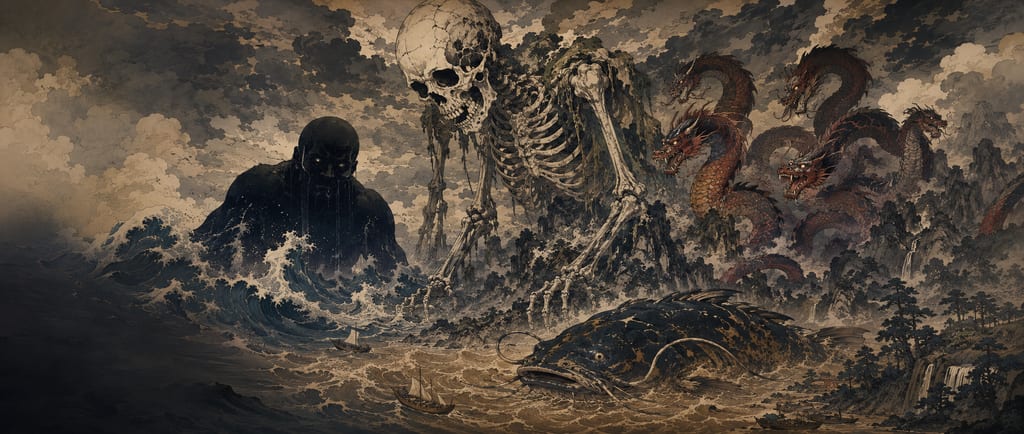
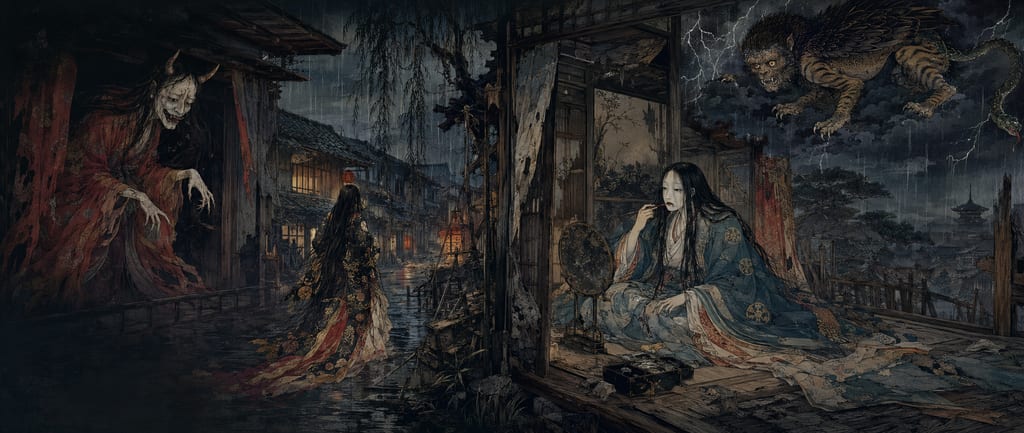
A representative early-modern source that clearly positioned Ōmagatoki within yōkai culture is Toriyama Sekien's *Konjaku Gazu Zoku Hyakki* (Illustrated Hundred Demons from the Present and Past, Continued), published in the 8th year of An'ei (1779). Sekien wrote, "It means twilight. It is the time when the hundred specters arise," continuing that, as a result, people in the world forbid letting children go outside. What is depicted here is not a single monster named Ōmagatoki. Within a single frame, he captures the setting sun on the far left, the houses and a pagoda below, and the cloud-like "hundred specters" with faces covering the sky above, visualizing the very moment when the bright time of humans ends and diverse uncanny entities acquire form.

The analogy of the "Hour of Wang Mang" can be verified prior to Sekien. Hayashi Razan's *Razan Hayashi Sensei Bunshū* (Collected Writings of Master Hayashi Razan), Volume 65, "Essays 1", compared the day to the Former Han, the night to the Later Han, and the twilight—when the qi of the sun has already sunk but the qi of the night has not yet arisen—to Wang Mang's Xin dynasty in between. Sekien inherited this older theory, explaining that just as Wang Mang usurped the throne of the Former Han, but his Xin dynasty did not last long and shifted to the Later Han, the boundary between day and night was likened to the interval between the two Han dynasties. This is not meant to prove the single historical origin of the word, but rather an intellectual analogy by Edo scholars superimposing Chinese history onto the same phonetic sound. Combined with *Ōma-doki* (おふま時) from *Yanagidaru* 7 (1772) and *Ōmagatoki* (大禍時) from *Hiyuzukushi* (1786) listed in dictionaries, it is evident that multiple phonetic forms and spellings existed in parallel. [1]

In "Kawataredoki," first published in the 5th year of Shōwa (1930), Yanagita Kunio did not reduce the unease of twilight solely to supernatural explanations, but considered it from the perspective of perception and village traffic. He posited that in an era when people wore hemp clothing, it was difficult to discern a person's physique from a distance; even upon hearing footsteps, until voices were exchanged, even an acquaintance might have felt like an outsider. For Yanagita, "Who goes there?" (*taso kare*) and "Who is that?" (*kare wa tare*) were not merely elegant etymologies, but actual questions posed to ascertain the true identity of an approaching figure in the dim light. His expression that both demons and travelers were greeted with a similar unease demonstrates that Ōmagatoki is constructed from both natural darkness and social vigilance.

In the first draft of *Yōkai Dangi* (Discussions on Yōkai) from the 11th year of Shōwa (1936), Yanagita discussed the sensation of recognizing the evening as a bad hour, calling it *ohomagadoki* or *gamagadoki*, and linked the act of calling out to a method for distinguishing between humans and other beings. According to a re-examination by Hirota Ryūhei, Yanagita cited an example from Saga where saying "Moshi" (Hello) only once would lead to being suspected of being a fox, hence they call out "Moshi-moshi," and an example from Okinawa where one does not reply until called three times. The *Game* (a turtle yōkai) of Kaga, the river otters of Noto, and the tanuki of Mino and Tosa were also said to reveal their true identities by failing to provide the proper response that a human ought to be able to say. Yanagita's interpretation was that calling out at dusk or on a night road serves simultaneously as a greeting and as a sort of license proving "I am not a monster."

However, one must not lump these together and assume that "the exact same etiquette was practiced nationwide during Ōmagatoki." Hirota points out that Yanagita constructed his argument without providing specific sources for these individual regional examples. The examples from Saga and Okinawa concern the number of calls, while those from Kaga, Noto, Mino, and Tosa relate to the pronunciation of disguised animals—these are separate traditions that also encompass the night in general. In the text, they are introduced as examples Yanagita compared, and they belong to a different layer of material than Sekien's prohibition against children going outside. [7]

Thus, Ōmagatoki is not a simple premise that "a specific yōkai will definitely appear in the evening." In Edo illustrated books, it became the dramatic opening curtain where the hundred specters arise; in modern folklore studies, it was re-read as a time of unease where humans had to be distinguished by face and voice. The way modern stories and games use it as a signal for the appearance of monsters also inherits these two layers. On the other hand, explanations that fix the "Hour of the Rooster" (kure-mutsu) to exactly 18:00 today, those seeking a single origin in ancient Shinto, or those attributing all accidents and distress solely to the Ōmagatoki tradition, require careful historical scrutiny.

Yokai Cards1

Ōmagatoki across multiple art-style decks

Card gallery

Detailed Analysis

This traditional image is constructed centering around the "Ōmagatoki" entry in Toriyama Sekien's *Konjaku Gazu Zoku Hyakki* (Illustrated Hundred Demons from the Present and Past, Continued), published in the 8th year of An'ei (1779). Ōmagatoki is not a single yōkai, but the temporal condition under which yōkai begin to appear. Therefore, rather than endowing it with a personality and having it attack people, it is treated as the twilight itself—when brightness is lost and the identities of familiar landscapes and people suddenly become uncertain.

Though brief, Sekien's explanation seamlessly links the definition, the uncanny, and a taboo. He first defines the time: "It means twilight. It is the time when the hundred specters arise," and immediately follows with the consequence: "In the world, it is forbidden to let children go outside." The practical warning to bring children home because it is evening and the supernatural explanation that the hundred specters arise form a mutually reinforcing structure. However, this is an explanation of "worldly custom" recorded by Sekien in the late 18th century, and it cannot be definitively said that this exact same prohibition was observed in homes nationwide since ancient times.

In the lower half of the picture, a quiet, unpeopled row of houses and a pagoda resembling a temple stand still, while a large sun is setting on the far left. In the upper half, faces with horns, beast-like faces, and faces that cannot be firmly identified as human or demon peer out one after another from a cloud-like mass. The "hundred specters" (*hyakumi*) do not appear as a roster tallying exactly one hundred entities, but rather as a collective term for numerous uncanny beings whose names and forms remain unfixed. Sekien does not place a single monster in the center; instead, he transforms the entire boundary between the sky and the town into a scene of yōkai manifestation.

The latter half of the text brings up the variant spelling "Hour of Wang Mang" (王莽時). In a theory recorded by Hayashi Razan before Sekien, the day corresponds to the Former Han, the night to the Later Han, and the twilight between them to Wang Mang's Xin dynasty. Sekien retold this older theory, overlaying the historical transition—where Wang Mang usurped the Former Han but his dynasty ended briefly before shifting to the Later Han—onto the boundary between day and night. This does not mean that Wang Mang himself appears as a yōkai; rather, it is an intellectual analogy decoding the sound *ōmagatoki* through the boundary of dynasties in Chinese history. The fact that dictionaries list Ōmagatoki alongside Ōmagatoki (Hour of Great Calamity), Ōmaji (Hour of the Great Demon), and Ōmōji (Hour of Wang Mang) also indicates that this word has been enveloped in multiple associations: disaster, encounters with demons, and historical intervals.

The terror of Ōmagatoki lies not in the darkness itself, but in the fact that one can still see, yet cannot identify correctly. In complete night, one would prepare a lantern; but at twilight, the sensation of day lingers, and a silhouette thought to be an acquaintance might actually be a stranger. In "Kawataredoki," Yanagita Kunio surmised that in an era when it was difficult to distinguish a person from the outline of their clothing, people probably could not confirm an individual's identity until they heard footsteps and exchanged greetings. The phrases *taso kare* ("Who goes there?") and *kare wa tare* ("Who is that?") crystallize this uncertainty directly into a question.

In the regional examples Yanagita compiled in *Yōkai Dangi*, voice serves to gauge the boundary between human and non-human. In Saga, a single "Moshi" (Hello) invites suspicion of being a fox; in Okinawa, one does not reply until called three times. The *Game* of Kaga, the river otter of Noto, and the tanuki of Mino and Tosa, even when disguised as humans, cannot correctly pronounce the local dialect, and their true identities are exposed through discrepancies in their responses. [7]However, as Hirota Ryūhei cautions, Yanagita did not clearly indicate the sources for these individual examples, and one cannot conclude that they were all identical Ōmagatoki customs. Here, they are positioned as Yanagita's comparative interpretation linking twilight and the stranger.

There is no fixed value on a modern clock for this hour. Even under the variable hour system of the Edo period, dawn and dusk served as the demarcations between day and night, and their positions shifted with the seasons. The time and duration of twilight differ between summer and winter, north and south, mountains and plains. Charts converting the Hour of the Rooster (kure-mutsu) to exactly 18:00 or 17:00–19:00 today are merely approximations; the essence of Ōmagatoki is not a number on a clock, but the brief transition where daytime visibility and social security begin to unravel.

Therefore, one cannot "defeat" Ōmagatoki. Behaviors such as returning home before sunset, exchanging greetings with companions, and identifying others with a lantern are not magic to erase time, but practical wisdom to reduce uncertainty. When the sun sets and complete night falls, even if the world of the hundred specters continues, Ōmagatoki as the "gap between day and night" comes to an end. The core connecting Sekien's hundred specters, Yanagita's stranger, and the modern fictional use of the hour as a signal for monsters to appear lies in that single point: the unsettling wavering of classification at the boundary where things can be seen but not easily defined.

Character Profile

This section is our own creative profile for storytelling. It is not historical fact or scholarship.

Rarity
Uncommon
Personality
It possesses no independent will or personality. It is an unsettling time that blurs the boundary between humans—easily identifiable during the day—and other beings, evoking a vigilance that seeks to ascertain the true identity of anyone approaching.
Compatibility
Highly compatible with those who take dusk as a cue to hurry home, exchange greetings with companions, and do not carelessly respond to unidentified calls. It amplifies anxiety for those who underestimate the boundary and step into it alone.
Abilities
Makes it difficult to distinguish human faces and true identities in the dim twilight before and after sunsetServes as the condition for the emergence of diverse uncanny beings as the hour when the 'hundred specters' ariseBlurs the boundaries between the familiar and the stranger, humans and other beingsTransforms the act of calling out and responding into a protocol for verifying identityAccompanied by the admonition to forbid children from going outsideCasts an unsettling pall over the entire landscape solely during the brief transition from day to night
Weaknesses
Because it has no concrete physical body, it cannot be defeated or exorcised. Danger can be avoided by returning home before sunset, calling out to companions, and using lamplight for confirmation; once twilight ends, the hour of "Ōmagatoki" itself also passes.
Habitat
It does not dwell in specific mountains, rivers, or shrines, but appears in the twilight itself, when the sunlight fades and human faces become hard to distinguish. It is keenly felt at places where those returning home intersect with those traveling outside, such as village roads and doorways.
🔮Yokai Compatibility Test

For more detailed information and diagnosis results about The Hundred Specters Arise at Twilight: Ōmagatoki, please click here.

Sources & References

7
  1. 精選版日本国語大辞典「大禍時」小学館(小学館(コトバンク)) [辞書・事典]大禍時・大魔時・逢魔時・王莽時の異表記、読み、語義、近世用例を収録する辞書項目。
  2. 日本の暦「中級第5問(櫓時計)解答」国立国会図書館(国立国会図書館) [公的機関資料]夜明けと日暮れを基準に昼夜を分け、季節で時間の長さが変わる江戸期の不定時法を解説する。
  3. 羅山林先生文集巻六十五「随筆一」林羅山(国立国会図書館デジタルコレクション(京都史蹟会編、1918), 寛文2年(1662)刊本系統) [古典文献]昼を前漢、夜を後漢、その間の黄昏を王莽の新朝へ比べる「王莽時」説を記す。
  4. かはたれ時柳田國男(初出『ごぎやう』第9巻第11号(青空文庫), 昭和5年(1930)) [民俗学資料]黄昏の地方語、人の姿を見分けにくい薄明、よそ者への警戒を論じた民俗学的随筆。
  5. 精選版日本国語大辞典「彼誰時」小学館(小学館(コトバンク)) [辞書・事典]かわたれ時が夜明け・夕暮れ双方の薄明を指し、現代では特に明け方に用いられることを示す辞書項目。
  6. 今昔画図続百鬼「逢魔時」鳥山石燕(江戸東京博物館所蔵・国文学研究資料館国書データベース, 安永8年(1779)) [古典文献]黄昏を「百魅の生ずる時」とし、小児を外へ出すことを禁じる世俗と王莽時の見立てを記した原典図像。
  7. 異人論が異人と出あうとき――動物=妖怪としての異人をアマゾニアに探る廣田龍平(『物語研究』22、215~229頁, 2022) [学術論文]柳田國男「妖怪談義」の黄昏・異人・応答例を再検討し、個別例の出典上の留保も指摘する。

Interested in this type of yokai?

Discover the yokai most similar to your personality with our yokai diagnosis

Start Yokai Diagnosis

Meet your guardian yokai at the shrine

Draw an omikuji fortune and discover the yokai watching over you today.