
ŌmagatokiThe Hundred Specters Arise at Twilight: Ōmagatoki
Ōmagatoki
Detailed Description
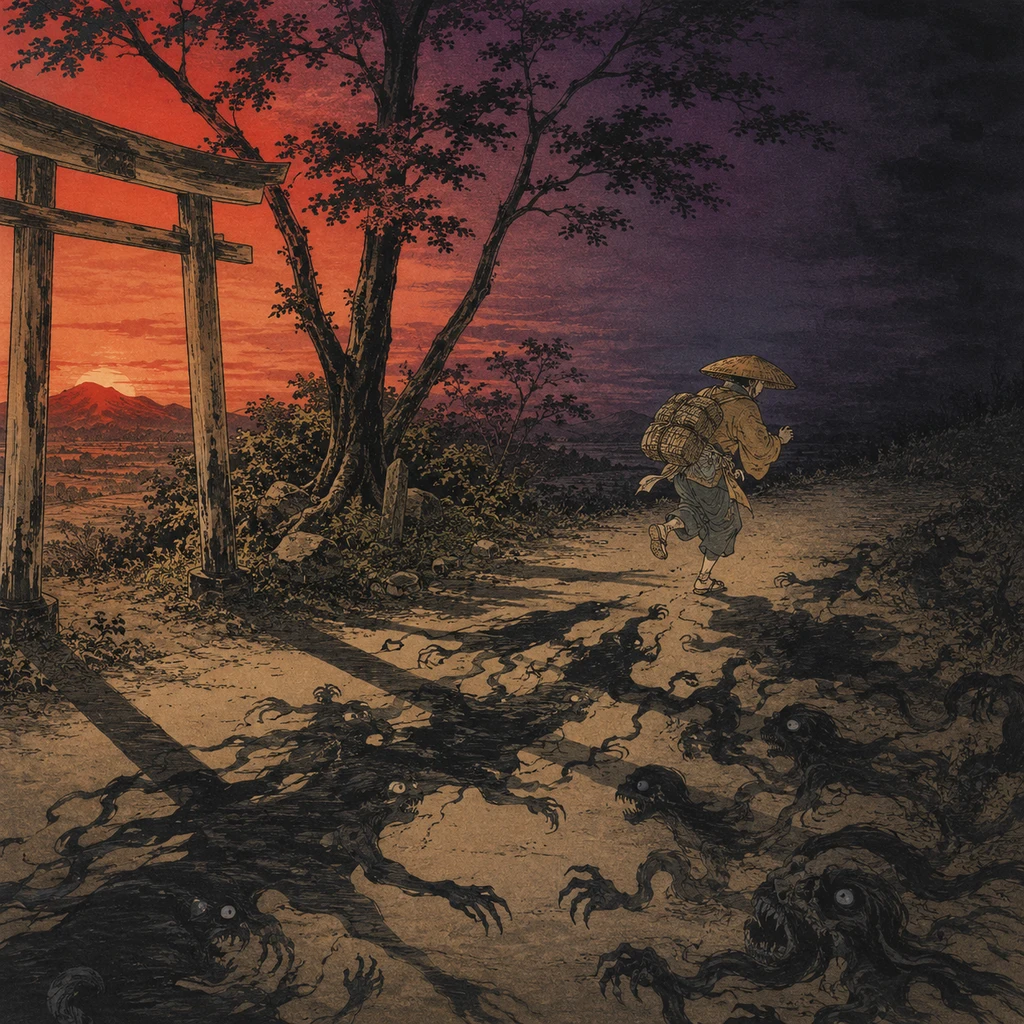
This traditional image is constructed centering around the "Ōmagatoki" entry in Toriyama Sekien's *Konjaku Gazu Zoku Hyakki* (Illustrated Hundred Demons from the Present and Past, Continued)[1], published in the 8th year of An'ei (1779). Ōmagatoki is not a single yōkai, but the temporal condition under which yōkai begin to appear. Therefore, rather than endowing it with a personality and having it attack people, it is treated as the twilight itself—when brightness is lost and the identities of familiar landscapes and people suddenly become uncertain.
Though brief, Sekien's explanation seamlessly links the definition, the uncanny, and a taboo. He first defines the time: "It means twilight. It is the time when the hundred specters arise," and immediately follows with the consequence: "In the world, it is forbidden to let children go outside." The practical warning to bring children home because it is evening and the supernatural explanation that the hundred specters arise form a mutually reinforcing structure. However, this is an explanation of "worldly custom" recorded by Sekien in the late 18th century, and it cannot be definitively said that this exact same prohibition was observed in homes nationwide since ancient times.
In the lower half of the picture, a quiet, unpeopled row of houses and a pagoda resembling a temple stand still, while a large sun is setting on the far left. In the upper half, faces with horns, beast-like faces, and faces that cannot be firmly identified as human or demon peer out one after another from a cloud-like mass. The "hundred specters" (*hyakumi*) do not appear as a roster tallying exactly one hundred entities, but rather as a collective term for numerous uncanny beings whose names and forms remain unfixed. Sekien does not place a single monster in the center; instead, he transforms the entire boundary between the sky and the town into a scene of yōkai manifestation.
The latter half of the text brings up the variant spelling "Hour of Wang Mang" (王莽時). In a theory recorded by Hayashi Razan before Sekien[2], the day corresponds to the Former Han, the night to the Later Han, and the twilight between them to Wang Mang's Xin dynasty. Sekien retold this older theory, overlaying the historical transition—where Wang Mang usurped the Former Han but his dynasty ended briefly before shifting to the Later Han—onto the boundary between day and night. This does not mean that Wang Mang himself appears as a yōkai; rather, it is an intellectual analogy decoding the sound *ōmagatoki* through the boundary of dynasties in Chinese history. The fact that dictionaries list Ōmagatoki alongside Ōmagatoki (Hour of Great Calamity), Ōmaji (Hour of the Great Demon), and Ōmōji (Hour of Wang Mang)[3] also indicates that this word has been enveloped in multiple associations: disaster, encounters with demons, and historical intervals.
The terror of Ōmagatoki lies not in the darkness itself, but in the fact that one can still see, yet cannot identify correctly. In complete night, one would prepare a lantern; but at twilight, the sensation of day lingers, and a silhouette thought to be an acquaintance might actually be a stranger. In "Kawataredoki," Yanagita Kunio[4] surmised that in an era when it was difficult to distinguish a person from the outline of their clothing, people probably could not confirm an individual's identity until they heard footsteps and exchanged greetings. The phrases *taso kare* ("Who goes there?") and *kare wa tare* ("Who is that?") crystallize this uncertainty directly into a question.
In the regional examples Yanagita compiled in *Yōkai Dangi*, voice serves to gauge the boundary between human and non-human. In Saga, a single "Moshi" (Hello) invites suspicion of being a fox; in Okinawa, one does not reply until called three times. The *Game* of Kaga, the river otter of Noto, and the tanuki of Mino and Tosa, even when disguised as humans, cannot correctly pronounce the local dialect, and their true identities are exposed through discrepancies in their responses. [5]However, as Hirota Ryūhei cautions, Yanagita did not clearly indicate the sources for these individual examples, and one cannot conclude that they were all identical Ōmagatoki customs. Here, they are positioned as Yanagita's comparative interpretation linking twilight and the stranger.
There is no fixed value on a modern clock for this hour. Even under the variable hour system of the Edo period[6], dawn and dusk served as the demarcations between day and night, and their positions shifted with the seasons. The time and duration of twilight differ between summer and winter, north and south, mountains and plains. Charts converting the Hour of the Rooster (kure-mutsu) to exactly 18:00 or 17:00–19:00 today are merely approximations; the essence of Ōmagatoki is not a number on a clock, but the brief transition where daytime visibility and social security begin to unravel.
Therefore, one cannot "defeat" Ōmagatoki. Behaviors such as returning home before sunset, exchanging greetings with companions, and identifying others with a lantern are not magic to erase time, but practical wisdom to reduce uncertainty. When the sun sets and complete night falls, even if the world of the hundred specters continues, Ōmagatoki as the "gap between day and night" comes to an end. The core connecting Sekien's hundred specters, Yanagita's stranger, and the modern fictional use of the hour as a signal for monsters to appear lies in that single point: the unsettling wavering of classification at the boundary where things can be seen but not easily defined.
Source Information
種類全体の出典primary
羅山林先生文集巻六十五「随筆一」
著者: 林羅山
年代: 寛文2年(1662)刊本系統
出版社: 国立国会図書館デジタルコレクション(京都史蹟会編、1918)
種類全体の出典primary
異人論が異人と出あうとき――動物=妖怪としての異人をアマゾニアに探る
著者: 廣田龍平
年代: 2022
出版社: 『物語研究』22、215~229頁
種類全体の出典primary
日本の暦「中級第5問(櫓時計)解答」
著者: 国立国会図書館
出版社: 国立国会図書館
種類全体の出典primary
精選版日本国語大辞典「彼誰時」
著者: 小学館
出版社: 小学館(コトバンク)
種類全体の出典primary
精選版日本国語大辞典「大禍時」
著者: 小学館
出版社: 小学館(コトバンク)
種類全体の出典primary
かはたれ時
著者: 柳田國男
年代: 昭和5年(1930)
出版社: 初出『ごぎやう』第9巻第11号(青空文庫)
種類全体の出典primary
今昔画図続百鬼「逢魔時」
著者: 鳥山石燕
年代: 安永8年(1779)
出版社: 江戸東京博物館所蔵・国文学研究資料館国書データベース
Personality
It possesses no independent will or personality. It is an unsettling time that blurs the boundary between humans—easily identifiable during the day—and other beings, evoking a vigilance that seeks to ascertain the true identity of anyone approaching.
Compatibility
Highly compatible with those who take dusk as a cue to hurry home, exchange greetings with companions, and do not carelessly respond to unidentified calls. It amplifies anxiety for those who underestimate the boundary and step into it alone.
Abilities & Skills
Weaknesses
Because it has no concrete physical body, it cannot be defeated or exorcised. Danger can be avoided by returning home before sunset, calling out to companions, and using lamplight for confirmation; once twilight ends, the hour of "Ōmagatoki" itself also passes.
Collection Inclusion
This yokai is included in the following collections:
Colossal Yokai
A curated look at Japan’s colossal yokai—Gashadokuro, Umibozu, Daidarabocchi—and their overwhelming, mythic scale.
Konjaku Gazu Zoku Hyakki | Toriyama Sekien’s Yokai of Rain, Darkness, and Dawn
Explore Toriyama Sekien’s 1779 Konjaku Gazu Zoku Hyakki, its Rain, Darkness, and Dawn volumes, and the yokai pictured in the original order.
診断評価
妖怪バウンダリー・タイプ指標
いたずら濃度
1.0high: 戯 low: 護
📝 メモ
不安を増幅し見まちがいや道迷いを誘うが、特定の加害主体ではない
変化適応
1.0high: 化 low: 定
📝 メモ
薄闇が認識を変え百魅を生じさせるが、個体の変身ではない
夜話度
1.0high: 夜 low: 昼
📝 メモ
夕暮れから夜へ移る薄闇の頃で、深夜ではなく夜の入口にあたる
情の深さ
-2.0high: 縁 low: 境
📝 メモ
人に憑く情ではなく、全国に流布する薄闇の観念として働く
結界強度
3.0high: 律 low: 流
📝 メモ
昼夜、里と野、人顔の判別の境に生じる典型的な境界霊性
表舞台圧
-3.0high: 表 low: 影
📝 メモ
妖怪個体ではなく日の暮れの時刻概念で、身体をもって表に出ない
妖怪相性診断
喜び
1.0喜びと楽しさの程度
📝 メモ
喜びや楽しさとは結び付かず、薄闇の不安を強める。
怒り
3.0怒りの激しさの程度
📝 メモ
怒りの人格はなく、禍を招くとされるが能動的な激怒の表現は少ない。
慈悲深い
2.0慈悲深さの程度
📝 メモ
慈悲の意図はなく、災厄観と注意喚起の語。情け深さは低い。
憂鬱
6.5憂鬱で思慮深い程度
📝 メモ
薄闇の憂愁や不安、思慮深さを誘う時間帯としての側面が強い。
静寂
5.0内なる平静の程度
📝 メモ
静けさの時間でもあるが、不穏さが拮抗。家内での落ち着きは促される。
いたずら好き
1.5いたずら好きで活発な程度
📝 メモ
いたずら的な性格はなく、誤認や道迷いは戯れより戒めの機能。
やさしい
2.0やさしく親しみやすい程度
📝 メモ
中立だが不穏とされ、具体的慈愛は乏しい。人に優しくはない時間帯の概念。
厳格
7.0厳格で真面目な程度
📝 メモ
早めの戸締まり・外出回避など規範を強く喚起し、慎みを求める。
守護的
4.0他者を守る傾向
📝 メモ
直接守護はしないが、戒めとして生活規範を促し結果的に身を守る面がある。
神秘的
9.0神秘的で不思議な程度
📝 メモ
姿なき境界の怪で、黄昏に百魅が生ずるという観念は強い神秘性を帯びる。
霊性の深さ
9.5精神的境界の深さ
📝 メモ
此岸と他界の境目の霊性を体現する時間概念で、境界霊性の深さは顕著。
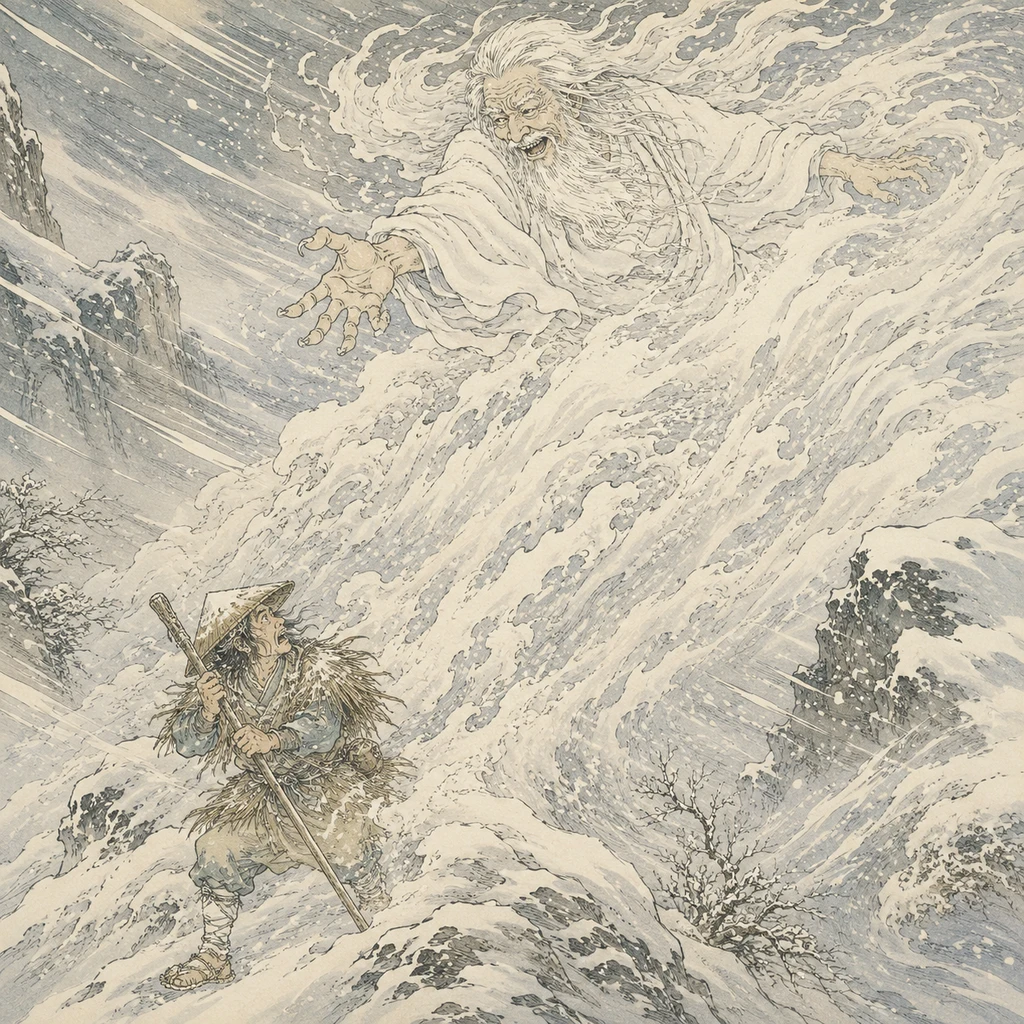
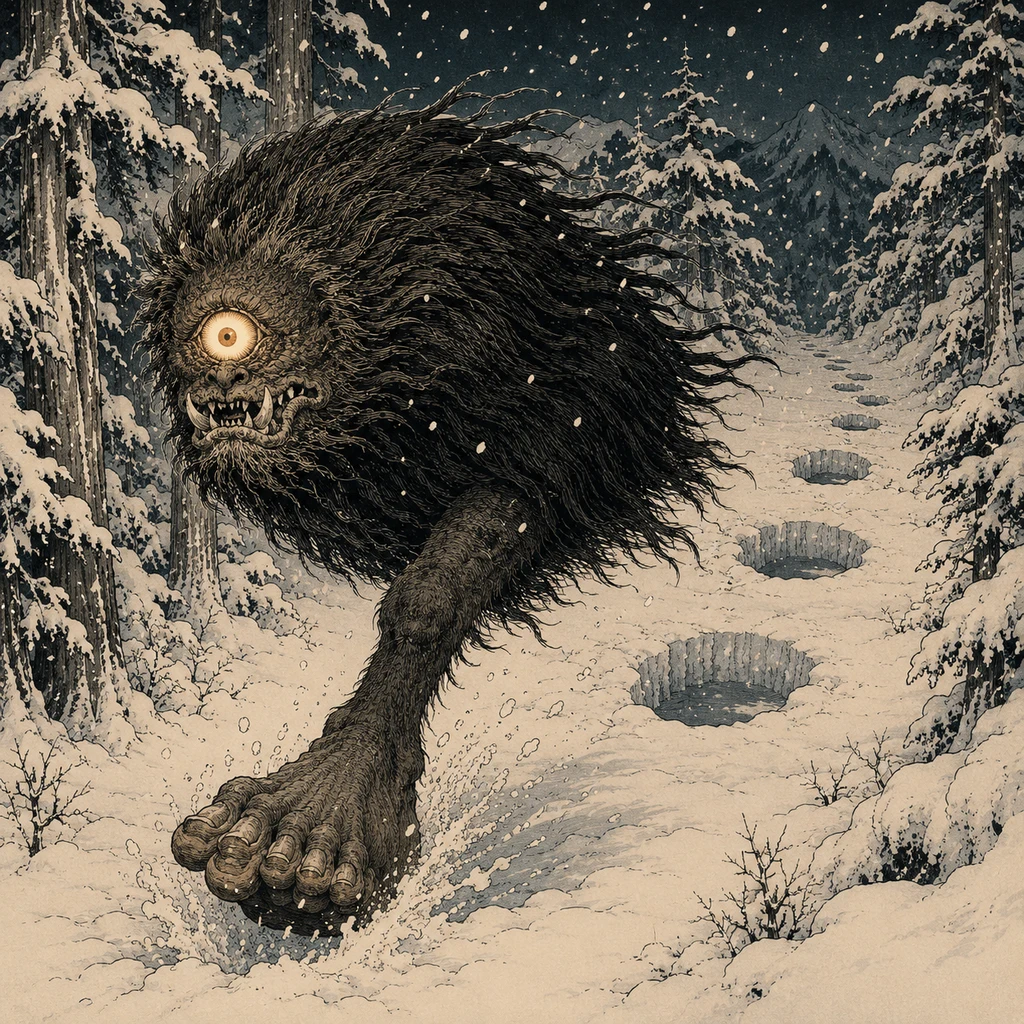
Similar Yokai
Yokai with similar personality and characteristics to The Hundred Specters Arise at Twilight: Ōmagatoki
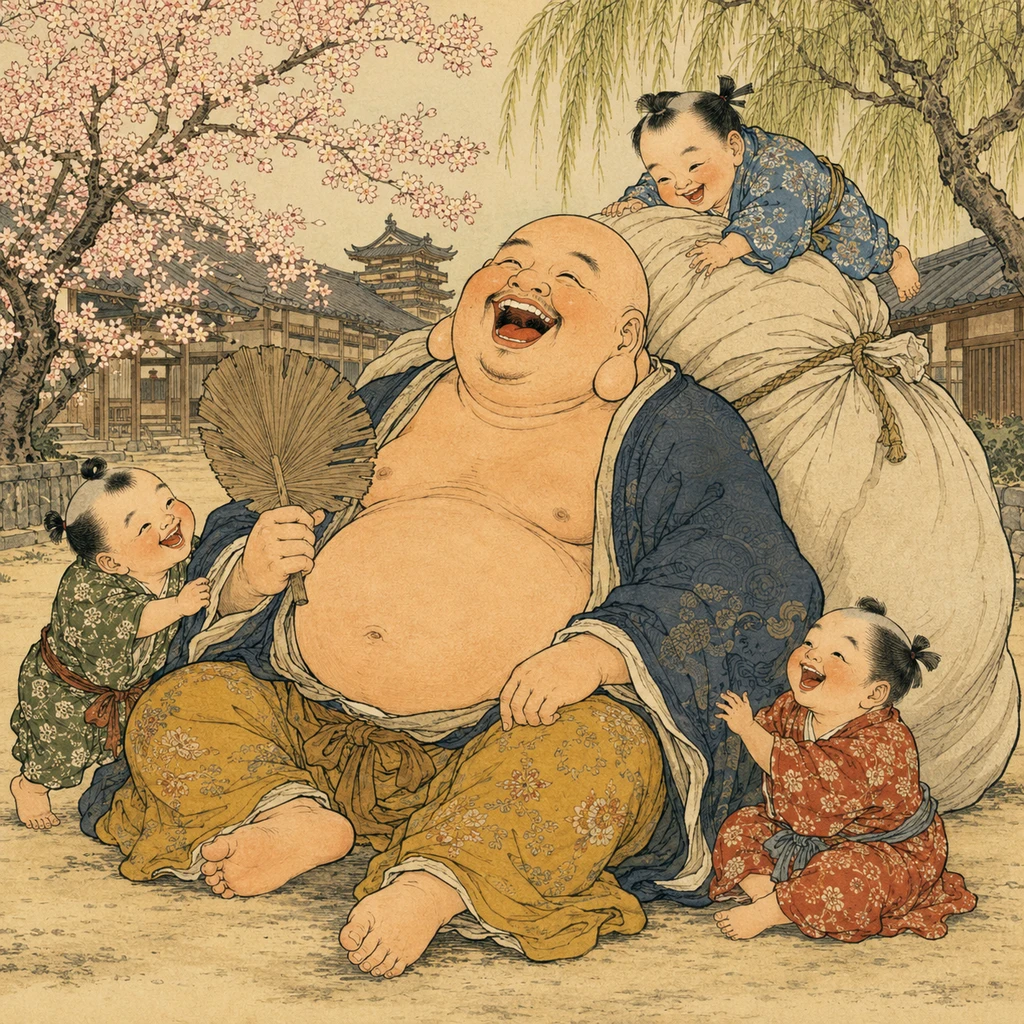
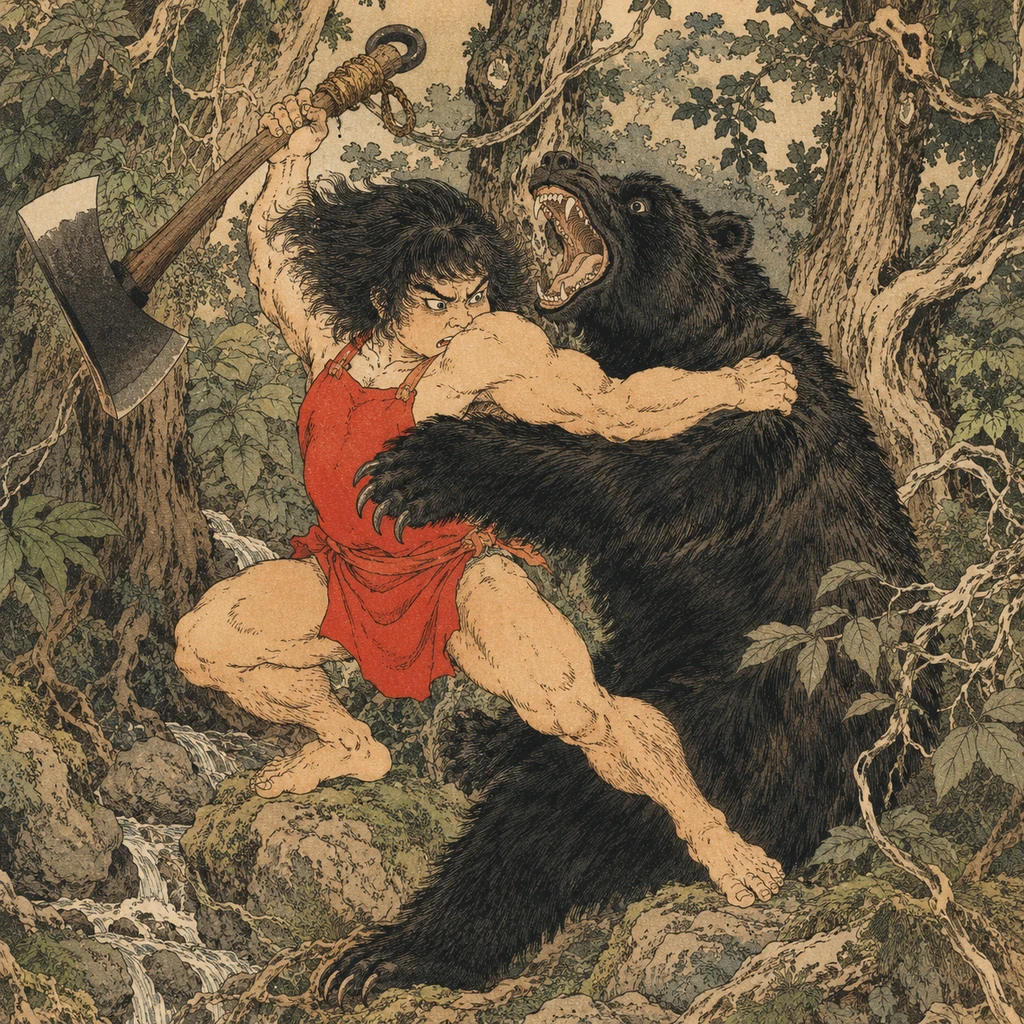
Opposite Yokai
Yokai with opposite personality and characteristics to The Hundred Specters Arise at Twilight: Ōmagatoki
🔮Test your compatibility with Ōmagatoki now!
Analyze your personality and values to get a detailed compatibility rating with this yokai.
Free, simple, and results in just minutes.