
FukurokujuThree-Stars-in-One Long-Headed Deity, Fukurokuju
ふくろくじゅ
Detailed Description
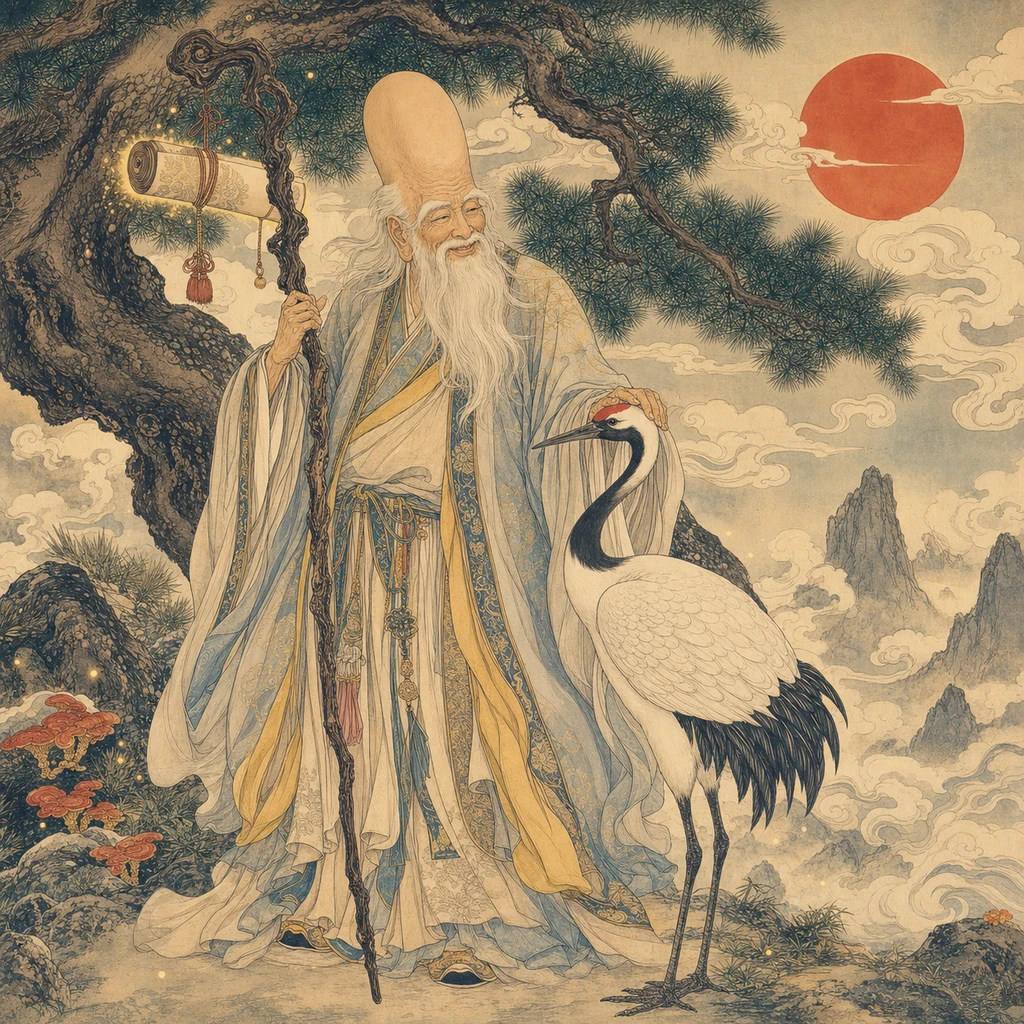
Fukurokuju is the anthropomorphic deity that integrates the three Daoist stars of China (the Gods of Fortune, Wealth, and Longevity) into a single body[1]. Among the three, the Star of Longevity (the Old Man of the South Pole = Canopus[2]) is an ancient astronomical deity recorded in the astronomical chapters of the "Records of the Grand Historian" and the "Book of Jin," and a year in which it could be seen was said to augur world peace. The Star of Fortune was associated with Jupiter, and the Star of Wealth with the Wenchang star of the Big Dipper. Although each initially had its own independent following, the "Sanxingtu" (Three Stars Image), depicting them together, was established in the Song dynasty and popularized as New Year decorations for the masses throughout the Ming and Qing dynasties. The singular deity Fukurokuju is the anthropomorphized amalgamation of these three stars. Multiple origin tales coexist, including the theory that he is the incarnation of the Song Daoist Tiannanxing[3], and the theory that he is the incarnation of the Old Man of the South Pole himself. His iconography depicts him as short in stature with an unusually elongated head, bearing a long white beard, attaching a scroll to the head of his staff, and accompanied by a crane or turtle. This is the epitome of Daoist iconography: the "short body and long head" are physical auspices of long life, the scroll signifies the mastery of the Dao, and the crane and turtle represent auspicious beasts of longevity. Introduced to Japan in the late Muromachi period (15th century) likely through Zen monks' travels to China and imported Daoist-Buddhist paintings, the Zen and painter-monk circles of the Higashiyama culture period[4] reorganized him into the "Seven Gods of Fortune and Virtue." By combining the already indigenized Ebisu, Daikokuten, Bishamonten, and Benzaiten with the fellow imported deities Hotei and Jurojin, they grouped them as the seven fortune deities styled after the Seven Sages of the Bamboo Grove—the prototype of the current Seven Lucky Gods. Fukurokuju's inherent dilemma lies in the problem of being the same entity under a different name as Jurojin; since both are incarnations of the Old Man of the South Pole, theories considering them the same deity have existed since ancient times. Although early modern popular encyclopedias like Kaibara Ekken's "Yamato Koto Hajime" list them as distinct entities, irregular Seven Lucky Gods variations replacing Jurojin with Kisshoten, Fukusuke, or Inari also circulated in Edo period Takarabune paintings. Because Fukurokuju simultaneously presides over three virtues (descendants, wealth, and longevity), he was favored for family celebrations by merchants and samurai. For longevity prayers by the clergy, however, Jurojin was often chosen. Their division of roles loosely converged in the late early-modern period as "the comprehensive fortune deity of the secular world (Fukurokuju)" and "the ascetic deity of longevity (Jurojin)."
Source Information
種類全体の出典primary
道教三星信仰 (福·禄·寿)
著者: 中国民俗·道教研究
年代: 宋代~現代
出版社: 道教正典群および民俗継承
種類全体の出典primary
南極老人星 (カノープス) ── 寿星信仰
著者: 司馬遷『史記』天官書ほか
年代: 前漢期~
出版社: 中国古代天文学
種類全体の出典primary
七福神信仰の整理
著者: 近世~現代の民俗·宗教研究
年代: 近世以降
出版社: 通俗百科·民俗学整理
種類全体の出典primary
天南星化身説
著者: 宋代道教文献
年代: 宋代
出版社: 道教伝承
種類全体の出典primary
東山文化と七福神画の成立
著者: 室町後期·禅林·画僧
年代: 15 世紀後半
出版社: 足利義政期文化圏
Personality
A serene, silent old man who watches over others with a smiling face. Showing no intense emotions, he possesses the disposition of a grandfather looking after his descendants.
Compatibility
Highly compatible with those praying for family harmony and the prosperity of their descendants, as well as those seeking both longevity and financial fortune. Because he and Jurojin share the same origin, enshrining them side-by-side causes their energies to overlap; traditional etiquette dictates choosing one or enshrining them with distinct roles.
Abilities & Skills
Weaknesses
The issue of sharing an identity with Jurojin (enshrining them together is said to make it difficult for either's virtues to manifest). It is also said that prayers greedily demanding too much of all three virtues are ironically less likely to be answered.
診断評価
妖怪バウンダリー・タイプ指標
いたずら濃度
-3.0high: 戯 low: 護
📝 メモ
福、禄、寿を授ける授福神で悪戯性はほぼない
変化適応
-1.0high: 化 low: 定
📝 メモ
南極老人星の化身だが、図像は長頭老翁として定型化する
夜話度
0.0high: 夜 low: 昼
📝 メモ
元日の夢枕に関わるが本質は長寿の瑞神である
情の深さ
-1.0high: 縁 low: 境
📝 メモ
子孫を見守るが、特定個人に執着する神ではない
結界強度
1.0high: 律 low: 流
📝 メモ
禅宗寺院や七福神巡りの信仰枠に留まる
表舞台圧
2.0high: 表 low: 影
📝 メモ
七福神図や夢枕に長頭老翁として明瞭に示される
妖怪相性診断
喜び
8.0喜びと楽しさの程度
📝 メモ
常ににこやかで福をもたらす喜びの象徴。
怒り
0.0怒りの激しさの程度
📝 メモ
激情を一切見せない穏やかな仙人。
慈悲深い
9.0慈悲深さの程度
📝 メモ
人々を静かに、そして温かく見守り続ける深い慈悲。
憂鬱
1.0憂鬱で思慮深い程度
📝 メモ
悲哀や憂鬱とは無縁の福徳神。
静寂
10.0内なる平静の程度
📝 メモ
静謐で物言わず見守る極めて平穏な気質。
いたずら好き
4.0いたずら好きで活発な程度
📝 メモ
にこやかではあるが、軽薄な遊び心というよりは老翁のゆとり。
やさしい
10.0やさしく親しみやすい程度
📝 メモ
子孫を見守る祖父のような限りない優しさ。
厳格
2.0厳格で真面目な程度
📝 メモ
非常に寛大で、厳しさで人を律するタイプではない。
守護的
9.0他者を守る傾向
📝 メモ
寿命と福禄を守護する強固な加護。
神秘的
6.0神秘的で不思議な程度
📝 メモ
極端な長頭という異相を持つ神仙としての不可思議さ。
霊性の深さ
8.0精神的境界の深さ
📝 メモ
道教の星の神格(カノープス)に由来する仙人としての霊性。
Similar Yokai
Yokai with similar personality and characteristics to Three-Stars-in-One Long-Headed Deity, Fukurokuju
Opposite Yokai
Yokai with opposite personality and characteristics to Three-Stars-in-One Long-Headed Deity, Fukurokuju


🔮Test your compatibility with Fukurokuju now!
Analyze your personality and values to get a detailed compatibility rating with this yokai.
Free, simple, and results in just minutes.