
YOKAI.JP

Iso-onna

iso-onna

Iso-onna

Iso-onna

This form can walk with you as your companion. Pick a portrait and make it your icon.

Basic Description

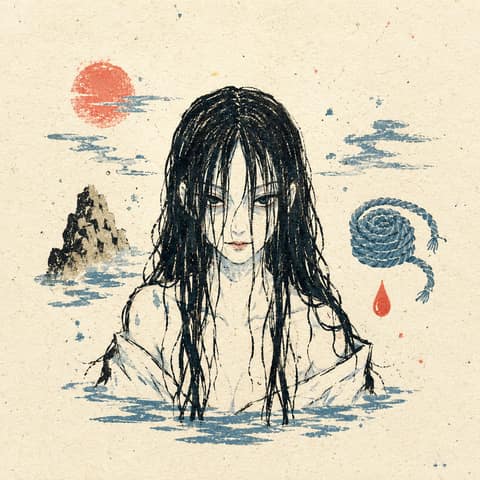
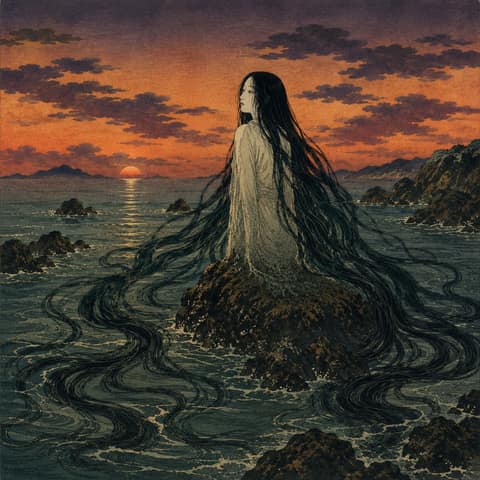
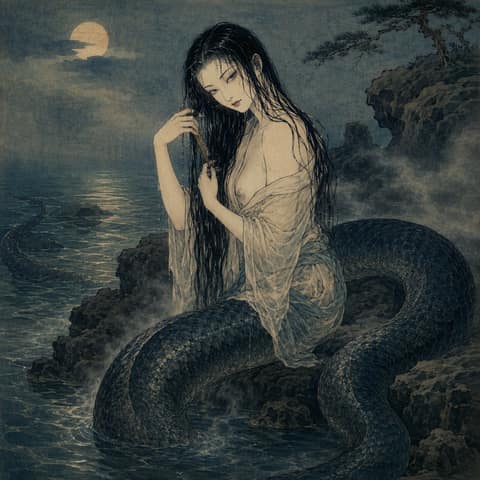
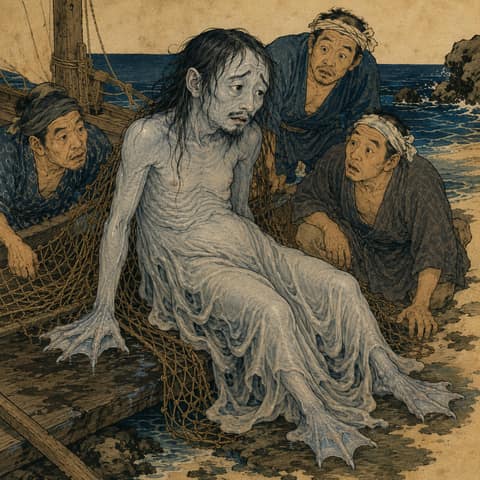
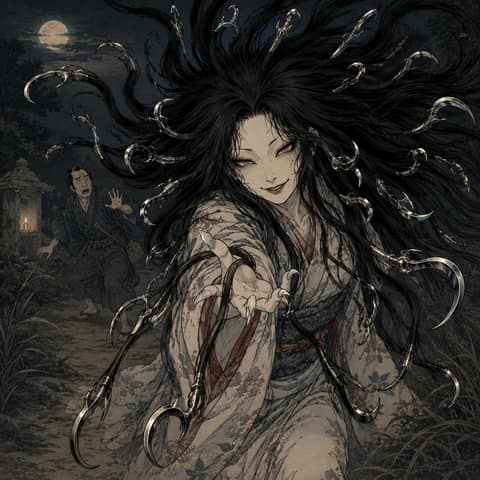
Iso-onna is a female sea apparition found along the northwestern coast of Kyūshū, including Amakusa, Shimabara, Tsushima, and Kakarashima. She approaches beaches, rocky shores, and moored boats, entangling people in her long hair and drinking their blood. Her upper body resembles a beautiful woman, while her lower half is said either to fade from view or to be serpentine; from behind, she may look like nothing more than a wet rock. Names vary by region, including Iso-joshi, Nure-joshi, Ama, and Umi-hime. She appears when the sea is calm and is sometimes linked with the resentful dead of maritime disasters. Some traditions also pair her with Ushi-oni, another dangerous being of the shore.

Folklore & Legends

In Minamishimabara, Nagasaki, Iso-onna is said to stand staring out to sea. If someone speaks to her, she gives a piercing shriek, winds her hair around the person, and drinks their blood. In Amakusa, she climbs aboard at night along the stern mooring line and covers sleepers with her hair. Boats staying in an unfamiliar harbor therefore lower only the anchor and do not tie the stern to the shore. On the Shimabara Peninsula, people were advised to sleep with three stems of thatching reed laid on their clothing.

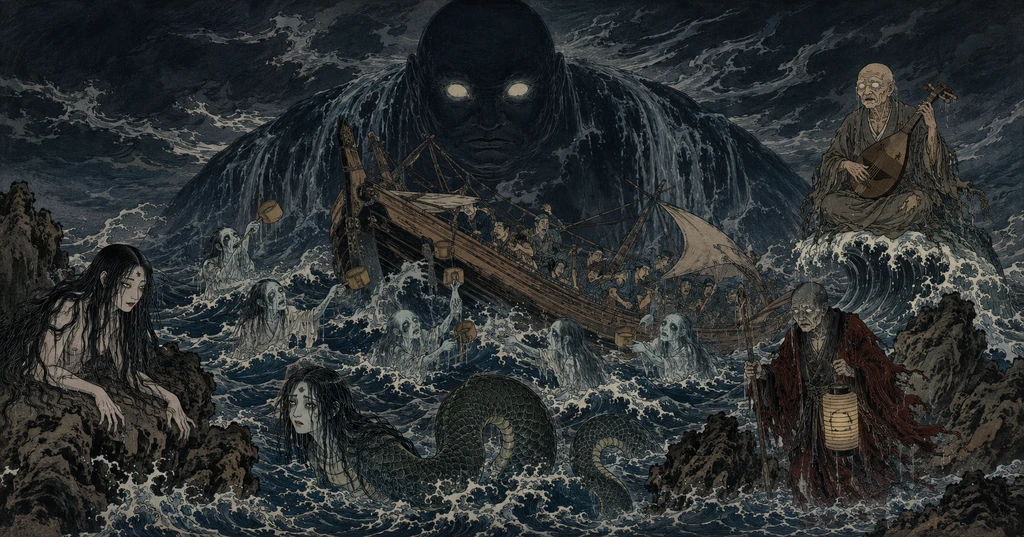
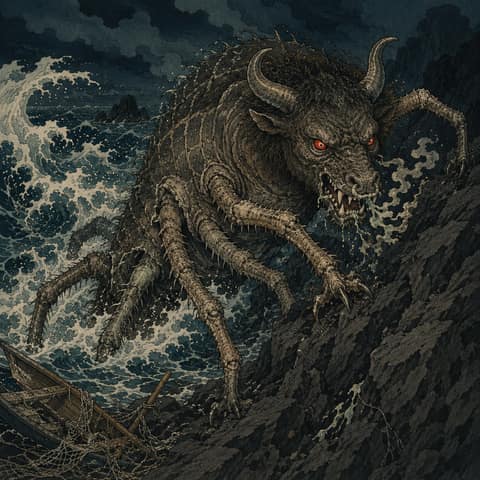
Northern Kyūshū has a tradition that Iso-onna is a crab transformed, while stories from the Fukuoka coast let her walk across the surface of the water. On Ojika, she is identified with the spirit of someone who drowned. Unlike Umibōzu and Funayūrei, which confront vessels farther offshore, Iso-onna waits at rocky shores and anchorages—the boundary where land and sea meet. Long hair, blood, and the danger of a quiet shoreline define this female sea apparition of western Japan.

Yokai Cards1

Iso-onna across multiple art-style decks

Card gallery

Related Yokai

Yokai deeply tied to this one in legend.

Kindred1
Related1

Detailed Analysis

2 different forms of Iso-onna have been confirmed. Each has unique characteristics and personality, with various ways of interacting with people. Details of each form are introduced below.

Iso-onna, the Shore Woman Who Climbs a Mooring Line

To explain Iso-onna, the Shore Woman Who Climbs a Mooring Line in detail:

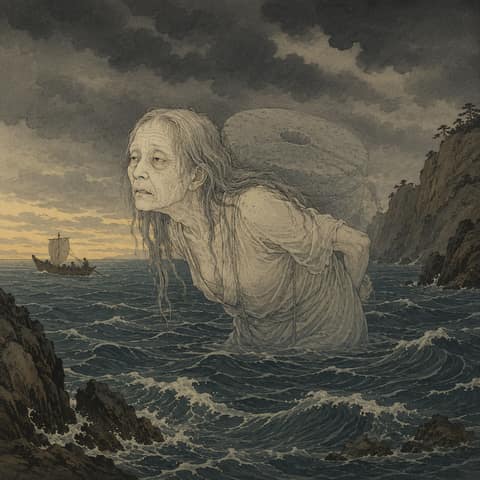
Iso-onna is a female sea apparition of northwestern Kyūshū. Above the waist she looks like a young woman with long black hair soaked in seawater. Below it, her outline dissolves into mist and waves without leaving footprints, or else lengthens into a serpent's body. Seen from behind, she can be mistaken for a wet rock. In Minamishimabara, Nagasaki, she stands gazing offshore; anyone who speaks to her is answered with a piercing cry, then caught in her hair and drained of blood.

Her most feared habit is boarding vessels at anchor. In Amakusa, Kumamoto, Iso-onna climbs a stern mooring line after dark and covers a sleeping person's face with her hair. Boats spending the night in an unfamiliar harbor therefore lower the anchor but leave the stern untied from shore. The very line joining boat and land becomes her path aboard.

Other safeguards survive around the region. On the Shimabara Peninsula, three stems pulled from a thatched covering were laid on a person's clothing before sleep so that Iso-onna's hair could not catch them. The Sōgō Nihon Minzoku Goi, edited under the supervision of Yanagita Kunio, records this coastal female apparition under names including Iso-onna and Iso-nyōbō.

Iso-onna differs from Umibōzu and Funayūrei, which more often attack in open water. Her defining territory is the rocky shore or anchorage, where land and sea touch. Many communities connect her with drowned women or with a woman who died while waiting for her husband to return. In western Japan, she may also appear beside Ushi-oni, approaching first to lower a victim's guard before the other creature attacks.

Hair, blood, and the shoreline boundary form the core of her image. The story of her climbing a mooring line, and the practical customs of anchoring without tying the stern or placing three reeds on one's clothing, preserve both a fishing village's fear of the night sea and its knowledge of how to live beside it.

Character Profile

This section is our own creative profile for storytelling. It is not historical fact or scholarship.

Rarity
Epic
Personality
She keeps to the boundary between land and sea and appears only on calm nights. A careless call or an act of disrespect may bring a shriek and the grasp of her hair, although some traditions say she avoids boats that honor the maritime dead.
Compatibility
She is least hostile toward fishers who observe coastal custom, travelers who respect the night sea, and people who remember those lost in maritime disasters.
Abilities
Entangling people in long hair and drinking their bloodClimbing a stern mooring line onto an anchored vesselStunning people with a piercing shriekAppearing on rocky shores during calm nightsBlending into the shape of a wet rock when seen from behind
Weaknesses
Three thatching reeds laid on one's clothing are said to keep her hair from catching; a boat that anchors without tying its stern to shore gives her no line to climb; some accounts say she avoids vessels that keep a light burning and honor the maritime dead.
Habitat
The northwestern coast of Kyūshū, including Amakusa, Shimabara, and Tsushima; stern mooring lines of anchored boats; and the boundary of rocky shore and beach.

🔮Yokai Compatibility Test

For more detailed information and diagnosis results about Iso-onna, the Shore Woman Who Climbs a Mooring Line, please click here.

Isonna of the Aft-Rope Crossing

To explain Isonna of the Aft-Rope Crossing in detail:

A feared variant along Amakusa and the Shimabara Peninsula, named for slipping aboard by following the aft mooring rope. She appears as the upper body of a young woman scented with the sea, while her lower half is hazy and shifting like wave-shadows. Her long wet black hair constantly streams from her chest to the floor, branching into fine threads that cling to human skin. When a hush falls over the harbor at midnight, she stands in the lee of the shore or at a stern’s tip staring seaward, and will either echo the name of anyone who calls to her or answer with a piercing scream. At that cry she reaches a white hand to the aft rope, crosses soundlessly onto the boat, shrouds a sleeper’s face with her hair, and twists up blood strand by strand. By morning only a tide stain and a thin ring of hair remain at the pillow. Said to be the shape taken by the regrets of the drowned or a love unfulfilled by one who waited at the harbor, she is known as an isonna and also as nure-onna. The practice of avoiding the aft rope comes from this variant’s habit of treating ropes as roads. So long as she touches a line she can climb anywhere, but she does not swim about recklessly and prefers calm surfaces. On thin-moon nights some have seen her walk the water from shore, but only when the harbor tide lies asleep. She is weakened by light and prayer, so fishermen in unfamiliar ports avoid taking the aft rope, drop only the anchor, and keep the gunwale light burning. In Shimabara it is said that placing three dry thatch reeds from a roof upon one’s kimono while sleeping prevents tangling and wards her off. Those who touch her hair are seized by chill and lethargy, and the roar of the sea lingers in their ears for days. She is merciless toward mockery and rudeness, targeting first those who call her name without honorifics or taunt her with whistles. Conversely, she is said to avoid boats whose crews offer prayers for the lost at sea. Some tales claim that if you move behind her she resembles a rock shadow, and under moonlight her back becomes the outline of a wet reefs tone to let waves pass. The Isonna of the Aft-Rope Crossing is a grudge born at the liminal space of the harbor, hard to approach for those who keep the code and unforgiving toward arrogance, dropping her hair without mercy.

Character Profile

This section is our own creative profile for storytelling. It is not historical fact or scholarship.

Rarity
Epic
Personality
quiet and relentless, approaches without a word, answers provocation with a shrill cutting scream, bound by grudge and lingering regret, emotions sway like hair in the night wind
Compatibility
those who keep the laws of the sea and act with caution, sailors who maintain lights and prayers, those who refrain from needless calling out, extremely bad with people who mock carelessly, extremely bad with braggarts who shout for show
Abilities
aft-rope traversal—moves along ropes and lines as along a road, slipping aboard without a sound, hair-draining—splits her hair into threadlike strands to draw off body heat and blood on contact, name-echo—returns a called name in a clear voice to seize attention and awareness, rock-shadow guise—alters her back to resemble wet reef stone to be indistinguishable in darkness
Weaknesses
lamps and prayer—ship’s lights, sutra chanting, and memorial talismans repel her, dry thatch—placing three dry roof reeds on the body prevents tangling and weakens her power
Habitat
harbor fronts along Amakusa City, Kumamoto, inlets and boat havens of the Shimabara Peninsula, small harbors and river mouths at the stern during nights of calm

🔮Yokai Compatibility Test

For more detailed information and diagnosis results about Isonna of the Aft-Rope Crossing, please click here.

Sources & References

3
  1. 怪異・妖怪伝承データベース「磯女」国際日本文化研究センター(国際日本文化研究センター, 2002-) [研究資料]全国の民俗誌・地誌から採録した怪異伝承の検索データベース。磯女の天草・島原・対馬など九州各地の伝承事例を収める。
  2. 綜合日本民俗語彙 [古典文献] Reference
  3. 妖怪事典村上健司(毎日新聞社, 2000) [研究書] Reference

Interested in this type of yokai?

Discover the yokai most similar to your personality with our yokai diagnosis

Start Yokai Diagnosis

Meet your guardian yokai at the shrine

Draw an omikuji fortune and discover the yokai watching over you today.