Killing Stone
Sesshōseki
The Killing Stone of Nasu, the Poison-Breathing Stone
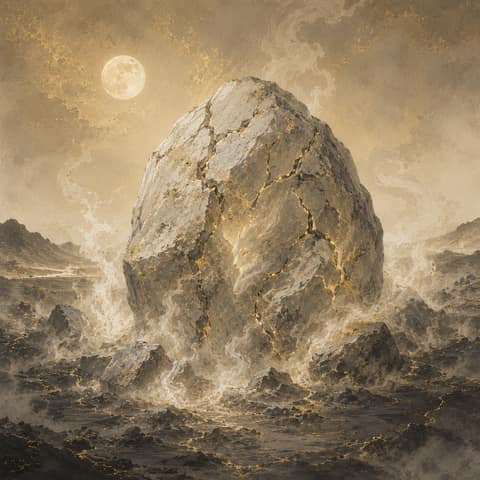
This version looks at how the Sesshōseki, as a poison stone, has been told of on the noh stage and at sites of worship. In the noh play Sesshōseki, when the traveling priest Gennō approaches the stone on the Nasu Plain, a village woman appears and tells the stone’s origin; in time the stone splits open and the spirit of the fox emerges from within. The spirit repents of the evil deeds of its life, vows to attain buddhahood, saved by the priest’s ritual power, and vanishes. Here the Killing Stone is not merely a stone that kills, but something in which a lost soul dwells, to be quieted through memorial rites. Around the Killing Stone lies a desolate land where no plant grows and sulfurous smoke hangs in the air, called from of old the Sai-no-Kawara, lined with countless Jizō statues that mourn the dead. The Nasu Onsen Shrine stands close by, and at its Goshinka (Sacred Fire) Festival each May, a rite is said to be held in which the shrine’s fire is carried before the stone to quiet the mountain’s fire and the stone’s numinous power. Seen this way, the dread of the Killing Stone is rooted less in a stone that moves of its own will than in the sense of a boundary: “step past here and you lose your life.” The very zone filled with poison fumes was feared as a threshold between the world of the living and the world beyond, and it was believed that calamity reached only those who trespassed that boundary.