osaki-gitsune
The Small Fox Clinging to Family Lineages: Osaki-gitsune
Animal YokaiChichibu, Musashi Province (Present-day Chichibu region, Saitama Prefecture) / Kōzuke Province and Kōshinetsu region
In this version, we read the Osaki-gitsune as the "small fox clinging to family lineages." The terror of the Osaki-gitsune is not that it suddenly jumps out on a mountain path. Its terror lies in the fact that by being spoken of as possessing a house for generations—that the family is an "Osaki holder"—it completely alters the reputation of the entire family. The yokai does not appear before the individual; it rides upon the family name.
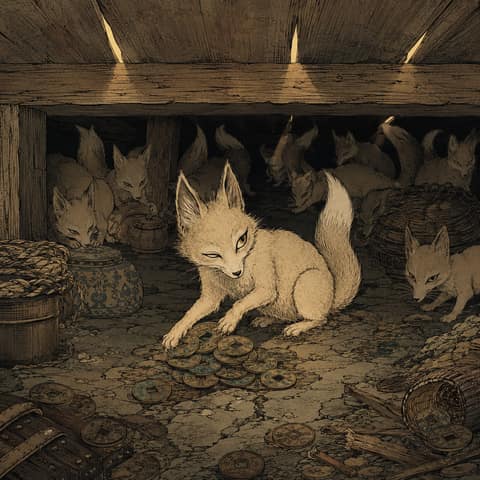
The Osaki-gitsune functioned as an explanation for wealth. In village societies, when only a specific family became wealthy, the reason was sometimes spoken of not merely as effort or luck, but as the invisible power of a fox. This narrative contains both envy and fear. A wealthy family has power, but whether that power is legitimate is doubted. The Osaki-gitsune is an entity that translates economic imbalance into the form of a yokai.
As an explanation for illness or possession, the Osaki-gitsune also played a major role. Unexplained ailments, sudden madness, and abnormal appetites were spoken of as fox possession, becoming subjects for prayers and exorcisms. Here, the fox does not just enter the sick person's body; it spreads the suspicion of "Who sent it?" and "Which family has it?" The belief in spirit possession expands bodily issues into issues of the family and the community.
The proximity to the Kuda-gitsune enriches the reading of this version. Both are small fox spirits that possess houses and are tied to wealth and disease. However, while the Kuda-gitsune easily takes on the sorcerous image of bamboo tubes or Izuna magic, the Osaki-gitsune functions more strongly as a family's reputation. Whether they actually keep a fox cannot be confirmed. Even so, simply being said to "have it" sways marriage prospects and social interactions. The invisible fox has visible effects socially.
The Osaki-gitsune in this version is less a yokai with the appearance of a small animal, and more a suspicion dwelling in a house. While the shape of its tail or the size of its body changes depending on the teller, the feeling that "there is something in that house" never disappears. The outline of the Osaki-gitsune is clearest when we shift our eyes from searching for yokai in the fields and mountains, to looking at family reputations.
The power of the Osaki-gitsune lies not in visible possessions, but in the suspicion of invisible possession. Even without evidence of actually keeping a fox, if it is said that "that house has Osaki," the attitudes of those around them change. Before showing its form, the yokai begins to operate as a reputation.
In this version, we read the Osaki-gitsune as a memory device of the village. A certain family has been rich since the old days, produces sick people, or is avoided in marriage. Such memories are bundled under the name of the fox. The Osaki-gitsune has the function of transforming individual incidents into the narrative of a single family lineage.
Therefore, the cute image of a fox is insufficient for the Osaki-gitsune. Even though it is small, it sways the evaluation and future of a family. Though it is a fox yokai, what it truly bites into are human relationships. The small fox lurking in the house becomes largest in the eyes of the community.
Precisely because it is invisible, this fox enters deep into the house. The fewer people who have seen its form, the harder it is to deny. Something no one can verify sways the judgments of marriage and association. The Osaki-gitsune demonstrates very sharply the process by which a yokai becomes a social fact.
That slight invisibility is what makes the Osaki-gitsune remain for a long time.