YOKAI.JP

Kami Encyclopedia

Shinto, Buddhist and Daoist deities formally enshrined

77 Yokai|8 Category|Page 3 of 4
Localization in Progress - More content available in Japanese version
View Japanese
Sort by: NameAscending
Sakanoue no Tamuramaro

Sakanoue no Tamuramaro

Divine

さかのうえのたむらまろ

God of War Pacifying Demons, Tamura Daimyojin

Divine Spirit / DeityKyotoMie

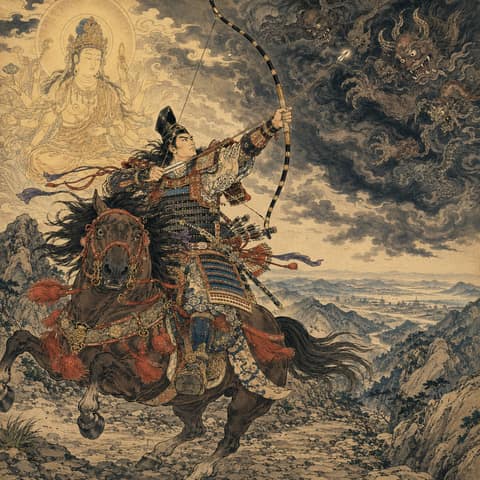
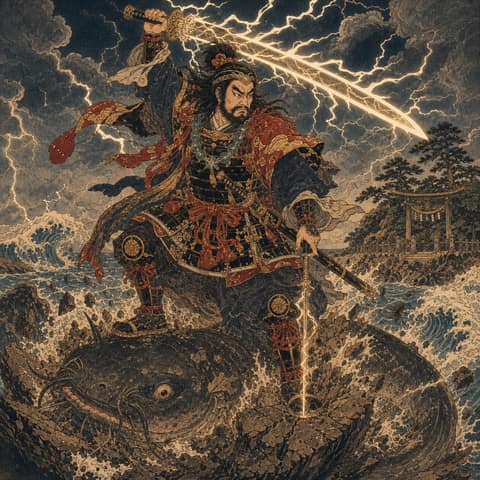
This version of Sakanoue no Tamuramaro is not treated as the historical military official, but as the deified Tamura Daimyojin of later generations. He is told as a warrior receiving the protection of Kannon at Kiyomizu-dera, a paired husband-and-wife deity with Suzuka Gozen at Suzuka Pass, and as General Tamura subjugating Akuro-o and Otakemaru in Tohoku. A single person's name wandered through the temple origins of Kyoto, the mountain pass faith of Suzuka, and the shrine and temple origins of Tohoku, acquiring different faces in each land. The power of Tamuramaro is not the sword that slashes demons itself. Kiyomizu Kannon, Vaisravana, Suzuka Gozen, the sacred sword, and the gods of the passes support his story, transforming his martial prowess into "protection acknowledged by the gods and buddhas." Therefore, in the Tamura-gatari, rather than the scenes of defeating enemies, what matters more is which gods and buddhas took his side, in what land he was enshrined, and to which mounds or temples the memories were transferred. Sakanoue no Tamuramaro is a hero who defeats yokai, but at the same time, an axis to pass down yokai as stories to later generations.

Sarutahiko-no-Mikoto

Sarutahiko-no-Mikoto

Legendary

さるたひこのみこと

Grotesque Guiding God of the Tenson Korin / Sarutahiko-no-Mikoto

Divine Spirit / DeityMie

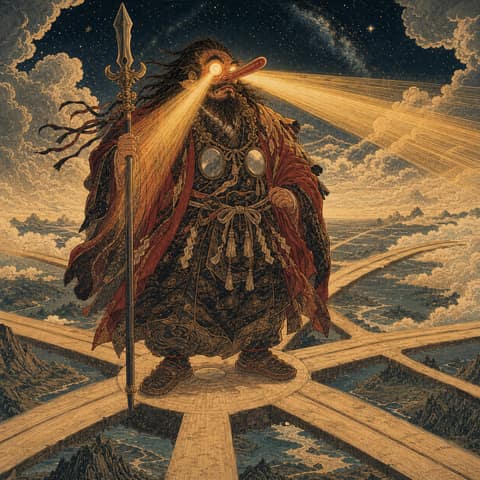
Special Position in Ancient Mythology as the 'Grotesque Guiding God'. While the basic description touches on Sarutahiko-no-Mikoto's main myth, this detailed explanation delves into his unique position as a 'grotesque guiding god' in ancient Japanese mythology. His bizarre appearance, with a nose seven ata long and eyes shining like the Yata-no-Kagami, is extremely visual and concrete even among the descriptions of deities in ancient myths, serving as the ultimate religious expression of 'a deity standing at the boundary between the otherworld and this world.' The fact that such a strong contrast between the noble Amaterasu-lineage deities and a grotesque Kunitsukami was placed at the core moment of the Tenson Korin, the central ancient Japanese state myth, can be interpreted as an intentional narrative device by the myth's compilers. Grotesqueness is not just visual oddity; it is the concrete embodiment of universal religious feelings such as protection from the otherworld, crossing boundaries, and reconciling with the heterogeneous. Prototype of the Tengu ── Development into Shugendo and Mountain Beliefs. Sarutahiko-no-Mikoto's grotesque description (long nose, red face, glowing eyes) is folklorically positioned as the prototype of the later Tengu (shugendo-related mountain yokai). The Tengu beliefs of the Heian and medieval periods inherited Sarutahiko's grotesque nature while intricately intertwining with Buddhism, shugendo, and mountain worship to undergo unique development. The hierarchical system of Tengu, such as Daitengu, Karasu Tengu, and Konoha Tengu, can be understood as the medieval refinement of the 'grotesque deity' originating from the ancient Sarutahiko. The relationship between Sarutahiko and the Tengu is a crucial genealogical theory in Japanese yokai studies, serving as core material for examining the continuity between ancient mythology and medieval yokai culture. Reconciliation and Cooperation between 'Amatsukami and Kunitsukami'. In the political and religious event of the Tenson Korin, where 'Amatsukami (deities of the heavenly realm) descend into the territory of Kunitsukami (deities of the earthly realm),' Sarutahiko-no-Mikoto stands out as a rare Kunitsukami who proactively welcomed the Amatsukami. In contrast to Okuninushi's yielding of the land, which was a 'forced transfer,' Sarutahiko's guidance occupies the contrasting position of 'voluntary cooperation.' This represents two aspects of religious integration between the center (Amatsukami lineage) and the periphery (Kunitsukami lineage) in ancient Japan. The contrast between forced integration (Okuninushi) and voluntary cooperation (Sarutahiko) reflects the editorial intent of the ancient state myths and the complex multiplicity of ancient Japanese political history. The Tragedy of the Hirabu-gai ── Vulnerability of the Deity and the Meaning of His End. The ending where Sarutahiko-no-Mikoto drowns after being caught by a hirabu-gai is a unique tale in ancient mythology that expresses the vulnerability of deities, human contingency, and the unknowability of fate. The ironic conclusion in which the great guiding god receives a fatal wound from a small natural object like a shell mythologizes universal themes in ancient Japan, such as 'confrontation with nature,' 'the limits of heroes,' and 'the unknowability of fate.' Furthermore, the specific circumstance of 'an accidental death while fishing' includes a religious reflection of marine, fishing, and coastal life in ancient Japan, symbolically demonstrating Sarutahiko's essence as a god standing at the boundary of sea and land, the intersection of life and death. The ending of the myth is not merely a tragedy but an advanced symbolic device that narrates the essential attributes of the deity. The Core of Doso-jin and Crossroads Deity Beliefs ── The Heart of Nationwide Folklore. From the Middle Ages onwards, Sarutahiko-no-Mikoto was widely venerated as the guardian deity of village boundaries, crossroads, mountain passes, and barriers through syncretism with Doso-jin, Funado-no-Kami, and Sae-no-Kami. The fact that Sarutahiko is positioned at the center of folk religion, such as Doso-jin stone monuments, phallic stones, crossroads Jizo, and Sae-no-Kami festivals distributed nationwide, demonstrates the continuous inheritance from ancient state myths to medieval folk religion. Doso-jin worship is not merely a religious ritual but a folkloric practice that gives meaning to universal anthropological themes of 'boundaries, new beginnings, protection, and harmony' through ancient myths. As a deity supporting the roots of Japanese people's sense of life, movement, and boundaries from ancient times to the present, Sarutahiko possesses a cultural reach that transcends a single deity appearing in a myth. Association with Koshin Belief ── Popular Religion in the Edo Period. During the Edo period, due to the phonetic association of 'Saru' (monkey) in Sarutahiko, he was linked to the Koshin belief (originating from Chinese Daoism, involving an all-night gathering every 60 days to defeat the Three Corpses), and Koshin towers, Sarutahiko Koshin mounds, and the three wise monkeys (see no evil, hear no evil, speak no evil) spread nationwide. This is a representative example of the multilayered fusion of ancient mythology, medieval Doso-jin, early modern Daoism, and Edo popular religion, demonstrating the typical Japanese religious culture of 'syncretism through phonetic association.' The combination of Koshin and Sarutahiko beliefs functioned as a core institution supporting the collective religious life, village society, and nighttime socializing of commoners in the Edo period, leaving traces in the modern landscape of the three wise monkeys and Koshin mounds. Sarutahiko-no-Mikoto in the 21st Century ── Modern God of Travel, Guidance, and New Beginnings. Today in the 21st century, Sarutahiko-no-Mikoto is widely cherished as the god of 'roads, travel, new beginnings, and guidance,' serving as an object of prayer for new car purchases, traffic safety, starting new businesses, safe travels, and major life milestones. Pilgrimages to Tsubaki Grand Shrine, Sarutahiko Shrine, and Futamiokitama Shrine continue ancient customs, and the religious structure of the ancient myth of 'visiting Amaterasu-Omikami under the guidance of the guiding god' has been inherited to this day. Even in a modern society marked by globalization, informatization, and individualization, the universal theme of 'life's paths, choices, and guidance' continues to impart new modern meanings to the ancient guiding god. As a rare deity whose presence bridges ancient mythology and modern Japanese spiritual culture for over two thousand years, he bears a living inheritance in religion, culture, and tourism in the 21st century.

Sugawara no Michizane

Sugawara no Michizane

Divine

Sugawara no Michizane

Tenman Daijizai Tenjin: Michizane

Divine Spirits & DeitiesKyotoFukuoka

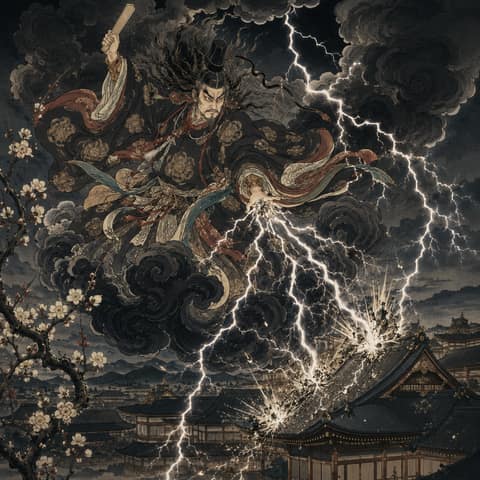
This edition follows, in close detail and bound to chronology and iconography, how a single man of letters became a thunder god and then turned into the god of learning—those two transformations. Michizane's becoming a vengeful spirit did not begin immediately upon his death. In the eighth year of Engi (908) his former disciple Fujiwara no Sugane died; the next year, the ninth of Engi (909), the very author of his exile, Fujiwara no Tokihira, died at thirty-nine; and in the twenty-third year of Engi (923) the crown prince Yasuakira passed away. That year the court restored Michizane to Minister of the Right and posthumously granted him the junior first rank, absolving him of guilt—yet the calamities did not cease, and in the third year of Enchō (925) even the next crown prince, Yoshiyori-ō, left the world at only five. The process by which this chain of deaths came to be felt by the people of the capital as the curse of the innocent Michizane is the very genesis of goryō belief. Its apex was the lightning strike on the Seiryōden in the eighth year of Enchō (930). The lightning that struck the palace in the midst of a rain-prayer council killed Fujiwara no Kiyotsura, who had watched over Michizane at Dazaifu, instantly, and burned the nobles present one after another. The reading of lightning as Michizane's will became decisive here, and the spirit, surpassing a mere vengeful ghost, was exalted into a dread godhead called Karai-Tenjin, Tenman Daijizai Tenjin, and Nihon Daijō Itoku-ten—a deity who commands the thunder. The Kamakura-period Kitano Tenjin Engi Emaki depicts this scene of becoming a thunder god as the masterpiece of the scroll, and the image of Tenjin driving the thunderclouds cast its shadow even upon the later wind-and-thunder-god paintings of Tawaraya Sōtatsu and others. The iconography of Tenjin has two contrasting lineages. One is the raging Fire-and-Thunder Deity of the engi scrolls, mounted on thunderclouds and hurling lightning. The other is the composed image of a man of letters and official in court robes holding a baton (shaku), accompanied by a plum at his side—and this became the standard image of the god of learning. The "Tang-crossing Tenjin" (Totō Tenjin), clad in Chinese robes, bearing a sack and holding a sprig of plum, is a variant based on a Zen monastic tale that Michizane crossed in a single night to a Song-dynasty Zen master to receive his teaching. The shift of weight from vengeful spirit to god of learning advanced gradually. Already in the mid-Heian period he was praised in ritual prayers as a merciful god presiding over letters and honesty, and in the fourth year of Shōryaku (993) the posthumous senior first rank and the office of Chancellor were conferred, fully restoring his honor. But his popular establishment as the god of academic success came far later, in the Edo period, with the spread of terakoya schools. The image of Michizane the outstanding scholar in life was hung in the places of penmanship, and as the guardian of reading, writing, and learning, Tenjin shed the dread of the thunder god and spread to Tenmangū shrines across the land.

Sukunabikona

Sukunabikona

Divine

sukunabikona

The Tiny God of Wisdom and Nation-Building

Divine Spirit / DeityShimane

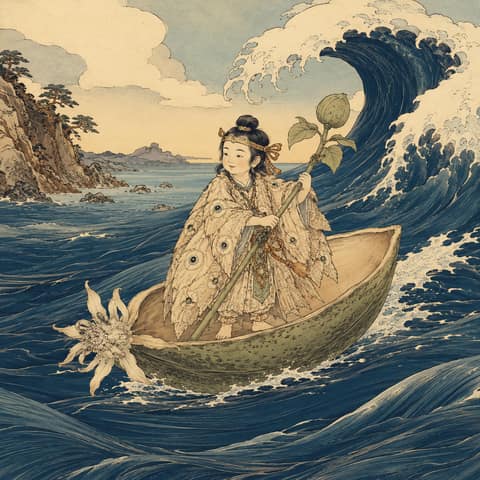
Sukunabikona is the "paired" deity who supported Okuninushi, the main god of Izumo Taisha, as his sole partner in nation-building. His divinity is fully realized not in isolation, but as one half of a pair with Okuninushi. The contrast between the massive earthly god (Kunitsukami) Okuninushi and his diminutive stature—small enough to ride in a milkweed pod boat—highlights their collaboration. His functions center on practical arts and civilization-building, such as medicine, incantations, agriculture, sake brewing, and hot springs. He left his mark beyond Izumo in the founding legends of hot springs like Dogo and Arima, as well as at Sukunahikona Shrine (the god of medicine in Doshomachi, Osaka), becoming a nationwide figure in medicine and hot spring worship. His departure, bouncing off a millet stalk to the Eternal Land, acts as the hinge connecting the myth to the arrival of Omononushi at Mt. Miwa, embodying the Izumo mythos structure where nation-building is achieved through the successive cooperation of multiple gods. His archetype of a small body with immense power is also the mythological origin of "tiny child" folktales like Issun-boshi.

Sumiyoshi Sanjin

Sumiyoshi Sanjin

Divine

すみよしさんじん

Guardian of the Sea & Waka Kami (Default)

Divine Spirit / KamiOsaka

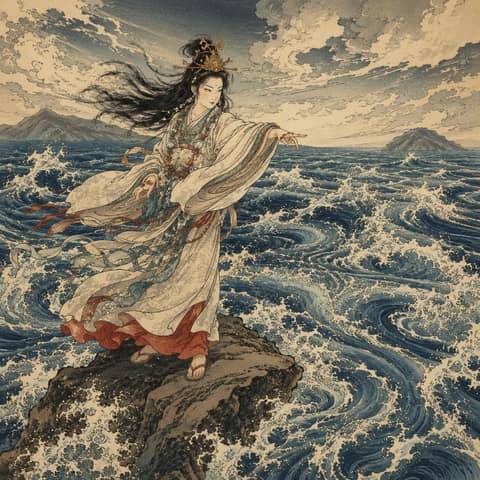
The true identity of the Sumiyoshi Sanjin is the three kami of purification belonging to Izanagi-no-Mikoto, appearing in the first volume of the Kojiki (Age of the Gods). When Izanagi returned from Yomi (the underworld) and performed misogi (purification) at Ahagihara in Himuka of Tsukushi, he submerged himself in seawater to cleanse his body. From three different depths, three deities were born: recorded as 'Sokotsutsu-no-o-no-kami, Nakatsutsu-no-o-no-kami, Uwatsutsu-no-o-no-kami' in the Kojiki, and as 'Sokotsutsu-no-o-no-Mikoto, Nakatsutsu-no-o-no-Mikoto, Omotetsutsu-no-o-no-Mikoto' in the Nihon Shoki. The orthographic difference between 'Uwa' (upper) in the Kojiki and 'Omote' (surface) in the Shoki is one basis for the later interpretation of 'tsutsu' as layers of water. Simultaneously, the three Watatsumi kami (Sokotsu, Nakatsu, Uwatsu Watatsumi) were born, making Sumiyoshi and Watatsumi a paired dual structure—bottom = Sokotsutsu/Sokotsu Watatsumi; middle = Nakatsutsu/Nakatsu Watatsumi; surface = Uwatsutsu/Uwatsu Watatsumi. This tripartite structure is common to both texts. The etymology of 'Tsutsu' has not been academically resolved. Major theories are listed alongside each other: ① Star theory — 'Tsutsu' is an archaic word for 'star' (hoshi); it deifies the three central stars of Orion (ancient name 'Miboshi') as navigational stars for ancient seafaring clans. However, this is a modern theory advocated by Hoei Nojiri in "Japanese Stars" (1936), and there are no direct supporting primary texts from early folklorists like Orikuchi or Yanagita; treating it as the 'accepted folkloric theory' is academically inaccurate. ② Tsu (port) theory — 'Tsu' is a particle meaning 'of', and the second 'tsu' means 'port/sea route', an interpretation from Orikuchi's lineage; ③ Tsuchi phonetic change theory — 'Tsu' is a particle, and 'chi' is an honorific spirit suffix (akin to Orochi or Nozuchi); ④ Tsutsu-ro theory — 'Tsuchi' equals 'tsuji' meaning sea route; ⑤ Ship spirit theory — ancient ship spirit worship enshrined at the bottom of a boat; ⑥ Tsutsu toponym theory — derived from Tsutsu at the southern tip of Tsushima, the origin of seafaring clans; ⑦ Literal tube theory — using bamboo tubes as a yorishiro (vessel). Listing multiple theories is academically accurate, and it is particularly imprecise to refer solely to the 'star theory' as the accepted view. The Empress Jingu legend is the most important narrative in the history of Sumiyoshi Sanjin worship. According to the Nihon Shoki, when Empress Jingu became possessed after Emperor Chuai's death, the Sumiyoshi kami delivered an oracle: "Conquer Silla, a land filled with gold and silver. If you worship us three deities, Silla and Kumaso will submit." They protected her maritime expedition (subjugating Silla, Baekje, and Goguryeo), and upon her return, a second oracle commanded: "Enshrine our Aramitama (rough spirit) in Yamada village of Anato (Nagato)" — this became the origin of the Shimonoseki Sumiyoshi Shrine. Enshrining the Nigimitama (gentle spirit) in Settsu became the origin of Sumiyoshi Taisha. The structure of jointly enshrining Empress Jingu and Sumiyoshi Sanjin originated here, establishing the unique four-hall structure of Sumiyoshi Taisha. However, the dating of the Empress Jingu chronicles is heavily debated by scholars, and treating the legendary date (211 AD) as historical fact requires extreme caution—archaeologically, it is pointed out as potentially reflecting events from the 4th century onwards. Sumiyoshi Taisha, the head shrine (2-9-89 Sumiyoshi, Sumiyoshi-ku, Osaka), is the Ichinomiya of Settsu Province, one of the Twenty-Two Shrines (Middle Seven Shrines), and a former Kanpei-taisha. Its official history dates its founding to the 11th year of Empress Jingu's regency (211 AD) on the first Day of the Hare in the Month of the Hare — a legendary date without archaeological proof. Its four main halls have a unique layout: the First, Second, and Third Halls line up vertically (facing west, toward the sea), while the Fourth Hall sits south of the Third, forming an L-shape. The First Hall enshrines Sokotsutsu-no-o, the Second Nakatsutsu-no-o, the Third Uwatsutsu-no-o, and the Fourth Empress Jingu. "Sumiyoshi-zukuri" is considered the oldest style in shrine architectural history, characterized by a gabled roof, cypress bark thatch, and red and white walls. The current main halls were built in 1810 and are all designated National Treasures. The steeply arched red Sorihashi (Taiko Bridge) is the iconic visual symbol of the Sumiyoshi faith, frequently appearing in ukiyo-e, paintings, and waka poetry. There are over 2,300 branch shrines nationwide (the official number from Sumiyoshi Taisha, whereas Wikipedia undercounts at ~600). The distribution is concentrated along coastlines, ports, the Seto Inland Sea, Kyushu, and northern Japan, proving it to be the most vital faith for fishermen, shipping merchants, and navy personnel from ancient to modern times. The "Three Great Sumiyoshi" and ancient shrine dispute: ① Sumiyoshi Taisha (Osaka) = Settsu Ichinomiya, Nigimitama, Head Shrine; ② Sumiyoshi Shrine (Shimonoseki, Yamaguchi) = Nagato Ichinomiya, Aramitama, site of Empress Jingu's return oracle; ③ Sumiyoshi Shrine (Hakata, Fukuoka) = Chikuzen Ichinomiya, self-proclaimed "Japan's First Sumiyoshi-gu", oldest theory identified with Ahagihara. Additionally, Hon-Sumiyoshi Shrine in Kobe is based on an influential Edo-period theory by Motoori Norinaga (1764-1798) identifying Settsu's Sumiyoshi village as the ancient "Nanakura's Long Strait". Academically, the "first Sumiyoshi" cannot be determined, with each shrine claiming primacy based on its own legends. In ancient and medieval times, it was customary for Japanese envoys to Sui and Tang China to pray at Sumiyoshi Taisha before departing. The "Tosa Nikki" (Ki no Tsurayuki, 935) also notes prayers for maritime safety to the Sumiyoshi deities. In Heian-period waka by poets like Izumi Shikibu, Ki no Tsurayuki, and Ono no Komachi, Sumiyoshi frequently appears, positioning the kami at the head of the "Three Deities of Waka". In the medieval and early modern periods, the Noh play "Takasago" featured the "Pines of Sumiyoshi and Takasago" as a symbol of marital harmony and longevity, often performed at shrine weddings. The Noh play "Sumiyoshi Mode" is another masterpiece representing this faith. The rice-planting ritual (Otaue Shinji), a National Important Intangible Folk Cultural Property, is Sumiyoshi Taisha's most representative festival, sanctifying the entire rice-farming cycle from planting to harvest. As a samurai faith from the medieval to Edo periods, they garnered reverence from warrior clans like the Minamoto due to Empress Jingu's Sankan Seibatsu legends. During the Muromachi and Sengoku periods, Sumiyoshi Taisha received immense veneration from the shipping industry in the Seto Inland Sea, Settsu, and Izumi, actively participating in both commercial and military affairs as the guardian of maritime traffic in Osaka Bay. Today, visits by the Maritime Self-Defense Force, merchant ships, fishermen, and shipping businesses remain robust. It is one of Osaka's premier spots for New Year's visits, Shichi-Go-San, and shrine weddings. Affectionately called "Sumiyoshi-san" in the Kansai region, the Sumiyoshi Sanjin are a national divine presence offering wide-ranging blessings for maritime protection, safety at sea, poetry, scholarship, marital harmony, safe childbirth, and business prosperity. The 2,300 branch shrines, known as Sumiyoshi Shrine, Sumiyoshi-sha, Sumie Shrine, or Sumiyoshi Jinja, line Japan's coastlines and ports, forming the backbone of an uninterrupted maritime faith from ancient times to the present day.
Susanoo

Susanoo

Legendary

すさのお

Susanoo (Default)

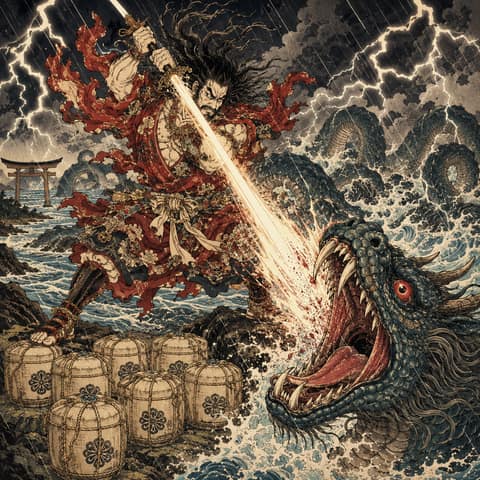
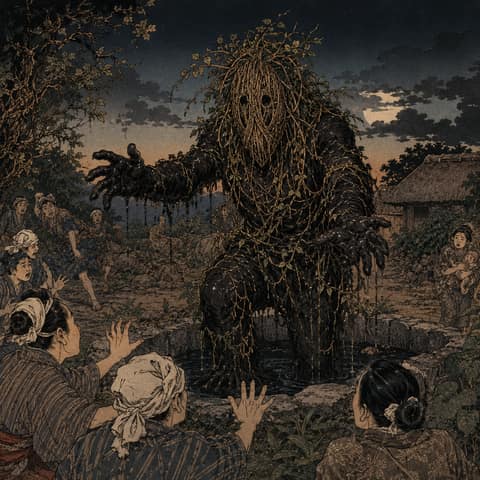
The Dramatic Transformation from 'Wild God' to 'Hero God'. While the basic description traced Susanoo's primary myths, this detailed explanation delves into his dramatic personality shift from 'wild god' to 'hero god'. The Susanoo of the Kojiki and Nihon Shoki possesses diverse characteristics, having three entirely different aspects: the childishness of weeping for his mother, the ferocity in Takamagahara, and the heroism, paternity, and wisdom in granting trials after descending to Izumo. Folklorist Teiji Yoshimura (1977) pointed out that 'the Susanoo of Takamagahara mythology and Izumo mythology have different personalities.' This can be interpreted as the result of multiple different mythological traditions being integrated into a single deity. Two lineages—the Takamagahara mythological sphere (Amatsu-kami lineage) and the Izumo mythological sphere (Kunitsu-kami lineage)—were converged into the single deity 'Susanoo' during the process of political and religious integration in ancient Japan, resulting in a unique deity with a multi-layered personality. Yearning for the 'Mother's Country' ── Ancient Motherhood Beliefs. Despite being entrusted with the rule of the sea plain by his father Izanagi, Susanoo continued to weep and howl in longing for the root country (Ne-no-Katasu-Kuni) of his deceased mother Izanami. This 'yearning for the Mother's Country (Hahanokuni)' is an important motif in ancient Japanese mythology, expressing the fundamental tension among patriarchy, matriarchy, and generational succession. Shinobu Orikuchi deciphered this motif comparatively as 'Tokoyo-no-Kuni belief' and 'Mother's Country belief'. The later tale of Okuninushi descending to Ne-no-Katasu-Kuni to undergo Susanoo's trials also reflects the structure of generational succession: 'deceased mother → father god (Susanoo himself) → son-in-law god (Okuninushi)'. It can be read as a multi-layered expression of ancient Japanese views on motherhood, fatherhood, and life and death, transcending a simple heroic myth. Soshimori in Silla and Ancient Japan-Korea Relations. The Kojiki's account that the banished Susanoo descended to Mount Torikami in Izumo via 'Soshimori in Silla (Shiragi Soshimori)' is extremely interesting as a rare 'tale via the continent' in ancient Japanese mythology. The specific location of Soshimori in the southeastern Korean Peninsula is debated, and it can be interpreted as a passage mythologizing ancient Japan's history of continental immigrant culture and exchanges with the Korean Peninsula. It has been pointed out that Shinto of the Izumo Kuni-no-Miyatsuko lineage likely developed within the maritime trade network with the Korean Peninsula and the continent since ancient times, and Susanoo's tale via Silla can be read as a memory layer mythologizing this history of maritime exchange. It serves as documentary evidence showing that ancient Japan was not an isolated cultural sphere but formed through close interaction with the continent and peninsula. Social Historical Interpretation of Slaying Yamata-no-Orochi. The tale of slaying Yamata-no-Orochi has been interpreted as a multi-layered story reflecting the socio-historical situation of ancient Japan, going beyond a simple heroic monster-slaying myth. The specific descriptions—'eight heads, eight tails, along the Hii River, blood flowing from the belly, an iron sword from the tail'—strongly support the 'iron-making origin theory' (proposed by Takeshi Matsumae, Shohei Mishina, etc.), which suggests that the ancient Izumo tatara iron-making, the iron content of the Hii River, river flooding, and the social organization of iron-making communities were mythologized. Susanoo's heroic tale was formed in intense dialogue with the iron culture of ancient Japan and the nature and society of the Hii River basin, re-evaluated not as a simple myth but containing valuable record layers of ancient social history. 'Eight Clouds Arise' ── Japan's Oldest Waka. The poem Susanoo composed when he built a palace in Suga, Izumo after slaying Yamata-no-Orochi—'Eight clouds arise, the eightfold fence of Izumo creates an eightfold fence to keep my wife in, oh that eightfold fence'—is positioned as the origin of the history of Japanese literature and waka. The basic format of the thirty-one syllables (5-7-5-7-7) was already established here, demonstrating the identification of the birth of songs with mythological heroism in ancient Japan. The fact that the starting point of the entire Japanese waka culture, leading to the Man'yoshu, Kokinshu, and Shin-Kokinshu, is attributed to the mythic hero-god Susanoo symbolizes the inseparability of poetry and mythology in Japanese culture. The opening phrase 'Eight clouds arise' remains a sacred cultural resource repeatedly cited in the world of waka and tanka today. Syncretism with Gozu Tenno and Medieval Gion Beliefs. From the Middle Ages onward, Susanoo syncretized with Gozu Tenno, derived from Buddhism, Taoism, and the Korean Peninsula, becoming the guardian deity of dispelling epidemics and warding off disasters as the principal deity of the Kyoto Gion Shrine (now Yasaka Shrine). Gozu Tenno is considered a plague god originating from Silla and the Korean Peninsula, and has a complex religious history where Chinese beliefs of the guardian deity of Jetavana Monastery and Japanese Susanoo beliefs syncretized in the Middle Ages. The history of the Gion Goryo-e, initiated in 869 (Jogan 11) to pray for the end of an epidemic spreading in the capital, exceeds a millennium, and was inherited as the largest religious festival for dispelling epidemics nationwide throughout the Edo period, early modern, and modern eras. It continues to be inherited in the 21st century as the Kyoto Gion Festival (a nationally designated Important Intangible Folk Cultural Property) and a UNESCO Intangible Cultural Heritage, showing that the multi-layered overlap of ancient myth and medieval Buddhism continues to exert a sustained influence on the religious life of modern Japan. Resurgence in Modern Culture. Susanoo has been repeatedly re-sculpted in post-war Japanese subculture works. He frequently appears as one of the strongest demons in the 'Megami Tensei' series, in the portrayal of Susanoo and Kushinadahime in the game 'Okami', as a motif like 'Sun Breathing' in the manga 'Demon Slayer', and in anime such as 'Nura: Rise of the Yokai Clan' and works like 'Touhou Project'. His multi-layered attributes as a 'wild god', hero, ancestor of poetry, and guardian deity against epidemics have high affinity with modern character creation. He is a symbolic figure of ancient mythology who continues to drive the mythological imagination of the Japanese people for over two thousand years.

Taira no Masakado

Taira no Masakado

Divine

Taira no Masakado

Masakado, Goryō God of the Kantō

Divine Spirits & DeitiesTokyoChiba

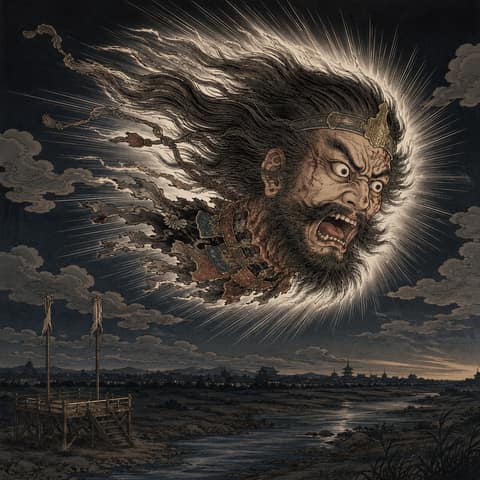
This edition follows in close detail—while fixing the boundary between history and legend—how a single Bandō warrior became the uncanny "flying head" and then turned into a god who guards Edo. First, history and the uncanny must be separated. The revolt itself is conveyed by the near-contemporary Shōmonki, which records in classical Chinese the private feud beginning in 935, the subjugation of the Kantō provincial seats, the proclamation as New Emperor, and the death in battle in 940. But here there is no marvel of a flying head. The supernatural story of a head that would not rot, cried out, and flew appears only centuries later, in the Nanboku-chō-period Taiheiki, with anecdotal relays such as the Konjaku Monogatari-shū in between. It is in this later stratum of legend that Masakado is told as a "yokai." The story of the curse around his head mound is newer still. The dread transmitted at the Masakado Grave-Mound at Ōtemachi—"move it and it curses"—is a modern urban legend, layered onto events that occurred in the heart of the city in the Taishō and Shōwa eras: the deaths of those involved in building the Ministry of Finance's temporary office after the Great Kantō Earthquake, and the bulldozer accident during the Occupation. The factual events and the interpretation that attributes them to Masakado's curse must be carefully separated. The path of deification, on the other hand, reaches back into the medieval age. In the second year of Enkyō (1309), the Ji-sect holy man Shinkyō Shōnin, who attributed a plague to Masakado's curse, pacified the spirit and added it to the enshrined deities of Kanda Myōjin. This, like Michizane, is the textbook goryō belief of enshrining a raging vengeful spirit and turning it into a protecting god. The ups and downs—drawing the reverence of the people as the great tutelary of Edo, being removed from the enshrined deities as a traitor in the Meiji era, and being restored at the end of Shōwa—also reflect well the duality of the image of Masakado as a hero who rebelled against the throne. In later ages, the story of his daughter Princess Takiyasha commanding a giant skeleton won popularity in kabuki and popular fiction and was depicted in Utagawa Kuniyoshi's "The Old Palace at Sōma"; it should be noted that this is a derivative starring the daughter, not Masakado himself.

Takemikazuchi

Takemikazuchi

Legendary

たけみかづちのかみ

God of Thunder, Swords, Martial Arts, Sumo, and Earthquake Pacification

Divine Spirit / DeityIbaraki

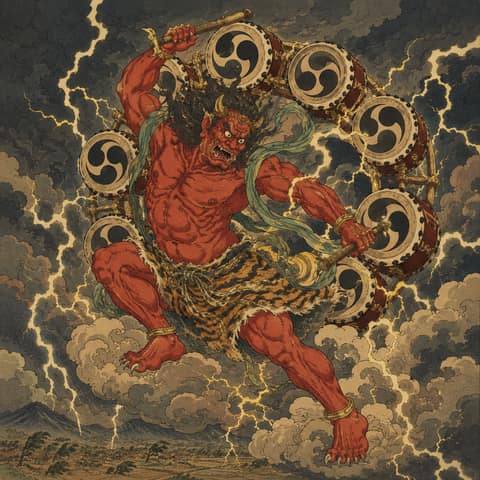
The Unique Position of the 'God of War'. While many deities in ancient Japanese mythology center around agriculture and nature, Takemikazuchi uniquely symbolizes 'war, swords, power, and conquest' as a rare male war god. This reflects Japan's complex history of unification through military force, symbolizing the justification and sanctification of military power in ancient national mythology. The Kuniyuzuri Myth ── Mythologization of Ancient Political History. The test of strength with Takeminakata mythologically represents the political integration of the central Yamato court and the regional Izumo and Suwa factions. The narrative of deciding matters through a legitimate trial of strength rather than sheer oppression served to secure religious justification during this integration process. The Ancestral God of Ancient Military Clans. The Futsu-no-Mitama sword became the core of worship for the Mononobe clan, the ancient military clan of Japan. Takemikazuchi concurrently supported the tutelary worship of both the Nakatomi/Fujiwara and Mononobe clans, making him a central figure in ancient Japanese religion, politics, and military affairs. The Two Great Shrines of Kashima and Katori. Kashima Shrine and Katori Shrine have historically formed the core of ancient military worship in the Kanto region. They served as the highest religious authorities in eastern Japan, standing alongside Ise and Izumo in the ancient Shinto shrine system. Earthquake Pacification. The Kaname-ishi (Keystone) belief at Kashima Shrine added a new attribute to Takemikazuchi as a guardian against earthquakes. This represents a significant evolution of an ancient mythological deity into a figure of early modern disaster folklore. Two Thousand Years of Sumo. The religious essence of sumo, persisting from ancient court rituals to the modern Grand Sumo, stems from Takemikazuchi's mythological origins. Sumo remains a rare example of a globalized sport retaining its ancient mythological roots. Takemikazuchi in the 21st Century. Today, he is revered as a guardian of martial artists, the ancestral god of sumo, and a protector against disasters. As Japanese martial arts spread globally, his worship garners international attention as the religious origin of these disciplines.

Takeminakata-no-Kami

Takeminakata-no-Kami

Divine

takeminakata

Takeminakata-no-Kami, the Fierce God of Water and War Residing in Lake Suwa

神霊・神格Nagano

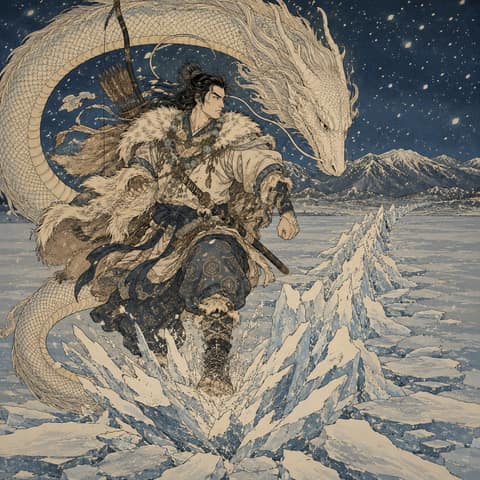
To read Takeminakata-no-Kami deeply, it is crucial not to treat the defeat in the *Kojiki* and the victory of Suwa Daimyojin as separate stories. In the Kuni-yuzuri myth, Takeminakata-no-Kami challenges Takemikazuchi-no-Kami to a test of strength, is defeated, and pursued to the Sea of Suwa. Kokugakuin cites a theory that interprets this scene as refusing to submit to the words of Takemikazuchi-no-Kami, and provoking another kind of contest through a test of strength. In other words, he is a god who did not obey the command of Heaven with words, but responded with the power of his body. The defeat is not a sign of this god's weakness, but evidence that he touched the order of the world with strength. Upon entering Suwa, that defeat shifts into a narrative of local integration. Suwa Taisha narrates that Takeminakata-no-Kami moved from Izumo to Suwa, building and ruling Shinano Province—Takeminakata-no-Kami moved from Izumo to Suwa. Kokugakuin introduces that the *Suwa Daimyojin Ekotoba* states he defeated the original god of Suwa, Moriya-no-Kami, and enshrined himself. Here, there is a composition where a god arriving from the central myth overlaps with the old gods and rituals of Suwa. Takeminakata-no-Kami is not merely a god who fled to Suwa. He collided with the land of Suwa itself, settled there, and changed into a god called by the name of the land. The divine character of Suwa Daimyojin is strong as a god of wind and water. Suwa Taisha explains Takeminakata-no-Kami as a god worshipped since ancient times for governing rain and wind, and as a tutelary god of agriculture, hunting, seafaring, and contests—tutelary god of agriculture, hunting, seafaring, and contests. These four are not disjointed. Rain and wind dictate rice farming; lakes and rivers support transportation and fishing; mountains serve as hunting grounds; and contests relate not only to warriors but to negotiations with nature. Takeminakata-no-Kami was worshipped as a god who reconnects fierce nature to human life. The Omiwatari makes this reconnection visible. According to Nagano Prefecture's explanation, when Lake Suwa completely freezes over, the ice cracks and forms high, mountain-like ridges of ice. This path is considered to be the trail left by the male god of the Kamisha, Takeminakata-no-Mikoto, visiting the female god of the Shimosha, Yasakatome-no-Mikoto—the path where the male god visited the female god. Furthermore, in the Miwatari ritual, the direction and shape of that path are used to divine crops, social conditions, and climate rainfall. The ice is not just a natural phenomenon; it is the movement of a god, becoming letters that read the future of the land. In the Onbashira Festival, Takeminakata-no-Kami's power manifests as the movement of trees and people. The explanation of the Onbashira Festival by Suwa Taisha states that it is a festival where sixteen massive fir trees are hauled and erected at the four corners of the four shrines' precincts, and that a sacred *nagikama* harboring a divine spirit is struck into them to recognize them as sacred trees—sacred nagikama said to harbor a divine spirit. The pillars are dragged purely by human strength, without the use of carts or rollers. Here, divine power is not a quiet interiority, but is renewed as a giant tree moving from the mountain to the village, the bodies of parishioners taking on danger, and the pillars standing at the four corners of the shrine. The god of Suwa is periodically re-erected. Beliefs about hunting and meat-eating also connect the fierceness of this god to daily life. Suwa Taisha recounts that even in eras when taking life was considered a sin, the people of Suwa received the divine talisman of O-Suwa-sama and were permitted to eat venison to survive—eating venison to survive. This is not so much a denial of Buddhist taboos as it is a mechanism where the god assumes the reality of a mountain province. Takeminakata-no-Kami is not a god who grants only clean fertility. He protects the life of the land by embracing hunts involving blood, sacrifices, the winter lake, and the danger of massive trees. Finally, the system of the Ohori, a living god (arahitogami), is crucial. Suwa City explains the Ohori as the yorishiro of Suwa Myojin, and the priest who stood at the apex of the Suwa shrines as a living god—the yorishiro and living god of Suwa Myojin. In the faith of Takeminakata-no-Kami, god does not solely exist in distant myth, but dwells in the human body, the system of the shrine, and the roles of festivals. The god defeated in the Kuni-yuzuri stands at the center of politics and ritual in Suwa through a living god. This inversion is the deepest allure of Takeminakata-no-Kami.

Takuhatachijihime

Takuhatachijihime

Divine

よろずはたとよあきつしひめのみこと

Takuhatachijihime, the Mother Goddess Who Weaves the Heavenly Grandchild

神霊・神格Mie

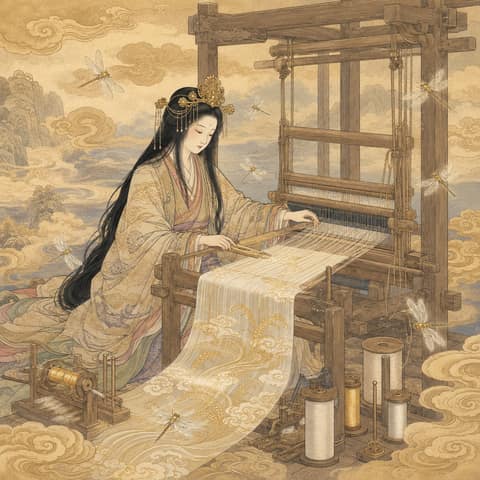
The key to deeply understanding Takuhatachijihime lies in the fact that she is an "unspoken center". In the main text of the *Kojiki*, she only appears in the lineage explaining the transition from Ame-no-Oshihomimi to Ninigi-no-Mikoto, without speaking a word. Yet, for the protagonist of the Tenson Korin to shift from Ame-no-Oshihomimi to Ninigi, her existence is indispensable. Amaterasu's child does not descend directly; instead, the child born with Takagi-no-Kami's daughter, Yorozuhata-Toyoakitsushi-Hime descends. By this single sentence, the heavenly grandchild becomes a direct descendant of the sun goddess while simultaneously inheriting the blood of the creator god Takamimusubi. Therefore, defining her divinity merely with the word "mother" is too narrow. Ame-no-Oshihomimi is established as Amaterasu's child through the *ukehi* and chosen as the prince to rule Ashihara-no-Nakatsukuni. Meanwhile, Takagi-no-Kami issues commands alongside Amaterasu during the pacification, reinforcing heavenly political authority. Takuhatachijihime connects these two authorities through marriage and childbirth, integrating them into the person of Ninigi-no-Mikoto. She is not a god who commands from the front, but acts as the "loom of lineage" establishing the legitimacy of the Tenson Korin. The strong presence of weaving in her name resonates well with this role. The Kokugakuin University Deity Name Database explains that the "hata" in "Yorozuhata" refers to woven cloth, and that "hata" can also indicate weaving itself. Cloth is not a single thread. Only when the warp and weft intersect and repeat does it become a surface. Takuhatachijihime's function in myth is similar. She layers Amaterasu's lineage and Takamimusubi's lineage, heavenly commands and earthly fertility, the branching lineage of Ame-no-Honoakari and the royal lineage continuing to Ninigi, like a single piece of woven cloth. The abundance of variant names does not just blur her image; rather, it indicates the thickness of the myth's ancient layers. The database organizes the names appearing in the *Nihon Shoki*, such as Takuhatachijihime, Yorozuhatabime, and Amayorozutakuhatachihatahime, emphasizing that they all share "hata" (cloth/loom) in their names. *Taku* (paper mulberry) evokes the material of cloth, while *chiji* (thousand, thousand) suggests fine layering. Although Yorozuhata and Takuhatachiji may not share exactly the same etymology, the perception of the heavenly grandchild's mother as a "cloth-making woman" is universal. Furthermore, she simultaneously gives birth to two streams: Ame-no-Honoakari and Ninigi-no-Mikoto. The first part of the Tenson Korin in the *Kojiki* lists Ame-no-Honoakari-no-Mikoto. Next, Hikoho-no-Ninigi-no-Mikoto, two deities, and it is the latter who descends. This order suggests that the Tenson myth is not a monolith, but encompasses multiple clan memories and divine lineages. Because Takuhatachijihime is placed at this branching point, reading her is also reading how the Tenson Korin myth wove multiple lineages together. Her connection to the Amaterasu faith cannot be overlooked. The database notes that the *Kotai Jingu Gishikicho* describes Yorozuhata-Toyoakitsuhime being enshrined in the same hall as Amaterasu-Sume-Okami, and presents a theory viewing the deity of "Yorozuhata" as a weaving goddess connected to Amaterasu worship. This shows that the mother of the heavenly grandchild was not merely understood as a daughter of Takamimusubi, but was a deity who entered Amaterasu's ritual space. Just as the death of the weaving maiden brought darkness in the Heavenly Rock Cave myth, weaving and the order of the sun are deeply intertwined in Takamagahara. The rituals at Tsubaki Grand Shrine transfer this divinity to the present space of worship. The shrine explains that it enshrines the principal deity Sarutahiko-Okami, and in the *aidono* (companion shrine), it enshrines Ninigi-no-Mikoto and Takuhatachijihime-no-Mikoto. Sarutahiko is the god who guides the Tenson Korin, and Ninigi is the descending heavenly grandchild. When the mother goddess is enshrined beside them, the descent is seen not as a mere movement, but as an order passed down like cloth from mother to child, from heaven to earth. Takuhatachijihime has a quiet voice in the story, but she is the goddess who supports the very weave of the Tenson myth.

Toyotama-hime

Toyotama-hime

Divine

とよたまひめ

Grandmother of the Imperial Line

Divine Spirit / Sea DeityNagasaki

Taking the form of a giant shark (eight-fathom wani) in the *Kojiki* and a dragon in the *Nihon Shoki*, she is the grandmother of the first emperor and the maternal origin of the seafaring Azumi clan. A sacred deep-sea shrine maiden symbolizing pearls, whose legends live on in Udo Jingu's Breast Rock and Watadzumi Shrine.

Toyouke-Omikami

Toyouke-Omikami

Divine

とようけのおおみかみ

Toyouke-Omikami, the Great Deity of the Geku Who Presides Over Daily Sacred Meals

神霊・神格MieKyoto

The core of Toyouke-Omikami lies in placing the simple fact of "the god who eats" at the center of religious rites. Amaterasu-Omikami is the imperial ancestral goddess, and the Naiku is the center of Ise Jingu, but the system of offering sacred meals to Amaterasu is supported by the Geku. When the official history of Ise Jingu calls Toyouke the Miketsu-kami of Amaterasu-Omikami, it does not merely mean she is a goddess in charge of food. The very act of purifying rice, water, salt, and fire, and offering them daily so that the sun goddess can continue to be welcomed as the sun goddess, is deified. The story of the Geku's establishment portrays Toyouke as a "god invited because she was needed." In the official explanations of the Jingu based on the *Toyouke-gu Gishikicho*, Amaterasu appears in Emperor Yuryaku's dream, stating that being alone in one place is painful and she cannot peacefully enjoy her sacred meals, thus requesting that the Toyouke-Omikami residing at Hiji-no-Manai be brought to her side. Here, Amaterasu does not appoint Toyouke from a superior position; rather, centered around the necessity of eating, she *needs* Toyouke. The heart of the myth is not domination, but a relationship of provision and dependence. This relationship is enacted daily through the *Higoto Asayu Omikesai*. Twice a day, morning and evening, at the Geku's Mikeden, rice, water, salt, and other items are offered to the deities of the Naiku, Geku, and auxiliary shrines. The items of the sacred meal are strictly prescribed, cooked using fire specially ignited in the Imibiyaden, and purified with sacred water drawn from the Kami-no-Mi'i Shrine. Toyouke's power does not manifest in an instant like thunder or a sword. It appears in the unbroken repetition of kindling fire, drawing water, cooking rice, offering it, reciting prayers, and doing it all over again the next morning. The details of the sacred meals teach us that Toyouke is not a vague symbol of "food in general." Not just rice, but water, salt, sake, fish, seaweed, vegetables, and fruit are designated, and chopsticks are provided. This is not simply placing products of nature as they are; it is a series of etiquettes in which humans offer them to the gods through fire, water, and vessels. Toyouke's divine virtue encompasses both the yielding of the harvest and the process of purifying it, bringing it before the gods, and establishing it as a prayer. In myth, Toyouke appears under multiple names: Toyouke-bime-no-Kami, Toyuuke-no-Kami, and Toyouke-Omikami. The Kokugakuin Deity Name Database identifies Toyouke-bime as the child of Wakumusubi, noting the possibility of reading her as the spirit of food or rice. On the other hand, regarding Toyuuke-no-Kami, while considered the deity of the Ise Geku, cautious debate remains about her position in the *Kojiki* text and whether she is the exact same deity. In other words, Toyouke is not a deity completely closed within a single classic text. She is a deity with the thickness of ritual history itself, formed by overlapping the food goddess of the *Kojiki*, the Manai traditions of Tanba/Tango, and the rites of the Ise Geku. The custom of *Geku-sensai* (worshipping at the Geku first) is also a key to understanding this divinity. In the Jingu's festivals, the Miketsu-kami is worshipped first at the Geku before proceeding to the Naiku. This does not mean the Geku is higher in status than the Naiku. Rather, it represents the order of preparing the act of offering food to the supreme deity before worshipping that supreme deity. Toyouke does not usurp the center. But she quietly and preemptively fulfills what is necessary for the center to continue being the center. This act of "preemptively fulfilling" is precisely what makes Toyouke stand out not as an auxiliary god, but as the god standing at the gateway of ritual. The sense that food must be prepared before welcoming the gods shows that prayer begins with the procedures of daily life. This figure is easy for modern readers to understand. Those who cook, those who support the dining table, those who grow crops, and those who begin their necessary work at the same time every morning often do not become the protagonists of the story. But the moment that repetition is lost, both daily life and religious rites grind to a halt. Toyouke-Omikami is not merely behind the scenes of myth. From the Geku, she quietly continues to show us that the preparation of food itself is the central act that drives the order of the gods.

Tsukuyomi-no-Mikoto

Tsukuyomi-no-Mikoto

Legendary

つくよみのみこと

God of Night, Moon, and Calendar: Tsukuyomi-no-Mikoto

Divine Spirit / DeityNagasaki

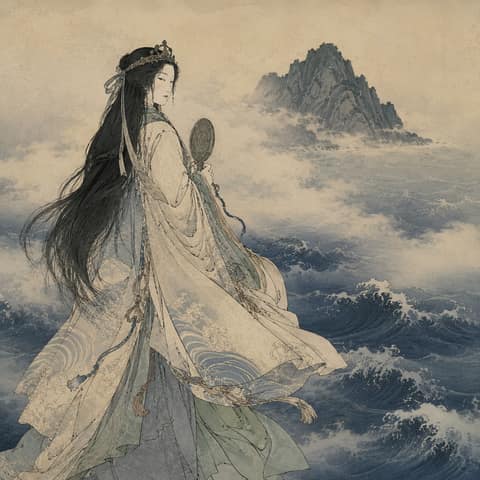
Tsukuyomi's Position Among the Three Precious Children. While the basic description touches upon Tsukuyomi's primary myth, this detailed explanation delves into the deity's unique structural position within the "Three Precious Children" (Mihashira-no-uzu-no-miko). The tripartite rule by Amaterasu Omikami (Takamagahara, day, light), Tsukuyomi (Yoru-no-Oskuni, night, moon), and Susanoo-no-Mikoto (the sea, untamed force) established the three domains of day, night, and wild power in ancient Japanese cosmology. However, Tsukuyomi alone has almost no detailed mythological narratives throughout the *Kojiki* and *Nihon Shoki*, disappearing from the center of the story immediately after being entrusted with the "Yoru-no-Oskuni." The discrepancy between the high structural position as the middle child and the sparsity of mythological activity is a major point of discussion in the study of ancient Japanese mythology. The Slaying of Ukemochi — A Contrast with the Kojiki. Tsukuyomi's primary mythological tale, the slaying of the food deity Ukemochi, is recorded only in the *Nihon Shoki* and does not appear in the *Kojiki*. In the *Kojiki*, this identical narrative motif is performed by Susanoo-no-Mikoto against Ogetsuhime. This indicates that ancient Japanese mythology possessed a single narrative template for the "origin of grain = five cereals sprouting from a deity's corpse," which was assigned to different deities (Susanoo vs. Tsukuyomi) in the two texts. The difference in this allocation is a vital piece of evidence for examining the compilation process, variant transmissions, and cosmological consistency of ancient Japanese myths. The editorial intent of the *Nihon Shoki* in assigning the Ukemochi murder to Tsukuyomi is interpreted as an effort to emphasize the connection between the moon and the agricultural calendar. Comparative Religion of a "Quiet Deity". Tsukuyomi's "quiet, reclusive" personality is unique even when compared to lunar deities worldwide. From Selene and Artemis in Greece, to Luna in Rome, the Persian moon god Māh, the Chinese lunisolar calendar, and Korean lunar spirits, moon deities across the ancient world are often depicted as highly active and central figures. In contrast, Japan's Tsukuyomi is rare for having few myths and an emphasized serene, introverted, and mediatory nature. Scholars such as Shinobu Orikuchi and Eiichiro Ishida deciphered this characteristic, concluding that "the Japanese moon deity has a 'watchful' nature," and organized the ancient Japanese relationship with the moon not as one of "direct worship" but as a connection of "quiet watchfulness." Moon and Immortality Beliefs — Okinawa and East Asian Comparisons. Nikolai Nevsky, Shinobu Orikuchi, and Eiichiro Ishida positioned Tsukuyomi's primitive attributes within the broader East Asian beliefs linking the "moon and immortality". In Okinawa and the Ryukyu Islands, there is a tradition of "Sudemizu" (water of molting or rejuvenation), a water of immortality bestowed upon humanity from the moon, indicating a symbolic link between the moon's "molting" (the cycle from full moon to new moon) and immortality/rebirth. Similar "moon and immortality" beliefs are distributed across China, Korea, Mongolia, and Southeast Asia, framing the prototype of Tsukuyomi as a Japanese variation of this widespread belief system. The moon's periodicity, its association with feminine tides, the agricultural calendar, and the mystery of its waxing and waning all multi-layered the ancient faith. Gassan Shrine and Shugendo. Gassan Shrine in Yamagata Prefecture, a former Kanpei-taisha (Imperial shrine, 1st rank), served as the core of the Three Mountains of Dewa (Mt. Haguro, Mt. Gassan, Mt. Yudono) and became a center for mountain worship and Shugendo from the Heian period onward. Mt. Gassan is an extinct volcano standing 1,984 meters tall, where Shugendo practitioners envisioned a "Pure Land where Tsukuyomi resides" at the summit, aiming for the rebirth of the soul through rigorous mountain asceticism. Within Shugendo, Tsukuyomi developed uniquely as a deity symbolizing the "moon of death and rebirth," occupying a significant position within the complex evolution of mountain worship, Shugendo, and Pure Land Buddhism during the Heian, medieval, and early modern periods. Even today, the "Gassan-mode" (pilgrimage to Mt. Gassan) is carried on as a symbolic custom of Tohoku folklore and Shugendo. The Geography of Tsukuyomi Shrines. The enshrinement sites of Tsukuyomi are distributed across four main lineages: (1) Gassan Shrine in Yamagata Prefecture (Tohoku mountain worship); (2) Tsukiyomi Shrine in Kyoto (central Shinto under the ancient Ritsuryo system); (3) Tsukiyomi-no-miya and Tsukiyomi-no-miya as auxiliary shrines of the Inner and Outer Shrines at Ise Jingu in Mie Prefecture (State Shinto and the Ise Jingu system); and (4) Tsukiyomi Shrine in Iki City, Nagasaki Prefecture (the oldest Tsukuyomi shrine in Japan, tracing the Korean Peninsula route). The Kyoto shrine is considered to have derived its spirit from the Iki shrine, serving as valuable folkloric-geographical evidence showing the route through which lunar worship originating from the continent and the Korean Peninsula was transmitted to ancient Japan. This demonstrates that Tsukuyomi worship is not an isolated phenomenon unique to Japan but the result of formation within a broad East Asian network of lunar beliefs. Tsukuyomi in the 21st Century. In postwar Japanese subculture works—such as the *Megami Tensei* game series, *Okami*, and the "Moon Breathing" in the manga *Demon Slayer*—Tsukuyomi's attributes of tranquility, mystery, isolation, and dark-night moonlight have a high affinity with modern character design. The symbolic deity of "night, moon, tides, calendar, and immortality" in ancient Japanese cosmology continues to acquire new meanings in the 21st-century era of globalization, space exploration, and social media. Pilgrimages to Mt. Gassan, Ise, and various Tsukiyomi shrines are inherited today, and the serene, mysterious lunar faith has been deeply rooted in the spiritual culture of the Japanese from ancient times to the present. The fact that the deity with the least mythological activity continues to live on in the most serene form within modern Japanese spiritual culture symbolizes the profound wonder of how mythological culture is passed down.

Ukemochi-no-Kami

Ukemochi-no-Kami

Divine

うけもちのかみ

Ukemochi-no-Kami, the Food Origin Deity Generating the Five Grains from Death

神霊・神格Ashihara-no-Nakatsukuni (The Earthly Realm in myth)

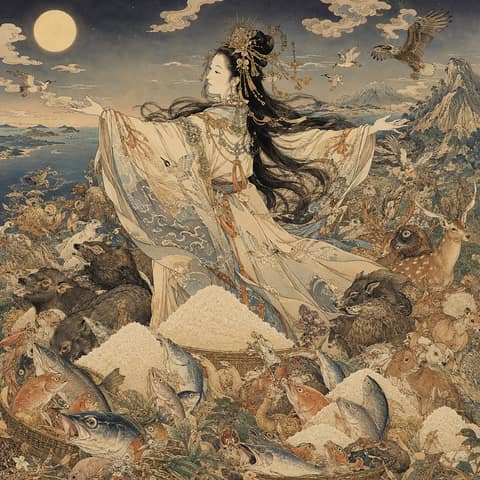
The core of Ukemochi lies in food being narrated not as a clean, finished product, but as something emerging from the body. Welcoming Tsukuyomi-no-Mikoto, Ukemochi does not bring rice out of a storehouse. Turning to the land, boiled rice comes from her mouth; turning to the sea, fish; turning to the mountains, beasts—food generated from the mouth. This is not an act lacking courtesy, but shows that the god's body itself is the food storehouse of the mountains, sea, and land. Food in the natural world, before being arranged into the formats of human kitchens or sacred offerings, exists chaotically inside the god's body. Ukemochi offers this chaotic abundance to her guest. However, Tsukuyomi did not see abundance there; he saw defilement. Food is the most intimate thing that sustains human life, but the moment it comes from the mouth, it takes on imagery of saliva and vomit. Myth does not hide this duality. Tsukuyomi's anger, while unreasonable, reflects the fear that food is inseparable from the body. Against a consciousness that wants to see the blessings of food only as pure offerings, Ukemochi bluntly presents the reality: to eat is inherently to touch other lives and the inside of the body. Therefore, the hospitality of this deity is a blessing, but simultaneously an unbearable proximity. Through murder, the narrative is inverted. When Tsukuyomi strikes down Ukemochi, food does not disappear; rather, it appears as a fixed resource. Cattle and horses form from the crown of her head, millet grows from her skull, silkworms from her eyebrows, barnyard grass from her eyes, rice from her belly, and wheat, soybeans, and adzuki beans from her genitals—food generating from a corpse. This enumeration of body parts assigned to livestock, grains, and sericulture is not merely a grotesque transformation. It gives mythic form to the sensation at the root of agricultural societies—that food is obtained by dismantling the life of the divine. Seeds are not pure abstractions; they come from the side of death. The role of Amaterasu-Omikami is not merely to lament Ukemochi's death. Seeing what Ame-no-Kumahito brought back, Amaterasu receives them as things people will eat to live, dividing millet, barnyard grass, wheat, and beans as seeds for dry fields, and rice as seeds for wet paddies—seeds for dry and wet fields. She further places cocoons in her mouth to draw thread, beginning the path of sericulture. Here, the result of violence is rewoven into the techniques of living by the hands of the sun goddess. Ukemochi's body becomes not just a corpse, but raw materials transferred to fields, livestock, mulberry silkworms, and seasonal labor. Amaterasu is a god who transforms what emerged from death into order. This myth is heavy because the origin of food and the separation of sun and moon occur in the exact same scene. Hearing of Ukemochi's murder, Amaterasu rejects Tsukuyomi as an evil god and refuses to see him again. The *Nihon Shoki* narrates this as the origin of why the sun and moon came to be separated by a day and a night—the reason day and night separated. That is, the establishment of a world where humans eat is also the event where the sun and moon can no longer exist in the same place. The origin of food overlaps with the origin of time. The daily routine of looking at the fields in the morning and the moon at night is a world ordered through the death of Ukemochi. When compared to Ogetsuhime-no-Kami of the *Kojiki*, this difference becomes even clearer. The Kokugakuin University entry for Tsukuyomi notes that while the myth of a food god being murdered is also found in the *Kojiki*, there it is organized as Susanoo killing Ogetsuhime—the pattern of Susanoo and Ogetsuhime. In Susanoo's case, the narrative gravity is on the violence of a rough god and the origin of grains. In Ukemochi's case, because the murderer is Tsukuyomi, the silence of the moon god, the rupture with the sun god, and the separation of day and night are unified. Despite being a similar pattern, the resonance of the myth is vastly different. Ukemochi expands the food myth all the way to the timetable of the cosmos. Therefore, treating Ukemochi merely as a "convenient god who produces food" loses the most important darkness. Ukemochi is a god who narrates that food is always adjacent to death; that before a pure meal, there is the tearing of a body; and that an order is needed to transform that tearing into human living. When rice, millet, wheat, beans, fish, beast, and silk thread are lined up, they overlap with mythological violence and gratitude that cannot be diluted simply by the phrase "I humbly receive this life" (Itadakimasu). Ukemochi bears that overlap entirely upon herself. This is precisely why the food born from the death of this deity does not merely fill the stomach, but becomes the sustenance that supports the very world of humans living between day and night.

Umisachihiko

Umisachihiko

Divine

うみさちひこ

Elder Brother of Sea Bounties & Hayato Ancestor, Umisachihiko

Divine Spirit / DeityMiyazaki

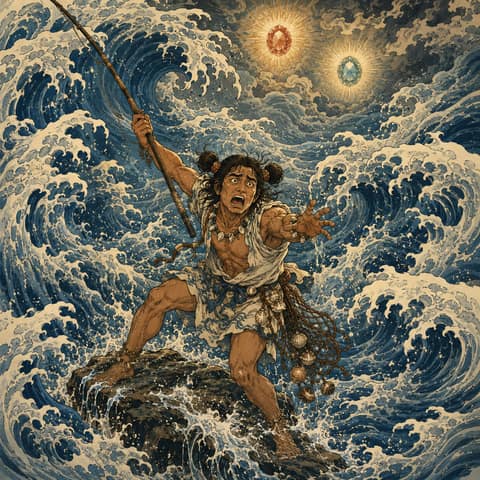
The true identity of Umisachihiko is Hoderi-no-Mikoto, the protagonist of the final section of the upper volume of the Kojiki and the tenth section of the Age of the Gods in the Nihon Shoki (also known as Honosusori-no-Mikoto in the Nihon Shoki). Born in a fire, he is the eldest of three sons of Ninigi-no-Mikoto (the Heavenly Grandson) and Konohanasakuya-hime (daughter of Oyamatsumi-no-Kami). The middle son is Hosuseri-no-Mikoto, and the youngest is Hoori-no-Mikoto (Yamasachihiko). The prefix "Ho" (fire) in all three names stems from the myth that their mother gave birth in a blazing delivery room to prove her purity after a single night's conception. The name "Hoderi" means the most intense stage of fire, while "Honosusori" similarly implies the height of flames. The common name "Umisachihiko" is an occupational title meaning "the male deity who presides over the bounties of the sea," indicating his role as a god of fishing. The core of his story lies in his position as the older brother in the myth of Umisachihiko and Yamasachihiko. Umisachihiko presided over the sea's fish, while Yamasachihiko presided over the mountain's game, each making a living with their respective tools. One day, Yamasachihiko exchanged tools with his brother and went to the sea, but lost the fishhook. The older brother strictly refused, saying, "Return the original fishhook, I will not accept any other," and even rejected a thousand replacement hooks. Yamasachihiko then went to the sea palace of Watatsumi, received the tide-flowing and tide-ebbing jewels, and returned to hand back the hook while chanting a curse. Thereafter, Umisachihiko gradually became impoverished. Holding a grudge, he attacked Yamasachihiko, but Yamasachihiko used the tide-flowing jewel to drown him, then used the tide-ebbing jewel to save him when he begged for his life. By repeating this, he forced Umisachihiko into submission. Umisachihiko finally swore to serve Yamasachihiko eternally as a "person of wazaogi" (entertainer). It is one of the most dramatic sibling tales in the Kojiki and Nihon Shoki, epitomizing ancient curse culture, divine manifestations, and submission rituals. Umisachihiko is positioned as the ancestral deity of the Hayato people in southern Kyushu. The Hayato were indigenous people living in ancient Satsuma, Osumi, and southern Hyuga, who served the court as guards, ritualists, and performers under the Ritsuryo system. The myth of his submission created a decisive asymmetrical structure: Yamasachihiko became the grandfather of Emperor Jimmu (the direct ancestor of the imperial line), while Umisachihiko became the ancestor of the subjugated border people. This is academically interpreted as the political mythologization of the 7th-8th century Ritsuryo state's subjugation of southern Kyushu. The "Ashiura" gestures Umisachihiko made while drowning—rubbing his feet, chest, and cheeks—are said to be the origin of the Hayato-mai, a court ritual. The Hayato-mai was a dance performed by the Hayato for the emperor during the Daijosai, Niinamesai, and New Year ceremonies. The Engishiki records its movements, which are partially inherited by the modern Imperial Household Agency. Thus, his submission myth functioned as the mythological basis for ancient Japanese court rituals. The center of his worship is Ushiodake Shrine (Kitago, Nichinan City, Miyazaki), the only shrine nationwide where he is enshrined as the primary deity. It is said to be located where he arrived after losing to his brother, symbolizing the localization of his legend. The fact that the shrine is located in the mountains, away from the sea, reflects the folklore interpretation of Umisachihiko being "driven into the mountains as a loser" and the geographic distribution of Hayato clans. The asymmetry between Yamasachihiko being enshrined in three major shrines and Umisachihiko in only one vividly reflects the myth's dominance/submission structure in shrine worship. In folk belief, he is deeply worshipped as a local guardian of fishing, maritime transport, and Hayato-lineage clans, especially in southern Miyazaki and Kagoshima. Modern discussions re-evaluate his "tale of the loser," deconstructing the central vs. border dichotomy. In pop culture, he frequently appears alongside his brother as the tragic older brother.

Wakumusubi-no-Kami

Wakumusubi-no-Kami

Divine

わくむすひのかみ

Wakumusubi-no-Kami, the Young Generative Spirit Tying Grain from Fire and Urine

神霊・神格Divine birth in mythology

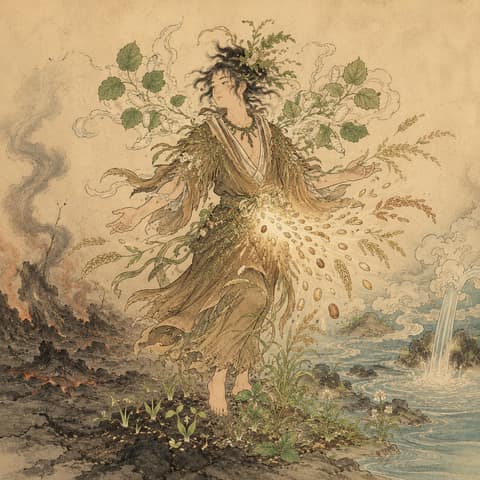
The true nature of Wakumusubi-no-Kami becomes visible not by viewing him as a frontline food deity, but as the underlying power that gives birth to food deities. In the *Kojiki*, when Izanami-no-Kami gives birth to Hinokagutsuchi-no-Kami, gets burned, and lies ill, Mitsuha-no-Me-no-Kami and Wakumusubi-no-Kami are formed from her urine—Wakumusubi-no-Kami formed from urine. Here, gods do not descend from a pure sky. They arise from places close to life crises and impurity—burns, illness, and urine. Therefore, Wakumusubi-no-Kami's generative power is from the outset earthy, bodily, and close to agriculture. The name "Waku" carries youthfulness. Using the *Nihon Shoki*'s character for "young" as a clue, Kokugakuin states that Waku means young and considers "Musuhi" to be the same word as Takamimusubi-no-Kami and Kamimusubi-no-Kami. *Musuhi* is the power to generate, tie, and form things. If Takamimusubi-no-Kami and Kamimusubi-no-Kami are *Musuhi* close to the beginning of the universe, Wakumusubi-no-Kami is a young *Musuhi* standing in the scene where Izanami-no-Kami's body breaks down. Creation restarts not from completed order, but from the bottom of a wounded body. That this deity is formed from urine is not merely a bizarre birth. Through the eyes of agriculture, urine and feces become fertilizer, water becomes irrigation, and fire leads to slash-and-burn farming and soil renewal. Kokugakuin introduces a theory viewing it as youthful agricultural productive power being born from receiving fire, fertilizer, and water, as well as a theory viewing it as a reflection of slash-and-burn agriculture—agricultural productive power born from fire, fertilizer, and water. In this reading, Wakumusubi-no-Kami is not a deity who avoids impurity, but one who transforms impurity into crops. He can be said to be an existence that mythologizes the cycles at the base of life. The *Nihon Shoki*'s Wakamusuhi demonstrates this character more concretely. Wakamusuhi is born between Kagutsuchi and Haniyamahime, and silkworms and mulberries grow on its head, and the five grains in its navel—Wakamusuhi harboring sericulture and the five grains. Being born from the fire god and the earth goddess is also agricultural. The burning fire, the receiving earth, and the mulberry, silkworms, and five grains arising from there. While this differs from corpse transformation after murder like Ukemochi-no-Kami or Ogetsuhime-no-Kami, it shares a mythic sensibility that the source of food and sericulture dwells in body parts. Wakumusubi-no-Kami is the generative power at the preliminary stage of food origin myths. The relationship with Toyoukebime-no-Kami firmly ties Wakumusubi-no-Kami to the genealogy of food deities. Kokugakuin's entry on Toyoukebime-no-Kami describes her as the child deity of Wakumusubi-no-Kami and explains that "Uke" means food or rice. Toyoukebime-no-Kami is an important name when considering the later Toyouke-no-Okami faith, connecting to the realms of sacred offerings, food, and the rice spirit. As her parent deity, Wakumusubi-no-Kami does not become food himself, but bears the root function of making food form. Before the dining table is the rice paddy; before the rice paddy are water, fertilizer, and fire; and deeper still in myth stands Wakumusubi-no-Kami. This deity also draws in readings related to water. Being formed from urine, the water goddess Mitsuha-no-Me-no-Kami being formed from the same urine, and the association of "Waku" with "springing forth" (waku) lead to theories surrounding the gushing of hot and cold springs—relationship with spring water and hot springs. Just as volcanic activity shows fire and water simultaneously, in myth too, water and generative deities appear immediately after the birth of the fire god. Water and productive power emerge from a body burned by fire. This reversal well expresses the ancient sensation that resources supporting life appear after calamity. In reading Wakumusubi-no-Kami, brevity of appearance is not a flaw. Rather, overlapping within the short description are the birth of the fire god, the death of Izanami-no-Kami, deities from excretions, Toyoukebime-no-Kami, the five grains, sericulture, slash-and-burn farming, water, and fertilizer. He is not a deity who shouts as a protagonist of a story, but one who connects multiple myths in the background. If Ukemochi-no-Kami and Ogetsuhime-no-Kami show that "food comes from the body and death," Wakumusubi-no-Kami declares that "the generative power to produce that food arises young from the depths of impurity." Therein lies the depth of the name "Young Generative Spirit" (Waku-musuhi).

Yamasachihiko

Yamasachihiko

Divine

やまさちひこ

Amatsuhikohikohohodemi-no-Mikoto

Divine Spirit / DeityMiyazaki

Also known as Amatsuhikohikohohodemi-no-Mikoto. In the Umisachi-Yamasachi myth, he visited the sea palace guided by Shiotsuchi-no-Kami. He married Toyotamahime and used the tide jewels to subjugate his brother. Breaking the taboo of looking led to his wife's departure, but their lineage established the imperial family tree. Venerated at Udo Shrine.

Yamato Takeru

Yamato Takeru

Legendary

Yamato Takeru

Yamato Takeru, the tragic hero and greatest warrior of ancient Japan

Divine spirit / deified heroShiga

The ancient mythic type of the tragic hero. The general entry covered Yamato Takeru's myth. Here the focus is the ancient pattern of the tragic hero. Yamato Takeru is a rare heroic deity who unites the tragic hero, short-lived warrior, father-son conflict, sacrificial love, and ascent after death in a single figure. He begins with fratricide, is rejected by his father and sent on campaigns, survives through his wife's sacrifice, and dies from a mountain god's curse. That arc is structurally close to tragic heroes across the ancient world, including Heracles, Sigurd, and Arjuna. It is a Japanese form of a widespread story pattern: the fate, suffering, and heavenly transformation of the hero. Father-son conflict and the myth of heroic exile. Yamato Takeru is estranged from Emperor Keiko and repeatedly ordered to go on distant campaigns. In comparative mythology, this belongs to the broad pattern of a dangerous son being exiled, tested, and made to conquer. Stories in which a father or ruler sends such a figure away are often compared with traditions surrounding David, Sigurd, and Zheng He, and they reflect questions of patriarchy, succession, and kingship. The tale marks the killing of the brother as a failure of human restraint, yet it also shows the father's coldness. That double structure gives the story a tragic intelligence beyond simple good and evil. Disguise as a young woman: strategy turned into myth. In the Kumaso episode, Yamato Takeru disguises himself as a young woman, enters the enemy camp, and kills the chieftain. The scene is a memorable mythic rendering of military strategy, disguise, and surprise attack. Yet the female disguise is more than tactics. In ancient Japanese myth and folklore, reversal, thresholds, and the crossing of gendered boundaries can be sources of ritual power and sacred danger. Yamato Takeru's disguise can therefore be read not simply as deception but as an act that embodies the magical force of inversion. It also stands as a mythic ancestor to later religious and theatrical traditions of cross-gender performance in kagura, noh, and kabuki. The Kusanagi sword and the Three Sacred Treasures. Yamato Takeru receives the Kusanagi sword from Yamato-hime, escapes the Yaizu fire with it, and after his death the sword is enshrined at Atsuta Jingu. Kusanagi is one of the Three Sacred Treasures at the core of ancient Japanese royal legitimacy. Its transmission runs from Susanoo's defeat of Yamata no Orochi, to presentation to Amaterasu, to the heavenly descent of Ninigi, to Yamato-hime, to Yamato Takeru, and finally to Atsuta Jingu. Through that chain, myth, sacred object, and imperial lineage are joined in material and religious form. Yamato Takeru is one of the few figures who actually uses a sacred treasure in battle, making him a symbol of the union of artifact, hero, and state. Ototachibana-hime's sea sacrifice and the origin of Azuma. Ototachibana-hime's self-sacrifice at sea and Yamato Takeru's cry, "Azuma haya," are treated as the mythic origin of Azuma, the eastern lands and eastern Japan. Ancient myth did not only entertain; it gave meaning to names, geography, land, and local custom. Here a woman's sacrifice becomes attached to the name of the entire east. Hashirimizu Shrine in Yokosuka still enshrines Ototachibana-hime, showing that the episode continues not only in texts but also in place names, worship, and local memory. The death poem and ancient Japanese longing for home. The death poem Yamato Takeru sings at Nobono, "Yamato wa kuni no mahoroba," has long been cherished as one of ancient Japan's foundational expressions of homeland, longing, and love of country. Mahoroba means an excellent, beautiful place, and the word condenses an early feeling for the homeland and the land itself. It influenced later waka traditions such as the Man'yoshu, Kokinshu, and Shinkokinshu. The structure is powerful: a hero at the edge of death praises the place he longs to return to. In modern Japan, the poem has continued to appear in education, literature, music, and public speech. The white-bird legend and ancient Japanese ideas of ascent and rebirth. After death, Yamato Takeru becomes a white bird, rises from his tomb, passes through Kotohiki-no-hara in Yamato and Shiki in Kawachi, and flies high into the sky. The legend is a representative example of the ancient Japanese idea that a hero may ascend and be transformed after death. In early Japan, the white bird could be imagined as a bearer of souls or a messenger of the gods. Beliefs in the dead soul becoming a bird and rising to the sky also have affinities with northern Asian, Siberian, and Korean ideas of birds, funerary practice, and the soul. The image later resonated with Pure Land faith, Shinto views of death, warrior ethics, and even the spiritual culture around the kamikaze special attack corps. It is not merely an ending to a hero tale. It is one of the narratives through which ancient Japan thought about death, religion, and beauty. Yamato Takeru in the twenty-first century. Today Yamato Takeru remains a subject of ancient-history research, local tourism, Shinto worship, and popular culture. Visits to Nobono, Kotohiki-no-hara, Atsuta Jingu, Yaizu Shrine, and Hashirimizu Shrine continue. He is repeatedly reshaped in works such as the game Okami, the 1994 film Yamato Takeru, and manga including Demon Slayer. Across more than two millennia of cultural memory, he has remained a symbol of the tragic hero, the short-lived warrior, love and sacrifice, and ascent after death. From political emphasis in prewar State Shinto, through postwar cultural reinterpretation, to plural retellings in the twenty-first century, he is a model case of how an ancient divine figure can keep entering modern culture.

Yatagarasu

Yatagarasu

Divine

yatagarasu

The Sacred Bird Leading from Kumano to Yamato: Yatagarasu

Divine Spirit / DeityWakayamaNara

In this version, we read the Yatagarasu as the "divine messenger who opens the way." The Yatagarasu is not a war god who strikes down enemies, but a presence that indicates where one should go. In the tale of the Eastern Expedition, when the party is lost on the mountain paths of Kumano, the heavenly gods do not increase their army, but send a single crow. Herein lies the essence of this sacred bird. Bestowing direction, rather than power, is the divine virtue of the Yatagarasu. The Yatagarasu in the *Kiki* binds geography and legitimacy simultaneously. The road entering Yamato from Kumano is not a mere mountain path, but a boundary that must be crossed for a new royal authority to be established. The scene in the *Kojiki* where the crow leads the way not only shows the route through the mountains but narrates that Jimmu's progression is approved by the gods. The direction the bird flies directly becomes the political course. The iconography of the three legs vastly expanded later understandings of the Yatagarasu. The three-legged crow overlaps with the East Asian concept of the sun bird, granting Japan's Yatagarasu the meanings of the sun, direction, and heavenly order. However, the strongest aspect in the original text of the *Kiki* is not "three legs" but "guidance." Therefore, this version does not lean too heavily on the splendor of its iconography, but centers on the primal sensation of a black bird flying ahead on a dark mountain road. Within the Kumano faith, the Yatagarasu gained a concrete place of worship as a divine messenger. The crow characters of the Kumano Goou Houin are not mere decorations; they are signs carrying the power of vows and talismans. While crows are often viewed as ominous scavengers of carrion, they also become birds that carry the words of the gods. This duality prevents the Yatagarasu from being reduced to a simple, cheerful mark of victory. The depth of the Kumano mountains and its mythology lies in the fact that a black bird becomes a holy guide. The modern image of the Yatagarasu is also read as a symbol of sports victories and indicating a team's course. Yet, at its root is the experience of a signpost appearing ahead when a lost person can no longer proceed alone. The Yatagarasu of this version does not explain the answer at length. It simply flies ahead. Whether to follow or not is left entirely to the humans. In this version, we also want to draw attention to the Yatagarasu's blackness. Crows are frequently viewed as inauspicious birds, but in the context of Kumano, they become messengers of the gods. Where the ominous and the sacred invert, there lies the profound depth of mountain asceticism. Proceeding without losing sight of the black bird on a dark mountain path is akin to reading divine will in the dark. Furthermore, the Yatagarasu is a guide who speaks few words. It does not stand before them as a god like Sarutahiko, but flies ahead as a bird. Humans must interpret the direction of its flight and advance on their own two feet. Guidance is not forced; it demands reading. Therein lies the quiet severity of the Yatagarasu. Even today, when the three-legged image and the soccer emblem are widely known, the root of this sacred bird remains on that mythological mountain path cutting from Kumano to Yamato. Stripping away the glamorous symbolic layers, what remains at the end is a single, giant crow flying ahead of a lost party. That simple scene is the strongest image of the Yatagarasu. Because of this, the Yatagarasu symbolizes not the destination itself, but the trust required to head toward the destination. When the road is unseen, a person must first believe in the direction they are advancing. The leading flight of the black bird is the mythological gesture that gives form to that trust.

Yudonosan-daigongen

Yudonosan-daigongen

Divine

Yudonosan-daigongen

The Unspeakable Deity of the Sacred Rock of Mount Yudono

Divine Spirits / DeitiesYamagata

Yudonosan-daigongen does not have a tangible statue form; instead, a giant, brownish-red sacred rock spewing hot water serves directly as the object of worship, preserving the oldest form of nature worship in Japanese mountain faith. The Dewa Sanzan are considered a trinity of ascetic training grounds: Mount Haguro symbolizes worldly happiness in the present, Mount Gassan represents the afterlife, and Mount Yudono signifies the future of rebirth. Therefore, Mount Yudono, as the inner sanctuary, is positioned as the final destination of the three-mountain pilgrimage. The object of worship has neither a shrine building nor a roof. Pilgrims must take off their footwear and walk barefoot on the approach mixed with earth and stones to climb the sacred rock. The strict taboo against disclosing one's experiences on the mountain—"Do not speak of it, do not ask of it"—is still observed today, and photography is strictly prohibited. Although it lost the title of "gongen" during the Meiji era's anti-Buddhist movement and became a shrine dedicated to deities like Ōyamatsumi-no-Mikoto, the faith itself—pressing one's hands together in prayer to the silent sacred rock—has never been broken. It is the silent divine entity of Dewa that presides over rebirth and *sokushin-jōbutsu*.

伊斯許理度売命

伊斯許理度売命

Divine

いしこりどめのみこと

岩戸に八咫鏡を鋳る鏡作神・伊斯許理度売命

神霊・神格Wakayama

Ishikoridome, casting the Yata-no-Kagami (Eight-Span Mirror) before the rock cave, is the deity in the Ama-no-Iwato myth who creates the vessel that reflects the lost light back onto itself. When Amaterasu-Omikami hides within the cave, the world goes dark. The gods gather at the Heavenly Tranquil River and prepare according to Omoikane's plan. The *Kojiki* (Ama-no-Iwato II) records that after seeking hard stones, iron, and a blacksmith, they commanded Ishikoridome to make a mirror. This mirror later becomes the central ritual implement used to lure Amaterasu out. The act of "making a mirror" is extremely proactive in the Ama-no-Iwato myth. If they merely wanted to wait for the light to return, the gods could have simply continued praying. However, Omoikane's strategy is to create a surface to catch the light in advance, even while the light is absent. Ishikoridome's mirror is not a trap to catch Amaterasu. It is a location of light, showing that the outside world is still prepared to welcome the deity. The mirrored surface is silent, but within that silence dwells the signal: "It is safe to return here." When Kokugakuin University's commentary reads the Ama-no-Iwato myth as an origin tale of ancient rituals, the mirror is a crucial implement alongside jewels, cloth, and oracle bones. A mirror possesses not only the practical utility of reflecting an image but the power to summon a deity and anchor its presence. As the deity responsible for crafting this implement, Ishikoridome bridges the beautiful surface of mythology with the heavy, gritty reality of metalworking. Fire, metal, stone, molds, and polishing—all of it converges into a single mirror placed before the gods. During the Descent of the Heavenly Grandson, Ishikoridome descends to earth as one of the Five Attendant Deities. The *Kojiki* identifies Ishikoridome as the ancestor of the mirror-making clan. This means the mirror-making technology that guided Amaterasu at Ama-no-Iwato is handed down to earthly clans and integrated into human rituals. Mirror-making is not merely a personal skill; it is a vocation rooted in myth, becoming a part of the ritual technology that supports the heavenly grandson's rule. The official history of Hinokuma Shrine and Kunikakasu Shrine connects Ishikoridome to another story of mirrors. Hinokuma Shrine enshrines the Hizokagami as its sacred body, while Kunikakasu Shrine enshrines the Hibokokagami. The official overview recounts that when Amaterasu hid in the cave, following Omoikane's advice, Ishikoridome acted as the master artisan and cast the sacred mirrors from copper. Here, the function of the mirror-making deity expands into the worship of two major shrines. While the Hizokagami and Hibokokagami belong to a different lineage than the Yata-no-Kagami, they are spoken of as mirrors born from the same darkness of Ama-no-Iwato. The shrines note that these two mirrors are revered by the Imperial Court as sacred treasures second only to the Three Sacred Treasures (which includes the Yata-no-Kagami). Here, Ishikoridome's divine status expands from "the deity who made a mirror" to "the deity who upholds the history of mirrors closely associated with the Imperial ancestors." A mirror is an image of the deity, and at the same time, the vessel (yorishiro) that welcomes the deity itself. Read in a modern context, Ishikoridome is a deity of reflection and recording. Mirrors, lenses, photography, video, measurement, inspection, design, and metal polishing—all are technologies centered on making an object visible without distorting it. The myth of forging a mirror in the darkness resonates with the act of preparing tools that reflect the truth in the midst of confusion. Ishikoridome is not a deity who wields blinding light. When the light returns, Ishikoridome is the deity who silently prepares the surface to catch it, reflect it, and return it to the world. Furthermore, this deity's mirror is a tool for self-recognition. When Amaterasu looks out from the cave, the mirror does not merely reflect the outside world; it returns the deity's own existence back to her. The hidden one sees her own light once more, reconnecting with the world. Ishikoridome creates that catalyst. To forge a mirror was to prepare the surface for a world that had lost its center to regain itself.

倭姫命

倭姫命

Divine

やまとひめのみこと

五十鈴川へ導いた御杖代・倭姫命

神霊・神格Mie

Yamatohime appears as the mitsueshiro who guided Amaterasu Omikami to Ise. A mitsueshiro is not a vessel that controls the divine, but a being that serves the divine will and receives its destination in the human world. Her journey is not an escape far from the Yamato court. It is a tour to search for where the great goddess should be enshrined, to read the physiognomy of the land, to cross through provinces, and to find the center where the deity can settle in peace. In the official history of the Jingu Administration, Yamatohime left Yamato, passed through Iga, Omi, and Mino, and entered Ise Province. Ise, the endpoint of her journey, is not a mere destination. It was chosen as a land capable of quietly receiving the divine authority of Amaterasu Omikami, where clear water descends from the mountains to form the Isuzu River flowing to the sea, where the ocean opens to Tokoyo, and where the forests envelop the shrine. The expression "the upper reaches of the Isuzu River" found in the history of the Naiku perfectly illustrates Yamatohime's power. She is not a hero who calls back the light, but a deity who searches for a place where the light can remain without becoming muddied. Therefore, Yamatohime's spiritual power resides in "selection" and "order." Dividing the sacred realm from the secular world, maintaining purification and abstinence, and ensuring the rules of offerings and festival days are not disrupted. The Jingu Administration explains that after creating Kotai Jingu, Yamatohime established the systems of rituals and purification, building the foundation of the shrine. There is a different kind of tension here from the sudden bizarre occurrences often found in yokai tales. Unseen things become unruly if not welcomed correctly. Sacred things exhaust people if placed in the wrong location. Yamatohime knows that boundary and measures the distance between the divine and humans. Her presence manifests not as a loud oracle, but as a stillness that makes one stop at a fork in the road. The sound of water suddenly becoming clear, the wind changing at the entrance of a forest, words becoming sparse before an old shrine ground. To those who do not misread such small signs, Yamatohime indicates the next step. Conversely, to those who rush to conclusions, who try to paint over sacred sites with their own desires, or who disregard purification as a troublesome formality, the road will feel long, as if wandering in circles. Her protection is not in speed, but in correct anchoring. When understanding Yamatohime, it is best not to separate the three roles: the priestess who hears oracles, the traveling imperial princess, and the institutionalizer who creates the shrine system. The enumeration of her historical touring sites shows that she is not a deity of a single point, but a being who sanctifies the road itself. A road can be a symbol of being lost, but for Yamatohime, it is a process of discernment. The lands she passed through were not failed places. They were necessary memories to confirm the conditions for welcoming the deity one by one, heading toward the conclusion called Ise. Therefore, her story is better suited to the repetition of stopping, purifying, and walking again, rather than flashy moments of victory. For those who pray, Yamatohime is less a "deity who grants wishes" and more a "deity who teaches where wishes should be placed." When one wishes to rebuild the foundations of work, home, relationships, or study, she does not bring sudden change, but guides people toward preparing the environment, restoring order, and washing away unnecessary impurities. Before asking what to seek before the deity, she makes you question with what state of mind and body you stand before the deity. That strictness is also Yamatohime's gentleness. The Yamatohime-gu in Kusube-cho, Ise City, rests quietly in the forest of Mount Kurata, midway along the Miyuki Road connecting the Naiku and Geku. Although established as a Betsugu (auxiliary shrine) in the Taisho era as a new shrine, the deity enshrined there touches the oldest layers of the Ise faith. This overlapping of old and new befits Yamatohime's figure. She is not a legend closed in the past, but a memory that exists to continuously renew the places where deities are enshrined. The deity who established the shrine at the end of her journey still quietly asks in today's noisy world, "Where should the heart be calmed?" The time spent listening closely to that question itself becomes a pilgrimage to Yamatohime.

天穂日命

天穂日命

Divine

あめのほひのみこと

出雲へ傾いた天つ穂霊・天穂日命

神霊・神格Shimane

Ame-no-hohi carries an ambiguity of belonging from the very moment he was born through the 'ukehi' pledge. Ameno-hohi-no-Mikoto emerged from the breath of Susanoo-no-Mikoto, but because the source material was Amaterasu Omikami's jewel, he is considered a child of Amaterasu. This structure anticipates his entire life. The one who sets him in motion and the one to whom he belongs are different. The place where he receives his orders and the place his heart leans toward are different. Ame-no-hohi, despite being born into the lineage of heavenly deities, is a deity who deeply embeds himself into the earthly Izumo. The character of the "rice ear spirit" residing in his divine name is also crucial. Kokugakuin University annotations interpret 'Ho' as rice ear and 'Hi' as spirit, explaining Ame-no-hohi as the heavenly spirit of rice ears. Rice ears are not completed solely in heaven. They must descend to the paddy fields, endure the seasons, and ripen through the moisture of the land and human hands. It is no mere coincidence that Ame-no-hohi is dispatched to Ashihara-no-Nakatsukuni. He is the rice ear meant to transfer the heavenly order to the earth, while simultaneously being a spirit that cannot function unless it touches the earthly soil. During the pacification of Ashihara-no-Nakatsukuni, this character manifests dangerously. The myriad deities and Omoikane nominate Ame-no-hohi as the messenger to pacify the unruly earthly deities. However, he curries favor with Okuninushi and does not report back for three years. Reading this alone, Ame-no-hohi appears to be a deity who abandoned his mission. Yet, in the deeper layers of the myth, the very fact that he was absorbed by the earth is significant. When heaven's command reaches the earth, it does not achieve fruition exactly as commanded; it is transformed by the local deities, human rituals, and the memories of Izumo. Ame-no-hohi embodies this transformation physically. This single point of "not reporting back" elevates Ame-no-hohi from a mere agricultural deity to a pivotal juncture in the story. Reporting back (fukuso) is the words that return what was seen on earth to Takamagahara, closing the loop of command. Because he does not do this, heaven's command is suspended in midair, necessitating a new messenger. Silence is not a void; it is a rift created between heaven and earth. The deities of Izumo enter this rift, eventually opening the stage for the massive negotiation known as Kuni-yuzuri (the transfer of the land). The tradition of the "Izumo-no-Kuni-no-Miyatsuko-no-Kamuyogoto" illuminates this deity in a different light. According to Kokugakuin University annotations, the Kamuyogoto narrates that Ame-no-hohi went to observe the state of the earthly realm, and his son Ame-no-hinadori, along with Futsunushi, pacified the unruly deities. Here, silence is not disloyalty; it is the process of measuring the earth as the ancestral deity of the Izumo governors and establishing ritual legitimacy. Ame-no-hohi's "flattery" is read as political deviation in central mythology, but as an approach to pacify deities in Izumo's rituals. The same act transforms into either betrayal or mediation depending on the observer's position. This deity's power is not the power to submit opponents with a sword. He enters the opponent's side, delays his return, and postpones his words of report. In modern terms, Ame-no-hohi is a deity of the middle ground. From the perspective of those issuing commands, he is difficult to handle; from the perspective of the land, he is easy to accept. That is precisely why stronger messengers and war gods must appear after him. Ame-no-hohi's failure pushes the Kuni-yuzuri myth to its next stage. The sensation of praying to him is closer to re-establishing relationships than seeking victory or punishment. Leaning toward Izumo was a betrayal of orders, but simultaneously the result of listening too closely to earthly voices. Ame-no-hohi stands on the boundary between understanding the opponent and losing his original mission. Therefore, his protection is precarious. He softens people, but also makes them easily swayed. When dealing with the ties of family, community, or organizations, this deity does not say, "Return and report immediately." He prompts one to first enter the land, know the opponent's deities, and then question what words should be returned. For those who pray, Ame-no-hohi is not a deity who grants quick success. Rather, between conflicting worlds, he is a deity who asks how far one should empathize with the other and from where one should return to their original mission. Amidst negotiations and the complex ties of lineage, community, and organization, when simple righteousness alone cannot move things forward, the story of Ame-no-hohi offers profound assistance. Just as rice ears only ripen once they take root in the soil, the protection of this deity also begins with the resolve to set foot on the opponent's land.

布刀玉命

布刀玉命

Divine

ふとだまのみこと

岩戸に御幣を取り持つ祭具神・布刀玉命

神霊・神格ChibaTokushima

Futodama, holding the *gohei* (ritual wand) before the Heavenly Rock Cave, is the deity in myth who transforms the objects prepared by the gods into the active power of ritual. When Amaterasu-Omikami hides within the cave, the world sinks into darkness. Following Omoikane's plan, the gods make the long-singing birds cry out, gather hard iron, forge a mirror, craft curved jewels, perform divination with deer bone and *hahaka* wood, and hang jewels, a mirror, and cloth upon a *Sasaki* tree. At the conclusion of these preparations, the *Kojiki* (Ama-no-Iwato II) records: Futodama, holding the grand *gohei*. In this moment, Futodama transitions the completed ritual tools into active divine service. The power of this deity lies in the very act of "holding." The *gohei* is not merely paper or cloth; it is a marker directed toward the divine, a pathway for prayer, and a medium to purify the space. When Futodama takes it in his hands, the jewels, mirror, cloth, and divination are no longer disparate materials, but a singular, unified ritual offered to Amaterasu. If Ame-no-Koyane's prayers form the center of voice, Futodama's *gohei* is the center of physical matter. Voice alone lacks form, and objects alone remain silent. Only when both are present is a space established before the cave to welcome the deity. Kokugakuin University's commentary highlights how the myth is densely layered with elements of ancient ritual. The mirror reflects Amaterasu, the jewels bear sacred adornment and spiritual power, the cloth is an offering, and the oracle bones seek divine will. Within this material worship, Futodama stands at the juncture where ordinary objects are transformed into "sacred offerings." Therefore, viewing him merely as a keeper of props is entirely insufficient. Futodama is the deity who presides over the exact moment when objects enter the sacred order. During the Descent of the Heavenly Grandson, this role is brought down to earth. In the *Kojiki* (Tenson Korin II), Futodama descends as one of the Five Attendant Deities and is named the ancestor of the Inbe clan. The Five Attendant Deities each carry functions such as ritual, dance, mirror-making, and jewel-crafting, demonstrating that the heavenly grandson's rule over the earth relies on more than just military might or lineage. It requires the techniques of worship, creation, and offering. Futodama is the deity who connects heavenly ritual tools to earthly vocations. The official deity description of Awa Shrine makes this connection remarkably concrete. The Upper Shrine's main deity, Ame-no-Futodama, served closely by Amaterasu and is revered as the ancestral god of the Inbe clan. The shrine further explains that because he led the Inbe deities in overseeing the creation of mirrors, jewels, textiles, weapons, and shrine construction, he is worshipped as the founding deity of all industries in Japan. Here, the hands that held the *gohei* before the cave have expanded to encompass crafts, architecture, textiles, and weaponry. The history of Oasahiko Shrine in Awa paints him as the "ancestral god who founds industry" in that region. During Emperor Jimmu's reign, his grandson Ame-no-Tomino-Mikoto is said to have arrived in Awa Province to sow hemp and paper mulberry seeds, producing cloth to establish the region's industry, while enshrining Futodama as a guardian deity. Materials like hemp, paper mulberry, and cloth resonate deeply with Futodama's nature as a deity of ritual implements. The cloth draped before the gods is the same cloth that pioneers new lands and builds industries. Here, we witness an ancient mindset where ritual and production were inseparable. Awa Shrine's traditions continue this narrative, stating that Ame-no-Tomino-Mikoto later led a branch of the Inbe clan from Awa across the sea to the Boso Peninsula, planting hemp and grain, and enshrining Futodama and his consort at Mera Beach. This migration story connects Futodama's divinity to tales of movement and pioneering. The deity who holds ritual tools appears not only before the gods but also at the sites where land is cleared, crops are planted, and shrines are built. Treating physical objects with sacred respect was, in itself, the act of laying the foundation for human life. Read in a modern context, Futodama may be a "behind-the-scenes" deity, but he is by no means a minor one. The preparation of ceremonies, the setting of stages, the management of sacred tools, architecture, paper-making, textiles, metalwork, crafting tools, and the passing down of family trades—to support the voices and dances on stage, one needs the technical skill to gather materials, arrange procedures, and maintain the integrity of the space. Futodama grants divine grace to these very skills. When praying, creating, or inheriting, one must never treat the materials at hand with disrespect. This quiet, steadfast ethic is the true power of Futodama.

Showing 49 - 72 of 77 yokai