YOKAI.JP

Kami Encyclopedia

Shinto, Buddhist and Daoist deities formally enshrined

77 Yokai|1 Category|Page 4 of 4
Localization in Progress - More content available in Japanese version
View Japanese
Sort by: NameAscending
湍津姫神

湍津姫神

Divine

たぎつひめのかみ

大島に鎮まる海中道の女神・湍津姫神

神霊・神格Fukuoka

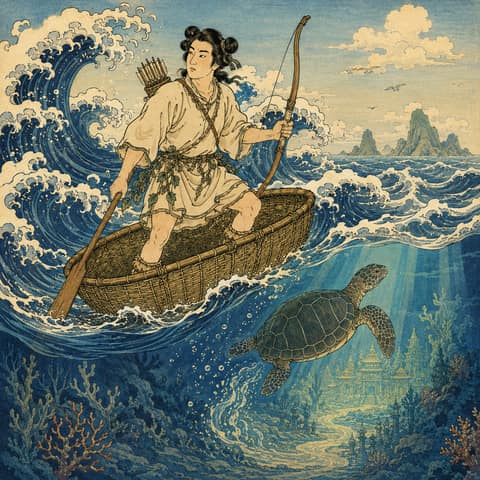
To understand Tagitsuhime, who resides on Oshima, one must first look at Nakatsu-miya not merely as the "middle of the three shrines," but as a sanctuary situated mid-voyage on the sea. Munakata Taisha links Okitsu-miya on Okinoshima, Nakatsu-miya on Oshima, and Hetsu-miya in Tajima as three shrines, collectively calling them Munakata Taisha. Its official history designates the three goddesses as the daughters of Amaterasu Omikami, layering the memories of state rituals and foreign exchange over the national treasures excavated from Okinoshima. Tagitsuhime of Nakatsu-miya stands at the center of this immense religious sphere, receiving and passing along both the awe of the open ocean and the prayers of the mainland. Today's Nakatsu-miya is treated as Munakata Taisha Nakatsu-miya even in official World Heritage documents. It is situated at 1811 Oshima, Munakata City, Fukuoka Prefecture, and the official Munakata Taisha webpage lists its enshrined deity as Tagitsuhime-no-Kami. Here, Tagitsuhime is not an abstract water deity, but a goddess with a tangible island, shrine buildings, approach paths, and festivals. Oshima is an inhabited island reached by ferry from the mainland, unlike Okinoshima, which generally refuses human entry. Yet simultaneously, Oshima is an island that looks out toward Okinoshima, houses the Okitsu-miya Yohaisho (worship hall for praying from afar), and transmits the taboos of the sea to human settlements. Tagitsuhime's "middle" exists between an accessible sacred site and an inaccessible one. Tracing the pronunciation of her divine name sharpens the contours of this goddess even further. "Tagitsu" encompasses the state of water rushing violently and boiling up. Rather than a deity of a calm lake surface, Tagitsuhime is a deity of places where tides shift, currents change, and a ship's judgment is tested. Guarding a voyage does not simply mean calming the waves. Sometimes it means allowing progress, sometimes ordering a wait, and sometimes forcing a turn back. Tagitsuhime's protection works not as a power to make the sea obey humans, but as a power to return humans to the sea's rhythm. Mount Mitake, behind Nakatsu-miya, is indispensable for considering Tagitsuhime's Aramitama (rough spirit). The official Munakata Taisha webpage notes that Mitake Shrine is located at the highest point on Oshima, enshrining Amaterasu Omikami and the Aramitama of Tagitsuhime, while noting that according to Japanese mythology, it is said to be the site of Tagitsuhime's descent. If Nakatsu-miya at the foot is the shrine that greets worshippers, Mitake at the summit is where the island itself received the deity. The shadow of the mountain visible from the sea, and the sea route viewed from the mountain—these intersecting gazes forge Tagitsuhime's divinity. The history of rituals shown in official World Heritage documents corroborates this duality. It is noted that by the late seventh century, open-air rituals sharing commonalities with Okinoshima rituals were conducted at the Mitakesan ritual site on Oshima and the Shimotakamiya ritual site on the mainland. Furthermore, the *Kojiki* and *Nihon Shoki* from the early eighth century record that the Munakata clan worshipped the three Munakata goddesses across the three shrines. Here, the structure of the three shrines connected by the sea was established. Tagitsuhime bears the intermediate memory within this, linking the ancient rituals of Okinoshima to the shrine-based rituals on the mainland. Discrepancies with classical texts are, in fact, an entryway to reading Tagitsuhime more richly. In the oath-taking section of the *Kojiki*, the name Takitsuhime-no-Mikoto appears, and she is recorded as being worshipped as one of the three Munakata goddesses. On the other hand, in the present Munakata Taisha, Tagitsuhime is the deity of Nakatsu-miya. Reducing this difference to "which is correct" loses the depth of the Munakata faith. The divine names in the classics, the three-shrine rituals preserved by priestly families, and the archaeological landscapes organized as a World Heritage site represent different historical layers. Tagitsuhime is also a deity who traverses these layers. Placing the maritime rituals overseen by the Munakata clan in the background, Tagitsuhime ceases to be merely the "second of the three goddesses." Official World Heritage documents state that the ancient rituals on Okinoshima were carried out by people of the Munakata region who possessed advanced navigational skills and engaged in foreign exchange. The sea was a trade route, a danger zone, a path for diplomacy, and a place to pray to the gods. Nakatsu-miya on Oshima is where all of these are concentrated into a single point. Here, travelers simultaneously feel the awe of heading out to the open sea and the relief of returning to the mainland. If reading this figure in an encyclopedia, Tagitsuhime is the "guardian deity of the flow." Flow is not just water currents. From myth to ritual, from Okinoshima to Oshima, from taboo to worship, from the prayers of the ancient state to modern traffic safety, the faith has flowed down to the present, changing its form. Tagitsuhime reconnects the things that threaten to sever along the way. Calming her Aramitama on the mountain peak, looking up to her Nigimitama (gentle spirit) at Nakatsu-miya, and gazing toward Okinoshima beyond the remote worship hall. Her divine authority manifests itself more as the shifting tides signaling the time to cross, rather than through flashy miracles.

瀬織津姫

瀬織津姫

Divine

せおりつひめ

速川の瀬に立つ祓戸の水神・瀬織津姫

神霊・神格Shiga

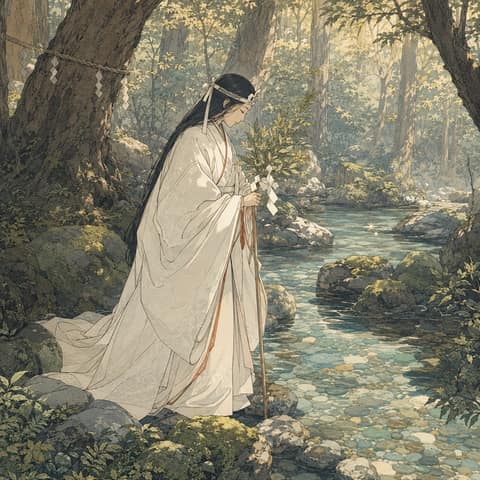
The key to reading Seoritsuhime lies in placing purification not on "making white" but on "making move." The sins and impurities in the Oharai-no-Kotoba are not things merely to be reflected upon in the mind. They are transferred onto purification objects, named by the incantation, and handed over to the water falling from the mountains. Seoritsuhime is their first carrier. The place she resides is not a calm lake surface, but the rapids of a swift river. In places where water hurries, where currents swirl, where footing becomes unstable, sins are separated from the human domain. The work of this deity differs from gentle comforting. Seoritsuhime does not envelop and preserve impurities. She receives what has been purified and carries it straight out to the great ocean. There is an ancient wisdom here that, rather than continually analyzing sin, one should change its location at a certain point. A human community would break if it only accumulated sins and impurities internally. Thus, purification reveals sins through words, places them on objects, and returns them to the natural cycle. Seoritsuhime is the deity of that switch, the power itself that returns stagnant things to the flow. Observing the chain of the four Haraedo deities makes Seoritsuhime's role even clearer. When she carries them from river to sea, Hayaakitsuhime swallows them in the tide's whirlpool, Ibukidonushi blows them away with his breath to the Root Country and Bottom Country, and Hayasasurahime finally causes them to be lost. In other words, Seoritsuhime is not the completion of eradication, but the initiation of the transfer toward eradication. The deity who handles the first step is often the closest to humans. In the moment a person lets go of a sin or impurity, it has not yet disappeared. However, it is no longer in the owner's hands. Seoritsuhime stands in that suspended time. Seoritsuhime's charm as a water goddess is also born from this. Water is precious not because it is pure, but because it purifies by flowing. It does not reject turbidity; it carries it. It is natural that faiths drawn to waterfalls and rapids turn toward Seoritsuhime. Falling water continuously crosses boundaries: from top to bottom, from mountain to river, from river to sea. The goddess standing there is not the guardian of a fixed sanctuary, but a deity who facilitates passage across boundaries. Her purity is not a halted innocence, but an order maintained by flow. On the other hand, one should keep a distance from the temptation to speak of Seoritsuhime as the "hidden true body" of Amaterasu Omikami. In the official explanation of Ise Jingu, Aramatsuri-no-Miya is the first auxiliary shrine of the Naiku, enshrining the Aramitama of Amaterasu Omikami, and the Aramitama is explained as a particularly conspicuous manifestation of divine power. Seoritsuhime's name is not placed there. Therefore, narratives connecting the two are safely treated as later annotations, folk beliefs, and modern reception. There is no need to deny such layers, but mixing them with the deity's character in the original texts ironically causes Seoritsuhime's own contours to be lost. Seoritsuhime's uniqueness lies not as a shadow name for the sun, but in the procedure of water. If Amaterasu Omikami is the deity who illuminates and orders the world, Seoritsuhime is the deity who hands over the sins and impurities inevitably generated within that order to the water for circulation. A bright order requires a system to process shadows. The place where Seoritsuhime works in the Oharai-no-Kotoba is exactly that location. To maintain a world ruled by light, water must carry the dirt away. She is not an opponent of light, but the waterway ensuring the world of light does not break. Praying to this deity does not mean pretending the dark things inside oneself never existed. Rather, it is about giving them a name, giving them a form, and handing them over to where they should flow. Seoritsuhime does not condemn those holding sins, but she refuses to let them hold onto them forever. Sadness, regret, anger, the turbidity of old relationships. She carries such things to the water's edge and creates a moment to let go. Her purification is not forgetting but transferring, not forgiveness but a flow path. Therefore, before Seoritsuhime is a pure goddess, she is a goddess of movement. In this sense, Seoritsuhime's divine authority is easily reinterpreted into modern emotional organization, but she should not be confined to simplistic psychology. The purification of the Oharai-no-Kotoba was a public word meant to rebuild a grand order encompassing not just the individual's inner self, but the community, officials, and the nation. Seoritsuhime connects that word to the water. She is a deity who hands over what cannot be resolved by the heart alone to space, current, and time.

玉祖命

玉祖命

Divine

たまのおやのみこと

岩戸に御珠を連ねる玉作神・玉祖命

神霊・神格Wakayama

Tamanooya, who strung the sacred beads at the rock cave, is the deity in the Ama-no-Iwato myth who gathers light into particles and brings them to order. When Amaterasu-Omikami hides in the cave, the gods follow Omoikane's plan: they make a mirror, craft jewels, hang cloth, and perform divination. The *Kojiki* (Ama-no-Iwato II) records that they had Tamanooya make the Yasakani no Magatama and the five hundred stringed Yasumaru beads. What Tamanooya creates here is not a single gem, but a spiritual rosary of many beads strung together to hang before the altar. The jewels stand in pair with the mirror at the Ama-no-Iwato scene. The mirror reflects Amaterasu's figure on one surface, while the jewels fill the sacred space with many particles. If the mirror is an implement for "seeing," the jewels are implements for "tying." By boring holes, threading strings, and aligning the particles without disorder, scattered small lights become a single ritual implement. Tamanooya's work is not merely to make the material beautiful, but to align individual brilliance into an order directed toward the divine. When Kokugakuin University's commentary reads the Ama-no-Iwato myth as an origin tale of ancient rituals, jewels—along with mirrors, cloth, ironware, and oracle bones—are major items that make the ritual possible. Jewels are implements close to the body; they decorate, protect, and indicate the status or spiritual power of the wearer. When hung on the true sakaki tree before the cave, a personal adornment transforms into a sacred symbol. Tamanooya is the deity who makes this transformation possible. In the Descent of the Heavenly Grandson, Tamanooya's vocation is connected to the history of human clans. The *Kojiki* (Tenson Korin II) counts Tamanooya among the Five Attendant Deities and designates him as the ancestor of the Tamanooya clan. This indicates that jewel-making descended to earth not just as manual labor, but as a vocation rooted in heavenly rituals. The techniques of polishing, piercing, and stringing jewels became part of the ritual technology supporting the heavenly grandson's world. In the official overview of Hinokuma and Kunikakasu Shrines, Tamanooya is enshrined in the auxiliary shrine of Kunikakasu Shrine. Kunikakasu Shrine enshrines the Hibokokagami (Sun Spear Mirror) as its sacred body, and the same page transmits the history of two sacred mirrors being cast during Amaterasu's seclusion in the cave. The enshrinement of Tamanooya in a shrine centered on mirror myths clearly shows that the ritual implements of the rock cave myth are not complete with mirrors alone. The jewels string light around the mirror. Tamanooya's power lies in not neglecting the details. Jewel-making requires selecting materials, polishing, boring holes, stringing, and arranging. If any one step is disrupted, the rosary will not take a form fitting for the gods. Rather than creating a massive light all at once, this deity refines small lights one by one, connects them, and makes them into a meaningful sequence. Tamanooya is the deity who teaches the weight of the finest manual labor within a grand ritual that changes the world. Seen in a modern light, Tamanooya resonates well with the senses of jewelry, accessories, rosaries, beads, souvenirs, design, lineage, and matchmaking. The work of polishing, selecting, and connecting small things is inconspicuous but supports people's memories and prayers. Tamanooya, who strung the sacred beads before the rock cave, is a deity who does not waste a single particle of light. He beautifully ties scattered things together and prepares the space to welcome the lost light. Those quiet, steady hands are the very essence of Tamanooya's divinity. Furthermore, Tamanooya is often paired with Ishikoridome. If Ishikoridome gathers light onto a single mirror surface, Tamanooya divides light into many particles and then creates a single chain from them. Concentration and connection, reflection and decoration, a single surface and many particles. Through these two crafts, the Ama-no-Iwato ritual simultaneously possessed light for seeing and light for tying. Tamanooya's jewels were not only beautiful but were implements that turned the gods' collaboration into a visible form. The gods' operation was not a single heroic act, but a collective ritual where wisdom, dance, prayers, cloth, mirrors, and jewels supported each other. Tamanooya is also the deity who symbolizes that collectivity as a chain of particles. The power to tie small things together deeply supports grand divine rituals.

田心姫神

田心姫神

Divine

たごりひめのかみ

沖ノ島に鎮まる海北道中の女神・田心姫神

神霊・神格Fukuoka

The key to understanding Tagorihime lies in the fact that Okinoshima is a "distant island." The three shrines of Munakata Taisha are arranged such that one ventures deeper into the sacred realm the further one crosses the sea: Hetsumiya on the Kyushu mainland, Nakatsumiya on Oshima, and Okitsumiya on Okinoshima in the Genkai Sea. The fact that the deity of Okitsumiya, placed furthest offshore, is Tagorihime clearly illustrates her character. She is not a guardian nestling close to human settlements, but a divine presence that arises when navigators spot the island's silhouette, read the tides, and stand in awe of unseen dangers. In the classic texts, she is born from a sword. The ukehi (oath) section of the Kojiki records that Amaterasu Omikami took Susanoo-no-Mikoto's ten-span sword, rinsed it in the Ame-no-Manai well, chewed it to pieces, and from the narrow mist of her breath blown away, Takiribime-no-Mikoto was formed. The sword is an object of military might and oaths, the well water is a medium of purification, and breath and mist are boundaries without form. Because Tagorihime is born at the intersection of these three, she can be understood not merely as a sea deity, but as the goddess of the very moment when martial force is transformed into prayer. The variations in her divine name indicate that she is a deity who cannot be confined to a single reading. Called Takiribime-no-Mikoto or Okitsushima-hime-no-Mikoto in the Kojiki, she is spoken of as Tagorihime or Tagirihime in the Nihon Shoki lineage. Depending on whether "Takiri" is read as the "surging (tagiru)" of the tides or "Tagiri" as the mist upon the sea, the expression she shows changes slightly. In either case, however, at her core lies the power to alter visibility right in the middle of the water's surface. To navigators, fog was both a danger and a sign signaling the realm of the gods. In the Munakata faith, this mythology is tied to actual sea routes. Okinoshima is a maritime transport hub connecting the Japanese archipelago and the Korean Peninsula, and official World Heritage documents explain that rituals praying for navigational safety and successful exchange were held from the late 4th century to the late 9th century. The evolution of offerings shows a transition of ritual sites from atop giant boulders, to rock shelters, half-rock-shelter half-open-air, and finally open-air locations, narrating how the ancient rituals of Okinoshima are essential in considering the formation of indigenous Japanese faith moving from nature worship to shrine rituals. The taboos surrounding the island reinforce Tagorihime's "invisibility." Official World Heritage documents convey customs such as not speaking of what one sees or hears on Okinoshima, not taking a single tree, blade of grass, or stone, and requiring even Shinto priests to undergo purification in the sea before entering. These are not so much a matter of secrecy as they are a decorum meant to prevent the consumption of the sacred realm. Tagorihime is not a deity who discloses everything within statues or narratives. Through what is not spoken, what is not taken away, and what is left behind on the island, she exists all the more profoundly. On the other hand, she is not confined solely to Okinoshima. The history of Munakata Taisha regards the three goddesses as the three daughters of Amaterasu Omikami, telling how the land of Munakata, which fulfilled the functions of overseas diplomacy, trade, and national defense, became deeply tied to state rituals. The description of "state rituals" seen in the history of Munakata Taisha prevents Tagorihime from remaining merely a deity of maritime safety. In the ancient state, crossing the sea meant trade, diplomacy, warfare, and prayer. Precisely because of this complexity, her stillness resonates not as weakness, but as the posture that both the state and humanity ought to uphold when facing the ocean. Furthermore, in the genealogy of the Kojiki, Takiribime-no-Mikoto bears Ajisukitakahikone-no-Kami and Takahime-no-Mikoto with Okuninushi-no-Kami. This means that the maritime goddess of Munakata also holds a place within the Izumo lineage. Situated in the genealogy of Okuninushi-no-Kami, Tagorihime is a guardian of the northern sea routes, while simultaneously a mother goddess expanding the bloodline of Izumo mythology. The goddess retreating far offshore paradoxically links the myths of the land. This duality is the quiet strength of Tagorihime. The deeper she withdraws into the island, the more she expands as the knot binding the entire mythology together.

高御産巣日神

高御産巣日神

Divine

たかみむすびのかみ

高木神として命を下す造化神・高御産巣日神

神霊・神格Tokyo

Takamimusubi, who issues commands as Takagi-no-Kami, has his core in the transformation of an unseen creator god into a political decision-maker. At the beginning of the *Kojiki*, Takamimusubi appears as the second deity to come into being in Takamagahara when heaven and earth began, but immediately hides his form as a solitary deity. Here, the name is placed but the form is not depicted. The power supporting the beginning of the world is shown not as personal martial prowess or emotion, but as the root action that generates existence. However, entering the pacification of Ashihara-no-Nakatsukuni, this hidden deity emerges from silence. When Ame-no-Oshihomimi returns after seeing earthly turmoil, by the command of Takamimusubi and Amaterasu-Omikami, the myriad gods are gathered at Ame-no-Yasukawa. What is important here is that the command is issued not by Amaterasu alone, but jointly with Takamimusubi. If the sun goddess is the visible center, Takamimusubi is the unseen gravity that operates that center as a system. The name Takagi-no-Kami is another entry point for understanding this deity. The *Kojiki* (Ashihara-no-Nakatsukuni Pacification III) explains that Takagi-no-Kami is another name for Takamimusubi in the scene where the returned arrow reaches Amaterasu and Takagi-no-Kami. The official explanation of the enshrined deity at Takagi Shrine also lists the names Takamimusubi (Kojiki), Takamimusubi-no-Mikoto (Nihon Shoki), and Takagi-no-Kami, introducing the understanding that he is the deification of a tall tree. A tall tree stretches vertically from earth to heaven. As an impression of the name, Takagi-no-Kami can be read as an axis passing heavenly commands to the earth. In the story of the returning arrow, Takagi-no-Kami's judgment appears sharply. The arrow Ame-no-Wakahiko used to kill Nakime ascends back to heaven, reaching Takagi-no-Kami's hands stained with blood. Seeing it, Takagi-no-Kami declares that if Ame-no-Wakahiko has no evil heart, it shall not strike him, but if he does, it shall strike him, returning the arrow to earth. The arrow pierces Ame-no-Wakahiko. The fearsomeness of this scene lies in the fact that the deity does not punish out of anger, but reads the evidence, declares conditions, and reverses Ame-no-Wakahiko's own action into a judgment. In the scene of the Kuni-yuzuri, Takagi-no-Kami acts like a signature on a command. When Takemikazuchi descends to Izumo and thrusts the question upon Okuninushi, that authority is expressed as the command of Amaterasu-Omikami and Takagi-no-Kami. This shows that the transfer of rule over Ashihara-no-Nakatsukuni is told not as mere armed force or negotiation, but as a legitimate heavenly decision. Takagi-no-Kami is not a sword-wielding deity, but stands behind the sword-bearing envoy, turning the question into a "mandate of heaven." In the Tenson Korin, Takamimusubi's generative power also enters the lineage. Amaterasu and Takagi-no-Kami try to send Ame-no-Oshihomimi down to the pacified Ashihara-no-Nakatsukuni, but he suggests sending his newborn child, Ninigi-no-Mikoto. The text places Ninigi as the child born from Takagi-no-Kami's daughter, Yorozuhata-Toyoakitsushi-Hime. Takagi-no-Kami not only issues commands but is also involved in the maternal lineage of the heavenly grandson. Here, "generation" and "rule" are not separate. Being born itself creates the legitimacy to descend to earth. The divinity of Takamimusubi resonates well with Omoikane. In the pacification of Ashihara-no-Nakatsukuni, Omoikane confers with the gods and undertakes the judgment of selecting envoys. Takamimusubi calls upon that thinking and stands on the side of convening the heavenly council. The god of wisdom devises the strategy, and the god of creation establishes the space for council and command. Reading this relationship, the politics of Takamagahara appears not as the single shout of a hero god, but as a system where generation, light, wisdom, force, and negotiation overlap and operate. It is natural as a reading of the myth that Takagi-no-Kami is connected to the divine virtues of "creation of all things" and "successful consultations" in modern faith. The official divine virtues of Takagi Shrine list creation of all things, fulfillment of wishes, negotiations, and successful consultations for Takamimusubi. Looking at the generation at the beginning of heaven and earth, the council at Ame-no-Yasukawa, the dispatch of envoys, the Kuni-yuzuri, and the Tenson Korin as a single flow, this deity is not only a god who "births something" but a god who "places what is born into order." Takamimusubi is the generation before light, the consensus behind commands, and the deity who reties the story descending to earth from heaven.

Showing 73 - 77 of 77 yokai