Yatagarasu

yatagarasu

Yatagarasu

Yatagarasu

Their soul is listening — speak, and they will answer.

Basic Description

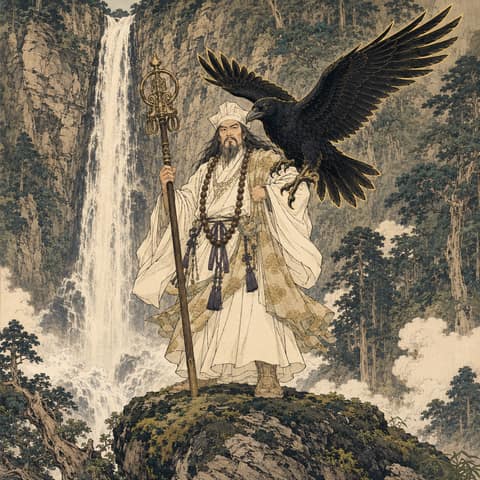
The Yatagarasu is a sacred bird sent from heaven during the legendary Eastern Expedition of Emperor Jimmu, guiding his forces on the path from Kumano to Yamato. According to the *Nihon Shoki* (Chronicles of Japan), Takamimusubi-no-Mikoto dispatched the Yatagarasu to lead Emperor Jimmu's party when they were lost in steep, treacherous mountains[1]. Similarly, the *Kojiki* (Records of Ancient Matters) describes a giant crow appearing as a guide during their advance from Kumano to Yoshino[2]. Its role is not that of a fighting bird, but rather the embodiment of divine will, visualizing the path one must take.

The Yatagarasu widely developed in later ages not only as the divine messenger of the Kumano faith but also as a symbol of the sun, direction, and victory. The image of the three-legged crow resonates with the ancient East Asian concept of the sun bird, and in Japan, it connects to the crow-shaped characters (karasu-moji) on the Kumano Goou Houin (sacred talisman), its divine virtue of guidance, and the modern emblem of the Japan Football Association (JFA)[3]. Rather than a yokai, this sacred bird is closer to a divine messenger or deity—an entity that bridges heaven's will with the course of action when people are geographically or politically lost. While Sarutahiko-no-Mikoto serves as the guide for the descent of the heavenly grandchild (Tenson Korin), the Yatagarasu stands as the black marker that cuts through the darkness of the mountains in the tale of the formation of royal authority during the Eastern Expedition.

When handling the Yatagarasu in a yokai compendium, it is necessary to emphasize its function within mythology rather than its eeriness as a monstrous bird. It is not a bird that misleads people, but one that ends their wandering. Through the overlapping of mountain darkness, political legitimacy, the Kumano faith, and solar bird iconography, the black crow reverses its role from an ominous omen to a holy signpost opening the way forward.

Folklore & Legends

The tale of the Yatagarasu holds deep meaning within the epic of migration and conquest that is the Eastern Expedition. For forces landing from the sea, Kumano was the entrance to deep mountains, and to reach Yamato, they had to cross rugged trails. In the account of the *Nihon Shoki*, the heavenly gods dispatch the Yatagarasu at precisely this juncture[1]. In other words, the appearance of the crow is not merely animal guidance, but a political and religious apparatus demonstrating that Jimmu's march is supported by the will of heaven.

The Yatagarasu of the *Kojiki* is also depicted as the guide on the road progressing from Kumano to Yoshino[2]. The description of a giant crow leading the way overlaps with the human experience of relying on the flight direction or calls of birds when lost in the mountains. However, in the context of the *Kiki* (the *Kojiki* and *Nihon Shoki*), this transcends natural observation; it is elevated to divine guidance, where geographical pathfinding becomes a myth supporting the legitimacy of royal authority.

Within the Kumano faith, the crow secured a special position as the messenger of the gods. The crow characters drawn on the Kumano Goou Houin carry the power of vows and talismans, and the image of the crow became the symbol of Kumano and guidance[3]. Since the modern era, the adoption of the Yatagarasu for the Japan Football Association's emblem is a reinterpretation of its character to "open the way" and "guide to victory." The sacred bird of ancient mythology continues to live on today as a symbol for breaking through hesitation.

The "Yata" (eight hand-spans) in Yatagarasu should be read not merely as physical enormity, but as a term denoting mythological scale. Precisely because it is not an ordinary crow, but a bird possessing dimensions that transcend human travel, it qualifies to fly ahead of Jimmu's party. Even before its three-legged form was emphasized, this bird was already not a standard animal, but a signpost traversing between heaven and earth.

By intertwining with the mountain asceticism of Kumano, the Yatagarasu transformed from a geographical guide to a religious divine messenger. For those making a pilgrimage to Kumano, traversing mountain paths is both physical movement and a process of approaching a sacred realm. The power of the crow-character talismans and vows indicates that the bird became not just a guide, but a medium connecting human words and promises to the gods[3].

The Yatagarasu as a modern sports symbol may seem like a repurposing of ancient myth, but its meaning has not strayed far. Victory is not merely defeating an opponent; it is also about finding the direction to advance without hesitation. Thus, from ancient royal mythology to modern stadiums, the Yatagarasu survives as a symbol of course and resolution.

Related Yokai

Yokai deeply tied to this one in legend.

Detailed Analysis

In this version, we read the Yatagarasu as the "divine messenger who opens the way." The Yatagarasu is not a war god who strikes down enemies, but a presence that indicates where one should go. In the tale of the Eastern Expedition, when the party is lost on the mountain paths of Kumano, the heavenly gods do not increase their army, but send a single crow[1]. Herein lies the essence of this sacred bird. Bestowing direction, rather than power, is the divine virtue of the Yatagarasu.

The Yatagarasu in the *Kiki* binds geography and legitimacy simultaneously. The road entering Yamato from Kumano is not a mere mountain path, but a boundary that must be crossed for a new royal authority to be established. The scene in the *Kojiki* where the crow leads the way not only shows the route through the mountains but narrates that Jimmu's progression is approved by the gods[2]. The direction the bird flies directly becomes the political course.

The iconography of the three legs vastly expanded later understandings of the Yatagarasu. The three-legged crow overlaps with the East Asian concept of the sun bird, granting Japan's Yatagarasu the meanings of the sun, direction, and heavenly order[3]. However, the strongest aspect in the original text of the *Kiki* is not "three legs" but "guidance." Therefore, this version does not lean too heavily on the splendor of its iconography, but centers on the primal sensation of a black bird flying ahead on a dark mountain road.

Within the Kumano faith, the Yatagarasu gained a concrete place of worship as a divine messenger. The crow characters of the Kumano Goou Houin are not mere decorations; they are signs carrying the power of vows and talismans. While crows are often viewed as ominous scavengers of carrion, they also become birds that carry the words of the gods. This duality prevents the Yatagarasu from being reduced to a simple, cheerful mark of victory. The depth of the Kumano mountains and its mythology lies in the fact that a black bird becomes a holy guide.

The modern image of the Yatagarasu is also read as a symbol of sports victories and indicating a team's course[3]. Yet, at its root is the experience of a signpost appearing ahead when a lost person can no longer proceed alone. The Yatagarasu of this version does not explain the answer at length. It simply flies ahead. Whether to follow or not is left entirely to the humans.

In this version, we also want to draw attention to the Yatagarasu's blackness. Crows are frequently viewed as inauspicious birds, but in the context of Kumano, they become messengers of the gods. Where the ominous and the sacred invert, there lies the profound depth of mountain asceticism. Proceeding without losing sight of the black bird on a dark mountain path is akin to reading divine will in the dark.

Furthermore, the Yatagarasu is a guide who speaks few words. It does not stand before them as a god like Sarutahiko, but flies ahead as a bird. Humans must interpret the direction of its flight and advance on their own two feet. Guidance is not forced; it demands reading. Therein lies the quiet severity of the Yatagarasu.

Even today, when the three-legged image and the soccer emblem are widely known, the root of this sacred bird remains on that mythological mountain path cutting from Kumano to Yamato. Stripping away the glamorous symbolic layers, what remains at the end is a single, giant crow flying ahead of a lost party. That simple scene is the strongest image of the Yatagarasu.

Because of this, the Yatagarasu symbolizes not the destination itself, but the trust required to head toward the destination. When the road is unseen, a person must first believe in the direction they are advancing. The leading flight of the black bird is the mythological gesture that gives form to that trust.

Character Profile

This section is our own creative profile for storytelling. It is not historical fact or scholarship.

Yokai Type
Kami
Rarity
Divine
Personality
It flies quietly ahead, indicating only the course for those who are lost. It does not speak excessively, acting as a guide who waits for its followers to make their own resolutions.
Compatibility
転機、旅立ち、進路選択の前で迷っている人と相性がよい。勝敗よりも、正しい方向を見つけたい人に向く。
Abilities
Transmission of divine willMountain path guidanceIndication of directionKumano divine messengerSun bird symbolismTalisman of vowsGuidance to victory
Weaknesses
It does not possess military force to change the tide of battle itself. If humans do not accept the path it shows, its guidance merely passes by as the shadow of a bird.
Habitat
Kumano Sanzan, the Kumano Kodo trails, mountain paths in the legends of the Eastern Expedition, the Kumano Goou Houin, and the boundaries of journeys where the way is lost.

For more detailed information and diagnosis results about The Sacred Bird Leading from Kumano to Yamato: Yatagarasu, please click here.

Sources & References

3
  1. 日本書紀舎人親王ほか((奈良時代の勅撰正史), 720) [古典文献] Reference
  2. 古事記太安万侶(撰録)((現存最古の日本神話・史書), 和銅5年(712年)) [古典文献] Reference葦原中国平定段で天若日子の侍女「天佐具売」が雉の鳴女を射よと唆す。天邪鬼の語源とされる天探女の異表記。
  3. 八咫烏·神武東征の道案内·JFA エンブレム『日本書紀』『古事記』·『新撰姓氏録』(神社·世界遺産·修験道·中世史, 記紀·平安期·1931) [宗教·神社·世界遺産·民俗] Reference神武東征の山中道案内の霊鳥。 高皇産霊尊が遣わしたとされる。 三本足は平安期の三足烏 (太陽の精) 信仰との習合。 1931 年中村覚之助顕彰で日名子実三が JFA シンボル化。

Interested in this type of yokai?

Discover the yokai most similar to your personality with our yokai diagnosis

Start Yokai Diagnosis

Meet your guardian yokai at the shrine

Draw an omikuji fortune and discover the yokai watching over you today.