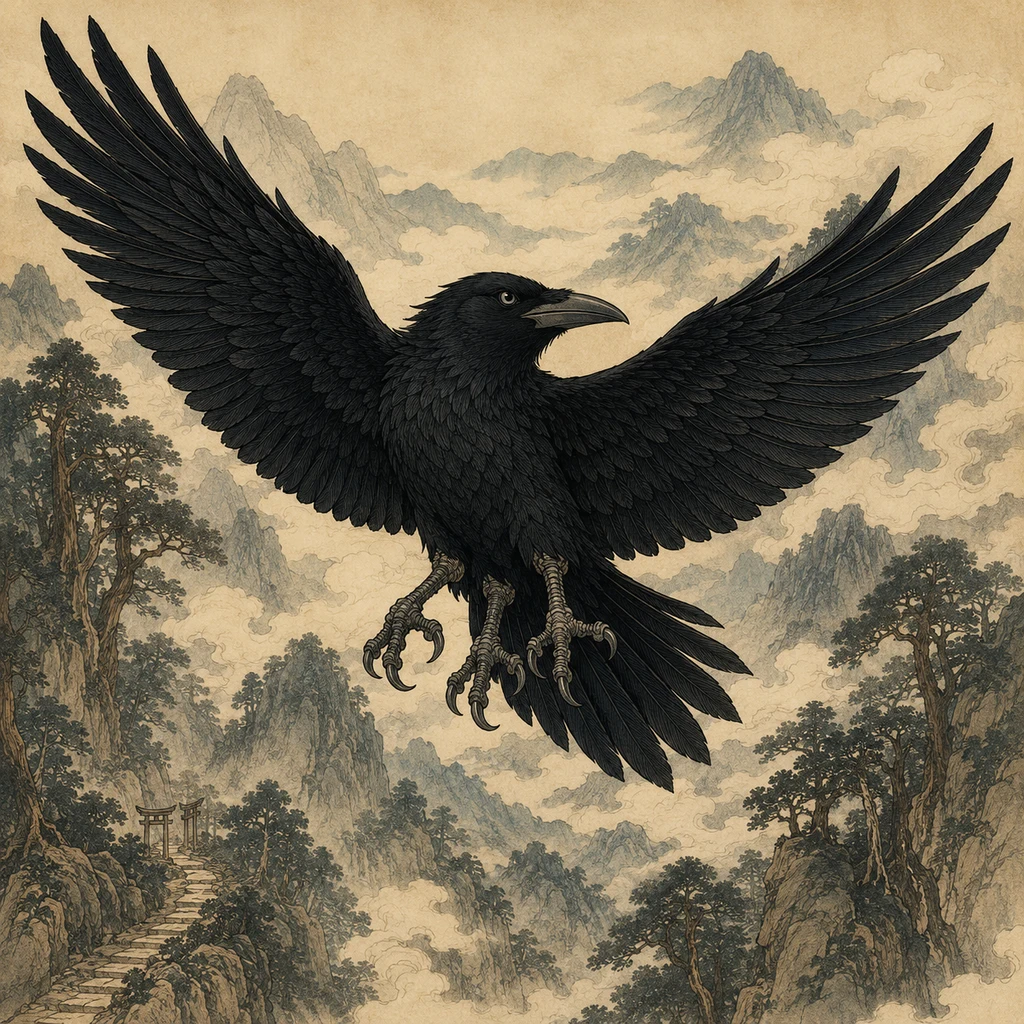
YatagarasuThe Sacred Bird Leading from Kumano to Yamato: Yatagarasu
yatagarasu
Detailed Description
In this version, we read the Yatagarasu as the "divine messenger who opens the way." The Yatagarasu is not a war god who strikes down enemies, but a presence that indicates where one should go. In the tale of the Eastern Expedition, when the party is lost on the mountain paths of Kumano, the heavenly gods do not increase their army, but send a single crow[1]. Herein lies the essence of this sacred bird. Bestowing direction, rather than power, is the divine virtue of the Yatagarasu.
The Yatagarasu in the *Kiki* binds geography and legitimacy simultaneously. The road entering Yamato from Kumano is not a mere mountain path, but a boundary that must be crossed for a new royal authority to be established. The scene in the *Kojiki* where the crow leads the way not only shows the route through the mountains but narrates that Jimmu's progression is approved by the gods[2]. The direction the bird flies directly becomes the political course.
The iconography of the three legs vastly expanded later understandings of the Yatagarasu. The three-legged crow overlaps with the East Asian concept of the sun bird, granting Japan's Yatagarasu the meanings of the sun, direction, and heavenly order[3]. However, the strongest aspect in the original text of the *Kiki* is not "three legs" but "guidance." Therefore, this version does not lean too heavily on the splendor of its iconography, but centers on the primal sensation of a black bird flying ahead on a dark mountain road.
Within the Kumano faith, the Yatagarasu gained a concrete place of worship as a divine messenger. The crow characters of the Kumano Goou Houin are not mere decorations; they are signs carrying the power of vows and talismans. While crows are often viewed as ominous scavengers of carrion, they also become birds that carry the words of the gods. This duality prevents the Yatagarasu from being reduced to a simple, cheerful mark of victory. The depth of the Kumano mountains and its mythology lies in the fact that a black bird becomes a holy guide.
The modern image of the Yatagarasu is also read as a symbol of sports victories and indicating a team's course[3]. Yet, at its root is the experience of a signpost appearing ahead when a lost person can no longer proceed alone. The Yatagarasu of this version does not explain the answer at length. It simply flies ahead. Whether to follow or not is left entirely to the humans.
In this version, we also want to draw attention to the Yatagarasu's blackness. Crows are frequently viewed as inauspicious birds, but in the context of Kumano, they become messengers of the gods. Where the ominous and the sacred invert, there lies the profound depth of mountain asceticism. Proceeding without losing sight of the black bird on a dark mountain path is akin to reading divine will in the dark.
Furthermore, the Yatagarasu is a guide who speaks few words. It does not stand before them as a god like Sarutahiko, but flies ahead as a bird. Humans must interpret the direction of its flight and advance on their own two feet. Guidance is not forced; it demands reading. Therein lies the quiet severity of the Yatagarasu.
Even today, when the three-legged image and the soccer emblem are widely known, the root of this sacred bird remains on that mythological mountain path cutting from Kumano to Yamato. Stripping away the glamorous symbolic layers, what remains at the end is a single, giant crow flying ahead of a lost party. That simple scene is the strongest image of the Yatagarasu.
Because of this, the Yatagarasu symbolizes not the destination itself, but the trust required to head toward the destination. When the road is unseen, a person must first believe in the direction they are advancing. The leading flight of the black bird is the mythological gesture that gives form to that trust.
Source Information
種類全体の出典reference
古事記
著者: 太安万侶(撰録)
年代: 和銅5年(712年)
出版社: (現存最古の日本神話・史書)
種類全体の出典reference
日本書紀
著者: 舎人親王ほか
年代: 720
出版社: (奈良時代の勅撰正史)
種類全体の出典reference
八咫烏·神武東征の道案内·JFA エンブレム
著者: 『日本書紀』『古事記』·『新撰姓氏録』
年代: 記紀·平安期·1931
出版社: 神社·世界遺産·修験道·中世史
バージョン固有出典 (熊野より大和へ導く霊鳥・八咫烏)reference
古事記
著者: 太安万侶(撰録)
年代: 和銅5年(712年)
出版社: (現存最古の日本神話・史書)
バージョン固有出典 (熊野より大和へ導く霊鳥・八咫烏)reference
日本書紀
著者: 舎人親王ほか
年代: 720
出版社: (奈良時代の勅撰正史)
バージョン固有出典 (熊野より大和へ導く霊鳥・八咫烏)reference
八咫烏·神武東征の道案内·JFA エンブレム
著者: 『日本書紀』『古事記』·『新撰姓氏録』
年代: 記紀·平安期·1931
出版社: 神社·世界遺産·修験道·中世史
Personality
It flies quietly ahead, indicating only the course for those who are lost. It does not speak excessively, acting as a guide who waits for its followers to make their own resolutions.
Compatibility
転機、旅立ち、進路選択の前で迷っている人と相性がよい。勝敗よりも、正しい方向を見つけたい人に向く。
Abilities & Skills
Weaknesses
It does not possess military force to change the tide of battle itself. If humans do not accept the path it shows, its guidance merely passes by as the shadow of a bird.
🔮Test your compatibility with Yatagarasu now!
Analyze your personality and values to get a detailed compatibility rating with this yokai.
Free, simple, and results in just minutes.