Udaうだ

2 yokai rooted in Uda. Explore the legends tied to this land.

Also known as: 宇陀郡 / 宇陀市
  • Yatagarasu

    Yatagarasu

    Divine

    yatagarasu

    The Sacred Bird Leading from Kumano to Yamato: Yatagarasu

    Divine Spirit / DeityKumano Hongu Taisha, Kumano Sanzan (Present-day Wakayama Prefecture) / Uda, Yamato Province (Present-day Nara Prefecture)

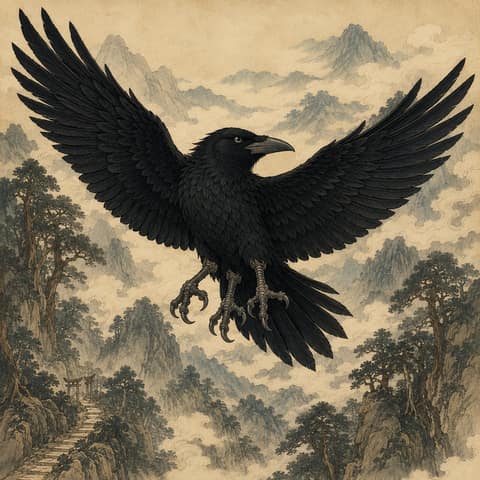
    In this version, we read the Yatagarasu as the "divine messenger who opens the way." The Yatagarasu is not a war god who strikes down enemies, but a presence that indicates where one should go. In the tale of the Eastern Expedition, when the party is lost on the mountain paths of Kumano, the heavenly gods do not increase their army, but send a single crow. Herein lies the essence of this sacred bird. Bestowing direction, rather than power, is the divine virtue of the Yatagarasu. The Yatagarasu in the *Kiki* binds geography and legitimacy simultaneously. The road entering Yamato from Kumano is not a mere mountain path, but a boundary that must be crossed for a new royal authority to be established. The scene in the *Kojiki* where the crow leads the way not only shows the route through the mountains but narrates that Jimmu's progression is approved by the gods. The direction the bird flies directly becomes the political course. The iconography of the three legs vastly expanded later understandings of the Yatagarasu. The three-legged crow overlaps with the East Asian concept of the sun bird, granting Japan's Yatagarasu the meanings of the sun, direction, and heavenly order. However, the strongest aspect in the original text of the *Kiki* is not "three legs" but "guidance." Therefore, this version does not lean too heavily on the splendor of its iconography, but centers on the primal sensation of a black bird flying ahead on a dark mountain road. Within the Kumano faith, the Yatagarasu gained a concrete place of worship as a divine messenger. The crow characters of the Kumano Goou Houin are not mere decorations; they are signs carrying the power of vows and talismans. While crows are often viewed as ominous scavengers of carrion, they also become birds that carry the words of the gods. This duality prevents the Yatagarasu from being reduced to a simple, cheerful mark of victory. The depth of the Kumano mountains and its mythology lies in the fact that a black bird becomes a holy guide. The modern image of the Yatagarasu is also read as a symbol of sports victories and indicating a team's course. Yet, at its root is the experience of a signpost appearing ahead when a lost person can no longer proceed alone. The Yatagarasu of this version does not explain the answer at length. It simply flies ahead. Whether to follow or not is left entirely to the humans. In this version, we also want to draw attention to the Yatagarasu's blackness. Crows are frequently viewed as inauspicious birds, but in the context of Kumano, they become messengers of the gods. Where the ominous and the sacred invert, there lies the profound depth of mountain asceticism. Proceeding without losing sight of the black bird on a dark mountain path is akin to reading divine will in the dark. Furthermore, the Yatagarasu is a guide who speaks few words. It does not stand before them as a god like Sarutahiko, but flies ahead as a bird. Humans must interpret the direction of its flight and advance on their own two feet. Guidance is not forced; it demands reading. Therein lies the quiet severity of the Yatagarasu. Even today, when the three-legged image and the soccer emblem are widely known, the root of this sacred bird remains on that mythological mountain path cutting from Kumano to Yamato. Stripping away the glamorous symbolic layers, what remains at the end is a single, giant crow flying ahead of a lost party. That simple scene is the strongest image of the Yatagarasu. Because of this, the Yatagarasu symbolizes not the destination itself, but the trust required to head toward the destination. When the road is unseen, a person must first believe in the direction they are advancing. The leading flight of the black bird is the mythological gesture that gives form to that trust.
  • Betobeto-san

    Betobeto-san

    Epic

    betobeto-san

    The Footsteps Echoing on the Night Road

    Mountain/Field YokaiUda District, Yamato Province (Present-day Uda City area, Nara Prefecture) / Shizuoka Prefecture

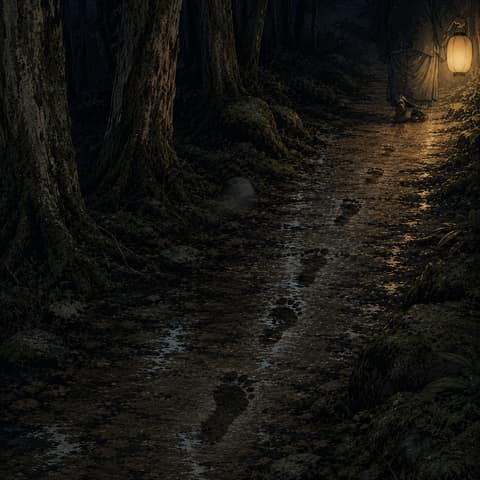
    In this version, we interpret Betobeto-san as an "invisible companion of footsteps." While there are many unseen yokai, it is rare to find one like Betobeto-san that is established solely by the sense of distance in sound. The footsteps seem to be right behind you, yet they never catch up. Turn around, and they vanish; start walking, and they begin again. Through this repetition, the walker is forced to harbor the unshakable sensation that "I am not alone," a feeling they can neither prove nor deny. It is crucial that the stage for this yokai is the "road." A mysterious sound inside a house would be a phantom of the parlor or ceiling, but Betobeto-san clings to the body in transit. On a night road, a person has no choice but to move forward; they cannot continuously check behind them. When footsteps occur in this context, fear is locked just outside the field of vision. Because the sound from behind approaches from the place the human body finds hardest to verify, it generates a far more sustained anxiety than a yokai with a physical form. The phrase "Please go ahead" (Osaki e okoshi) is the central etiquette of this version. Betobeto-san is not exterminated, but rather given a turn to pass. This concept reflects a folkloric attitude of treating the yokai not as an enemy, but as a fellow traveler encountered on the road. By calling out, the invisible footsteps transform from a threat behind into a companion walking ahead. Changing the position of the fear is the best way to handle this anomaly. Shigeru Mizuki's iconography converted a formless sound into an approachable yokai. The figure resembling a small shadow wearing a hat was easy even for children to remember, popularizing Betobeto-san as a character. However, in this version, the focus is placed heavily on sound rather than imagery. If seeing a round figure puts one at ease, then half of Betobeto-san's original power is lost. Precisely because it is unseen, it expands and contracts within the imagination of the listener. Despite being a yokai of little harm, Betobeto-san alters the very nature of solitary walking. On a path that should be empty, another rhythm that mimics one's own stride overlaps. Ignore the sound, and it stays behind; acknowledge it and yield, and it moves ahead. In other words, this anomaly teaches the minimum folkloric manners required to walk a road alongside the unseen. In this version, the footsteps are read not only as the "presence of an other," but also as the "echo of one's own anxiety." Betobeto-san's sound appears to come from the outside, yet it syncs perfectly with one's own walking. If it were completely an other, the distance should fluctuate, but because it continues at exactly the same interval, the listener cannot separate the external anomaly from their internal unease. Therefore, the phrase "Please go ahead" is simultaneously a greeting directed at an external yokai and a physical gesture of sending one's own anxiety forward. By shifting what is stuck to one's back to the front, a person is finally able to keep walking. Betobeto-san is not a monster to be slain, but a yokai that realigns the physical and mental rhythm of the walker. What remains at the end of this version is the small ethic of yielding the road. Rather than forcefully pushing forward while ignoring the unseen, one offers a brief word to the presence that might be there. Betobeto-san seems like a weak anomaly, but it serves as a reminder that humans do not monopolize the dark roads.