Betobeto-san

betobeto-san

Betobeto-san

Betobeto-san

Their soul is listening — speak, and they will answer.

Basic Description

Betobeto-san is a night-road yokai that never reveals its form, accompanying people from behind solely through the sound of footsteps. Widely known primarily around Uda District in Nara Prefecture, it is said that while walking down a dark road, one might hear wet, smacking footsteps—"beto-beto" or "peta-peta"—trailing behind them, yet turning around reveals no one[1]. The terror it induces does not stem from a grotesque appearance, but from the fact that the distance of the footsteps never changes. Neither catching up nor falling behind, the footsteps perfectly match the person's stride, forcing the walker to carry an invisible companion on their back.

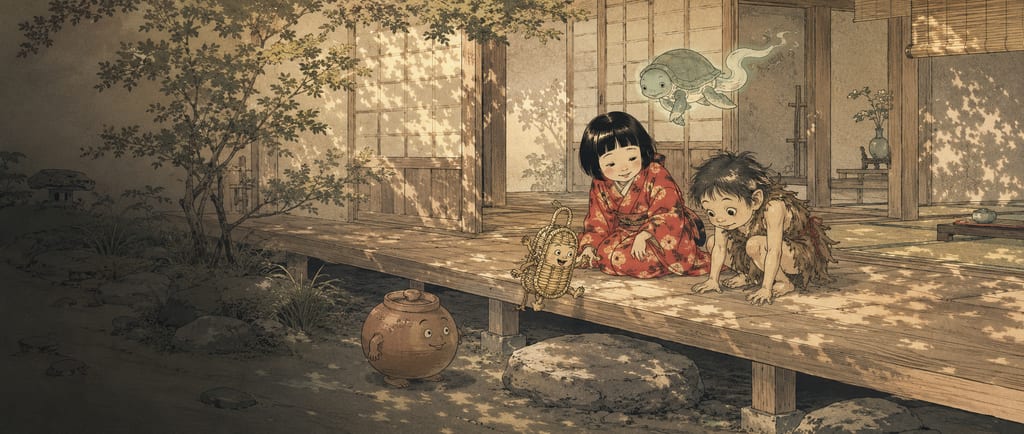
Rather than a yokai that inflicts harm, Betobeto-san is an anomaly of the boundary that can be safely passed by showing courtesy to the unseen. It is said that if one calls out, "Betobeto-san, please go ahead" (Betobeto-san, osaki e okoshi) and yields the path, the footsteps will move to the front and eventually disappear[2]. This etiquette demonstrates the folkloric wisdom of not eliminating fear through force, but acknowledging the other's existence and yielding the right of way. While Shigeru Mizuki's illustrations gave it a round, friendly appearance[3], the original Betobeto-san is a formless presence born from the sounds of night roads, wet soil, and the emptiness behind one's back.

There is a vast distance between this yokai's visualized modern character form and the formless folkloric experience it originated from. Though it gained a small body in pictures, the core of the legend remains the footsteps approaching from behind. Therefore, to truly understand Betobeto-san, rather than looking for its figure, one must imagine the sensation of gaining an extra set of walking sounds on a dark, lonely road.

Folklore & Legends

The lore of Betobeto-san perfectly illustrates how sounds on a night road are monsterized by human imagination. On dark village paths or mountain trails, the sound of one's own straw sandals, the dampness of the earth, the echoes of the trees, and the feeling of someone walking behind easily intermingle. When the experience of "hearing footsteps even though no one is there" occurs, the sound is no longer a mere illusion, but becomes a named companion. Documented in the *Sogo Nihon Minzoku Goi* (Comprehensive Vocabulary of Japanese Folklore) as a footstep anomaly, Betobeto-san is crucial not for describing a physical form, but as folkloric data conveying the repetition of sound and how people processed it[1].

The method to handle this anomaly is not an exorcism spell, but a greeting to yield the road. By saying, "Please go ahead," the unseen footsteps shift from behind to the front. Within this lies the sensibility of not treating whoever one encounters on a mountain path or village boundary with disrespect. Be it a human or a spirit, one must make way for those who wish to pass. Betobeto-san is a yokai that processes fear through etiquette, preserving the passing customs of folkloric society as a small ghost story[2].

The modern image of Betobeto-san was drastically changed by Shigeru Mizuki's drawings. A form with a round head and short legs makes an invisible, sound-only anomaly easy to remember as a character[3]. However, that visualization does not fully explain its original terror. Betobeto-san's true nature is not the small yokai depicted in pictures, but the footsteps that echo again when you start walking, even though every time you look back, there is only emptiness. That is why this yokai is so strong precisely because it has no form. Because it cannot be seen, the walker must continuously imagine what is behind them.

Even among footstep anomalies, Betobeto-san is not a monster that corners and attacks people. Rather, it is spoken of as a companion who will yield the road if spoken to. In this regard, the sense of coexistence with unseen entities on mountain trails and village roads is profound. Instead of completely erasing the fear, one passes safely by acknowledging the other's right to traverse. Remaining there is the ancient sensibility that humans are not the sole masters of the road.

Furthermore, a yokai consisting only of footsteps changes its intensity depending on the physical state of the listener. If you are tired, you are more likely to feel something behind you; if you hurry, the footsteps sound as if they are hurrying too. Betobeto-san is an anomaly that parasitizes the very act of human walking. Because of this, despite having no form, once you know the tale, it becomes a yokai anyone might encounter on a night road.

Detailed Analysis

In this version, we interpret Betobeto-san as an "invisible companion of footsteps." While there are many unseen yokai, it is rare to find one like Betobeto-san that is established solely by the sense of distance in sound. The footsteps seem to be right behind you, yet they never catch up. Turn around, and they vanish; start walking, and they begin again. Through this repetition, the walker is forced to harbor the unshakable sensation that "I am not alone," a feeling they can neither prove nor deny[1].

It is crucial that the stage for this yokai is the "road." A mysterious sound inside a house would be a phantom of the parlor or ceiling, but Betobeto-san clings to the body in transit. On a night road, a person has no choice but to move forward; they cannot continuously check behind them. When footsteps occur in this context, fear is locked just outside the field of vision. Because the sound from behind approaches from the place the human body finds hardest to verify, it generates a far more sustained anxiety than a yokai with a physical form.

The phrase "Please go ahead" (Osaki e okoshi) is the central etiquette of this version. Betobeto-san is not exterminated, but rather given a turn to pass[2]. This concept reflects a folkloric attitude of treating the yokai not as an enemy, but as a fellow traveler encountered on the road. By calling out, the invisible footsteps transform from a threat behind into a companion walking ahead. Changing the position of the fear is the best way to handle this anomaly.

Shigeru Mizuki's iconography converted a formless sound into an approachable yokai. The figure resembling a small shadow wearing a hat was easy even for children to remember, popularizing Betobeto-san as a character[3]. However, in this version, the focus is placed heavily on sound rather than imagery. If seeing a round figure puts one at ease, then half of Betobeto-san's original power is lost. Precisely because it is unseen, it expands and contracts within the imagination of the listener.

Despite being a yokai of little harm, Betobeto-san alters the very nature of solitary walking. On a path that should be empty, another rhythm that mimics one's own stride overlaps. Ignore the sound, and it stays behind; acknowledge it and yield, and it moves ahead. In other words, this anomaly teaches the minimum folkloric manners required to walk a road alongside the unseen.

In this version, the footsteps are read not only as the "presence of an other," but also as the "echo of one's own anxiety." Betobeto-san's sound appears to come from the outside, yet it syncs perfectly with one's own walking. If it were completely an other, the distance should fluctuate, but because it continues at exactly the same interval, the listener cannot separate the external anomaly from their internal unease.

Therefore, the phrase "Please go ahead" is simultaneously a greeting directed at an external yokai and a physical gesture of sending one's own anxiety forward. By shifting what is stuck to one's back to the front, a person is finally able to keep walking. Betobeto-san is not a monster to be slain, but a yokai that realigns the physical and mental rhythm of the walker.

What remains at the end of this version is the small ethic of yielding the road. Rather than forcefully pushing forward while ignoring the unseen, one offers a brief word to the presence that might be there. Betobeto-san seems like a weak anomaly, but it serves as a reminder that humans do not monopolize the dark roads.

Character Profile

This section is our own creative profile for storytelling. It is not historical fact or scholarship.

Rarity
Epic
Personality
It does not show itself, but matches your stride and follows closely from behind. Though somewhat imposing, if politely offered the right of way, it obediently moves ahead.
Compatibility
夜道の音、余韻、背後の気配に敏感な人と相性がよい。怖さの中に少しのユーモアや礼儀を見つけられる人にも向く。
Abilities
Footstep trackingInvisibilityStride synchronizationAmplification of rear anxietyRelocation by yielding the roadMaterializing the presence of the night road
Weaknesses
It has almost no power to reveal itself and attack. If its presence is acknowledged and it is politely allowed to pass, the pressure from behind simply vanishes.
Habitat
Night roads around Uda in Nara Prefecture, damp mountain trails, village borders, deserted paths home, and dark routes where footsteps echo.
For more detailed information and diagnosis results about The Footsteps Echoing on the Night Road, please click here.

Sources & References

3
  1. 綜合日本民俗語彙 [古典文献] Reference
  2. 妖怪事典村上健司(毎日新聞社, 2000) [古典文献] Reference
  3. 水木しげるの妖怪事典水木しげる(東京堂出版, 1981) [古典文献] Reference水木しげるが100の妖怪を絵と話でつづった事典。各地の妖怪像を現代に広く定着させた。

Interested in this type of yokai?

Discover the yokai most similar to your personality with our yokai diagnosis

Start Yokai Diagnosis

Meet your guardian yokai at the shrine

Draw an omikuji fortune and discover the yokai watching over you today.