YOKAI.JP

Kami Encyclopedia

Shinto, Buddhist and Daoist deities formally enshrined

77 Yokai|9 Category|Page 2 of 4
Localization in Progress - More content available in Japanese version
View Japanese
Sort by: NameAscending
Izanagi

Izanagi

Legendary

Izanagi

Izanagi no Mikoto, ancestral god of creation, land-birth, and purification

Deity / divine spiritHyogo

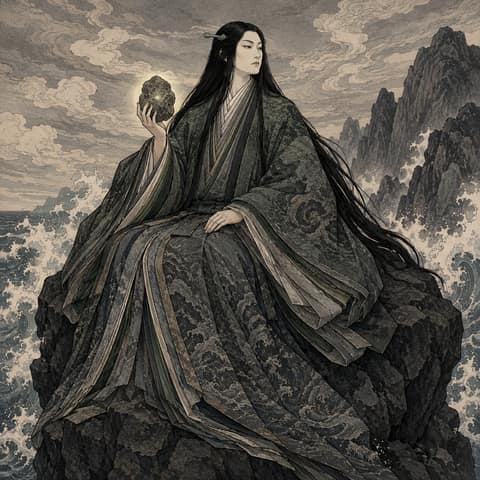
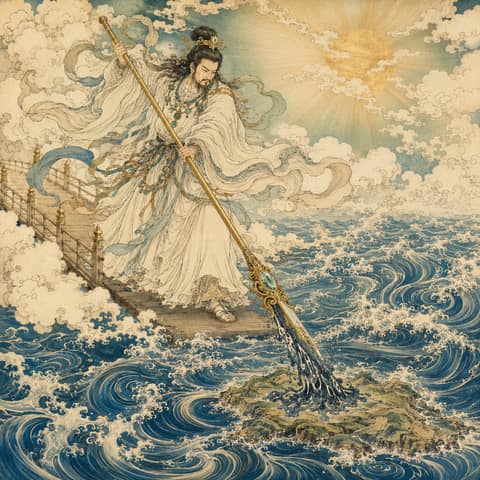
The Seven Generations of the Gods and the cosmology of creation. The basic account covers land-birth and god-birth. Looking more closely, the Seven Generations of the Gods form a creation sequence in their own right. The Kojiki says that after heaven and earth open, the three creator deities and the Separate Heavenly Deities appear, followed by the divine generations beginning with Kuni-no-tokotachi. The line moves from solitary, abstract deities toward paired gods, then finally reaches Izanagi and Izanami as husband and wife. Myth moves from abstraction into relation, sex, marriage, and birth. Their marriage and the birth of the land are the decisive passage from divine potential into a concrete world. The Floating Bridge, the jeweled spear, and Onogoro Island. The scene in which the two gods stand on the Floating Bridge of Heaven and stir the sea with Ame-no-nuboko is one of the most important images in ancient Japanese cosmology. The bridge joins heaven and earth as a vertical world axis. The spear is an instrument of creation. Brine hardening into an island marks the passage from liquid to solid, from formlessness to form. Onogoro Island means something close to an island that congealed by itself, suggesting that creation is not only divine command but also natural self-formation. The scene can be read beside Pangu's separation of heaven and earth, the Indian cosmic egg, and Eurasian myths of stirring primordial waters. The descent to Yomi, an early East Asian Orpheus myth. Izanagi's descent to Yomi, his broken taboo, and his flight from the dead belong to the mythic type in which someone enters the underworld to recover a lost wife and fails after violating a prohibition. The Greek story of Orpheus and Eurydice is the most famous example, while Izanagi's version, written in the Kojiki in 712, is one of East Asia's earliest textual witnesses to the type. The stolen glimpse, the broken command, the pursuing dead, and the protective peaches all echo underworld narratives from India, China, and Europe, suggesting deep affinities across ancient Eurasian religious imagination. Misogi, the origin myth of Shinto purification. After escaping Yomi, Izanagi washes away its pollution at Awagihara. This is the origin myth of misogi and harae. Gods are born as he removes garments and objects from his body; sea deities are born as he washes in the stream; finally, the highest deities emerge from his eyes and nose. The structure binds body, impurity, purity, and divine birth together. The hand-washing before shrine worship, the Nagoshi no Oharae summer purification, and ritual ablutions before major ceremonies all find a mythic source here. Eda Shrine and Izanagi Jingu honor him as the ancestral deity of purification, showing how an ancient myth continues inside living Shinto practice. The Three Precious Children and ancient Japan's cosmic order. Izanagi divides the sky, night, and sea among the Three Precious Children. Amaterasu Omikami receives Takamagahara, the realm of heaven, daylight, and light. Tsukuyomi no Mikoto receives the realm of night, quiet, and calendrical rhythm. Susanoo no Mikoto receives the sea plain, the ocean and its violent force. This threefold division is not only a mythic plot point. It later supports the legitimacy of the imperial line and Ise Shinto. Medieval, early modern, and modern political thought in Japan repeatedly return to this narrative. It is a central line running through Japanese ideas of state, religion, and cosmic order. Taga Taisha, Izanagi Jingu, and Eda Shrine. The three major sacred places of Izanagi correspond to different moments in the myth. Izanagi Jingu in Awaji marks the beginning of land-birth, the marriage of the two gods, and Izanagi's hidden palace. Eda Shrine in Miyazaki marks Awagihara, purification, and the birth of the Three Precious Children. Taga Taisha in Shiga became a popular early modern shrine of long life and vitality. Together these sites turn the sequence of creation, purification, and longevity into geography and pilgrimage, sustaining Izanagi worship across Japan. Motoori Norinaga's Kojiki-den and the formation of kokugaku. Motoori Norinaga, the Edo-period kokugaku scholar, completed the forty-four-volume Kojiki-den in 1798, using rigorous philology and historical linguistics to interpret the Kojiki, including the myths of Izanagi. Debate continues over whether such myths should be read as history, symbolic narrative, or cultural memory, but Norinaga's method laid an important foundation for modern Japanese humanities. Izanagi therefore extends beyond myth alone. He belongs to the intellectual history of kokugaku, Shinto, modern national thought, and postwar folklore studies, and remains a symbolic figure in Japanese religion, scholarship, politics, and culture.

Izanami

Izanami

Legendary

Izanami

Izanami no Mikoto, Ancient Mother Goddess of Birth and Death

Deity / divine spiritMie

The cycle of birth and death: the nature of an ancient mother goddess. The basic profile described Izanami's mythic role; the deeper issue is that she embodies birth and death in a single archaic mother figure. Izanami gives birth to the Oyashima islands and thirty-five nature deities, and even on her deathbed continues to produce gods of mines, earth, and grain from her vomit, urine, and excrement. This resembles the ambivalence of mother goddesses across the ancient world, such as Gaia in Greece, Inanna in Sumer, or Kali in India: the one who gives life also contains death. Izanami is more than a creator deity. She joins birth and death, the living world and the underworld, purity and pollution into one Japanese variation of the archaic mother goddess. Kagutsuchi's birth and the symbolism of fire. Izanami dies because she gives birth to the fire god Kagutsuchi, an event of major symbolic force in ancient Japanese cosmology. Fire begins civilization: forging, pottery, cooking. Yet fire also brings destruction and death. In ancient societies, childbirth itself could threaten a woman's life, and the myth binds those dangers together. Kagutsuchi is born, Izanami dies, and from her dead or dying body arise deities of mines, earth, and grain. This chain makes the material foundations of civilization, metallurgy, agriculture, land-making, emerge from the sacrifice of the mother goddess. The myth gives a stark expression to an ancient worldview: civilization stands on the body of the mother. Yomi no Kuni and the queen of the dead. After burial, Izanami reigns as queen of Yomi no Kuni. This is an unusual structure in ancient myth. Chinese underworlds are often ruled by male figures such as Fengdu or the Lord of Mount Tai; India has Yama, and Greece has Hades. In Japanese myth, however, the realm of the dead is ruled by the former creation goddess. Izanami's rule over Yomi shows the close ancient Japanese linkage of woman, death, and underworld. Later images of Enma, Jizo, and the Sanzu River grow in soil prepared by this imagination of the dead. The idea of death as a feminine principle is one of the most striking points for comparative religion. The burial debate: Izumo and Kumano. The Kojiki names Mount Hiba, on the Izumo-Hoki border, as Izanami's burial place, while a variant in the Nihon Shoki names Kumano in Kii. The two traditions map onto two religious geographies. The Izumo line, Shobara in Hiroshima, Yasugi in Shimane, and Higashi-Izumo in Matsue, connects with Izumo ritual lineages and faith in Ne no Katasukuni. The Kumano line, Hana no Iwaya in Mie and Kumano Hayatama Taisha in Wakayama, connects with Kumano Sanzan worship, Fudaraku sea-crossing beliefs, and Pure Land imagination. Izumo lies to the north, facing the Sea of Japan; Kumano lies to the south, facing the Pacific. Together the two burial traditions form a core problem in the religious geography of ancient Japan. Hana no Iwaya Shrine and ancient iwakura worship. Hana no Iwaya Shrine in Kumano, Mie, is named in the Nihon Shoki as Izanami's burial place and is one of Japan's oldest shrines; it has no shrine hall and worships a forty-five-meter sacred rock as its divine body. Iwakura worship is an old Japanese mode of nature veneration in which trees, boulders, waterfalls, and mountain peaks are treated as places where divine spirits dwell. Later shrine architecture grew out of such natural sacred places, and Hana no Iwaya preserves an especially ancient layer by having no main building. The Otsunakage rite, held on February 2 and October 2, hangs a rope about 170 meters long from the sacred rock to the precincts; it is a rare living folk practice that carries ancient rock worship into the present. "One thousand a day, fifteen hundred a day": the cosmology of life and death. The exchange at Yomotsu Hirasaka is the moment when Japanese myth fixes the order of life and death. Izanami says she will kill one thousand people a day; Izanagi answers that he will cause fifteen hundred to be born. The scene is grief after marital separation, but also a cosmic declaration that death and life, underworld and this world, feminine and masculine principles will stand in permanent tension. Death counts one thousand; birth counts fifteen hundred. Life exceeds death. That inequality becomes a religious expression of life's continuation. Japanese myth does not remain a simple tragedy; it turns the dialectic of life and death into cosmology. Izanami reevaluated in the twenty-first century. Postwar feminist myth studies and cultural criticism have moved beyond reading Izanami only as a victim of patriarchal myth. They also understand her as an embodiment of the ancient mother goddess who unites birth, death, and the underworld. Motoori Norinaga's Kojiki-den, completed in 1798, laid the philological foundation; later comparative mythologists such as Orikuchi Shinobu, Obayashi Taryo, and Yoshida Atsuhiko added new interpretive layers. In the twenty-first century, Izanami is no longer merely a mythic character. She has become an image of the feminine root of Japanese myth and of cosmic order as mother, continuing to shape religion, scholarship, and cultural imagination.

Jingu-kogo

Jingu-kogo

Divine

jingu-kogo

The Empress Who Received an Oracle and Crossed the Sea

Deity / Divine SpiritFukuokaOsaka

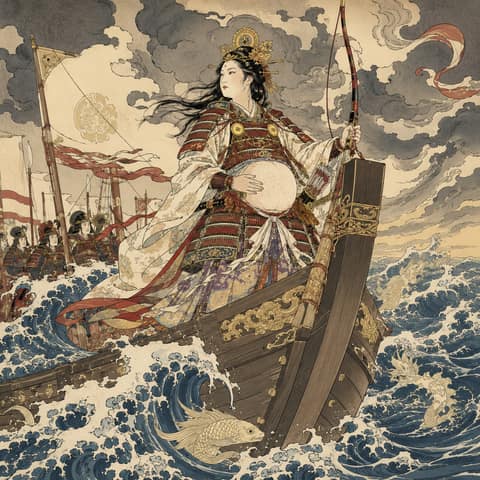
This version of Empress Jingu is read not as an introduction to a historical figure, but as a body that receives divine oracles. In the scene where divine will descends before Emperor Chuai, the empress is not merely a consort, but a vessel through which the voice of the gods passes. In ancient kingship, politics and ritual were not separated. Her decisions were simultaneously military actions and rituals executing divine will. The mythological nature of the Three Han conquest tale is the core of this version. The plot of crossing the sea while pregnant, delaying childbirth with a stone, and returning to give birth to Emperor Ojin seems bizarre from a modern realistic perspective. But viewed as myth, it is the story of a woman carrying a future king in her womb, crossing the outer seas under the protection of the gods. The mother's body itself becomes the ship carrying the nation's future. The sweetfish fishing at Matsura is important as a scene that grounds her myth to the land. Within the large-scale expedition tale, a subtle action of fishing at Tamashima village to divine fortunes is included. Here, Empress Jingu becomes a shamanistic figure reading waterside omens, concurrently with being the protagonist of a maritime military myth. Grand epic and minute folklore overlap in the same person. Empress Jingu in the Hachiman belief is not only the mother of Emperor Ojin but a deity supporting Hachiman's spiritual authority. When the Hachiman god spreads as the protector of the samurai, there is an underlying complex structure of mother and child, oracles and military, maritime transport and national protection. Extracting the empress alone, severing the relationship lines with Hachiman and the three Sumiyoshi deities, halves her power. To visualize this version, an armored queen alone is insufficient. The forest of Kashii, the rough sea, the divine majesty of Sumiyoshi, the prince in her womb, the caught sweetfish, the expedition fleet. By layering these elements, Empress Jingu emerges not as a fighting woman, but as a presence imbued with mythological kingship. In modern diagnoses and articles, Empress Jingu becomes a symbol of the "power to bear a role." Her story resonates strongly when one must accept a massive flow even if undesired, or when one must proceed while holding what must be protected in the womb or heart. However, it requires the honesty to treat her not as a historical fact, but as a deity created by the Kiki myths and shrine beliefs. The terror of Empress Jingu lies in divine will larger than personal emotion passing through her body. One who receives an oracle is simultaneously bound by it. She is not a hero adventuring freely, but an existence pushed forward by the gods and the future of kingship. Including that weight ensures the legend is not merely a tale of victory. The relationship with Emperor Ojin is the most crucial line connecting Empress Jingu to the Hachiman belief. The prince residing in her womb is at the center of the story even before birth. The mother's expedition, the gods' protection, and the birth upon return connect to prepare the sacredness of the Hachiman god. The empress is the entity that carries Hachiman's prehistory within her body. Furthermore, Empress Jingu is a deity that moves locations. Place names like Kashii, Matsura, Sumiyoshi, and Usa hold meaning in the story, each remaining as modern sites of worship. Linking this with YOKAI.JP's place articles allows one to walk the actual geography while reading the myth. There is practical value in adding this page there.

Juroujin

Juroujin

Legendary

じゅろうじん

Juroujin, the Pure Sage of Longevity Accompanied by a Black Stag

Divine Spirit / DeityChina (Daoist avatar of the South Pole Old Man Star) / Introduced during the Muromachi period / Pilgrimage sites of the Seven Lucky Gods in Kanto and Kinki (Zen, Obaku, and Tendai sect temples)

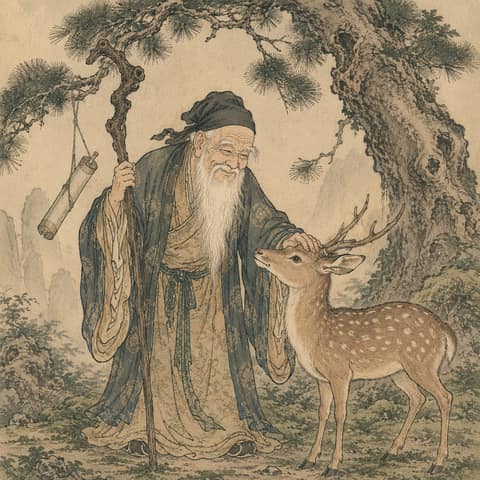
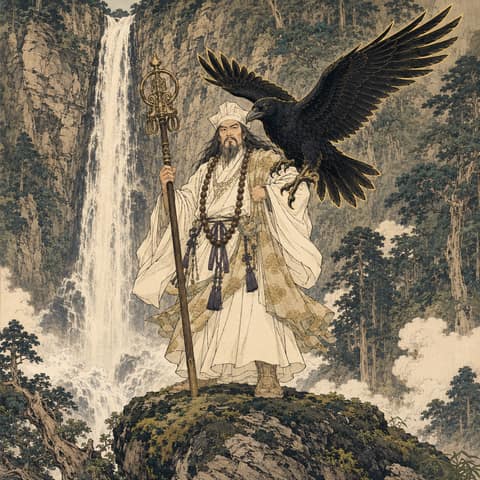
Juroujin's true form is the South Pole Old Man Star (Canopus). This is the alpha star of the constellation Carina—the second brightest star in the entire night sky after Sirius. Because it only appears low in the southern sky of the Northern Hemisphere, ancient Chinese lore passed down the saying, "The year it can be seen is a year of universal peace; the land where it can be seen is a land of longevity." Already registered as an astronomical deity in the 'Treatise on Astrology' of the *Records of the Grand Historian* and the 'Treatise on Astronomy' of the *Book of Jin*, it forms the core of Longevity Star worship in Chinese folk belief. Daoism personified this star as the Longevity Star or Longevity Sage, arranging auspicious items alongside him: a black stag said to live 1,500 years, the Peaches of Immortality of the Queen Mother of the West (which extend life by a thousand years with a single bite), and a gourd containing the elixir of immortality. Iconographically, he is depicted as a short old man with a long head and a long beard, tying a sutra scroll to the head of his staff. A "short body and long head" is a physical omen of longevity in Chinese physiognomy, a formative principle entirely identical to that of his counterpart, Fukurokuju. This is the reason the two have long been considered the same deity under different names. His arrival in Japan occurred in the late Muromachi period (15th century), routed through monks traveling to Song and Ming China and the importation of Daoist and Buddhist paintings by Zen monasteries. The prototype of the current Seven Lucky Gods was formed during the Higashiyama culture period when Zen monks and painters (such as Noami, Soami, and Sesshu) bundled the localized Ebisu, Daikokuten, Bishamonten, and Benzaiten with the imported deities Hotei, Fukurokuju, and Juroujin into the "Seven Gods of Fortune and Virtue." The overlap with Fukurokuju had been an old issue since before the Song dynasty. In Japan, this was resolved by dividing their roles: "Fukurokuju = a secular deity synthesizing happiness, wealth, and longevity," and "Juroujin = an ascetic longevity deity purified to the single virtue of longevity." During the Edo period, a significant number of variant Seven Lucky Gods groupings circulated that removed Juroujin to avoid duplication, replacing him with the sake-loving beast Shojo, Kisshoten, or Fukusuke. Juroujin was loved by the common people for his appearance as an unpretentious, sake-loving sage, appearing frequently in the treasure ship pictures of Kyoden Santo (*Kottoshu*, 1813), Hokusai Katsushika, Kuniyoshi Utagawa, and Yoshitoshi Tsukioka. In the Seven Lucky Gods pilgrimages across Edo and Tokyo, his sites were often small halls belonging to Zen, Obaku, and Tendai sects, gathering prayers for longevity and health, especially from the elderly and the sick. In folk tradition, he also holds an important position as a main constituent deity of the "First Dream Treasure Ship" (established in the mid-Edo period), where placing a treasure ship picture containing Juroujin under one's pillow early on New Year's Day is said to grant an auspicious dream.

Kagutsuchi

Kagutsuchi

Divine

kagutsuchi

The Fire God Who Spawns Death and Rebirth

Deity / Divine SpiritKyotoShizuoka

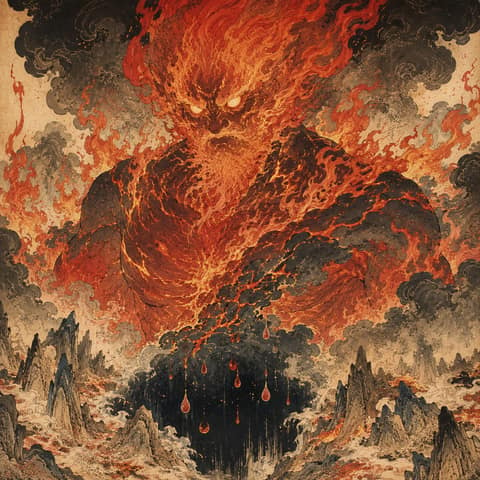
This version of Kagutsuchi bears fire not as a "convenient attribute" but as an "event that changes the world." In the "Kojiki," the scene where Izanami dies giving birth to the fire god instantly pivots the bright story of national creation to the tale of Yomi (the underworld). Fire is the result of birth, yet it takes the mother goddess away. Here lies the fundamental duality between the fire that sustains life and the fire that burns houses and bodies. The scene of Kagutsuchi being slain is the epitome of creation arising from destruction. When Izanagi's sword severs the fire god, other deities are born from the blood and body parts. The myth does not end by extinguishing the fire. Even when cut, the power of fire branches off into blood, swords, mountains, and lightning. Kagutsuchi is not a self-contained deity, but a generating device for subsequent gods. Layering the variant traditions of the "Nihon Shoki" reveals that Kagutsuchi is the totality of fire passed down with fluctuating names and personalities in the Kiki. Names like Kagutsuchi and Homusubi are not mere spelling differences, but indicate multiple perspectives grasping fire as "that which burns," "that which creates," and "that which possesses spiritual power." In YOKAI.JP, explaining this fluctuation adds depth to the page as a divine spirit. Kagutsuchi, expanding into fire prevention beliefs, reverses from a god of terror to a god of protection. At Atago Shrine and Akihasan Hongu Akiha Shrine, prayers are continuously offered to him as a god of fire and fire prevention. Precisely because he is the god with the power to cause fires, he is expected to have the power to quell them. The mindset of not avoiding the cause of disaster but praying at its center is characteristic of Japanese fire protection beliefs. Visually, this version is better suited by layering childbirth, swords, and mountains rather than a simple ball of flame. Red fire, black soot, blood dripping from a sword, fire protection talismans on mountain peaks, the dark entrance to Yomi. When these elements align, Kagutsuchi stands up not as a fantasy fire attribute, but as a dangerous turning point in myth. In diagnoses or cards, Kagutsuchi symbolizes strong change. When one cannot proceed to the next stage without ending something, when one has no choice but to burn down the old order, he becomes a terrifying but necessary god. However, fire cannot be treated lightly. Kagutsuchi's protection is only directed at those who take responsibility even for the aftermath of the burning. Reading Kagutsuchi in relation to Izanami, fire appears as a wound left on the mother goddess's body. The birth of fire takes the mother, and her death spawns the story of the underworld. In other words, Kagutsuchi bears not only the blessing of parent-child relations but also the mythological pain that birth hurts someone. There is a weight there beyond a mere god of flames. Kagutsuchi as a god of fire prevention is also the name for humans to coexist with dangerous forces. Life cannot be sustained without using fire. But if fire is used, disaster can strike at any time. Prayer is not a technique to extinguish fire, but the ethics of living with fire. If this sense of daily life is included in Kagutsuchi's page, ancient mythology and folklore connect beautifully. In the association network, it expands not only to Izanami and Izanagi but also to fire and mountain anomalies like Atagoyama Tarobo and Kasha. Placing Kagutsuchi allows the stream from the upper reaches of mythology through folk fire protection beliefs to yokai-like images of fire to converge into a single flow.

Kannon

Kannon

Divine

kannon

Bodhisattva of 33 Forms and Infinite Compassion

神霊・神格大乗仏教の菩薩、浄土は南インド補陀落、渡来仏

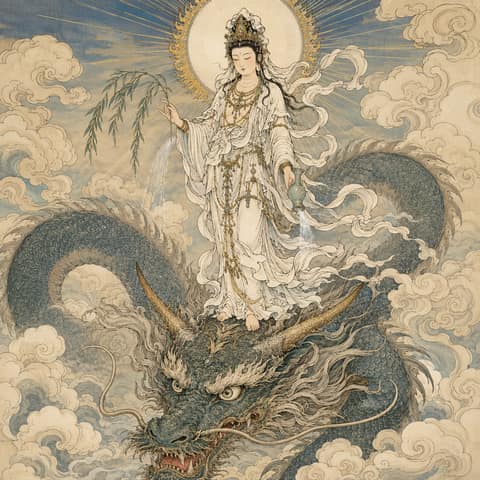
Ultimate Metamorphosis and Empathy. The greatest characteristic of Kannon Bodhisattva lies in having no fixed form, possessing the ability of "Fumon Jigen" to infinitely transform into the most suitable form (a Buddha, a god, a human, or even a non-human entity) to save the other person. This is not mere magic; it is the manifestation of an "ultimate empathic ability (compassion)," standing at the exact same eye level as the suffering other and sharing their pain as one's own. Kannon has served as the emotional pillar for the Japanese people for over a millennium precisely because Kannon does not reign as an absolute, transcendent dictator, but descends into the mud-stained living spaces of humans to weep alongside them. Attendant to Amida Nyorai and Care at the Moment of Death. Kannon Bodhisattva is not only worshipped independently but also plays a crucial role as an attendant (assistant) to Amida Nyorai, the Lord of the Western Paradise (Pure Land). When a person reaches the end of their life, it is Kannon's duty to appear riding on a cloud alongside Amida Nyorai (Raigo) to welcome the deceased, placing their soul on a lotus pedestal to guide them to paradise. Kannon was not only a savior from all the hardships of the present world but also the "ultimate deity of terminal care" who alleviated the fear of death and guaranteed the soul's destination. The "Hidden Christians" and Maria Kannon. The vast tolerance of Kannon worship (the flexibility to take any form) proved its worth even in the harshest phases of history. Under the ban on Christianity during the Edo period, oppressed "Kakure Kirishitan" (Hidden Christians) secretly continued their worship by venerating statues of the "Jibo Kannon" (Koyasu Kannon, holding a child) as the Virgin Mary. By embracing even the god of a foreign religion as a variation of its own form and receiving the prayers of persecuted people, the "Maria Kannon" demonstrates the absolute zenith of Kannon worship's function as an asylum (sanctuary).

Kariba Myojin

Kariba Myojin

Divine

kariba-myojin

The God of Hunting Who Guided Kukai to Koya, Takanomiko no Okami

Divine Spirit/DeityWakayama

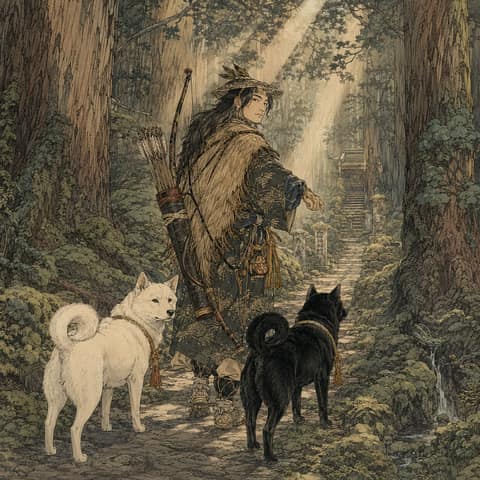
Kariba Myojin is the guardian deity of Mount Koya who most purely embodies the nature of a "God of Guidance." The religious logic that sacred sites are not found by humans but revealed by gods was narrativized into the legend of a hunter and divine dogs guiding an esoteric Buddhist practitioner into the mountains. His true name, Takanomiko no Okami, means the child deity of Niutsuhime. By both mother and son deities yielding the divine territory to Kukai, it represents the local pantheon's approval of the site becoming a sacred ground for Shingon esoteric Buddhism. The iconography of the kariginu, bow and arrows, and two dogs preserves the form of an ancient mountain god presiding over mountain livelihoods (hunting) and resonates with the historical fact that the Niu clan was a group of hunters accompanied by sacrificial dogs. The divine dogs generated a belief as "guiding divine dogs" leading people to good matches and happiness, a motif carried on by the modern Kishu dogs, Shiromaru and Kuromaru, at Niutsuhime Shrine. The footprints of this guiding deity are carved throughout the pilgrimage routes, such as the Mount Koya Choishi-michi and Niukanshofu Shrine.

Kasuga-no-kami

Kasuga-no-kami

Divine

kasuga-no-kami

The Divine Spirit of Kasuga Riding a White Deer to Protect Nara

Deity / Divine SpiritNara

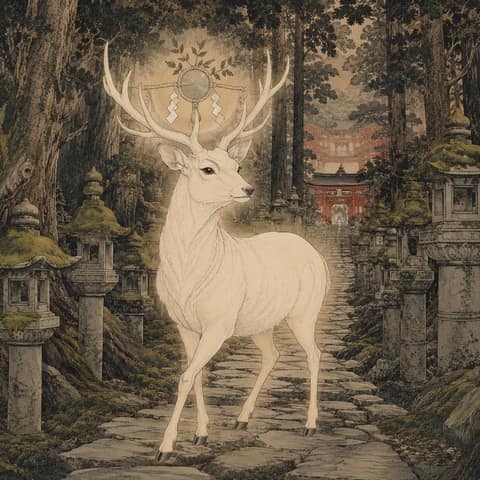
This version of Kasuga-no-kami is not a single character, but the totality of divine spirits overlapping the location of Nara. By enshrining Takemikazuchi-no-mikoto, Futsunushi-no-mikoto, Amenokoyane-no-mikoto, and Himegami in one shrine, Kasuga simultaneously takes on martial might, rituals, clan lineage, and feminine mystery. Rather than cutting it down by simple attributes, it is more accurate to read it as an ensemble of multiple deities. The arrival of Takemikazuchi riding a white deer is the most beautiful entrance to this version. The legend that the god moved from Kashima to Kasuga riding a white deer connects the distant sacred site to Nara's Mount Mikasa with a single spiritual path. The deer is a vehicle, a messenger, and a living sign of the sacred precinct. This story quietly teaches that the deer of Nara are not mere tourist resources. The sacred precinct of Kasuga Taisha lies on the boundary between the city and the forest. Despite being near Heijo-kyo, it bears the presence of Mount Mikasa and the Kasugayama Primeval Forest. Kasuga-no-kami is a god that protects the political center of the capital while also coming from the depths of the forest. This duality makes Kasuga feel not just like a rigid state ritual, but a soft sanctuary. In the world of Kasuga Mandalas and the "Kasuga Gongen Genki," the god is taken on a pilgrimage within paintings. The shrine buildings, mountains, deer, and trace manifestation Buddhas are combined, and the divine majesty of Kasuga becomes a single visual universe. This iconographic quality is important for a yokai/deity page. It is difficult to fix Kasuga-no-kami into a single form, but drawing the sacred deer, shrine buildings, and forest is enough to establish Kasuga-no-kami. The nature of being the tutelary deity of the Fujiwara clan gives Kasuga-no-kami historical depth. A clan enshrines its own ancestral and guardian gods, religiously supporting political legitimacy. Because the martial nature of Takemikazuchi and Futsunushi overlaps there, Kasuga-no-kami does not end with just the gentle image of a deer. The god protecting the capital casts a strong boundary when necessary. In modern cards and articles, explaining Kasuga-no-kami merely as "the deer god of Nara" makes it thin. By placing the arrival of the white deer, the Fujiwara clan, the four-deity composition, Shinto-Buddhist syncretic iconography, and the forest sanctuary together, you can naturally guide readers from an easily searchable entrance to a deep deity page. On YOKAI.JP's network, it becomes a crucial point connecting Takemikazuchi and Nara place articles. The terror of Kasuga-no-kami lies in its quietness. It does not scream like a vengeful spirit, nor attack like an oni, yet it watches the behavior of those who enter the sacred precinct. A deer crossing the path, the shadow of a lantern flickering, the wind blowing from the depths of the forest. Such small events create the feeling that the god is near. The divine aura of Kasuga appears more as the density of the place than as flashy miracles. The aspect of being the tutelary deity of the Fujiwara clan serves as an entrance to thinking about the relationship between politics and sacred sites. The clan enshrines the god, and the god supports the clan's legitimacy. Kasuga-no-kami bore this exchange for a long time. Therefore, the beauty of Kasuga also contains the history of power. Beyond the vermilion shrine buildings and the gentle figures of the deer, one also wants to show the strictness of the rituals that support the capital. On modern pages, Kasuga-no-kami can be used as a location hub. Nara, deer, Takemikazuchi, the Fujiwara clan, Shinto-Buddhist syncretism, Kasuga Mandalas, Wakamiya On-matsuri. Because these search terms connect naturally, the value of internal links is high, not just standalone traffic. While maintaining its dignity as a deity, it can provide a pathway that makes readers want to actually go to Nara.

Kojin

Kojin

Legendary

こうじん

The Raging Fire and Boundary Deity, Kojin

Divine Spirits / DeitiesSeikojin Kiyoshikojin Seicho-ji Temple (Takarazuka, Hyogo Prefecture; head temple of the Sanbo Kojin faith) / Seto Inland Sea cultural sphere of the Chugoku and Shikoku regions (Okayama, Hiroshima, Yamaguchi, Ehime, etc.)

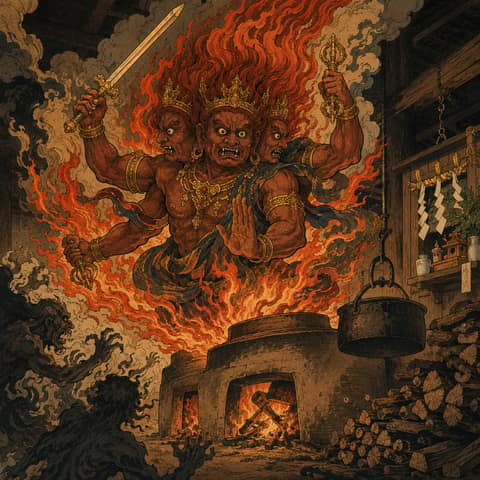
Aramitama Ideology and the Duality of Japanese Religion. While the basic description touches upon Kojin's two main systems, this thorough explanation delves deeper into the "Aramitama" (rough spirit) concept and the dualistic structure of Japanese religion. Ancient Shinto understands deities on an axis of "Nigimitama" and "Aramitama," recognizing that a single deity possesses both an aspect of a gentle savior and that of a raging curse-bringer. The Nigimitama gently protects people, while the Aramitama brings curses and disasters; ritually balancing the two is viewed as the religious goal of purification. The Kojin faith represents the extreme realization of this option to "worship the Aramitama independently." It holds a paradoxical structure: by fearing and worshipping a terrifying deity, its violent power is transformed into a protective force for the community. This is a variation of a universal structure in East Asian religious culture, comparable to the City God (Cheng Huang) in China, local deities in Korea, and spirit worship in Southeast Asia. Yaksha Origins and Esoteric Syncretism. Sanbo Kojin is a composite deity that incorporated the form of ancient Indian Yaksha spirits, blending elements of Buddhism, Shinto, mountain asceticism, Esoteric Buddhism, and Onmyodo. In ancient Indian mythology, Yakshas were semi-divine, semi-demonic beings guarding forests, mountains, and treasures; upon entering Buddhism, they were recontextualized as protectors of the Dharma (such as the retinues of Vaisravana). The process by which this merged with Japanese hearth and fire worship to become Sanbo Kojin is a prime example of the dynamism of Buddhism's reception in ancient Japan. The three-faced, six-armed wrathful statue, adorned with flaming hair, fangs, and carrying a bow and arrow, is the result of the fusion between its Yaksha roots and ancient Japanese demon-god imagery. The Religious Economy of Ascetics, Onmyoji, and Monks. The nationwide spread of the Sanbo Kojin faith during the Edo period was driven by the active proselytization of religious groups like Shugendo ascetics, Onmyoji, and lower-ranking monks. Operating outside the institutional structures of major temples and shrines, they made their living by offering prayers, fortune-telling, distributing talismans, and presiding over festivals for local communities. By preaching devotion to Sanbo Kojin, issuing talismans, and organizing rituals, a social system was built that supported the economic foundation of these wandering ascetics. The religious history of medieval and early modern Japan must be understood not just as a history of changing doctrines, but as concrete social history encompassing religious economy, the hierarchy of practitioners, and negotiations with local communities—with the spread of Sanbo Kojin serving as a typical case. The Seto Inland Sea Cultural Sphere and Kagura Theater. Bitchu Kagura in Okayama Prefecture originated as a ritual to "invite Kojin and dance before him," earning the alternative name "Kojin Kagura," and was designated a National Important Intangible Folk Cultural Property on February 24, 1979. In the late Edo period, the scholar Nishibayashi Kokukyo composed mythological plays (Shin-no) such as "The Transfer of the Land by Okuninushi," based on the Nihon Shoki and Kojiki, incorporating them into the rituals and thereby establishing the modern form of Bitchu Kagura. This is a symbolic example of how classical mythology and local Kojin faith heavily intertwine in the Seto Inland Sea cultural sphere. It preserves a unique theatrical culture where national deities (Susanoo, Okuninushi), Kojin, and local gods appear together as an integrated pantheon on the Kagura stage. Since ancient times, the Seto Inland Sea has been a maritime trade route with the continent and the Korean Peninsula, a center of Shingon Esoteric Buddhism, and a vast cultural region where local Shinto traditions—such as those of Izumo, Kibi, and Sanuki—have densely intersected. Ji-Kojin and Village Communities. The outdoor Ji-Kojin possesses a different origin story than the indoor Sanbo Kojin. Worshipped by individual households, kin groups, or small settlements—often using the estate's demon gate, village borders, or mounds beneath large trees as vessels—Ji-Kojin acts as a guardian of community boundaries, land, and ancestors. The dense concentration of Ji-Kojin worship in the mountain villages of the Chugoku region and the islands of the Seto Inland Sea has functioned as a mechanism to religiously reaffirm the hierarchical order of families, small settlements, and villages. The festival dates of the 28th of every month, January, May, and September hold social significance beyond simple religious rituals, acting as social time to confirm the solidarity of community members. Gyuba Kojin: The Industrial Aspect. A third system of Kojin that has garnered folkloric attention is Gyuba Kojin (the Kojin protecting cattle and horses). Tied to the history of using cattle and horses as primary sources of power for farming and transport in the mountain villages of Chugoku and Shikoku, the custom of affixing Kojin talismans in stables and praying for the animals' health during spring and autumn festivals was widespread. This reflects the religious life of pre-modern farming villages, where livestock were not mere economic assets but were religiously positioned as members of the family and community. With the advance of mechanization and modern power sources, Gyuba Kojin worship rapidly declined, but numerous ritual artifacts remain preserved in museums and local history centers across Chugoku and Shikoku. Re-evaluation in the 21st Century. In post-war Japan, folklorists such as Kenichi Tanigawa, Noboru Miyata, and Kazuhiko Komatsu advanced academic re-evaluation of Kojin worship, repositioning it as "the representative of Japan's indigenous local deities." In literature, Miyuki Miyabe's novel *Kojin* (Asahi Shimbun Publications, 2014) explored the deity, becoming a widely read narrative that cross-pollinated Edo-period local Kojin faith with modern societal anxieties. Today, in the 21st century, Kojin festivals and Kagura are inherited as intangible folk cultural properties throughout the Seto Inland Sea, Chugoku, and Shikoku regions. It remains one of the few "active" folk deities living on across academia, literature, and regional folklore. Homes enshrining Sanbo Kojin are still numerous, serving as precious embodiments of folkloric continuity.

Konjin

Konjin

Divine

konjin

The Inauspicious God Blocking Directions: Konjin

Divine Spirit / DeityOkayama

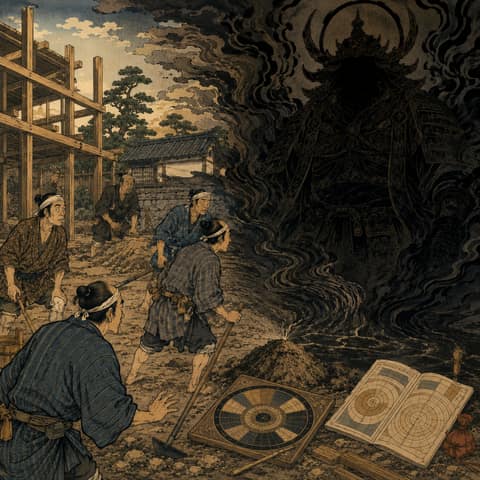
In this version, we read Konjin as the "inauspicious god blocking directions." Konjin does not stand before the gates like an oni. He stops human action in the form of "you must not go in that direction today," "you must not dig there," or "you must not move the house to face that way". He is not weak because he lacks a physical form; rather, because he has no form, he permeates widely into calendars and directions. Konjin's power appears at the milestones of life. Construction, relocation, marriage, travel, and public works are acts that change a household's destiny. When the taboos of inauspicious directions overlap there, people postpone the plans themselves, perform directional avoidance (katai-gae), or seek prayers. Konjin is not a one-time ghost story, but a god repeatedly appearing within the calendar of life, wielding sustained power to rule daily judgments. The relationship with Kimon (Demon Gate) and Kata-yoke (directional warding) is key to understanding Konjin. In the Onmyodo directional worldview, space is not homogeneous; fortune and misfortune dwell in every direction. Among these, Konjin was feared as an entity that invites heavy disaster if violated. If drawn as a yokai, he is not a monster with horns or fangs, but an invisible red line drawn over house blueprints or travel directions. Misfortunes occurring not at the moment of crossing, but *after* crossing, prove the god's existence. In folk society, Konjin also became a device for explaining disaster. When illness, fire, family death, or business failure occurred, it was said, "That is because they violated Konjin's direction during that construction". This cannot be dismissed merely as superstition. Faced with inexplicable misfortune, people used the order of time and direction to assign meaning and learn what to avoid next. Konjin was a terror, but simultaneously a framework for interpreting life. The endpoint of this version is the transformation in Konkokyo. Through the faith experience of Bunjiro Kawate, the feared Konjin was re-accepted as the god of salvation, Tenchi Kane No Kami. Rather than distancing oneself from the inauspicious god, one faces the center of the fear and reconnects the relationship between god and human. Because of this inversion, Konjin does not end as merely a "god of bad directions." The amplitude of shifting from a taboo deity to a deity of salvation is the true depth of Konjin. Konjin's terror lies in his lack of visibility beforehand, combined with his explanatory power afterward. After something bad happens, people look back on past actions and wonder if they violated that direction at that time. Konjin is a god who stops the future, and at the same time, a god who rereads past misfortunes. This nature is quite abstract, even among yokai and deities. Oni have shapes; foxes have actions. But Konjin resides within the systems of directions and calendars. That is exactly why his influence is so broad. Every time people move, build, dig, marry, or travel, the possibility of Konjin rises. The shift to Konkokyo was an attempt to turn this abstract terror into salvation. Instead of continuously avoiding a feared god, that god is re-accepted as the workings of heaven and earth. Here, folk belief possesses the power not just to observe taboos, but to remake the meaning of the god at the very center of the taboo.

Konohanasakuyahime

Konohanasakuyahime

Divine

konohana-sakuyahime

Goddess of Mount Fuji and Cherry Blossoms

神霊・神格Shizuoka

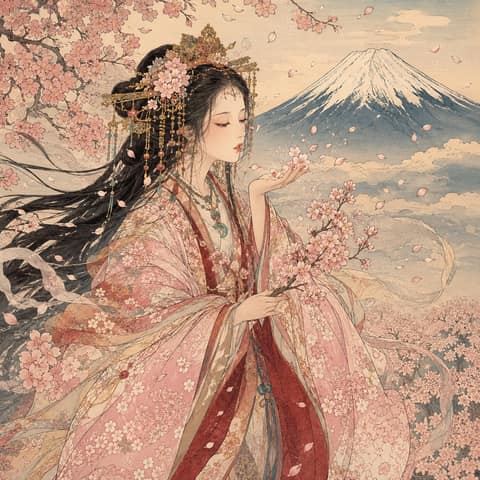
The Embodiment of Beauty Pregnant with Roaring Flames. Konohanasakuyahime is not merely a "delicate and beautiful goddess." The myth of her willingly entering a burning delivery hut to clear her husband's doubts reveals an overwhelming pride and fierce passion (intense like volcanic magma) hidden within her. Her beauty is a fierce and dangerous one, shining only in extreme situations adjacent to death—much like cherry blossoms blooming on the slopes of an active volcano (Mount Fuji) that could erupt at any moment. The Ruler of the Boundary Between Life and Death (The Delivery Hut). In ancient Japan, "childbirth" was an extremely dangerous act adjacent to the impurity of death (a magical space of blood and fire). The story of Konohanasakuyahime giving birth to Hoderi-no-mikoto (Umisachihiko) and others in the flames is a metaphor for the victory of life force itself—bringing forth new life by overcoming the danger of death (fire). Consequently, she garnered fanatic devotion as the absolute "guardian deity of safe childbirth and child-rearing" from women striving to sustain life amidst harsh realities. Fuji Worship and the Salvation of the Common People. In the "Fuji-ko" faith popular during the Edo period, the worship of Konohanasakuyahime (Asama Okami) evolved into a massive folk religion encompassing not just safe mountain climbing, but everything from worldly benefits to posthumous salvation. It seems contradictory at first glance to install a goddess as the principal deity of Mount Fuji, which was originally closed to women (Nyonin Kinsei). However, this symbolizes the dynamism of Japanese religious history, where a harsh mountain of asceticism gradually transformed its nature into a mountain of affection embracing the common people (including women).

Konpira

Konpira

Divine

こんぴら

Konpira Daigongen

kamiKagawa

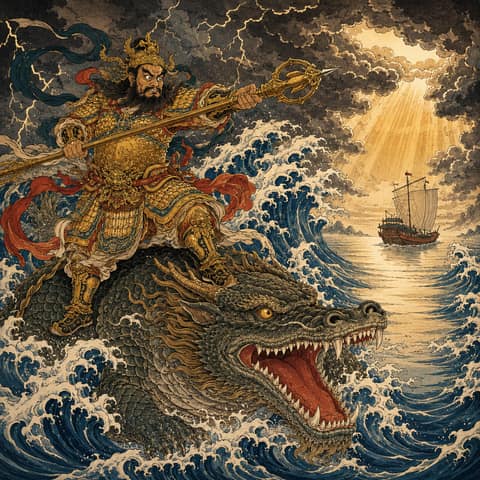
The original term for Konpira is the Sanskrit Kumbhīra, a deification of crocodiles inhabiting the Ganges River. In Hinduism, it is the mount of Gaṅgā. It was incorporated into Buddhism as Kumbhira, chief of the Twelve Heavenly Generals. Through Honji Suijaku, it syncretized with the local deity Omononushi-no-Kami into "Zozusan Konpira Daigongen." Kotohira-gu is situated halfway up Mount Zozu. The approach consists of 1368 stone steps. The main deity is Omononushi-no-Mikoto, with Emperor Sutoku enshrined alongside. The enshrinement of Emperor Sutoku is a typical example of Goryo (vengeful spirit) worship. Exiled to Sanuki after the Hogen Rebellion, he deeply revered Konpira Daigongen. The renaming due to the Meiji Shinbutsu Bunri marked the greatest turning point in its history. It was transformed into the Shinto "Kotohirasan Kotohira-gu." Its rise during the Edo period was a massive leap forward as a guardian of the sea. It became the "supreme deity of maritime protection." The folk song "Konpira Funefune" became a nationwide hit. The Konpira dog is a rare folk custom of the Edo proxy pilgrimage culture. Those unable to make the pilgrimage sent their pet dogs as proxies. The phonetic transcription path originates from Sanskrit Kumbhīra → Chinese transliteration → Japanese "Konpira."

Kumano Gongen

Kumano Gongen

Divine

kumano-gongen

The Three Mountains Syncretized: Kumano Gongen

神霊・神格Wakayama

The Perfected Form of Honji Suijaku. Kumano Gongen is the most elaborately systematized example of "Honji Suijaku," the Japanese philosophy of Shinto-Buddhist syncretism. Each of the main deities of the Kumano Sanzan was assigned a Buddhist "original ground" (Honji Butsu). For instance, Ketsumimiko-no-Okami of Hongu was identified as Amida Nyorai; Kumano Hayatama-no-Okami of Hayatama Taisha as Yakushi Nyorai; and Kumano Fusumi-no-Okami of Nachi Taisha as Senju Kannon (Thousand-Armed Avalokitesvara). Consequently, a pilgrimage to Kumano functioned as a complete salvation system spanning the past, present, and future: erasing the sins of past lives (Yakushi), gaining benefits in this world (Senju Kannon), and securing a promise of rebirth in the Pure Land in the next life (Amida). Institutionalization and Networks of Shugendo. Kumano is one of the birthplaces of Shugendo, and rather than just a place of prayer, it was a rigorous training ground. From the medieval period onward, Shugendo developed into massive religious organizations such as the Honzan-ha (Tendai sect lineage) and Tozan-ha (Shingon sect lineage), building a nationwide network backed by the religious authority of Kumano. The establishment of "Kumano Shrines" (Junisho Gongen) in various regions was the result of propagation activities through this network of ascetics. The fact that thousands of these shrines still exist nationwide today demonstrates the deep penetration of Kumano Gongen into local communities. The Religious Nature of the "Path" Itself. When discussing the Kumano Gongen faith, the existence of the "Kumano Kodo" (Kumano Ancient Trail) cannot be overlooked. The journey to Kumano was extremely arduous, dotted with numerous small shrines called "Tsukumo Oji." Pilgrims were not merely aiming for a destination; the act of walking the treacherous mountain paths and enduring hardships was itself considered ascetic training to extinguish sins (Dochu Shugyo). Even from the perspective of modern public history, the Kumano Kodo retains its value not just as historical heritage, but as a "space to practice faith" where one purifies the mind using one's own body.

Mishaguji

Mishaguji

Divine

Mishaguji

Mishaguji, Ancient Suwa Deity Descending into Stones and Trees

Divine Spirit / DeityNagano

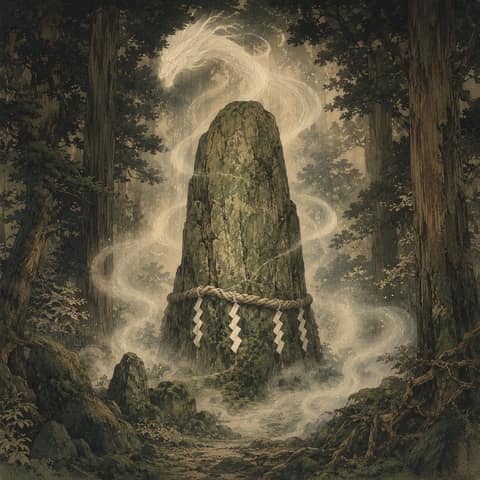
If one were to treat Mishaguji as a "yokai," it should be viewed not as a terrifying monster, but as a being existing on the border between kami and yokai. Its essence does not lie in folktale tropes like attacking people, shape-shifting, or appearing on dark roads at night, but rather in the spiritual power of stones, trees, pillars, and land invoked through rituals. In Suwa, Takeminakata, Moriya, the Moriya clan, and the Onbashira Festival overlap in complex ways, leaving behind a thick layer of faith that cannot be fully explained by the deities of central mythology alone. Mishaguji is the key to reading this underlying stratum, a presence that transforms Suwa from a mere "stage of myths" into a "place where the land itself harbors the divine."

Moriya-no-kami

Moriya-no-kami

Divine

もりやのかみ

Moriya-no-kami, the Local Deity of Suwa Who Confronted Takeminakata-no-kami

Divine SpiritNagano

The charm of Moriya-no-kami lies in the fact that he is spoken of not as the victor of the central mythology, but as the deity who was there first. Takeminakata-no-kami is the Great God of Suwa standing at the center of the official historical view of Suwa Grand Shrine, but the story of that god entering Suwa requires a god on the receiving end. Moriya-no-kami fulfills that role. He is not a god who fights, loses, and vanishes, but one who, after reconciling, enters into the ritual order as the High Priest. Therein lies a uniquely Suwa-like layering of faith, not merely conquest and replacement. When reading Onbashira, Mishaguji, the Moriya clan, and Suwa Myojin as a single geological stratum, Moriya-no-kami stands precisely at the boundary of those layers.

Ninigi-no-Mikoto

Ninigi-no-Mikoto

Legendary

ににぎのみこと

Tenson Korin (Heavenly Descent)

The Structure of the Ancient State Myth: "Tenson Korin". While the basic description touches upon the outline of the Heavenly Descent, this deep dive explores the structure of the "Tenson Korin" as the foundational myth of the ancient Japanese state. The Tenson Korin depicts the divine descent from Takamagahara (the celestial world of purity and order) to Ashihara no Nakatsukuni (the earthly world of chaos and conquest) as the core myth establishing ancient Japan's foundation, ruling authority, and the origins of agricultural civilization. Its intricate structure—involving specific artifacts (the Three Sacred Treasures), attendants (the five pillar gods), commands (the divine decree), and bedding (the Madoko-ofusuma)—forms the fundamental basis for religious ceremonies like the ancient enthronement rituals, the Niiname-no-Matsuri, and the Daijosai. Transcending a simple mythological tale, it is a foundational narrative device that has threaded through Japanese state, religion, politics, and culture from antiquity to the modern era. Comparative Mythology of Descent Myths in World History. In global mythology, the Tenson Korin myth is positioned as a quintessential example of "heavenly descent/divine incarnation" myths. From the Dangun myth of the Korean Peninsula (Hwanung, son of the Lord of Heaven, descending to Mount Taebaek), to the legends of Genghis Khan in Mongolia, the shaman descent tales of northern Tungusic peoples, the descent of Krishna in India, and the Incarnation in Christianity, "divine descent from heaven to earth" myths are widely distributed across the ancient world. The similarities with descent myths in Northeast Asia (like Korea and Mongolia) present a crucial comparative religious question, suggesting that ancient Japanese mythology may have formed within a broader Northeast Asian cultural sphere. Understanding the Tenson Korin not as an isolated Japanese phenomenon but as a Japanese variation of a shared ancient Northeast Asian mythological imagination is a significant achievement of post-war Japanese mythological studies. The Historicity of the Descent Site Controversy. The fact that the alleged location of Ninigi's descent site, "Takachiho Peak in Tsukushi Hyuga," is split between two major traditions—Takachiho Town in Miyazaki Prefecture and the Kirishima mountain range in Kagoshima Prefecture—is the result of the ancient state myth evolving through multiple layers of regional folklore, geographic manifestation, and political competition. The ancient central government (the Yamato Court) did not pinpoint a specific location, adopting the abstract name "Takachiho in Hyuga," allowing independent "our land is the descent site" traditions to develop throughout southern Kyushu across the medieval, early modern, and modern periods. Amid modern tourism branding rivalries, local historical research, and shrine heritage systems, the two major traditions coexist, functioning as unique cultural resources. This is a classic example of how ancient mythology is multi-layeredly integrated into regional culture. Konohanasakuya-hime and the Origin of Lifespan ── The Choice Between Beauty and Eternity. The fact that Ninigi-no-Mikoto's choice of Konohanasakuya-hime (the cherry blossom goddess) and rejection of Iwanaga-hime (the rock-eternal goddess) became the origin myth explaining why his descendants—the Imperial lineage and humanity—lack eternal life illustrates the "fundamental tension between beauty and eternity" in ancient Japan. The contrast between the beautiful but fleeting cherry blossom and the ugly but eternal rock demonstrates the root structure of the ancient Japanese view of life, aesthetics, and impermanence. As a uniquely Japanese concept of impermanence predating the introduction of Buddhism, this idea has been passed down as a foundational philosophy threading through later Japanese culture, including Ukiyo (the floating world), cherry blossom appreciation, Bushido, and the tea ceremony. It serves as crucial material providing the mythological basis for the Japanese aesthetic of "it is beautiful precisely because it fades." From Umisachi-hiko and Yamasachi-hiko to Jimmu's Eastern Expedition. Among the three children of Ninigi-no-Mikoto and Konohanasakuya-hime, Yamasachi-hiko (Hoori-no-Mikoto) visited the Sea God's palace, married Toyotama-hime, and fathered Ugayafukiaezu-no-Mikoto, who in turn had Emperor Jimmu with Tamayori-hime. This four-generation lineage forms the core of ancient Japanese state legitimacy. Jimmu's Eastern Expedition (the myth of Emperor Jimmu migrating east from Hyuga to Yamato to ascend the throne) is the logical conclusion of the Heavenly Descent, mapping the establishment of the ancient Japanese state as a three-stage geographic migration: "Takamagahara → Hyuga → Yamato." As the starting point of ancient state mythology, Ninigi-no-Mikoto is the foundational deity spanning over two millennia of political history, from Jimmu's expedition and successive enthronements to the ancient Ritsuryo system, pre-war State Shinto, the post-war Imperial family, and the modern Emperor system. The Tenson Korin Cultural Sphere of Southern Kyushu. Southern Kyushu (Miyazaki, Kagoshima, and southern Kumamoto Prefectures)—the primary area enshrining Ninigi-no-Mikoto—has developed unique religions, cultures, and folklore as the "Land of the Heavenly Descent" since ancient times. With the Yokagura of Takachiho Town (a Nationally Designated Important Intangible Folk Cultural Property reenacting the opening of the heavenly rock cave), the sacred Kagura dances and festivals of Kirishima Jingu, the pilgrimages to the imperial tomb at Nitta Shrine, and the Jimmu accession festival at Miyazaki Jingu, the region maintains a multi-layered system of religion, performing arts, and festivals that carries ancient mythology into the present. The creation of modern regional brands like "Myths of Hometown Miyazaki" and "Kirishima Tourism" are prime examples of how ancient myths have expanded into modern regional revitalization, tourism industries, and educational materials. This is a rare instance of ancient mythology functioning as a living cultural resource spanning over two thousand years. Ninigi-no-Mikoto in the 21st Century ── Ancient Mythology and Modern Japan. In the 21st century, Ninigi-no-Mikoto and the Tenson Korin myth are preserved as material for ancient historical research, southern Kyushu tourism, Shinto rituals, and pop culture. Moving from political reinforcement under State Shinto before and during the war, to cultural relativization under the post-war separation of religion and state, and finally to multi-layered expansions in 21st-century tourism, subcultures, and education, the ancient myth maintains a strong continuity with modern Japanese spiritual culture. Continuously reimagined in subculture works like the games 'Okami' and 'Megami Tensei,' and the manga 'Demon Slayer,' the ancient Heavenly Descent myth bridges two millennia to continually drive the spiritual culture of 21st-century Japanese people. He is the symbolic deity of Japanese mythology, embodying the continuous thread of cultural inheritance from antiquity to the present.

Niutsuhime

Niutsuhime

Divine

niutsuhime

The Guardian Deity of Mount Koya, Niu Myojin

Divine Spirit/DeityWakayama

Niutsuhime is the "god of the land" at the foundation of Mount Koya's religious landscape. Although the sacred site of Shingon esoteric Buddhism is known as the mountain of the Buddha (Dainichi Nyorai), its foundation is a land governed by local deities from before Kukai's arrival. The founding legend establishes the indispensable role of both Niu and Takano Myojin through a narrative of yielding this territory (dedication of divine land). The cinnabar indicated by the name "Niu" has been highly valued since ancient times as a mineral for preservation, warding off evil, and magic. The distribution of mercury veins at the foot of Mount Koya corroborates the existence of the Niu clan mining group and the deity they worshipped. Simultaneously, due to her location controlling the headwaters of the Kinokawa River, she is also revered as a water god, extending her protection to agriculture and irrigation. Under the syncretism of Shinto and Buddhism, she was considered a manifestation (suijaku) of the Womb Realm Dainichi Nyorai, and was enshrined in the Miyashiro and Amano-sha shrines within Mount Koya as the mountain's guardian. The romon gate and main sanctuary of the World Heritage Niutsuhime Shrine continue to convey that this goddess is the starting point of Mount Koya's 1,200 years of faith.

Ogetsuhime-no-Kami

Ogetsuhime-no-Kami

Divine

おおげつひめのかみ

Ogetsuhime-no-Kami, the Food Goddess of Awa Who Bears the Five Grains from Her Body

神霊・神格Tokushima

The fascination of Ogetsuhime lies in how land, food, and body are superimposed onto a single name. In the "Birth of the Land" in the *Kojiki*, Awa Province—one face of the island of Iyo-no-Futana—is named Ogetsuhime, acting as Ogetsuhime as the name of Awa Province. In the "Birth of the Gods," Ogetsuhime-no-Kami is born. Then, in the episode of Susanoo's banishment, she produces food from her body and is killed, giving rise to the five grains and silkworms. This overlapping indicates that ancient storytellers felt the land not merely as a map, but as a body that generates food. Awa Province is read not just as a place name, but as the name of a food goddess. Her feast begins from the exact opposite of pure, pristine sacred offerings. Asked for food, Ogetsuhime produces various items from her nose, mouth, and rectum, and cooks them to serve—providing food from the nose, mouth, and rectum. Here, the body's orifices are simultaneously places of defilement and the gates through which food enters the world. That Susanoo viewed this as filthy was not simply a misunderstanding; it expresses a fundamental revulsion toward food being too close to the body. Food sustains life, but its roots touch flesh, blood, and excretion. Ogetsuhime offers it without erasing this uncomfortable proximity. Through her murder, the deity's body transforms into a catalog of seeds. Silkworms grow from her head, rice seeds from both eyes, millet from both ears, adzuki beans from her nose, wheat from her genitals, and soybeans from her rectum—forming seeds generated from body parts. This is a grotesque corpse transformation, yet it perfectly illustrates how agricultural societies perceived food. Seeds do not come from nothing. They appear as what remains after something is broken, torn apart, and dies. By having Kami-musubi have these seeds collected, the corpse is not merely a loss, but is transferred into a cultivatable future. Placed alongside Ukemochi-no-Kami, Ogetsuhime's outline becomes starker. Ukemochi in the *Nihon Shoki* is killed by Tsukuyomi, and Amaterasu incorporates what grew from her corpse into the order of agriculture and sericulture—the origin of the five grains and sericulture from Ukemochi. There, even the separation of day and night is narrated. In Ogetsuhime's case, the murderer is Susanoo, and the story is placed at the turning point where the narrative moves from Takamagahara to Izumo. Rather than in the silence of the moon god, the seeds of food are placed in the void just before the banished, violent god heads for the earth. Because of this difference, Ogetsuhime leans much more deeply toward the beginning of the land and agriculture than toward cosmology. As Kokugakuin's commentary points out, this story is difficult to connect directly with the surrounding context, leading to the theory that it was originally a separate tradition added episodically—the theory of episodic placement. However, this very "inserted" quality tells of the myth's function. After the Heavenly Rock Cave, and before Susanoo fully enters the Izumo story, the *Kojiki* places a small, dark story about the origin of food. Before entering the heroic tales of land-creation, a world where humans could eat was necessary first. In the crevices of the story, Ogetsuhime prepares the conditions for earthly life. Her figure appearing in the genealogy of O-toshi-no-Kami also cannot be overlooked. With Haya-mato-no-Kami, Ogetsuhime gives birth to Wakayamakui, Wakatoshi, Wakasaname, Mizumaki, Natsutakatsuhi, Akibime, Kukutoshi, and Kukiki-wakamuro-tsunane—her eight child deities with Haya-mato-no-Kami. This genealogy, lining up names associated with mountains, years, summer, autumn, and kuzu roots, prevents her from remaining merely a god killed once. Even after birthing the origin of grains, she supports the time of the food world as a mother goddess expanding into the seasons of the mountains, the cycle of crops, and year-round fertility. From the perspective of comparative mythology, Ogetsuhime has long been read as a Hainuwele-type myth. Kokugakuin introduces the typology where various crops generate from a corpse, and notes the similarities between the myth of the girl Hainuwele from Seram Island in Indonesia and the Kojiki/Nihon Shoki myths of Ogetsuhime and Ukemochi—a comparison with Hainuwele-type myths. However, this comparison does not mean "it's simple to equate because it's foreign." Kokugakuin cautions that limiting the origin to one region is difficult due to the reality of pre-Kiki traditions and the limitations of data. What is important is that the sensation of staple foods being born from a dead body became a powerful form to narrate the origin of agriculture across the world. The myth of Ogetsuhime does not narrate food solely as a bright blessing. Food is something to be grateful for, but it is also something that comes out of a body. Seeds open up the future, but they are also born from a corpse. The land feeds people, but it is carved with the name of the food goddess, Awa Province. Ogetsuhime is a deity who embraces all the defilement, death, dry fields, mountains, and seasons that lie behind eating. That is exactly why her fertility is not merely gentle. It is a strong fertility close to the soil, offered from the boundaries of the nose, mouth, and rectum, sprouting from a murdered body.

Okuninushi no Kami

Okuninushi no Kami

Legendary

Okuninushi no Kami

Okuninushi no Kami, Lord of Izumo Myth and God of Matchmaking

Deity / divine spiritShimane

The many-named god and the gathering of local faith. The basic profile noted Okuninushi's many names; the deeper point is what such multiplicity means in religious history. Names such as Onamuchi, Okuninushi, Omononushi, Ashihara-shikoo, Yachihoko, Utsushi-kunitama, and Okunitama are often interpreted as traces of local land, agricultural, warrior, medical, and serpent cults absorbed into Okuninushi. When the Kojiki and Nihon Shoki were compiled in the early eighth century, the ritsuryo state needed a mythic structure that could relate central power to regional cults. The result was a paired mythology: the heavenly line of Takamagahara and Amaterasu, and the earthly line of Ashihara no Nakatsukuni and Okuninushi. The convergence of Izumo ritual lineages, Mount Miwa worship, and faiths from Inaba, Hoki, Koshi, Noto, Omi, and other regions makes Okuninushi a figure of religious, political, and geographic integration. The White Hare of Inaba as the origin of compassion and healing. The White Hare of Inaba is one of ancient Japan's most famous myths of compassion, medicine, and dialogue with animals. Washing the flayed hare in fresh water and applying cattail pollen can be read as a mythic form of herbal knowledge and ritual healing. The hare's prophecy that Yagamihime will choose Onamuchi rather than the powerful elder brothers presents an ethics of matchmaking: true connection comes not from force or appearance, but from inner compassion. This remains the ethical core of Izumo Taisha's matchmaking faith. Bonds are not random accidents; they are drawn by virtue. Trials in Ne no Katasukuni and the heroic descent to the underworld. Onamuchi survives Susanoo's trials in Ne no Katasukuni: the snake chamber, the chamber of centipedes and bees, and the field set on fire, all with Suseribime's help. In comparative mythology this belongs to the broad pattern of the hero's visit to the underworld, the overcoming of ordeals, and marriage to a woman from the other realm. Parallels are often drawn with heroic cycles such as Odysseus, Heracles, Sigurd, Nala, and Hou Yi. The Japanese version is especially striking because the trial comes from the father god, the marriage is with that god's daughter, and the hero leaves with both blessing and power, joining themes of patriarchy, generational succession, and otherworldly marriage. Land-making with Sukunabikona as a civilization myth. The joint work of Okuninushi and Sukunabikona forms a myth of civilization: medicine, agriculture, ritual healing, hot springs, and the techniques that make life possible. Sukunabikona is a tiny deity, said to be about the size of a thumb and clothed in a moth's skin, and he forms a sharp counterpart to the great land-lord Okuninushi. Myths of civilization around the world often pair figures of contrasting scale or character; they imagine culture as something born from cooperation. After Sukunabikona leaves for Tokoyo no Kuni, Omononushi appears and helps complete the land. The pattern suggests a world made not by one god alone, but through divine differentiation and collaboration. Kuniyuzuri as a religious expression of political integration. The yielding of the land translates the political integration of ancient central and regional powers into mythic form. Takamagahara presses its claim; Okuninushi consents; Izumo Taisha is built; he withdraws as lord of the unseen realm. This sequence is often read as a mythic reflection of the incorporation of Izumo's independent religious culture into the central ritsuryo order. The strength contest between Takemikazuchi and Takeminakata also links the story to Suwa worship and warrior-god traditions, showing how local cults were nested within the central mythic system. The legends of Izumo Taisha's immense ancient hall, forty-eight or ninety-six meters high, symbolize the extraordinary ritual compensation granted to Okuninushi after the yielding. Izumo Taisha and the faith of Kamiarizuki. Izumo Taisha, Kizuki Taisha, is one of ancient Shinto's great sacred centers, alongside Ise Jingu, and enshrines Okuninushi as its principal deity. The old tenth month is Kamiarizuki in Izumo, when the gods are present, and Kannazuki elsewhere, when the gods are absent. The belief that Japan's myriad gods gather in Izumo to discuss ties, destiny, and human affairs underlies the Kamiari Festival to this day. That ritual imagination supports Okuninushi's modern identity as god of matchmaking and fate. Even the contrast between "the month with gods" in Izumo and "the month without gods" elsewhere preserves an ancient religious geography in language itself. Daikokuten syncretism and Seven Lucky Gods worship. From the medieval period onward, Okuninushi merged with Daikokuten, the Buddhist Mahakala. The shared sound daikoku connected "great land" and "great black," allowing a land-making, healing, matchmaking deity to absorb the prosperity and mercantile power of early modern Daikokuten. As Seven Lucky Gods worship spread in the Edo period, Okuninushi entered popular life as Daikoku-sama, a god of flourishing trade, wealth, and harvest. Seen beside Benzaiten and the other lucky gods, he shows how ancient myth, early modern urban piety, and modern tourist religion remain linked across two millennia. Okuninushi in the twenty-first century: matchmaking and the Izumo brand. Today Okuninushi still draws enormous numbers of visitors as the principal deity of Izumo Taisha and as Japan's great god of relationships. His layers, matchmaking, healing, land-making, commerce, and fate, remain active in modern practices around marriage, life choices, business, divination, and travel. The "Izumo" image is built from all of these layers. Modern media, including games such as Okami and manga such as Demon Slayer, continue to reuse and reshape Izumo myth. Okuninushi is therefore a leading example of an ancient deity still narrated, visited, and consumed in contemporary culture.

Omoikane

Omoikane

Divine

omoikane-no-kami

Omoikane, God of Wisdom Who Devises the Rock Cave Plan

Deity / Divine SpiritNaganoSaitama

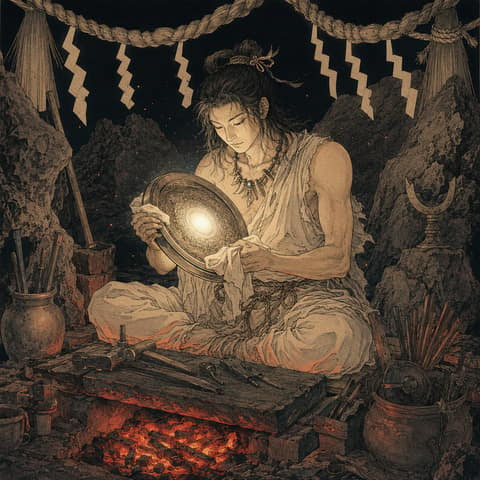
Omoikane, who formulates the plan for the rock cave, is the god who was first commanded to "think" in the darkness. When Amaterasu-Omikami hid in the Heavenly Rock Cave and the world was filled with calamity, the Kojiki recounts that the myriads of gods gathered at Ame-no-Yasukawara and there bade Omoikane, child of Takamimusubi-no-kami, to ponder. Amaterasu is at the center of the crisis, Ame-no-tajikarao is the one who reaches out at the end, and Ame-no-uzume is the one who turns the situation with her dance. However, it is Omoikane who places them all within the same strategy. He is not just a "god of wisdom," but the architect of crisis management. Omoikane's wisdom manifests not as quiet abstraction, but as highly specific procedural arrangements. After his deliberation, he has the long-crowing roosters of Tokoyo crow, takes hard rocks and iron of heaven, seeks the smith Amatsu-mara, has Ishikoridome make a mirror, has Tamanoya make magatama jewels, and tasks Ame-no-koyane and Futodama with divination, reciting norito prayers, and holding gohei offerings. These are not disjointed props. Just as Kokugakuin University's artifact commentary reads the Heavenly Rock Cave myth as an origin tale of rituals equipped with mirrors, jewels, cloth, iron products, and divination bones, Omoikane's plan is the compositional power to organize ritual technology into a single drama. The core of this compositional power is not in "persuading" Amaterasu, but in creating a situation where she approaches the doorway on her own. The mirror shows Amaterasu a strange presence outside, the jewels and cloth decorate the sacred space, the prayers establish order as words, and the dance and laughter break the enclosed atmosphere. Ame-no-tajikarao hides beside the door, but the only moment he can act is when Amaterasu attempts to step outside slightly. In other words, Omoikane's strategy is not one of coercion. It is a strategy to arrange the conditions that change the opponent's consciousness, creating a single point where the final force can act. It is significant that the Kokugakuin University annotations connect the meaning of Omoikane's name to "possessing the wisdom of deep thought" from an alternate account in the Nihon Shoki. Thoughtfulness is not merely having a lot of knowledge. It is the ability to read the situation, the stakeholders, and the procedures, thinking about what order of actions will cause the maximum change with the minimum destruction. At the Heavenly Rock Cave, merely breaking the stone door with military force was not the solution. The sun goddess's reappearance had to be established as a ritual, a council, a laugh, and the act of looking into a mirror. Omoikane is the god who reads that totality. His reappearance during the Descent of the Heavenly Grandson shows that this god's wisdom was not a one-time cleverness. Amaterasu-Omikami adds Tokoyo-no-omoikane-no-kami, Ame-no-tajikarao, and Ame-no-ishikadowake-no-kami alongside the sacred treasures, and commands that the mirror be worshipped as her own spirit. Furthermore, Omoikane is given the role of "taking charge of preceding affairs and governing." The god who assembled the ritual before the rock cave takes charge of the rituals centered around the mirror on earth, and engages in governance. Here, "thinking" transitions from mythological crisis response to the intellect of operating institutions. Ame-no-yagokoro-omoikane-no-mikoto at the Chusha of Togakushi Shrine preserves this character as a tactical god within mountain worship. The official history states the Chusha's deity is Ame-no-yagokoro-omoikane-no-mikoto, describing him as the god who originated the Iwato Kagura (sacred dance) during the Heavenly Rock Cave event. Here, Omoikane is not simply a smart god, but the inventor of rituals including performing arts. The Iwato Kagura belongs not only to Uzume who danced it, but also to the wisdom of Omoikane who constructed that setting. The Chusha's faith in academic success and business prosperity can be read as a faith in the power to synergize multiple conditions, beyond the simple wish that wisdom works well for exams or commerce. Yagokoro-omoikane-no-mikoto at Chichibu Shrine provides further political and regional context. The official page identifies this god as the ancestral god of politics, scholarship, industry, and good fortune, marking Chichibu-hiko-no-mikoto's enshrinement of his ancestral god as the origin of the shrine. The combination of politics, scholarship, and industry is very close to Omoikane's essence. Politics is the intellect to position people, scholarship is the intellect to establish logic, and industry is the intellect to actualize materials and techniques. The god who combined mirrors, jewels, iron, divination, and personnel allocation at the Heavenly Rock Cave being worshipped as the ancestral god of these three domains in later eras shows a perfect alignment between his mythological deeds and his divine virtues in faith. Reducing Omoikane to a light metaphor like "brain trust" obscures the gravity of the myth. He is a god who, when darkness covered the world, did not fight the darkness itself, but designed a space so the world could regain its brightness on its own. Amaterasu, Uzume, Tajikarao, the mirror maker, the jewel maker, norito, divination, and the sakaki tree—only when all of these are aligned does the rock cave open. Omoikane's power is not individual cleverness, but the power to weave multiple forces into a single restoration. What is needed in a deadlocked situation is neither shouting nor destruction, but the intellect to find the sequence. Omoikane is the god of that quiet sequence.

Oyamatsumi

Oyamatsumi

Divine

oyamatsumi

The Supreme Deity of Mountains, Seas, and War

神霊・神格Ehime

The Master of Life's Eternity and Finitude. The myth wherein Oyamatsumi offers his daughters Iwanaga-hime (the eternity of rock) and Konohanasakuya-hime (the fleeting beauty of a blossom) to the Heavenly Grandson is not merely a marriage tale, but a philosophical myth determining human lifespan and natural providence. When Ninigi-no-mikoto chose only the beautiful younger sister and sent back the ugly older sister, Oyamatsumi delivered a declaration that was both a curse and a prophecy: "The lifespan of the Heavenly Grandson, which should have been eternal like a rock, will now scatter fleetingly like a blossom." He is depicted as a god with a cold, primordial fatherhood who teaches humanity both the beauty and harshness of nature, and the finitude of life. A Massive Perspective of Nature That Rejects Anthropomorphism. Among Japanese deities, rather than being depicted in a specific anthropomorphic form (such as an old man), Oyamatsumi is strongly perceived as a massive mountain block, a dense forest, or an island serving as a navigational landmark. This grand scale is the very perspective of mother nature, transcending the morals and ethics of human society. Even during the era of Shinto-Buddhist syncretism (Honji Suijaku), rather than being tied to a specific Buddha, he was worshipped as an overwhelming aggregate of natural energy. Guardian of Mines, Blacksmithing, and Brewing. The multifaceted nature of the mountain god expanded further. He was devoutly worshipped as a professional deity by miners who extracted ore from the mountains and by blacksmiths. Furthermore, he possesses the aspect of a god of brewing as "Sakatoke-no-kami." This stems from ancient memories of alcohol being brewed from wild nuts and spring water found in the mountains, and the indispensability of alcohol in rituals before the gods. Oyamatsumi is an all-powerful tutelary deity (Ubusunagami) who manifests on all boundary lines where nature's bounty is transformed into human culture (livelihood).

Paantu

Paantu

Legendary

Paantu

Paantu, the Mud-Clad Visiting Deity

Deity / Divine SpiritOkinawa

This is a bizarre visiting deity covered in mud and vines. It is said to chase villagers while glaring from beneath an expressionless mask, pressing muddy handprints onto them to drive away the year's misfortunes. Though its arrival is rough and chaotic, it brings both awe and blessings, as the mud it bestows is believed to grant protective power to people and their homes. Usually residing in the otherworld, isolated from the human realm, it only crosses the boundaries of the village on designated festival days, fully coated in the mud of the Spring of Birth. Its silent, plodding steps reflect its solemn duty as a deity of purification—taking the impurities and calamities of the people upon itself and bearing them back to the otherworld.

Raijin

Raijin

Divine

らいじん

Raijin, the Deity Who Strikes Drums to Summon Thunder

神霊・神格賀茂別雷神社 (上賀茂神社、現·京都府京都市北区) / 北野天満宮 (現·京都府京都市上京区、天神信仰) / 雷電神社 (現·群馬県邑楽郡板倉町)

The definitive image of Raijin was established by Tawaraya Sotatsu's "Wind God and Thunder God Screens", a pair of two-panel folding screens with a gold-leaf background. It pits a white Raijin on the left (carrying a ring of connected drums on his back) against a green Fujin on the right (carrying a wind bag). This composition was faithfully reproduced by subsequent Rimpa school painters like Ogata Korin and Sakai Hoitsu, becoming the standard iconography for Fujin and Raijin today. The drums encircling Raijin's back are said to produce thunderclaps when struck; combined with his ogre-like form, tiger-skin loincloth, and sharp claws, this design visualizes the tempestuous forces of the sky. In the history of faith, Raijin can be broadly classified into three lineages. First is the classical thunder god represented by Kamo-wakeikazuchi-no-Okami (Kamigamo Shrine). Second is the Tenjin lineage, which conflates the vengeful spirit of Sugawara no Michizane with Karai Tenjin (Kitano Tenmangu, founded in 947). Third is Takemikazuchi, who bears "thunder" in his name but is essentially a sword and martial deity, and should not be equated with Raijin. In the Kanto region, Raiden worship spread outward from its headquarters at Raiden Shrine in Itakura, Gunma; it enshrines deities like Karai-no-Okami, Oikazuchi-no-Okami, and Wakeikazuchi-no-Okami as targets for prayers against lightning strikes and for bountiful harvests. In an agrarian society, lightning was seen as a harbinger of fertility—striking rice paddies to make the crops bear fruit as "inazuma" (literally "spouse of the rice"). Thus, Raijin has long been revered as a dual-natured entity: a terrifying deity who delivers heavenly punishment, and a benevolent god who brings the blessings of rain and harvest.

Ryujashin

Ryujashin

Rare

ryujashin

Ryuja-sama, the Guiding Messenger of the Kamiari Festival

Divine Spirit / DeityShimane

Ryujashin occupies a unique position as a "divine messenger" functioning within the specific ritual context of Izumo's Kamiari Festival. While general dragon gods (composite water deities governing water, rain, and the sea) are based on nationwide rain-making and rain-stopping beliefs, Ryujashin is strictly a functional deity acting as the guide for the eight million gods, limited to the Kamiari rituals of shrines like Izumo Taisha and Sada Shrine. Its essence is not an abstract concept of faith, but a real marine animal—the yellow-bellied sea snake—that actually washes ashore on the Izumo coast in late autumn. The perfect alignment of a natural phenomenon (warm-water sea snakes drifting on the Tsushima Current) with mythological time (the gathering of gods in the Kamiari month) forms the core of a rare seasonal ritual. The washed-ashore individuals are dedicated to the Grand Shrine, and through the Ryuja-ko of Izumo Taishakyo, it developed into an independent object of worship, with talismans distributed to the common people for protection against fire, water disasters, theft, and for good fortune. By visiting from the Eternal Land and the otherworld beyond the sea, it embodies the ancient worldview that saw Izumo as a passageway to the otherworld.

Showing 25 - 48 of 77 yokai